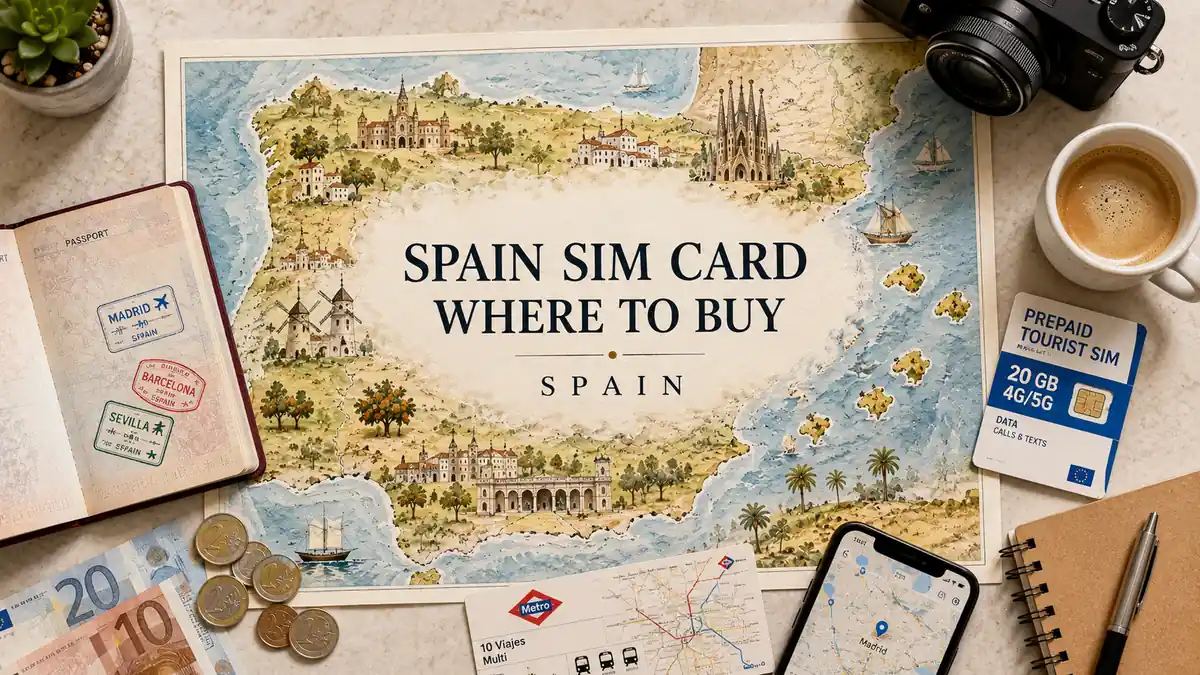
You have decided to get a physical SIM card for your trip to Spain — now you just need to know where to buy one, which carrier to pick, and how to set it up. This guide answers all three fast. Spain has one of the most competitive mobile markets in Europe, so a prepaid tourist SIM is cheap, easy to find, and works the moment it is registered. We cover where to buy (city store, airport kiosk, convenience shop, or online), which carrier or budget MVNO fits your travel style, the realistic cost, and the simple activation steps. We also flag honestly when an eSIM is the smarter choice for your trip and point you to the right place to compare those. By the end, you will know exactly how to get online in Spain with the least cost and hassle.
Quick Answer
Buy a prepaid SIM from a Spanish carrier store for the best value, or an eSIM before flying. Short trips favor airport kiosks or eSIMs; longer stays favor a city carrier or cheaper MVNO. Bring your passport to register, and expect a low, stable cost for a tourist data bundle.
Trust Layer
Tripstou planning guide for travelers resolving one travel decision. Covers the main variable, traveler context, and practical tradeoffs.
Produced with AI assistance and reviewed by Alex Perrut, working in tourism since 2015, for the Tripstou editorial team. See our editorial process for details.
Last factual review: June 16, 2026.
Official sources consulted: European Union, EU travel and tourism portal.
Key Takeaways
- City carrier stores offer the best all-round value for most travelers, while airport kiosks are fastest but carry a convenience markup.
- Bring your passport: Spain legally requires photo ID to register any prepaid SIM before it activates at the point of sale.
- A prepaid tourist SIM with a data bundle stays cheap in Spain, costing far less than roaming on your home plan.
- Pick a major carrier (Movistar, Orange, Vodafone, Yoigo) for coverage, or a budget MVNO like Lowi or Simyo for value.
- Choose a physical SIM for value and longer stays, or an eSIM to skip the queue and activate before you fly.
- A Spanish SIM works across the EU at no extra cost, drawing on your home allowance within fair-use roaming limits.
Table of Contents
Where can you buy a SIM card in Spain?
Buy a Spanish SIM at a city carrier store, an airport kiosk, a convenience or phone shop, or online. City carrier stores are the best choice for most travelers, offering the widest plan range, staff who register your SIM on the spot, and fair prices.
Each location suits a different priority. Choose by how much you value convenience, price, or speed on arrival:
- City carrier store — the best all-round option. Staff handle registration, you compare plans in person, and prices are fair. Worth the short detour for any stay longer than a few days.
- Airport kiosk — the fastest way to connect on arrival, but you usually pay a convenience markup over the same plan in town. Handy for very short trips or tight connections.
- Convenience and phone shops — widely available in tourist areas. Selection is narrower and staff may not always register the SIM for you, so confirm before buying.
- Online pre-order — order before you travel and pick up or activate on arrival. Useful for planners who want everything sorted in advance.
If the airport kiosk is your plan, factor in the queue and markup against simply buying in the city. For getting from the terminal into town first, see our Barcelona airport transport and Madrid airport transport guides. For broader on-the-ground practicalities, our Spain travel tips cover the wider context around staying connected.
Which Spanish carrier or MVNO should you choose?
Choose one of the four main carriers — Movistar, Orange, Vodafone, or Yoigo — for the strongest coverage. Budget MVNOs like Lowi, Simyo, Digi, and Pepephone run on those same networks for less. For most travelers, a major carrier’s prepaid tourist plan is the safest default.
The trade-off is coverage and convenience versus price. Major carriers have the most stores and the widest reach, including rural and coastal areas. MVNOs piggyback on those same networks at lower cost, but with thinner store presence and slower support. If you are staying in cities and want value, an MVNO is excellent; if you need reliability off the beaten track, stick with a major carrier.
| Option | Coverage | Value | Best for |
|---|---|---|---|
| Movistar | Widest national reach, including rural areas | Premium pricing tier | Travelers needing rural and remote reliability |
| Orange / Vodafone | Strong urban and coastal coverage | Mid-range pricing | Most city and beach-based visitors |
| Yoigo | Good urban coverage, leaner rural reach | Competitive pricing | Budget-aware travelers staying in cities |
| MVNOs (Lowi, Simyo, Digi) | Use the same networks as host carriers | Lowest cost option | Longer stays focused on value |
How much does a Spanish SIM card cost?
A prepaid tourist SIM with a generous data bundle is inexpensive in Spain. It usually costs far less than roaming on your home plan. Price depends mainly on data allowance, contract length, and where you buy. MVNOs sit at the lower end, while airport kiosks sit at the top.
You are paying for the data bundle more than the SIM itself, so the size of the allowance is the main lever. A few factors push the price up or down:
- Data allowance — bigger bundles cost more; a modest tourist allowance is enough for maps, messaging, and light browsing.
- Where you buy — MVNOs and city carrier stores are cheaper than airport kiosks for the same data.
- Plan length — short tourist plans cost a little more per day than longer prepaid plans aimed at residents.
Do you need a passport to buy a SIM in Spain?
Yes — Spain requires valid photo ID to register any prepaid SIM. Your passport is the simplest document for visitors, and staff register it at the point of sale before the SIM activates. This is a standard legal requirement across all carriers and MVNOs.
The registration takes a minute and is done in the store or at the kiosk when you buy. Bring your physical passport rather than a photo of it, as the seller links the SIM to your ID before it works. EU and other national ID cards are also accepted, but a passport is the most reliable choice for travelers.
How to set up and activate your Spanish SIM
Activating a Spanish SIM takes only a few minutes once it is registered. The process is simple: insert the SIM, confirm registration with your ID, add credit or a data plan, then enable mobile data. Most travelers are online within minutes of leaving the store.
If you bought in a carrier store, staff usually complete most of these steps for you. If you are doing it yourself, follow this order:
- Insert the SIM into your unlocked phone, or activate the eSIM profile if that is what you bought.
- Confirm registration with your passport — done in-store at purchase, or via the carrier’s app or website.
- Add credit or select your prepaid data plan, then confirm the bundle is active.
- Enable mobile data and data roaming, and check the APN settings if data does not connect automatically.
- Restart your phone if needed, then test the connection with a quick search or map load.
Physical SIM or eSIM: which is better for your trip?
Choose a physical SIM for value and longer stays, and an eSIM for no-queue convenience. A physical SIM wins on price and works in any unlocked phone, while an eSIM lets you buy and activate before you fly. Your phone’s compatibility and trip length decide the call.
The honest split is this: a physical SIM is the value pick and is essential if your phone does not support eSIM, while an eSIM removes the queue and registration step entirely by letting you set up before departure. An eSIM only works on a compatible, unlocked phone. If you want to weigh the no-queue route, see our guide to the best eSIM for Spain, which compares the options in detail.
Get online the moment you land
An eSIM installs before you fly — no SIM swap, no roaming bill, no queue at an airport kiosk. Two options, depending on how you travel:
Holafly — unlimited-data plans, so nothing counts against a
cap. Best for longer stays, remote work, and heavy map and video use.
Code TRIPSTOU applies automatically: 5% off any travel eSIM,
reusable on every order, or 10% off Holafly Plans.
Get a Holafly eSIM →
Airalo — pay for the data you need, across 200+ destinations,
trusted by 20M+ travelers. Best for short trips and light use.
Use code NEWTOAIRALO15 for 15% off your first order:
Get an Airalo eSIM →
Tripstou may earn a commission if you purchase through these links, at no extra cost to you.
Will your Spanish SIM work across the EU?
Yes — a Spanish SIM works across the European Union at no extra cost. EU roaming rules let you use your home allowance for calls, texts, and data in any EU country, within fair-use limits designed to prevent permanent roaming. For short trips around Europe, this is a real advantage.
That means a SIM bought in Spain keeps working as you cross into neighboring EU countries, drawing on the same data bundle without surcharges. The fair-use policy is built around normal travel use, so a typical multi-country trip stays well within limits; only very heavy or near-permanent use abroad can trigger restrictions. If you are routing a wider trip, our Spain travel guide helps you plan the bigger picture.
Frequently Asked Questions
Can I buy a Spanish SIM card at the airport on arrival?
Yes, kiosks at major Spanish airports sell prepaid tourist SIMs the moment you land, and staff register them with your passport on the spot. It is the fastest way to connect, but you usually pay a convenience markup over the same plan bought in a city carrier store.
Can tourists buy a prepaid SIM in Spain without residency?
Yes, tourists can buy and register a prepaid SIM in Spain without being a resident. You only need a valid passport or national ID, which the seller links to the SIM at purchase. No Spanish address, bank account, or proof of residency is required for a prepaid tourist line.
How much mobile data do I need for a week in Spain?
For a week in Spain, a modest data bundle covers most travelers comfortably. Maps, messaging, and light browsing use little, so a small-to-mid tourist allowance is usually enough. If you stream video, use hotspots, or rely heavily on navigation, choose a larger bundle to avoid topping up mid-trip.
Can I top up a Spanish prepaid SIM online?
Yes, every major Spanish carrier and MVNO lets you top up a prepaid SIM online through its app or website. You can add credit or renew a data bundle using a card, often in a couple of minutes. Supermarkets, kiosks, and phone shops also sell top-up vouchers.
Does a Spanish SIM work in Portugal and France?
Yes, a Spanish SIM works in Portugal, France, and every other EU country at no extra charge. EU roaming rules let you use your home data, calls, and texts allowance abroad within fair-use limits. This makes a Spanish SIM convenient for multi-country trips around Western Europe.
What happens to my Spanish number when I leave?
Your Spanish prepaid number stays active for a set period after your last use, then expires once the credit lapses or the line goes unused. Most travelers simply let it deactivate. If you return regularly, keep the SIM topped up occasionally to preserve the number and any remaining balance.
Related Guides
- Best eSIM for Spain — compare the buy-before-you-fly, no-queue alternative to a physical SIM.
- Spain travel tips — the wider practical context for getting around and staying connected.
- Spain travel guide — plan the full trip, from regions to logistics.
- Barcelona airport transport — get from the terminal into the city after you land.
- Madrid airport transport — your options from Madrid-Barajas into the center.
- Seville Airport Transport — getting from the airport to the city centre.
- Valencia Airport Transport — getting from the airport to the city centre.
- Malaga Airport Transport — getting from the airport to the city centre.
- Granada Airport Transport — getting from the airport to the city centre.
Did this guide save you time or money? Tripstou is independent and reader-funded — if you'd like to give something back, you can support the site with a crypto contribution of any size.