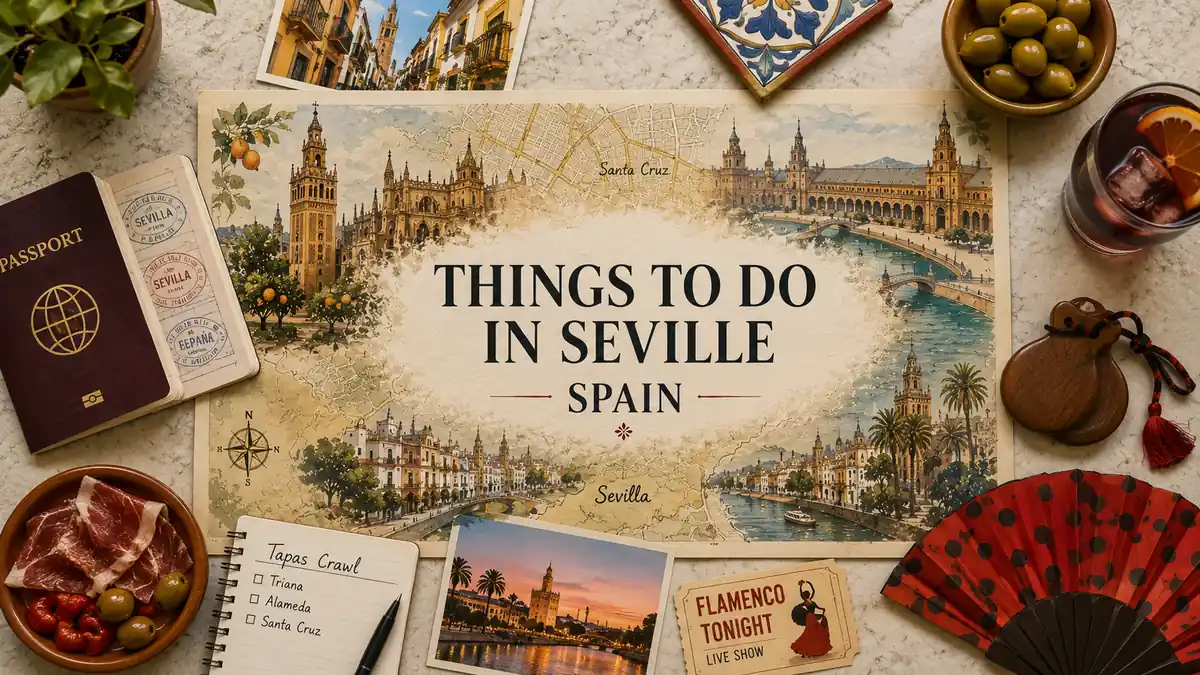
Seville rewards almost any visit — the problem is that your time there is finite and the best sights sell out. So the real question is not what you can do in Seville, but which experiences pay back the hours you give them. This page ranks them. You’ll find the marquee experiences worth booking ahead (walk the Real Alcázar, climb the Giralda), where and how to see flamenco properly, how a real tapas crawl works, what to do after dark, and the free experiences that outperform half the paid ones. Everything is judged by one measure — payoff per hour of a short trip. What doesn’t clear that bar gets an honest skip verdict instead of a diplomatic mention. No day-by-day plans, no hotel talk: just what to do in Seville and how to do each thing right.
Quick Answer
The Real Alcázar, the Giralda climb, and a live flamenco show are Seville’s highest-payoff experiences. The marquee sights demand advance booking, while the city’s other great experiences — tapas crawls, evening streets — need none. Seville rewards travelers who plan around its evenings; nights and free wandering deliver as much as any ticket.
Trust Layer
Tripstou selection guide for travelers choosing between multiple places. Covers selection criteria, traveler fit, and trip value.
Produced with AI assistance and reviewed by Alex Perrut, working in tourism since 2015, for the Tripstou editorial team. See our editorial process for details.
Last factual review: July 18, 2026.
Official sources consulted: Spain.info, Turespaña.
Key Takeaways
- The Real Alcázar is Seville’s highest-payoff sight — give it unhurried time if you only visit one interior.
- Book the Alcázar and Cathedral before you arrive; timed slots sell out even outside peak season.
- For flamenco, choose the smallest room you can get into — intimacy matters far more than the venue’s name.
- Treat a tapas crawl as the meal itself: order small, eat standing, and move after two or three plates.
- Seville peaks after dark, so plan your energy around the evenings and save midday heat for indoor sights.
- Some of the best experiences — Plaza de España, Santa Cruz, the riverbank — cost nothing at all.
Table of Contents
What Is Seville Famous For?
Seville is famous for Moorish palaces, flamenco, tapas culture, and street life that peaks after dark. Each one is something you do — walk, watch, eat, wander — not something you tick off from a distance. That fame sets the ranking on this page: experiences ordered by how much they give back per hour spent.
Payoff per hour is the only ranking logic used here. A famous sight that eats half a day for a modest reward ranks below a free evening walk that defines the whole trip. That standard produces some blunt verdicts — the Alcázar clears it easily, and a few big-name stops don’t make the page at all. Skip verdicts are part of the service.
This page owns the what, and only the what. For where to stay and when to visit, use the full Seville travel guide. If you’re deciding whether Seville should share the trip with other stops, the guide to the best places to visit in Spain handles that comparison.
The Alcázar and Cathedral Are Worth It — If You Book Ahead
Yes — the Real Alcázar and the Cathedral justify both the hype and the queue-planning they demand. Together with the Archivo de Indias, they form Seville’s UNESCO World Heritage trio, and the payoff matches the reputation. The only way to get these two wrong is to show up without a ticket.
Is the Real Alcázar Worth Visiting?
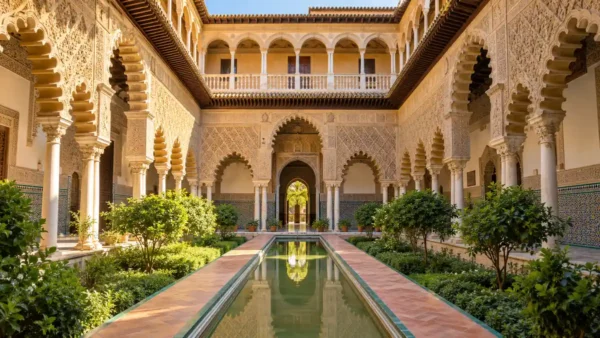
The Real Alcázar is the best thing to do in Seville, and it isn’t close. This is Moorish palace wonder at full strength — carved plasterwork, tiled courtyards, and gardens that keep unfolding long after you think you’ve seen the edge of them. It absorbs attention the way few sights anywhere can.
What separates it from the Cathedral next door is intimacy. The Cathedral overwhelms through scale; the Alcázar seduces through detail, drawing you from courtyard to chamber at reading distance. Give it unhurried time and it repays every minute. Rush it and you’ll have paid for a corridor walk.
Pick this if: you have time for only one paid sight in Seville — nothing else in the city matches its density of detail per hour.
Climb the Giralda at Seville Cathedral
Climbing the Giralda is the Cathedral’s defining experience, and the one to prioritize inside it. The bell tower is climbed by ramps instead of stairs, so the ascent is steady and manageable, and it ends in wide views over the rooftops of the old city. Few climbs anywhere deliver this much for this little effort.
What separates it from the Alcázar is perspective. The Alcázar keeps you immersed at ground level in ornament and garden; the Giralda pulls you above the city and shows you its shape — river, rooftops, orange trees, the geography of everything else on this page. The Cathedral floor below adds raw gothic scale as the supporting act.
Pick this if: you want Seville laid out beneath you — this is the one experience on the page that ends in a view.
Do You Need to Book Tickets in Advance?
Yes — book both sights ahead. Timed-entry slots for the Alcázar sell out even outside peak periods, and the Cathedral is not far behind. Walking up on the day is the classic way to lose hours of a short trip to a queue, or to miss the Alcázar entirely.
Three ways to visit, in rising order of hand-holding:
- Self-guided timed entry — the standard choice. Suits independent travelers happy to set their own pace; the trade-off is that context and timing are entirely on you.
- Guided tour — suits first-timers who want the layers of history decoded as they walk. The trade-off is a fixed slot and a group’s pace.
- Skip-the-line and combo options — suit short-trip travelers protecting their hours. The trade-off is paying a premium for convenience over content.
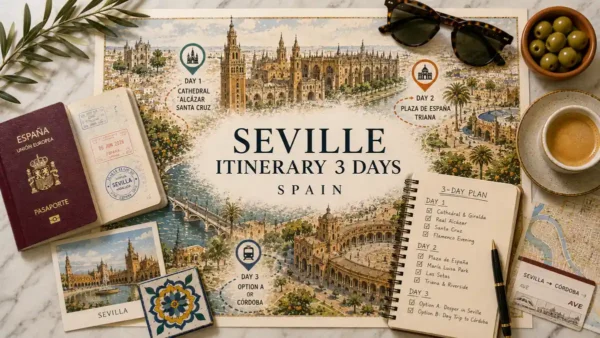
Don’t stack the two sights back-to-back if you can avoid it. The Alcázar’s detail demands a fresh eye, and it is the one that suffers when you arrive already saturated from the Cathedral. Ticket conditions and entry times shift, so verify them on official channels before you commit. If you’re working out how both fit into a short trip, see Seville in 2 days or the 3-day Seville itinerary.
Tours and activities
Book skip-the-line tickets, day trips and local tours with free cancellation on most activities.
You can also browse everything on getyourguide.com.
Tripstou may earn a commission if you book through this link, at no extra cost to you.
Where Is the Best Place to See Flamenco in Seville?
The best flamenco in Seville happens in a small, intense room, and Triana is the natural first choice. Seville is one of the recognized birthplaces of the art form, and intimacy beats production scale every time. Choose the venue type first; the specific stage matters far less.
Three venue types cover the real decision:
- Intimate tablao — a small room, close seating, and concentrated intensity at arm’s length. Suits first-timers and anyone who wants the full jolt; the trade-off is that seats are scarce and sell out.
- Cultural center or peña — stripped-back and artist-first, closer to how locals encounter the art. Suits repeat visitors and purists; the trade-off is sparse programming and zero frills.
- Big dinner show — comfortable, easy to book, dinner included. Suits groups and low-energy evenings; the trade-off is that production scale dilutes exactly the intensity that makes flamenco worth seeing.
Room size predicts quality better than price does. The closer you sit to the footwork, the more of the art survives the trip from stage to seat — book the smallest room you can get into, not the biggest show. Programs and prices change constantly, so treat any listing as a starting point and confirm before booking.
Pick this if: you want the one night in Seville you’ll still be describing years later — no other hour of the trip carries the same emotional charge.
Flamenco also travels beyond this city; the guide to things to do across Spain covers where else the art form — and Spain’s other defining experiences — are worth seeking out.
The Tapas Crawl: How to Eat in Seville Like a Local
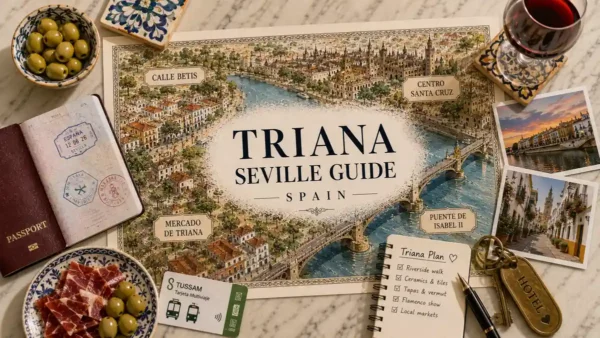
Eat standing, bar by bar, ordering one or two plates per stop — that is the tapas crawl. Triana and the Mercado de Triana are its classic ground. The crawl itself, not any single dish or restaurant, is the experience Seville does better than almost anywhere else in Spain.
The mechanics matter more than the map. Order small, eat at the bar, pay, and move — three or four stops make a full evening. Locals eat late, so the bars only reach proper voltage well after dark; arrive at tourist dinner hour and you’ll crawl through half-empty rooms. The crawl fails when you order like it’s a restaurant meal. Leave every bar slightly hungry, or the third stop never happens.
The two classic settings offer different theater. Triana — across the river, anchored by its market — is louder, more local, and less polished. Barrio Santa Cruz wraps the same ritual in lantern-lit lanes and heavier tourist traffic, trading rough authenticity for atmosphere. Both work; crossing between them is itself part of the experience.
A guided tapas tour buys ordering confidence, translation, and instant bar-picking judgment — worth it on a first night. Going self-guided buys freedom and the serendipity that produces the best stories. Neither choice is wrong; only sitting down for a long formal dinner every night is.
Pick this if: you’d trade a white-tablecloth tasting menu for three noisy bars and the best jamón of your life.
What Should You Do in Seville at Night?
Seville is an evening city; its best hours begin when the heat breaks and the streets refill. The siesta rhythm pushes dining, performance, and street life late into the night. Plan your energy around the evenings and the city meets you more than halfway.
The evening has a natural arc. It opens outdoors — Plaza de España glowing at dusk, the Guadalquivir riverbank filling with walkers — narrows into Santa Cruz’s lantern-lit lanes, and resolves into either a flamenco show or a tapas crawl, both covered above. You don’t need a plan so much as a direction.
Quick evening picks:
- Watch dusk at Plaza de España — the tilework and canal light up as the crowds thin.
- Walk the Guadalquivir and cross into Triana — the river at night is the city’s free spectacle.
- Get lost in Barrio Santa Cruz after dark — the lanes are at their most cinematic under lanterns.
- Find a rooftop terrace with a Giralda view — the tower floodlit is worth the price of one slow drink.
Free Things to Do in Seville That Are Actually Worth It
Some of Seville’s highest-payoff experiences cost nothing, and Plaza de España leads the free list. The plaza sits inside Parque de María Luisa, so a single visit delivers a landmark and a park in one unhurried wander. Beyond it, the city’s street fabric — lanes, river, plazas — is itself the attraction.
The free experiences that genuinely clear this page’s payoff bar:
- Wander Plaza de España, then drift into Parque de María Luisa — the grandest free hour in Andalusia.
- Get deliberately lost in Barrio Santa Cruz — the whitewashed maze rewards no plan at all.
- Cross the river into Triana — ceramics shops, market life, and the best view back at the city.
- Walk the orange-tree streets in blossom season — in spring the whole center smells of azahar.
The free tier covers Seville’s outdoors almost completely — what your money actually buys in this city is interiors. That’s the free-versus-paid logic in one line: wander everything open to the sky for nothing, and spend your budget where it changes the experience, above all on the Alcázar. Skip paying for views or plazas you can stand in for free.
Frequently Asked Questions
Is Seville worth visiting?
Yes — Seville is one of Spain’s most rewarding cities for a short trip. Few places pack this much into a walkable center: a world-class Moorish palace, living flamenco, a genuine tapas culture, and evenings built for wandering. It suits first-timers and repeat visitors alike, and rewards travelers who plan around its nights.
What should you do in Seville during the summer heat?
Follow the city’s own rhythm: sightsee early, retreat indoors at midday, and save the streets for the evening. Book the Alcázar and Cathedral interiors for the hottest hours, when shade and stone keep you comfortable. Reserve open spaces like Plaza de España and the riverbank for dusk, once the heat finally breaks.
What are the best things to do in Seville with kids?
Lean on Seville’s open-air experiences, which entertain children without much planning. The ramps up the Giralda make the climb easy for small legs, Plaza de España’s canal and boats are a natural hit, and Parque de María Luisa gives them room to run. Riverbank walks and Triana’s market round out an easy, low-stress day.
Is the Italica day trip from Seville worth it?
Yes, if Roman history appeals — Italica rewards the short trip out of the city. Just beyond Seville, it holds extensive Roman ruins and a large amphitheatre you can walk right into. It suits history-minded travelers and anyone wanting a half-day away from the crowds; skip it if your time is tight and monument-focused.
How long do you need for the Alcázar and the Cathedral?
Plan for roughly half a day to do both justice, ideally split into two visits rather than stacked. The Alcázar’s detail and gardens reward a couple of unhurried hours, and the Cathedral with the Giralda climb needs a good chunk more. Verify current times before you go, since hours shift seasonally.
Related Guides
Keep planning the trip with these guides:
- Seville travel guide — where to stay, when to visit, and how the city fits together.
- Seville in 2 days — the short-trip plan that fits the marquee sights in.
- 3-day Seville itinerary — the extra day that makes room for Triana and slower evenings.
- Things to do across Spain — the country-wide experience shortlist beyond Seville.
- Best places to visit in Spain — how Seville compares with the country’s other stops.
Did this guide save you time or money? Tripstou is independent and reader-funded — if you'd like to give something back, you can support the site with a crypto contribution of any size.