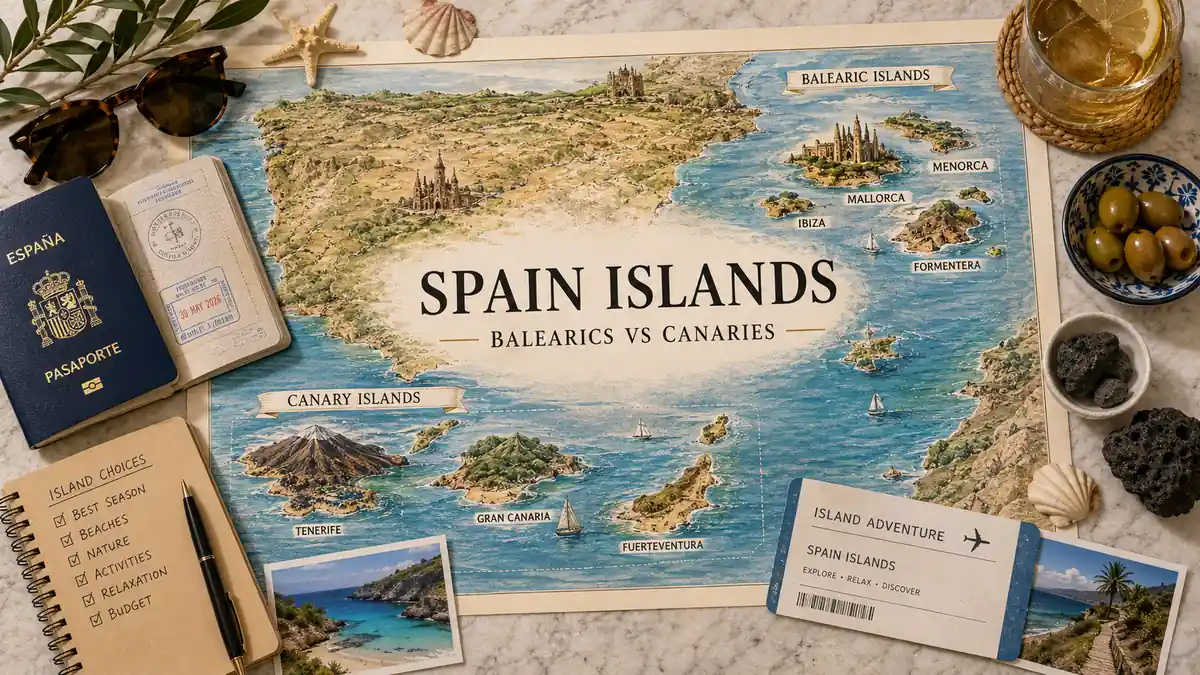
You know you want a Spanish island — you just don’t know which one. Spain has two very different archipelagos, and picking the wrong one for your season or travel style is the easy mistake to avoid. The Balearic Islands sit in the western Mediterranean, a short hop off the east coast, and shine in summer. The Canary Islands lie far south in the Atlantic, off northwest Africa, and stay warm all year. This guide helps you choose fast, by the four things that actually decide it: season, vibe, access, and sea temperature. It profiles the headline islands at a selection level, matches each to a traveler type, and flags when each direction is at its best. It is a router, not a logistics manual: once you’ve picked a direction, it hands you to the dedicated archipelago guides for island-by-island depth, plus itineraries, gateways, and packing.
Quick Answer
Choose the Balearics for warm summer seas, coves and nightlife; choose the Canaries for year-round and winter sun. The decision turns mainly on season and vibe: Mediterranean summer versus Atlantic winter. For a quiet escape, pick Menorca or Formentera; for variety and scale, pick Tenerife or Gran Canaria, the most versatile islands.
Trust Layer
Tripstou selection guide for travelers choosing between multiple places. Covers selection criteria, traveler fit, and trip value.
Produced with AI assistance and reviewed by Alex Perrut, working in tourism since 2015, for the Tripstou editorial team. See our editorial process for details.
Last factual review: June 20, 2026.
Official sources consulted: European Union, Travel Europe, ETIAS.
Key Takeaways
- Choose the Balearics for warm-summer seas, coves and nightlife, but expect the sea and buzz to fade outside summer.
- Pick the Canaries for reliable year-round and winter sun, trading warm Mediterranean coves for volcanic landscapes and Atlantic breeze.
- Mallorca is the strongest all-round first island, blending beaches, towns, mountains and the easiest flight access.
- Match the island to your traveler type: Ibiza for nightlife, Menorca or Fuerteventura for families, Tenerife for hiking.
- The biggest tradeoff is timing: Balearic warmth is summer-only, while the Canaries stay swimmable across the calendar.
- For a quiet small-island escape, choose Formentera in summer or El Hierro and La Gomera off-season.
Table of Contents
Balearics vs Canaries: which Spanish island group fits your trip?
Choose the Balearics for a warm-summer Mediterranean trip and the Canaries for year-round Atlantic sun. The two archipelagos split cleanly on four axes travelers actually decide on: season, vibe, access, and sea temperature. The Balearics sit close to the mainland; the Canaries lie far south off northwest Africa.
Season is the first filter. The Balearics are a summer destination: the sea warms up, coves fill, and the islands feel quieter in the cooler months. The Canaries hold mild temperatures every month, which makes them Spain’s go-to for winter sun when the Mediterranean is too cold to swim.
Vibe is the second filter. The Balearics trade on beach clubs, nightlife, sailing and sheltered coves within a compact, easy-to-combine group. The Canaries trade on volcanic landscapes, black-sand beaches, hiking and exceptionally clear night skies. Access is the third: the Balearics are a short hop off the east coast, while the Canaries are a longer flight south.
| Decision axis | Balearic Islands | Canary Islands |
|---|---|---|
| Best season | Warm from late spring to early autumn | Mild and swimmable for most of the year |
| Trip vibe | Coves, beach clubs, nightlife and sailing | Volcanic scenery, hiking and stargazing |
| Access from mainland | Short hop off the east coast | Longer flight far to the south |
| Sea and climate | Warm Mediterranean in high summer | Cooler Atlantic, steadier air temperatures |
| Landscape | Pine-backed coves and limestone cliffs | Volcanoes, black sand and rolling dunes |
For mainland context before you commit to an island trip, the broader Spain travel guide shows how the islands fit a wider route across the country.
The Balearic Islands are the pick for summer sea and coves
The Balearic Islands are the best choice for a summer-sea and cove-hopping trip. They sit closest to the mainland, warm up most reliably in high summer, and pack nightlife and sheltered coves into a compact group. Mallorca, Menorca, Ibiza and Formentera each pull a different traveler.
The group’s strength is variety within a short hop. You can mix a lively capital, mountain villages, calm family beaches and serious nightlife without a long flight, and ferries link the islands once you arrive. The main tradeoff is seasonality: outside summer the sea cools quickly and the buzz fades, so this is a warm-months direction.
- Mallorca — the biggest and most varied: beaches, a lively capital, mountain villages and the easiest flights.
- Menorca — the calm, family-friendly Balearic, known for quiet coves and a slower pace.
- Ibiza — the nightlife capital, but with surprisingly peaceful north-coast beaches by day.
- Formentera — the smallest and quietest, reached by ferry, with the clearest turquoise water.
For island-by-island depth, ferries and where to stay, continue to the Balearic Islands guide. Most travelers reach the group from the east coast: Barcelona and the wider Catalonia region are the busiest gateways, with the Costa Brava an easy add-on before or after. Further south, Valencia and the surrounding Valencia region open up shorter crossings to Ibiza and Mallorca.
The Canary Islands win for year-round and winter sun
The Canary Islands win for reliable winter sun and year-round warmth. Sitting in the Atlantic off northwest Africa, they stay mild when the Mediterranean cools, and they trade coves for volcanic landscapes, black-sand beaches and some of Europe’s clearest stargazing skies. Each headline island suits a distinct trip.
The Canaries are the answer when you want to swim and hike in months the rest of Spain has packed away. The tradeoff is distance and a cooler, breezier Atlantic feel: the flight south is longer, and the ocean rarely turns bathwater-warm. In return you get dramatic scenery and dependable weather across the calendar.
- Tenerife — the largest, with Spain’s highest peak, varied microclimates and the most flight options.
- Gran Canaria — a “continent in miniature”: dunes, mountains and a busy capital city.
- Lanzarote — defined by volcanic landscapes and design shaped by the artist César Manrique.
- Fuerteventura — long sandy beaches and steady wind, the pick for surfers and beach days.
- Western islands — La Palma, La Gomera and El Hierro stay green, quiet and hiking-focused.
For per-island detail, climate notes and where to base yourself, go to the Canary Islands guide. Many travelers pair the archipelago with a southern-mainland stop: Malaga and the Costa del Sol are handy launch points, set within the wider Andalusia region. Add a few days in Seville or Granada to bookend the islands with classic southern cities.
Best Spanish island by traveler type
The best island depends on your trip type, and Mallorca is the strongest all-round pick. It blends beaches, towns, mountains and easy access, which suits most first-timers. Beyond that, party travelers, families, hikers and quiet-seekers each have a clearer match across the two archipelagos.
Use these picks as a fast filter. Each one leads with fit, not hype, and most have a sensible backup if your dates or budget point elsewhere. The headline tradeoff stays the same: Balearic picks shine in summer, while Canary picks hold up across the year.
- Best for nightlife: Ibiza, the clubbing capital, with Mallorca as a livelier-than-expected backup.
- Best for families: Menorca for calm coves, or Fuerteventura for safe, sandy beaches.
- Best for nature and hiking: Tenerife and La Palma, plus La Gomera’s laurel forests.
- Best for a quiet small-island escape: Formentera in summer, El Hierro or La Gomera off-season.
- Best all-round first trip: Mallorca, which combines beaches, towns, mountains and easy access.
Travelers who prize green landscapes and cooler air over island heat sometimes find a better fit on the mainland: northern Spain and the Basque Country deliver hiking, coast and food without an Atlantic flight. For a dedicated island trip, though, the picks above hold.
When to go: summer Mediterranean vs winter Atlantic
Go to the Balearics in summer and the Canaries year-round, especially in winter. The Mediterranean islands peak from late spring through early autumn, when the sea is warm and coves come alive. The Atlantic Canaries stay mild every month, making them Spain’s strongest winter-sun direction when the mainland turns cool.
Timing is the cleanest way to settle the choice. If your trip falls in the warm half of the year, the Balearics give you the warmest, liveliest sea. If you are travelling in autumn, winter or early spring and want to swim, the Canaries are the reliable call. Shoulder months reward the Canaries more, since the Balearics quieten down as the water cools.
Pack to the direction, not just the calendar: a Balearic summer means swimwear and sun cover, while the Canaries can want a light layer for breezy evenings and higher trails. The Spain packing list covers both without the guesswork.
Where to go deeper after choosing your island
Once you’ve picked a direction, go straight to the archipelago guide for island-by-island depth. From there, an itinerary handles sequencing, mainland city and region guides cover your gateway and flights, and a packing list preps the trip. This page routes; the linked guides resolve the detail.
Work through the next steps in the order your plan needs them:
- Sequence the trip: the 7-day Spain itinerary, 10-day itinerary, or 14-day itinerary for longer trips that combine islands with the mainland.
- Route through a central hub: when flights connect via the centre, the Madrid guide and surrounding Madrid region cover the main hub and a few days around it.
- Go deeper on the islands: the dedicated archipelago guides hold the per-island detail this selection layer deliberately leaves out.
Frequently Asked Questions
Can you island-hop between the Balearics and Canaries on one trip?
Not easily — the two archipelagos sit far apart, so combining both in one trip rarely makes sense. The Balearics lie off Spain’s east coast, while the Canaries are far south in the Atlantic. Hop within one group by ferry or short flight, then choose the other for a separate trip.
Do you need a car on the Spanish islands?
A car helps on most Spanish islands, especially the larger ones. Mallorca, Tenerife and Gran Canaria reward a rental with access to remote coves, mountain villages and volcanic interiors that buses reach slowly. On small islands like Formentera or Menorca, you can manage with bikes, scooters or local transport instead.
Which Spanish island is cheapest to reach from the mainland?
The Balearic Islands are usually cheaper and quicker to reach from mainland Spain. They sit a short hop off the east coast, with frequent flights and ferries from cities like Barcelona and Valencia. The Canaries lie far south in the Atlantic, so flights there are longer and often pricier.
Can you visit the Canary Islands in summer?
Yes, the Canary Islands work well in summer, staying warm without the intense heat of mainland Spain. Atlantic breezes keep temperatures comfortable, making them a good escape from inland heatwaves. Summer is busy, though, so the islands feel calmer and better value in spring, autumn or winter.
Are the Balearic Islands too crowded in peak season?
The Balearic Islands do get busy in July and August, particularly around Mallorca’s and Ibiza’s resort hubs. Popular coves and nightlife spots fill quickly at peak season. You can still find quieter corners on Menorca and Formentera, or travel in June or September for warm seas with thinner crowds.
Which Spanish island is best for a short three- or four-day trip?
For a short three- or four-day trip, pick one compact island and stay put. Menorca, Ibiza or Formentera suit a quick Balearic break, while Lanzarote works for a short Canary escape. Larger islands like Mallorca or Tenerife reward more time, so save those for a full week.
Related Guides
Continue planning your Spanish island trip with the most useful next steps:
- Balearic Islands guide — per-island depth for Mallorca, Menorca, Ibiza and Formentera.
- Canary Islands guide — per-island depth for Tenerife, Gran Canaria and beyond.
- Spain travel guide — the mainland context and how the islands fit a wider trip.
- 7-day Spain itinerary — sequence an island stay into a wider route.
- Barcelona guide — the busiest gateway to the Balearic Islands.
- Malaga guide — a southern gateway often paired with the Canaries.
- Mallorca Travel Guide
- Tenerife Travel Guide
Did this guide save you time or money? Tripstou is independent and reader-funded — if you'd like to give something back, you can support the site with a crypto contribution of any size.