Madrid’s top experiences are one art-triangle museum, Retiro Park, a La Latina tapas crawl, and Temple of Debod at sunset — the four that repay a first visit best for the hours they cost. Night owls get their own flamenco and after-dark section; budget travelers get a free-and-local one.
Madrid has more worthwhile experiences than any trip has hours. The problem is not finding things to do — it is choosing between a world-class art museum, a royal palace, a tapas street, and a sunset temple when you cannot fit them all. This guide ranks Madrid’s experiences by payoff for the time they cost, so you build a shortlist instead of a checklist.
The picks are grouped by type: the icons that earn their reputation, the art-triangle decision, where to eat your way through an evening, what to do after dark, and the free experiences that compete with the paid ones. It closes with the honest part — what you can safely skip on a first visit, and what to do with the hours you get back.
How We Checked This
This is a curated shortlist of experiences inside Madrid, chosen and ranked by payoff for the time they cost; it is not a full Madrid city guide, a day-by-day itinerary, or a list of places to visit elsewhere in Spain.
Written with AI assistance, then checked by Alex Perrut (working in tourism since 2015) for the Tripstou editorial team; our editorial process explains the method.
Last factual review: July 18, 2026.
Official sources consulted: spain.info, tourspain.es.
The Madrid Icons Worth Your Limited Time
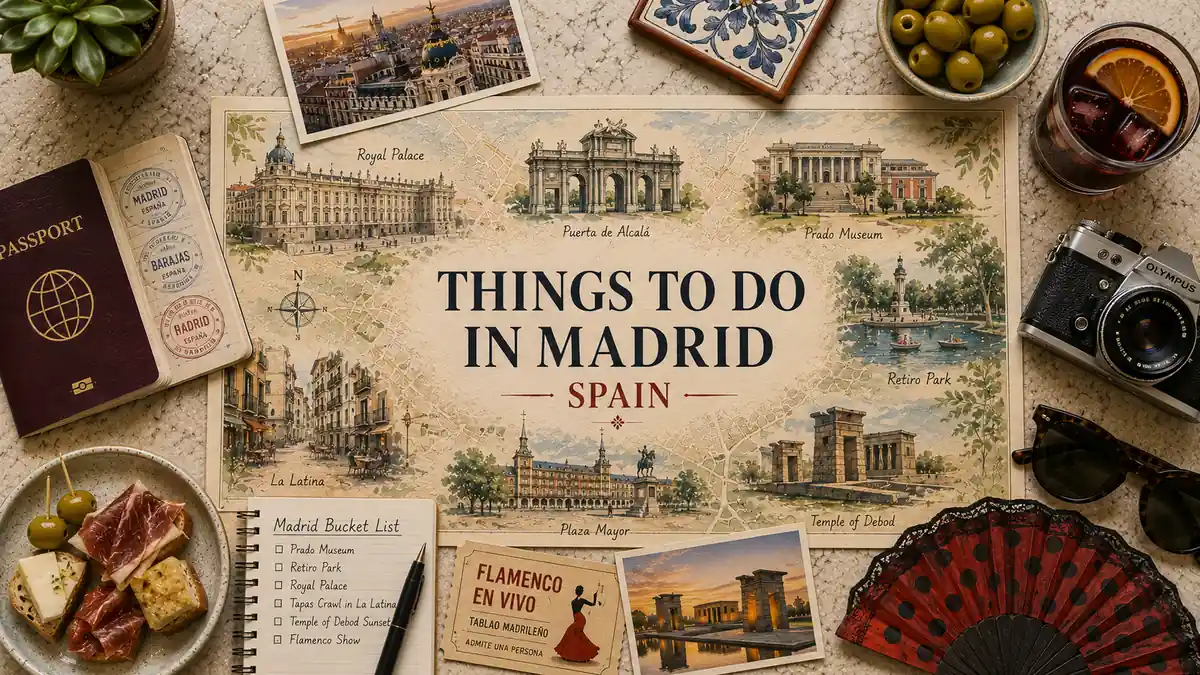
Three Madrid icons earn their hype on a first visit: the Royal Palace, Retiro Park, and the historic centre. Each is a real experience — a palace visit, a park afternoon, a long wander — not a photo stop. They rank here on payoff per hour, the rule this whole page follows.
Royal Palace and Almudena Cathedral
The Royal Palace made this list because it is the one Madrid interior that matches the city’s grandest expectations. Room after gilded room delivers the scale the exterior promises, and the armoury alone justifies the detour for anyone with a taste for history. Almudena Cathedral stands directly opposite and adds half an hour, not a separate outing. Free late-afternoon entry windows exist for EU citizens and residents — they draw long queues, so treat them as a bonus and check current conditions before planning around them. The Royal Palace draws long queues too, so a timed ticket saves waiting. Budget half a morning, and choose it over a museum when palaces move you more than paintings and one grand interior is all the trip needs.
Retiro Park
Retiro Park is Madrid’s best low-effort, high-payoff afternoon. It anchors the UNESCO-listed Paseo del Prado–Retiro landscape, and it is where the city actually relaxes — rowing boats on the lake, the glass Crystal Palace, long lawns full of locals doing nothing in particular. Unlike the other icons, it asks nothing of you: no ticket, no route, no pace. It also sits beside the art triangle, so a museum morning flows straight into a park afternoon. Give it more time than you think it needs: it is the slow half-day that fits between museum mornings and Madrid’s late nights.
Plaza Mayor, Gran Vía, and the Historic Centre
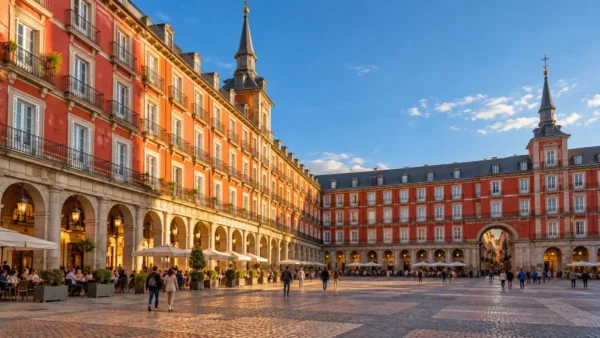
Walked as one continuous route, the historic centre is a better experience than any of its individual squares. Plaza Mayor’s arcaded theatre, the crowds of Puerta del Sol, and Gran Vía’s cinematic facades work as a single build in energy, from enclosed and historic to loud and modern. It is the only icon here that works at any hour — and it improves after dark, when Gran Vía lights up, which makes it the natural first-evening walk when you want the city’s energy at full volume. One caution:
- Plaza Mayor’s terrace restaurants are the most touristic eating in the city — walk the square, then eat elsewhere.
How you string these together — where to stay near them, how to get around — belongs to the full Madrid travel guide. And if you are still weighing Madrid against other Spanish cities for the trip itself, start with the best places to visit in Spain before committing your days.
Tours and activities
Book skip-the-line tickets, day trips and local tours with free cancellation on most activities.
You can also browse everything on getyourguide.com.
Tripstou may earn a commission if you book through this link, at no extra cost to you.
Prado, Reina Sofía, or Thyssen: Which One Should You Pick?
Pick the Prado if you only do one art-triangle museum — it is the deepest collection and the safest first choice. The real decision is taste: old masters point to the Prado, modern art and Guernica point to the Reina Sofía. The Thyssen is the range-covering alternative for travelers who want one museum to span both.
Each museum delivers something the other two cannot. The Prado holds the Velázquez, Goya, and El Greco collections that define Spanish painting — hours disappear in its core rooms alone. The Reina Sofía is built around one gravitational centre: Picasso’s Guernica, a painting that justifies the visit by itself, surrounded by Spain’s modern masters. The Thyssen covers the widest span, running from old masters to modern movements in a single, walkable sweep.
If you can already name the painting you would cross a city to see, skip the Thyssen — its range only wins when your taste is undecided. And doing all three on a short trip usually backfires. Museum fatigue is real. The second collection lands with half the force of the first, and the third becomes a corridor walk; two museums across two mornings beats three in two days.
Free-entry windows and timed reservations exist for these museums — check current hours and booking conditions on the official sites before you go, because the details change and the slots fill. For the Prado, booking ahead is strongly recommended, especially in peak season and for the free-entry window, which uses timed reservations that fill fast.
| Museum | Strongest for | Pick it if |
|---|---|---|
| Museo del Prado | Velázquez, Goya, and El Greco — the old-master benchmark | Classical painting is why you came to Madrid |
| Museo Reina Sofía | Guernica and Spain’s modern masters | One landmark painting outweighs breadth for you |
| Museo Thyssen-Bornemisza | One sweep from old masters to modern art | Your taste is undecided or split across eras |
Where Do You Do a Real Tapas Crawl in Madrid?
A real tapas crawl happens on Cava Baja in La Latina — the classic — or on Ponzano for the local version. Both are streets you eat along, not restaurants you sit in. Tapas is Madrid’s best food experience because the moving format lets one evening cover five kitchens instead of one.
The mechanics matter more than the venue list. Stand at the bar. Order a drink and a plate or two, share them, and move on when they are gone — repeat across three or four bars and you have a full evening that never drags. Madrid eats late, so join the rhythm instead of fighting it; an empty street at what feels like dinner time just means you arrived early.
A crawl dies the moment you sit down for a full meal at the first stop — keep every visit short and standing, and the whole street stays in play. Where to do it comes down to three settings:
- Cava Baja (La Latina): the classic crawl street — dense, atmospheric, made for first visits, though it is the most visitor-heavy of the three, especially at weekends.
- Ponzano (Chamberí): where Madrid itself goes out to eat, with newer bars beside old-school counters. It sits away from the sights, so it costs you a metro ride and earns you the local crowd.
- Mercado de San Miguel: a beautiful iron-and-glass market where you sample under one roof, steps from Plaza Mayor — but you are paying for the setting: atmosphere over value.
Madrid After Dark: Flamenco, Rooftops, and the Late-Night Rhythm
The best after-dark experience in Madrid is an hour of live flamenco at a real tablao. The city runs late — dinner starts when other capitals wind down, and the streets fill after it. Plan evenings as a sequence: sunset viewpoint first, then tapas, then a show or a nightlife neighborhood.
A Real Flamenco Tablao
A tablao show is the closest thing Madrid offers to a guaranteed unforgettable hour. Flamenco up close — a small room, a singer, a guitarist, a dancer working at full intensity — hits harder than almost any staged performance in Europe. Corral de la Morería is the oldest tablao in the city and the benchmark name; smaller rooms trade polish for intimacy. If your Spain trip has room for one cultural performance, this is the one delivered at benchmark level. What sets this pick apart is that it is the only experience on this page that punishes improvising: the good rooms are small and sell out, and programs and prices vary, so check the current schedule and book before you arrive.
Rooftop Views at Sunset
Madrid’s rooftop bars turn an ordinary drink into the evening’s main event. The city’s low skyline and sharp light mean the golden hour genuinely performs, and a terrace above Gran Vía or the centre gives you the transition from day-Madrid to night-Madrid in one sitting — the right call whenever golden hour with a drink in hand beats another monument. It needs no planning beyond showing up early enough for a spot. One caveat: many terraces are seasonal or weather-dependent, so have a ground-level backup rather than building the night around a single rooftop.
Nightlife Neighborhoods: La Latina, Malasaña, Chueca
Madrid’s real nightlife is a neighborhood, not a venue. Each of the big three offers a different night out, and the choice shapes the whole evening:
- La Latina: the natural continuation of a tapas crawl — bars flow into bars until late.
- Malasaña: indie, creative, slightly chaotic — Madrid’s alternative heart.
- Chueca: the city’s most festive streets and the centre of LGBTQ Madrid.
The format is zero-commitment: no ticket, no start time, no plan required — you simply pick a neighborhood and let it unfold. It is also the truest way to feel Madrid’s famous late rhythm, because the streets themselves are the show, and the best fit when the night itself is the destination, with nothing booked and no schedule.
Of these three, only flamenco demands a decision in advance. Rooftops and neighborhoods forgive spontaneity. The show does not — choose it and book it before your trip starts.
Free Things to Do in Madrid That Locals Actually Do
Temple of Debod at sunset is the best free experience in Madrid — and it beats most paid ones. Madrid’s free tier is no consolation list: a genuine Egyptian temple, Europe’s liveliest flea market, and neighborhoods built for wandering. Locals do these on ordinary weekends, which is exactly why they outrank half the ticketed sights.
Temple of Debod at Sunset
Nowhere else in Europe do you watch the sun set behind a genuine ancient Egyptian temple. Built in the 2nd century BC and rebuilt stone by stone in Madrid, Debod sits in a hilltop park facing west over the city — and it is completely free. The experience is the timing: arrive well before sunset, find a spot by the reflecting pools, and let the light do the work. What makes it distinct is simple — it is the one Madrid experience with no equivalent in any other European capital, and the sunset to choose when you want it without a bar bill.
El Rastro Flea Market
El Rastro is Madrid at its most local — a sprawling open-air flea market that takes over the Embajadores and La Latina streets every Sunday. The payoff is not the shopping; it is drifting downhill through the stalls, side streets, and antique shops with half the city doing the same. The built-in follow-up sets it apart from every other pick here: the market empties into La Latina just as the vermouth-and-tapas afternoon begins, chaining two of Madrid’s best experiences into one day. It only happens on Sundays, and nothing else on this page is this time-locked, so a trip that includes a Sunday morning should keep it for the market.
Neighborhood Wandering by Day
Daytime wandering in Malasaña and La Latina is the free experience most visitors underrate. Malasaña’s streets stack independent shops, murals, and cafés into a compact grid made for aimless walking; La Latina’s narrow lanes deliver old Madrid at its most photogenic before the evening crowds arrive. This is deliberately a different experience from the nightlife covered above — by day these neighborhoods are about texture and coffee, not bars. Its real use is filling the awkward gaps of a trip: the hour between museum and lunch, the slow first morning. It rewards anyone who enjoys cities most in the spaces between the sights, coffee in hand.
The paid icons have free tiers too, and they are worth knowing about:
- The Prado opens free daily in its final two opening hours — a timed reservation is required, and slots go fast.
- The Royal Palace has late-afternoon free windows for EU citizens and residents — check current conditions before relying on one.
If Madrid is one stop on a longer Spanish route, the same payoff-per-hour logic applies nationwide — the guide to things to do across Spain extends this shortlist beyond the capital.
What to Skip in Madrid — and What to Do Instead
Skip sit-down meals on Plaza Mayor, the sightseeing bus, and the third art museum — none repays its cost. Each has a higher-payoff substitute already on this page. Skipping well is how a short trip fits Madrid’s best experiences without feeling rushed, and it is the easiest upgrade you can make.
The substitutions are direct:
- Skip eating on Plaza Mayor’s terraces → walk the square, then crawl Cava Baja ten minutes away. The same money buys dramatically better food and a better evening.
- Skip the hop-on-hop-off bus → walk the Plaza Mayor–Sol–Gran Vía route instead. Madrid’s core is compact, and the centre walk is itself one of the icons.
- Skip the third art-triangle museum → spend that half-day on Retiro or Debod at sunset. The second museum keeps its payoff; the third rarely does.
This page ranks and prioritises — it deliberately stops short of scheduling. When you are ready to turn the shortlist into an actual sequence of days, the 2-day Madrid itinerary and the 3-day Madrid itinerary do that job properly.
More Questions About Visiting Madrid
Is Madrid worth visiting?
Yes, Madrid is worth visiting for its world-class art, late-night food culture, and remarkably walkable centre. Few European capitals pack this many high-payoff experiences into such a compact core — the Prado, Retiro Park, tapas crawls, and flamenco all sit within minutes of each other. It rewards even a short first trip.
What are the best things to do in Madrid with kids?
Retiro Park is the easy winner with kids — rowing boats on the lake, wide open lawns, and room to run without a ticket or a plan. Temple of Debod’s hilltop park gives a low-effort sunset with space to roam, and Mercado de San Miguel makes a painless, varied family meal. Short walking distances help.
What are the best day trips from Madrid?
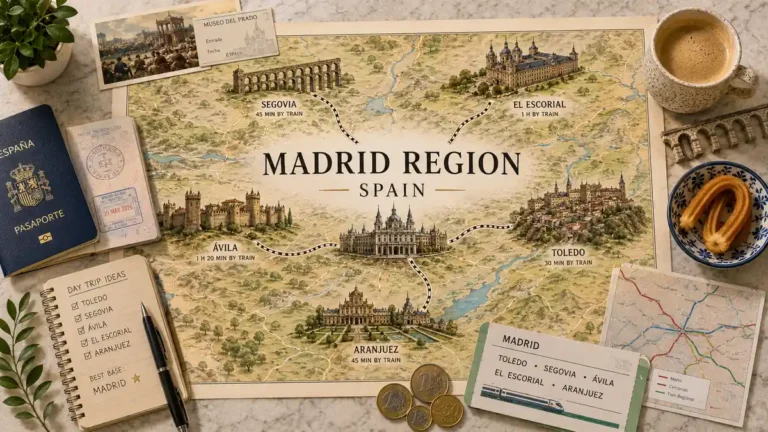
Toledo and Segovia are the two day trips most first-time visitors add, both within easy reach of the capital. This guide stays focused on Madrid itself, so it stops at naming them — the guide to day trips from Madrid covers the logistics. On a short first trip, though, the city usually earns your full attention.
Did this guide save you time or money? Tripstou is independent and reader-funded — if you'd like to give something back, you can support the site with a crypto contribution of any size.