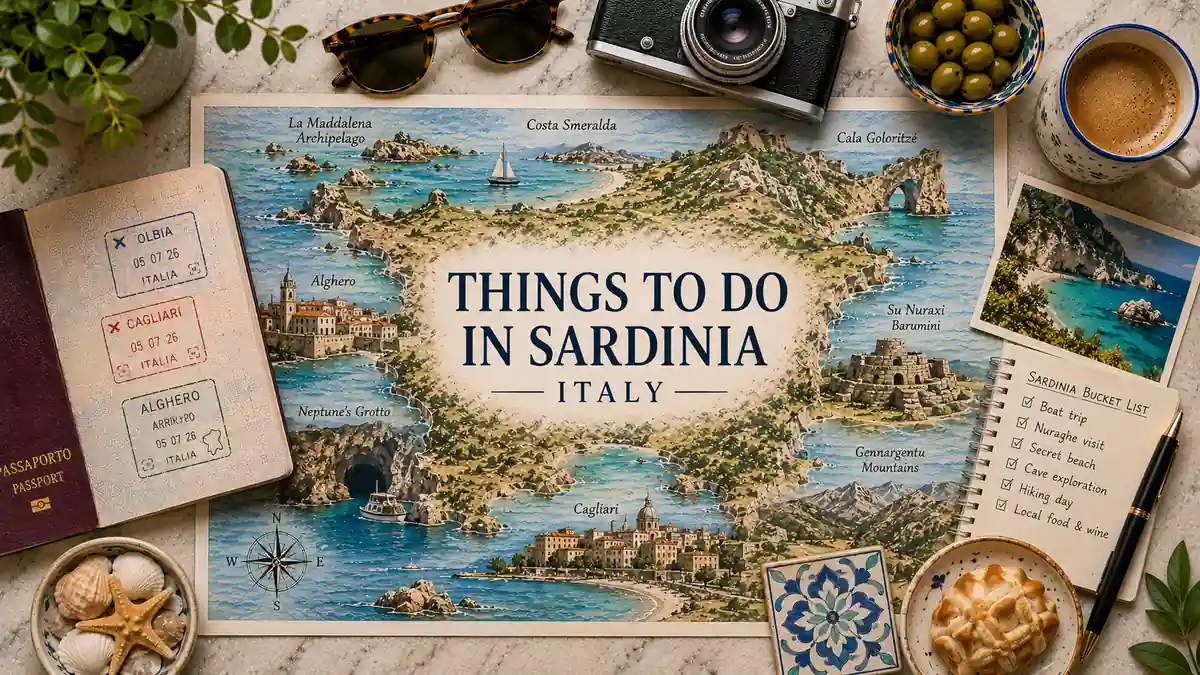
Sardinia is not one trip — it is several, and the hard part is choosing which experiences are worth your days and which are worth booking. The island packs turquoise beaches, three-thousand-year-old stone towers, mural-covered mountain villages, floodlit sea caves, deep canyons, and a food culture unlike mainland Italy’s onto one Mediterranean landmass. You cannot do all of it well in a short visit, and trying to spreads a trip thin. This guide groups Sardinia’s best things to do by experience type — beaches and boat trips, nuragic sites, historic towns, caves and natural wonders, outdoor adventure, and food and wine — so you can match them to how you actually like to travel. For each, it names the standout picks, explains what makes them worth the time, and tells you who they suit. The aim is selection, not a checklist.
Quick Answer
Sardinia’s best experiences span beaches, boat trips, nuragic sites, historic towns, sea caves, outdoor adventure, and food and wine. The main split is coast-and-boat versus interior culture and nature, and picks are grouped by type. Beach lovers, culture seekers, and adventurers each find a fit; headline boat trips and capped sites reward booking ahead.
Trust Layer
Tripstou selection guide for travelers choosing between multiple places. Covers selection criteria, traveler fit, and trip value.
Produced with AI assistance and reviewed by Alex Perrut, working in tourism since 2015, for the Tripstou editorial team. See our editorial process for details.
Last factual review: July 5, 2026.
Official sources consulted: italia.it, enit.it.
Key Takeaways
- Plan around interests, not a checklist, and combine coast with interior — a single base reaches beaches, canyons, and nuraghi in one day.
- Boat trips to the Gulf of Orosei and La Maddalena reach coves no road touches, earning their cost where the coast can’t be driven.
- Su Nuraxi at Barumini is the island’s only UNESCO nuragic site and the clearest window into a civilization mainland Italy lacks.
- Access-capped sites like La Pelosa and Cala Goloritzé require booking a slot ahead in high season, so reserve before arriving.
- For food and wine, skip the coastal storefronts and book inland cooking classes and Cannonau tastings where Sardinians actually cook.
Table of Contents
What are the best things to do in Sardinia?
Sardinia’s best things to do split into seven experience types, and the island rewards mixing coast with interior. Beaches and boat trips, nuragic sites, historic towns, sea caves, outdoor adventure, and food and wine each headline a different kind of trip. The strongest visits pair one coast day with one inland experience.
The right mix depends on your travel style. Plan around interests, not a checklist. The table below matches each experience type to who it suits and where to find it.
| Experience type | Who it suits | Where on the island |
|---|---|---|
| Beaches and boat trips | Beach-first travelers and families | Northeast coast and Gulf of Orosei |
| Nuragic and Bronze Age sites | Culture-curious travelers and history lovers | Interior, especially around Barumini |
| Historic towns | Slow travelers who explore on foot | Alghero on the coast, Orgosolo inland |
| Caves and natural wonders | Scenery seekers who don’t mind effort | Capo Caccia and the Gulf of Orosei |
| Outdoor adventure | Active travelers, divers, and hikers | Supramonte interior and east coast |
| Food and wine | Travelers who plan trips around meals | Barbagia villages and inland cellars |
Two things make Sardinia easier to plan than its size suggests. Distances between coast and interior are shorter than the map implies, so a single base can reach beaches, canyons, and nuraghi in one day. The experience types also cluster geographically — the northeast for boats, the interior for culture and adventure.
Sardinia rewards travelers who combine one coast experience with one inland one; back-to-back beach days waste an island that does its most distinctive work away from the water.
For when to go, how to get around, and where to base yourself, the Sardinia travel guide covers the logistics this page leaves out. To see how the island’s experiences compare with the rest of the country, browse the wider guide to things to do in Italy. And once you are weighing route order, an Italy itinerary helps slot a Sardinia leg into a longer trip.
Beaches and boat trips are Sardinia’s headline experience
Boat trips unlock Sardinia’s best coastline, reaching coves and water that road access never touches. The island’s signature beaches — turquoise, shallow, and framed by granite — are the reason most travelers come. A half-day boat tour turns a single beach visit into a string of stops.
The choice is really about access. The best coves have no road. A boat tour earns its cost where the coast can’t be driven to — the Gulf of Orosei and La Maddalena qualify, while a beach you can park beside rarely does. Where coast-and-interior sequencing becomes the next question, route planning takes over from experience selection.
La Maddalena Archipelago island-hopping
La Maddalena Archipelago is the island-hopping day trip that tops most Sardinia lists. A cluster of granite islands off the northeast, it strings together pink-tinged sand, sheltered lagoons, and water clear enough to see the bottom from the deck. Boats run from Palau and La Maddalena town, from large group catamarans to small private charters, and prices vary widely — treat any figure as a range to verify before booking.
Pick this if: you want the best day on the water and don’t mind sharing the coves in summer.
Gulf of Orosei by boat
The Gulf of Orosei is a wall of limestone cliffs on the east coast, hiding beaches you can reach only by boat or on foot. Cala Mariolu, Cala Biriola, and Cala Luna line up along it, each a pale crescent under the rock. Day boats leave from Cala Gonone and Santa Maria Navarrese, often as multi-stop cruises with swim time at each cove.
Pick this if: you want dramatic cliffs and several swim stops over one crowded beach.
La Pelosa and the northwest beaches
La Pelosa near Stintino is the shallow, white-sand beach that appears on every Sardinia postcard, backed by a Spanish watchtower. To protect it, access is capped daily and requires a paid ticket booked ahead in high season — treat the rules and fee as a range to verify before you go. The wider northwest coast around Alghero adds road-reachable beaches without the same limits.
Pick this if: you want an iconic beach and are willing to reserve a slot in advance.
Tours and activities
Book skip-the-line tickets, day trips and local tours with free cancellation on most activities.
You can also browse everything on getyourguide.com.
Tripstou may earn a commission if you book through this link, at no extra cost to you.
Nuragic and Bronze Age sites worth visiting
Su Nuraxi at Barumini is Sardinia’s headline nuragic site and the island’s only UNESCO World Heritage monument. Nuraghi are Bronze Age stone towers found nowhere else, and thousands dot the island. Visiting one turns an abstract history lesson into something you can walk through. For culture-curious travelers, it anchors an interior day.
Nuraghi exist nowhere else on earth. That rarity is the reason a nuragic stop earns its place against another beach — you are seeing a whole prehistoric civilization that mainland Italy simply does not have.
Su Nuraxi / Barumini (UNESCO)
Su Nuraxi at Barumini is the best-preserved nuraghe on the island and the one to visit if you see only one. Its central tower and surrounding village date back more than three thousand years, and a guided visit is the only way in. Guides walk you through the chambers and explain a culture that left no writing. Entry is modest and time-slotted — treat the fee and hours as a range to confirm before arriving.
Barumini rewards the guided visit its ticket forces on you — the stonework says little without the narration, which is why a self-guided walk-past of a roadside nuraghe disappoints.
Pick this if: you want the clearest window into Sardinia’s Bronze Age past.
Historic towns that reward slow exploration
Alghero and Orgosolo are Sardinia’s two standout town experiences, and each rewards slow, on-foot exploration. These are experiences, not just places to tick off — Alghero for its Catalan old town and seafront, Orgosolo for its political murals. Both reward an unhurried half-day on foot over a quick drive-through.
Both towns reward walking, not driving. The value here is atmosphere and character, so treat each as an experience to sink into rather than a name on a map — the opposite of a where-to-go roster.
Alghero
Alghero is the walled seaside town where Sardinia sounds Catalan — street signs, dialect, and cuisine all carry the legacy of Aragonese rule. The honey-stone old town sits right on the water, best explored on foot with no fixed plan, ending on the ramparts at sunset. It also makes the natural base for Neptune’s Grotto and the northwest beaches.
Pick this if: you want an atmospheric old town with the sea on its doorstep.
Orgosolo (murals)
Orgosolo is a mountain village in the Barbagia interior covered in political murals, painted since the 1960s across house walls and alleys. The art turns a short wander into an open-air gallery of protest, satire, and local history — nothing else on the island reads like it. It pairs naturally with the Supramonte and a shepherd’s lunch inland.
Pick this if: you want culture and character over another coastal view.
Caves and natural wonders on coast and interior
Neptune’s Grotto and Cala Goloritzé are Sardinia’s two headline natural wonders, one a sea cave, one a beach. Both deliver landscape drama the beaches alone don’t. Neptune’s Grotto is a lit sea cavern near Alghero; Cala Goloritzé is a protected cove reached only by boat or a steep hike.
These are the experiences that convert scenery into effort. The access cap at Goloritzé is the reason it still looks like the postcard — on this coast, the harder a beach is to reach, the better it has usually aged.
Neptune’s Grotto (Alghero)
Neptune’s Grotto is a floodlit sea cave under the cliffs of Capo Caccia, filled with still saltwater pools and stalactites. You reach it two ways — down the Escala del Cabirol, a long clifftop stairway, or by boat from Alghero when seas are calm. Either approach is part of the experience. Entry and boat costs are modest but seasonal — treat them as a range to verify before booking.
Pick this if: you want a dramatic cave without any technical caving.
Cala Goloritzé / Gulf of Orosei
Cala Goloritzé is a protected cove at the south end of the Gulf of Orosei, famous for its limestone pinnacle and pale water. As a national monument it caps daily visitors and charges a small access fee, and you arrive only by boat or a roughly ninety-minute hike down. The effort keeps it quiet. Treat caps and fees as a range to confirm before you go.
Pick this if: you’ll trade an easy arrival for one of the island’s most striking beaches.
Outdoor adventures: diving, canyoning, and hiking
Sardinia’s core outdoor draws are diving, canyoning in the Supramonte, and coastal hiking along wild trails. The interior mountains and the clear, life-rich sea make the island a genuine adventure base, not just a beach one. These experiences suit active travelers who like to earn a view.
The interior is the surprise here. Most visitors picture only the coast, yet Sardinia’s mountains carry some of the Mediterranean’s most serious canyons and trails, and the adventure is what separates this island from a standard beach holiday.
Diving
Diving in Sardinia trades on clear, life-rich water and sites for every level, from the marine reserves around Tavolara and Capo Carbonara to wrecks and caverns. Visibility is among the best in the Mediterranean, and dive centers run guided outings and courses through the warm season.
Pick this if: you want reef, wall, and cave dives in exceptionally clear water.
Canyoning (Supramonte)
Canyoning in the Supramonte massif means descending limestone gorges by scrambling, sliding, and abseiling through cold pools. The Gola di Gorropu, one of Europe’s deepest canyons, anchors the area for guided trips scaled from beginner to serious. A guide is essential here. The terrain is unforgiving on your own.
Pick this if: you want a full-body adventure day in the wild interior.
Coastal hiking (Selvaggio Blu)
Coastal hiking peaks with the Selvaggio Blu, a multi-day traverse above the Gulf of Orosei rated among Italy’s toughest trails. Shorter day walks reach the same coves — Goloritzé and Cala Luna — without the ropework or the commitment. The views pay out either way.
Pick this if: you want the coast on foot, at whatever difficulty you can handle.
Food and wine experiences worth booking
A hands-on cooking class and a Cannonau wine tasting are the two Sardinian food experiences worth booking ahead. Sardinian food is distinct from mainland Italian cooking, built on pecorino, bottarga, suckling pig, and pane carasau. A class or a tasting turns a meal into something you understand and can repeat at home.
Where you book matters more than what you book. Skip the coastal-town storefronts. The food experiences that travel home with you happen inland, where Sardinians actually cook and grow — a short drive off the beach, not on the tourist promenade.
Sardinian cooking class
A Sardinian cooking class puts you hands-deep in the island’s staples — rolling malloreddus, shaping culurgiones, or stretching pane carasau with a local cook. Most run in farmhouses or agriturismi inland and end in a long shared lunch with wine. Prices vary by group size and length — treat any figure as a range to verify before booking.
Pick this if: you want to take a real skill home, not just a meal.
Cannonau wine tasting
Cannonau is Sardinia’s signature red, a robust grape tied to the island’s Blue Zone longevity story, and tastings cluster around Oliena, Jerzu, and the Barbagia. A cellar visit pairs several pours with pecorino, bottarga, and cured meats, often with the winemaker. Costs scale with the lineup — treat them as a range to confirm ahead.
Pick this if: you want to understand Sardinian wine at the source.
Frequently Asked Questions
Do you need to book tours and tickets in advance in Sardinia?
Yes, for capped sites and headline boat trips, especially in summer. Access-limited beaches like La Pelosa and Cala Goloritzé sell timed tickets that fill fast, and popular La Maddalena and Gulf of Orosei boats book out in peak season. Casual road-reachable beaches and towns need no reservation.
Is Sardinia worth visiting for activities beyond the beach?
Absolutely — the interior may be more distinctive than the coast. Sardinia holds the UNESCO nuraghe at Barumini, mural-covered Orgosolo, some of Europe’s deepest canyons in the Supramonte, and inland food and wine culture. Many travelers rate a Bronze Age site or a canyon day above another beach.
Is Sardinia good for families with children?
Yes, Sardinia suits families exceptionally well. Its shallow, calm beaches like La Pelosa are ideal for young children, while boat trips, sea caves, and walkable towns keep older kids engaged. Nuraghi appeal as real-life castles, and short interior drives make day trips manageable without long transfers between coast and mountains.
Can you enjoy Sardinia without taking a boat trip?
Yes, though you’ll miss the coves boats reach best. Plenty of standout beaches around Alghero and Stintino are road-accessible, and the island’s interior — nuraghi, Orgosolo’s murals, canyons, and food experiences — needs no boat at all. Skip the water only if crowds or seasickness make a tour unappealing.
What food is Sardinia known for?
Sardinia is known for pecorino cheese, bottarga, suckling pig, and crisp pane carasau flatbread. Its cooking diverges sharply from mainland Italy, favoring pasta shapes like malloreddus and culurgiones and the robust Cannonau red wine. These staples anchor the island’s cooking classes and cellar tastings, best sought inland rather than on the coast.
What is there to do in Sardinia when it rains?
On rainy days, head indoors to Sardinia’s caves, museums, and food experiences. Neptune’s Grotto and other sea caves stay dramatic in any weather, while a guided nuraghe visit, an inland cooking class, or a Cannonau cellar tasting all work sheltered. Historic town wandering suits light rain too.
Related Guides
Once you’ve chosen your experiences, these guides handle the planning around them — when to go, where to base, how to sequence a route, and where else in Italy to look.
- Sardinia travel guide — when to visit, how to get around, and where to base yourself on the island.
- Italy itinerary — how to sequence a Sardinia leg into a wider Italy route without backtracking.
- Things to do in Italy — the country-wide bucket list of experiences beyond Sardinia.
- Best places to visit in Italy — where to go across Italy, matched to your trip style.
- Hidden gems in Sardinia — the quieter beaches and towns beyond the headline names.
- Best time to visit Italy — national seasonality, and how island timing sits inside it.
Did this guide save you time or money? Tripstou is independent and reader-funded — if you'd like to give something back, you can support the site with a crypto contribution of any size.