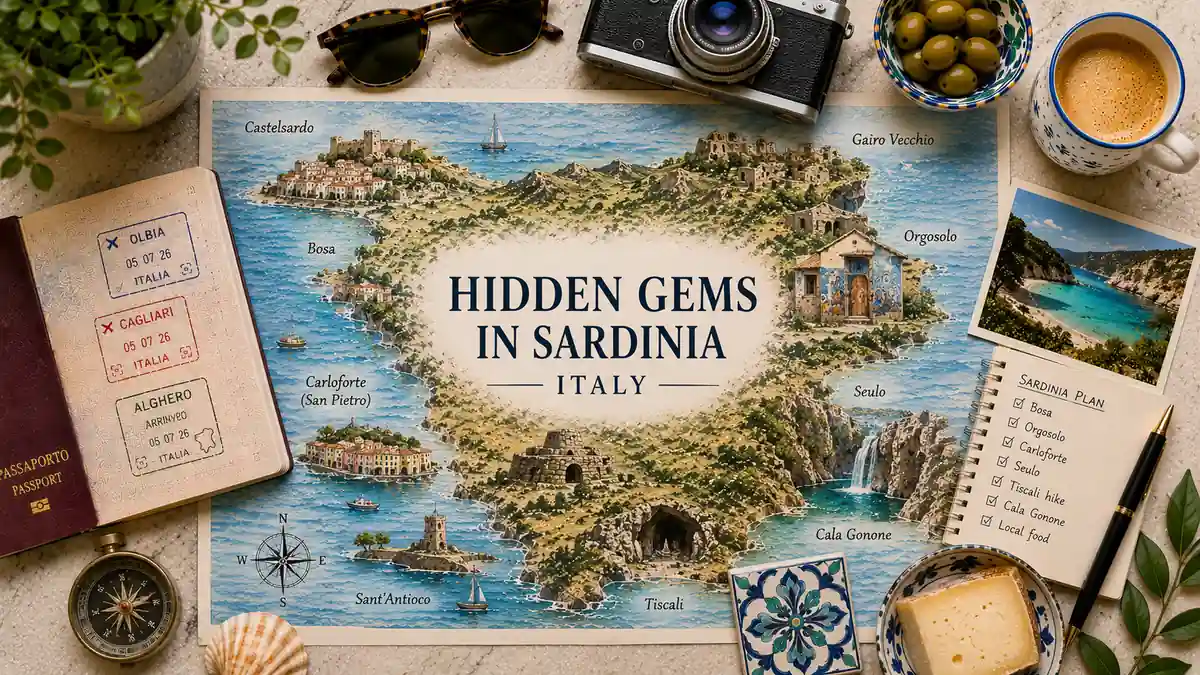
Sardinia’s fame pools around a handful of crowded headline spots — the Costa Smeralda’s yacht harbors, Alghero’s ramparts, Cagliari’s old town — leaving most of the island quietly overlooked. That’s good news if you want the places other travelers miss. This is a curated shortlist of genuinely lesser-known Sardinian towns, villages and micro-regions, grouped by area so you can pick by geography instead of scrolling a random list. For each pick you get the same three things: why it stays off the tourist trail, what makes it distinct, and which kind of traveler it suits. The picks span the northern and west coasts, an offshore island, the inland mountains of Barbagia, and the quiet east. No two feel alike, and none of them will have you queuing.
Quick Answer
Sardinia’s strongest hidden gems are Bosa, Orgosolo and Carloforte, spanning the west coast, inland Barbagia and a Ligurian-flavored offshore island. The picks are grouped by area — northern coast, west and islands, inland mountains, and east — so you choose by region. Culture and solitude seekers head inland; scenic detourers stay coastal.
Trust Layer
Tripstou selection guide for travelers choosing between multiple places. Covers selection criteria, traveler fit, and trip value.
Produced with AI assistance and reviewed by Alex Perrut, working in tourism since 2015, for the Tripstou editorial team. See our editorial process for details.
Last factual review: July 6, 2026.
Official sources consulted: italia.it, enit.it.
Key Takeaways
- Bosa is the strongest overall pick — candy-colored houses above the Temo, the prettiest wander with the least effort.
- Inland Barbagia hides Sardinia’s deepest culture — Orgosolo’s murals and Seulo’s Blue Zone longevity reward travelers who skip the coast.
- Most of these detours need a car — public transport into the interior and along the quiet coast is thin.
- Carloforte and San Pietro depend on a seasonal ferry, so fixed-date trips are safer built around road-reachable Bosa.
- For a striking one-off, Gairo Vecchio’s abandoned ghost town beats every polished village on the island for atmosphere.
Table of Contents
Why these Sardinian towns stay off the tourist trail
These Sardinian towns stay off the tourist trail because they sit away from the marquee coast and the cruise-port shortlist. Each pick here earns its place on three tests: genuinely low visitor numbers, a distinct character you can’t copy elsewhere, and a location spread across the island rather than clustered in one corner.
The selection axis is deliberate — famous versus hidden. The headline names, which you’ll find among Sardinia’s most famous destinations, deliver undeniable scenery, and they also deliver the crowds, the queues and the peak-season prices. The picks below keep the beauty and skip most of the friction.
Geography does the rest of the work. Spreading the shortlist across five zones — north coast, west coast, an offshore island, inland Barbagia and the east — means you can slot one detour into almost any route without backtracking. It also keeps the list honest: no single corner of the island does all the lifting. For the wider view, these sit inside a broader map of hidden gems across Italy.
The famous spots earn their reputation; they’re simply busier and pricier for the same stretch of Mediterranean coastline.
Hidden gems on Sardinia’s northern coast
Sardinia’s northern coast hides two quiet standouts: Castelsardo, a medieval hilltop town, and Stintino, gateway to pale Caribbean-like sand. Both stay calmer than the Costa Smeralda a short drive east, because neither carries the luxury-resort reputation that pulls the crowds. They reward travelers who want scenery without the price tag or the parade.
Castelsardo
Castelsardo is a medieval town stacked up a headland on the north coast, crowned by a Doria-family castle. Most tour buses skip it for the resort strip further east, so its steep stone lanes and basket-weaving workshops stay refreshingly local. The old town rewards an unhurried couple of hours on foot.
Pick this if: you want a photogenic medieval town without the crowds of the famous coast.
Stintino
Stintino began as a fishing village at Sardinia’s north-western tip and still feels like one, despite sitting beside La Pelosa, one of the island’s most photographed beaches. The town itself draws far fewer people than its famous shoreline, because most day-trippers head straight for the sand and leave. Wander the harbor and you get the setting without the beach-day scrum.
Pick this if: you want pale, shallow, Caribbean-like water with a low-key village base.
Stintino’s town empties out precisely as its beach fills. Arrive in the late afternoon and the harbor is almost yours while the day-trippers file back to their cars — the inverse of how most people time a beach town.
The west coast and Sardinia’s island escapes
The west coast and the island of San Pietro hold two of Sardinia’s most distinctive small towns: Bosa and Carloforte. Bosa stacks candy-colored houses along the Temo, Sardinia’s only navigable river; Carloforte feels transplanted from Liguria. Both take extra effort to reach, which is exactly why they stay uncrowded.
Bosa
Bosa is arguably Sardinia’s prettiest small town, a row of candy-colored houses climbing the hillside above the Temo river. It stays under the radar because it sits on the quieter west coast, away from the airports and resort clusters that funnel most visitors. The Malaspina castle above town and the old tanneries along the river anchor a genuinely lived-in place.
Pick this if: you want the prettiest wander on this list and don’t mind the drive.
Carloforte
Carloforte is the only town on San Pietro, a small island off Sardinia’s south-west coast, and it doesn’t feel Sardinian at all. Its founders were Ligurian coral fishermen who arrived via Tabarka in Tunisia, and the town still speaks a Genoese dialect and cooks Tabarkine tuna dishes. Reaching it means a short ferry hop, which quietly filters out the casual crowds. Sailings run frequently in the warmer months and thin out off-season — treat any timetable as a range and check current crossings before you plan a day around it.
Pick this if: you want a distinct cultural pocket that feels transplanted from the Italian Riviera.
Carloforte’s ferry is the whole reason it stays quiet, but the crossing cuts both ways: an off-season day trip can hinge on a single sailing, so if your dates are fixed, a road-reachable pick like Bosa is the safer choice.
Inland Barbagia’s mountain villages
Inland Barbagia is Sardinia’s most overlooked layer, a mountainous interior most beach-bound visitors never reach. Its villages carry the island’s oldest identity: Orgosolo’s political murals, Seulo’s Blue Zone longevity, and the Nuragic ruins of Tiscali hidden inside a mountain. These places suit travelers chasing culture and quiet over coastline.
Orgosolo
Orgosolo is a Barbagia mountain village famous for its murals — hundreds of painted walls covering political protest, Sardinian identity and everyday village life. It sees day-trippers but almost no overnight tourism, so mornings before the coach tours arrive stay genuinely quiet. The murals turn an ordinary hillside village into an open-air gallery you walk through for free.
Pick this if: you want Sardinia’s strongest dose of inland culture and political history.
Seulo
Seulo is a tiny inland village that once recorded one of the world’s highest concentrations of centenarians, part of Sardinia’s celebrated Blue Zone. It’s overlooked because it offers no beaches and no headline sights — just slow mountain life, forest trails and gorges. That’s precisely the appeal for travelers curious about the longevity culture over the coastline.
Pick this if: you want deep quiet, mountain walks and a taste of Blue Zone village life.
Tiscali
Tiscali is a Nuragic archaeological site hidden inside a collapsed mountain doline in the Supramonte, reachable only on foot. Ancient stone dwellings sit in a vast natural cavern, invisible until you are almost on top of them. The reward takes real effort: a marked hiking trail and a site fee, with access shaped by season and weather — check conditions locally before setting out.
Pick this if: you’re a hiker who wants an archaeological payoff few visitors ever see.
None of these Barbagia villages works well without a car — public transport into the interior is thin, and that same inaccessibility is what keeps them uncrowded. Once you’re here, the region also anchors some of the best things to do in Sardinia away from the beaches.
Tours and activities
Book skip-the-line tickets, day trips and local tours with free cancellation on most activities.
You can also browse everything on getyourguide.com.
Tripstou may earn a commission if you book through this link, at no extra cost to you.
The east coast and Sardinia’s ghost town
The quiet east coast of Sardinia pairs a living hilltop village with a hauntingly empty one. Posada crowns a rock above the coast, still inhabited and only lightly touristed; Gairo Vecchio stands abandoned in Ogliastra, a genuine ghost town emptied by landslides. Together they frame the island’s rawest, least-packaged side.
Posada
Posada is a hilltop village on the east coast, its pastel houses gathered under a ruined castle above a river valley and the sea. It stays quiet because travelers race past on the coast road toward bigger-name beaches further south. Climb to the castle keep for one of the east coast’s best views over the wetlands and shore.
Pick this if: you want a classic Italian hilltop village on a coast most people only drive through.
Gairo Vecchio
Gairo Vecchio is a genuine ghost town in Ogliastra, abandoned decades ago after repeated landslides and flooding forced residents to rebuild elsewhere. Its roofless stone houses now stand empty on the hillside, slowly reclaimed by prickly pear and graffiti. Few places on the island feel this haunting, and almost no tour itineraries include it.
Pick this if: you want a striking, atmospheric one-off unlike anything else on this list.
Gairo Vecchio rewards restraint. The ruins are unsecured and slowly crumbling, so the whole experience depends on treating it as a place to look at, not to climb through.
Which hidden gem suits your kind of trip?
Bosa suits most travelers best — it delivers the prettiest wander with the least effort. From there, match the pick to your priority: culture and solitude seekers head inland to Orgosolo or Seulo, scenic detourers stay coastal at Castelsardo or Stintino, and anyone wanting a striking one-off aims for Gairo Vecchio.
Photographers and small-town wanderers get the most from Bosa and Posada, where the whole appeal is the townscape itself. Hikers and history travelers should point straight at Tiscali and Orgosolo. If you want somewhere that feels culturally elsewhere, Carloforte’s Ligurian character is unmatched on the island. And for slow, restorative quiet with no sights to tick off, Seulo is the one.
Whichever way you lean, most of these detours slot into a wider loop with a car and a spare half-day. For when to go, how many days to allow, and where to base yourself, the Sardinia travel guide handles the logistics this selection deliberately leaves out.
Frequently Asked Questions
Do you need a car to reach Sardinia’s hidden villages?
For most of them, yes — a car is close to essential. The inland Barbagia villages like Orgosolo, Seulo and the Tiscali trailhead have thin public transport, and even quiet coastal towns are awkward by bus. Carloforte is the exception, reached by ferry, and Bosa has some coach links.
Which hidden gem is worth it if you only have one day?
Bosa is the best single-day pick — road-reachable, compact, and the prettiest wander here. It needs no ferry or long mountain drive, so a half-day covers it comfortably. If you’re already inland, Orgosolo’s murals make a strong alternative; save ferry-dependent Carloforte and the Tiscali hike for a dedicated day.
Are Sardinia’s hidden gems worth skipping the famous spots for?
Not entirely — the smart move is mixing both. Famous spots like the Costa Smeralda earn their scenery but bring crowds and peak prices, while hidden picks like Bosa or Orgosolo trade a little polish for space and character. Slot one or two detours into a wider loop instead of swapping wholesale.
Which hidden gem is best if you want to avoid crowds completely?
Inland Barbagia is your safest bet for near-total quiet. Villages like Seulo and Tiscali see almost no tourism because they offer no beaches and take real effort to reach. Orgosolo gets daytime coach visitors, so arrive early. On the coast, Gairo Vecchio’s abandoned ghost town stays eerily empty year-round.
Can you reach Sardinia’s islands like San Pietro easily?
Yes, San Pietro is reached by a short, frequent ferry from Sardinia’s southwest coast, landing you in Carloforte. Sailings run often in the warmer months and thin out off-season, so an off-season day trip can hinge on a single crossing. Check current timetables before planning your dates around it.
Are these hidden gems a good fit for a first Sardinia trip?
They can be, in small doses. A first trip usually wants a couple of headline highlights plus one or two hidden detours like Bosa or Castelsardo for contrast. Save the effort-heavy picks — Tiscali’s hike, ferry-only Carloforte, remote Seulo — for a return visit once you know the island.
Related Guides
Keep planning your Sardinia trip with these companion guides:
- Sardinia travel guide — when to go, how many days, and where to base yourself across the island.
- Things to do in Sardinia — experiences and activities to build around these towns.
- Sardinia’s most famous destinations — the headline spots these hidden gems are the antidote to.
- Hidden gems across Italy — how Sardinia’s underrated picks fit the wider country picture.
- Best time to visit Italy — national seasonality, and how island timing sits inside it.
- Italy itinerary — how to work an island leg into a wider Italy route.
Did this guide save you time or money? Tripstou is independent and reader-funded — if you'd like to give something back, you can support the site with a crypto contribution of any size.