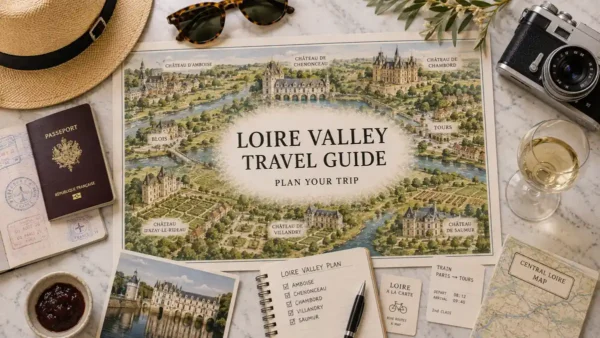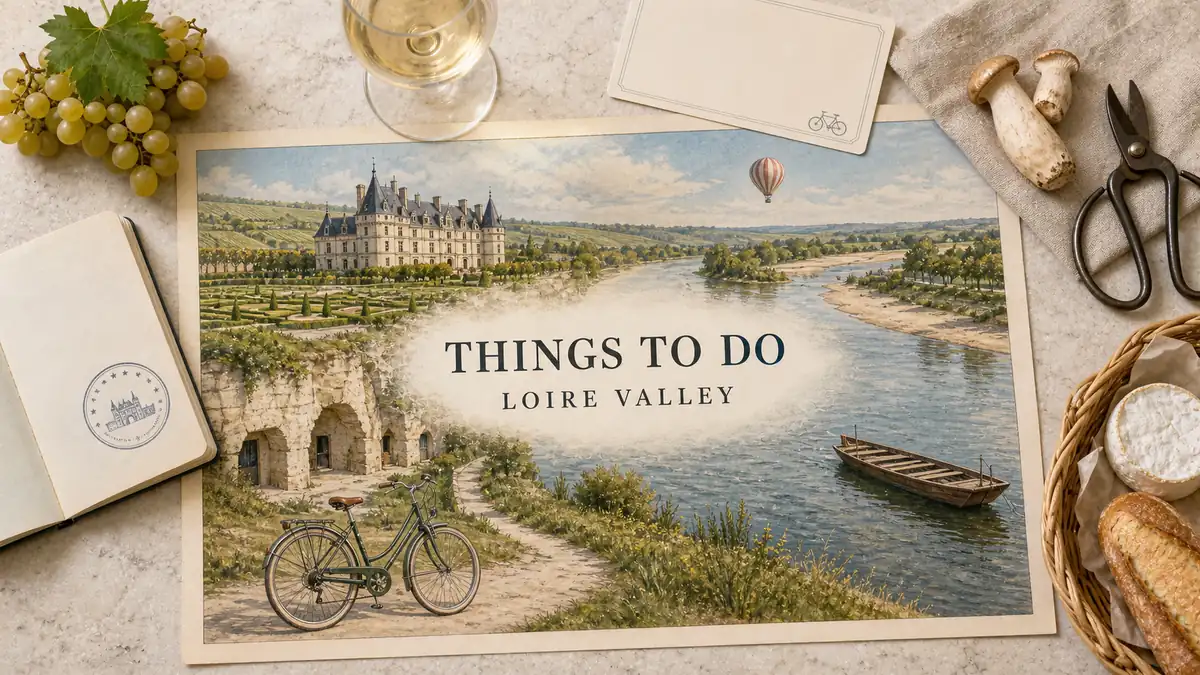
Everyone arrives in the Loire Valley knowing it means châteaux. The harder question is what else the valley holds, and how many grand interiors a short trip can absorb before they blur together. Château fatigue is the region’s classic planning failure: three days of gilded rooms, tapestries and formal staircases, and by the last one nobody is really looking. It happens to careful planners, not lazy ones. The valley’s defence is that it has other identities — wine cellars cut into soft rock, a signposted riverside cycling network, gardens built as design work, market mornings, a wide and unhurried river. This page treats the Loire as a set of distinct experiences and gives each one a verdict: what it is, who it rewards, and the tradeoff attached. Which châteaux to pick is a genuine decision, and it belongs on its own page.
Quick Answer
The Loire Valley rewards a mixed trip: châteaux earn a place in it, but not the whole of it. The real choice is how you split time between château days and the valley’s other identities — cave tastings, cycling, gardens, river time. Anchor the mix to your traveler type, since most Loire experiences are outdoor and weather-bound.
Trust Layer
Tripstou attraction guide for travelers deciding whether an experience is worth doing and how to do it well. Covers value, booking versions, timing, access, and traveler fit.
Produced with AI assistance and reviewed by Alex Perrut, working in tourism since 2015, for the Tripstou editorial team. See our editorial process for details.
Last factual review: August 23, 2026.
Official sources consulted: France.fr, Atout France.
Key Takeaways
- Châteaux belong in a Loire trip but should not fill it; alternating experience types is what prevents château fatigue.
- A troglodyte cave tasting is the valley’s strongest non-château experience, and the one that never needs rescheduling for weather.
- The Loire à Vélo runs 900 signposted kilometres, flat and riverside, which makes a half-day ride workable for non-cyclists.
- Most Loire experiences are outdoor and weather-bound, so the season you travel in changes the available mix more than anything else.
- Book balloon flights and equestrian performances early in the stay; markets, cycling and river boats work as turn-up decisions.
- Families do best when the day stays outdoors and physical; long cellar tastings and guided interiors are where trips unravel.
Table of Contents
Châteaux Are Worth It — but They Shouldn’t Fill Your Trip
Loire châteaux are worth visiting, but they work best as part of a trip, not the whole of it. A few well-chosen visits leave a strong impression. A schedule built entirely around them flattens into one corridor of tapestries and staircases. Château fatigue is the region’s classic planning failure, and the rest of this page is the cure.
The châteaux are unusual as a group, and that is the honest case for them. These are Renaissance pleasure palaces built for display and leisure, set among gardens and river bends, and they read completely differently from the defensive castles most travelers have seen elsewhere in Europe. The novelty is real. The novelty is also what wears out, because the architectural vocabulary starts repeating long before the buildings run out.
Which châteaux to visit, and in what order, is a real decision with real consequences — and it has its own page. Our guide to which Loire castles to visit handles selection, individual merits and pacing. This page assumes you have a shortlist and moves on to everything around it.
What actually spoils a Loire trip is the sameness of the days, and that is a scheduling problem more than a counting one. A château morning followed by a cave tasting, a market or an hour on a bike resets the palate completely; two château afternoons back to back do not. Alternate the type of day and the castles stay impressive to the last one.
It is also worth knowing what the valley does not do. There is no coast, no mountains, no serious nightlife, and no dense city centre that rewards two days of walking. Travelers who want those things should treat the Loire as a short chapter inside a wider French trip and plan the rest of the route around them.
Is a château visit worth your time at all?
Yes for most travelers, and genuinely no for a specific minority. If Renaissance architecture, decorative interiors and formal design leave you cold, the valley’s other experiences are strong enough to carry a trip on their own — there is no obligation to enter a single château to have a good time here. Travelers who love architecture, gardens or French history will get more out of one Loire château than out of a dozen generic old towns, and they should protect that time.
The clearest skip cases are practical. Restless young children, a single compressed day, or low tolerance for guided interiors all point the same way: stay outside. Grounds, gardens, moats and river views often carry the better half of the experience anyway, and they cost you nothing in patience.
Interiors, gardens, guided or evening show: pick your kind of château day
The version of the visit matters more than most people expect, because each one produces a different day. Choose deliberately.
- Interiors, self-guided. Best for travelers who move at their own speed and want the rooms without a script. Tradeoff: with no context, one set of state rooms blurs into the next by the second visit.
- Interiors with a guide or audio narrative. Best for first-timers who want the history to stick. Tradeoff: a fixed pace, and you cover less ground in the same time.
- Grounds and gardens only. Best for families, hot afternoons, and anyone already low on patience for interiors. Tradeoff: you miss the decorative craftsmanship that justifies the ticket for many visitors.
- Evening light-and-sound show. Best for couples and for travelers who have already done a daytime visit and want the building differently. Tradeoff: it is a performance, not a tour, and a late finish costs you the following morning.
Troglodyte Wine Caves Are the Loire’s Second Identity
A tasting in a troglodyte cave is the strongest non-château experience in the Loire Valley. The valley’s soft tuffeau limestone was quarried to build the châteaux, and the tunnels left behind became wine cellars, mushroom farms and homes. Drinking Loire wine inside that rock is the region explaining itself.
This is the experience first-timers most often underrate, usually because it sounds like a generic winery visit. It is not one. The caves are a by-product of the châteaux themselves, which means the wine culture and the castle culture are physically the same story told from two ends — the stone came out of the hill, the wine went back into it. Loire wines also suit tasting rooms unusually well: the range runs from crisp whites to light reds and sparkling styles, so a flight stays drinkable instead of turning into a procession of heavy bottles.
The caves are the valley’s weather insurance. A cellar tasting is identical in driving rain and in a heatwave, which makes it the one Loire experience you never need to reschedule — and the obvious thing to hold in reserve for the day the forecast collapses.
What is a troglodyte cave tasting actually like?
You walk out of daylight into a tunnel cut straight into pale rock, and the temperature drops within a few steps. Cellar conditions underground are cool and constant, which is exactly why the caves were used for storage centuries before anyone used them for tourism. Bring a layer even in high summer; the contrast catches people out.
The setting does most of the work. Bottles sit in side galleries, the acoustics go flat and soft, and the person pouring often works the vineyard as well as the counter. Some caves extend far enough back that the tasting room is only the entrance hall to something much larger. It is a slow, seated, conversational experience, which is precisely why it suits couples and wine-led travelers and does not suit children.
Not every cave visit is the same transaction. A small grower’s cellar puts you in front of the person who made the wine, which is the version wine-led travelers want and the one that rewards a few real questions. A larger house runs scheduled visits with more of the tunnel network open and more explanation built in, which suits first-timers who want to be shown around. Some cave sites are not about wine at all — the same soft rock holds mushroom growing and old troglodyte dwellings — and those visit better with children along.
Market mornings and Loire specialities worth planning around
Market mornings are the cheapest good experience in the valley, and they are worth building a morning around. Loire market towns run their markets in the morning and wind them down early, so this is a plan-ahead item disguised as a spontaneous one. Goat cheeses, rillettes and pork charcuterie, freshwater fish served with butter sauces, cave-grown mushrooms and local sparkling wine are the regional signatures, and they turn up together on one square.
The practical value is that a market morning feeds the rest of the day. A basket assembled before noon becomes lunch on a château lawn, on a riverbank, or at a picnic table halfway along a cycling stretch — which is how the region’s experiences are meant to connect. It also solves eating on a day spent moving between small places with nothing booked.
Treat the towns themselves as texture, not as a checklist — the market is the experience, and the setting is a bonus. If you are still deciding which parts of France deserve your days at all, our roundup of the best places to visit in France is the better place to settle that question.
Cycling the Loire à Vélo, Even If You’re Not a Cyclist
The Loire à Vélo is the region’s best-organised experience, and it works for casual riders. The route runs flat and close to the river for most of its length, which removes the two things that put non-cyclists off: climbing and traffic. You can ride it for an afternoon and stop.
The network is properly built infrastructure, not a suggested line on a map. According to France Vélo Tourisme, the official route covers:
- 900 km of signposted route in total.
- 630 km of linear route, running from Nevers to Saint-Brevin-les-Pins on the Atlantic.
- 270 km of loops and variants branching off the main line.
- The westernmost section of EuroVelo 6, largely flat and riverside for its length.
The signposting is what makes this usable by people who never cycle at home. You do not plan a route, work out junctions, or carry a map — you follow a logo, and you turn around whenever you have had enough. That single design decision is why a half-day here works for travelers who would never book a cycling holiday.
One honest qualification: not all of it is segregated cycle path. Long stretches share quiet country roads with light local traffic, which is a non-issue for adults and a real consideration for young children riding their own bikes. Ask what the specific stretch looks like before you commit a family to it.
How much of it to take on is the actual decision, and it comes in three honest sizes.
- A half-day out and back. Best for travelers who do not cycle at home and want one non-château afternoon. Tradeoff: you never leave the orbit of wherever you started.
- A full day between two riverside towns. Best for couples and confident casual riders who want the landscape to change under them. Tradeoff: it commits the whole day, and getting back to your base needs thinking about first.
- Several days point to point. Best for travelers for whom the ride is the trip and not the transport. Tradeoff: luggage becomes a problem to solve, and a fixed line of travel decides the rest of your days for you.
The fit is broad. Families ride short flat stretches between villages; wine-led travelers link cellars at walking pace; couples use it as the antidote to a château-heavy morning. The tradeoff is simple and non-negotiable: it is entirely weather-bound, and a wet, windy day turns the valley’s best experience into its worst. For getting around the region, where to base yourself and trip-level logistics, use our Loire Valley travel guide.
Balloon Flights and River Boats: The Loire From Above and Afloat
Seeing the valley from the air or from the water beats another ground-level day once the châteaux start repeating. A balloon flight is the region’s signature splurge and suits travelers marking an occasion. A traditional river boat is the slow, low-cost counterpoint, and suits an afternoon with nothing to prove.
Both exist because the Loire reads better at a distance. The valley’s structure — river, sandbanks, vineyards, forest, a château sitting in the middle of it — is hard to perceive from a car park and obvious from the air or from the middle of the water.
Is a hot-air balloon flight over the Loire worth it?
It is worth it for travelers who want one memorable splurge and are relaxed about it not happening. The Loire is one of the better ballooning landscapes in Europe precisely because it is flat, green and studded with landmarks, so the view has content and not just scale. Couples, anniversaries and milestone trips are the natural fit.
The tradeoff is total weather dependence. Flights need calm, stable conditions, and no amount of planning overrides that. Put the flight near the start of your stay, not the last evening. If conditions ground you on day one you still have days left to try again, and that scheduling choice shapes the outcome more than anything else you decide about it.
Three things should stop you booking: a tight budget, unease about heights in an open basket, and a stay too short to absorb a cancellation. None of those is a small objection, and a splurge you talked yourself into rarely repays the money.
What does a boat trip on the Loire actually offer?
A boat trip offers the river itself, which is the thing most Loire trips never actually meet. The Loire is broad, shallow and braided with sandbanks, and traditional flat-bottomed craft are built for exactly that — they sit high on the water and go where a deeper hull cannot. The experience is slow, quiet and largely narrative: the river, its birdlife, its old trading history.
It suits travelers who want an unstructured hour or two, and families who need the day to keep moving without walking. It does not suit anyone expecting a sightseeing cruise past monuments; the pleasure here is landscape and pace. Trips leave from riverside towns and slot into an afternoon without much planning.
Tours and activities
Book skip-the-line tickets, day trips and local tours with free cancellation on most activities.
You can also browse everything on getyourguide.com.
Tripstou may earn a commission if you book through this link, at no extra cost to you.
Loire Valley Gardens Worth Building a Half-Day Around
Gardens reward travelers who like design, slow walking and being outdoors more than they reward sightseers. The valley treats gardens as serious design work — geometric parterres, kitchen gardens planted as pattern, and an international garden festival where show gardens are rebuilt to new designs. Give them a half-day and they hold up.
There are two different experiences here, and they suit different temperaments. Formal French gardens, such as the ornamental and kitchen gardens at Villandry, are about geometry, symmetry and blocks of colour read from above — they reward photographers, gardeners and anyone who enjoys pattern. The contemporary garden festival held at Chaumont-sur-Loire works the opposite way: conceptual, experimental installations by invited designers, closer to an outdoor art show than to horticulture.
Fit is more polarised here than anywhere else on this page. Gardeners, photographers and design-minded travelers can lose a whole morning happily. Travelers who measure a day by sights seen will feel they paid to walk around a lawn. There is no middle verdict, which makes this the easiest experience on the page to decide about honestly.
Rush either one and it collapses into a pleasant walk you will not remember. That is the real risk with gardens: they are almost always attached to a château, which means they get treated as the twenty-minute thing you do on the way out. Gardens deserve their own slot in the day, not the tail end of someone else’s. Book the visit as the day’s main event and the half-day pays back; tack it onto a full interior tour and you dilute both.
Two things change the quality of a garden visit and neither costs anything. The first is light: early and late hours give the planting depth that flat midday sun erases, and formal geometry in particular reads better from a raised terrace or an upper window than from inside the beds. The second is direction of travel — walking a formal garden outward from its highest point shows you the design as it was meant to be seen, while walking it the other way mostly shows you hedges.
Gardens are also the most weather-exposed experience on this page after cycling, and the least rewarding in the cold months, when the structure is visible but the planting is not.
Is the Loire’s Classical Equestrian Show Worth an Evening?
The classical equestrian performance is worth an evening for travelers who enjoy ballet, opera or dressage. It is a display of classical riding — precision, silence, centuries-old figures performed by a national riding academy — closer to dance than to a horse show. Restless children and casual crowds usually find it slow.
The tradition is genuinely serious. The Cadre Noir, based at Saumur, is a national riding school rather than a tourist attraction that happens to use horses, and the performances are demonstrations of a formal discipline with a long institutional history. That is the whole appeal and also the whole limitation: the pleasure lies in noticing how difficult the near-motionless movements are, which is a taste some travelers have and some do not.
What the evening asks of you is attention, and that is worth knowing before you buy. Nothing is explained twice, the movements are small on purpose, and the room is quiet enough that fidgeting is conspicuous. Anyone who likes being told what they are looking at will enjoy it considerably more after reading something about the discipline first. Going in cold, the precision can look like a horse standing still.
Fit is narrow but strong. Equestrians, culture-led travelers and anyone who has enjoyed a classical performance elsewhere will find it a highlight of the trip. Travelers looking for a family evening or a spectacle with pace should choose something else and not feel guilty about it.
Treat it as a booked event, not a drop-in. Performances are limited and popular, so check availability before you fix the rest of your days around it — this is one of the few Loire experiences where turning up on the night is not a workable plan. The academy also opens to the public in more than one way, and the versions are not interchangeable evenings, so confirm what you are actually holding tickets for.
One more thing worth weighing: the venue sits in the valley’s wine country, which makes the show easy to justify on a day you were already spending nearby. Crossing the region for it alone is a bigger commitment than the ticket price suggests.
What Works in the Loire Valley With Kids?
Cycling and the region’s large animal park carry most family days in the Loire Valley. Château grounds, boat trips and open outdoor space work well too, as long as the day stays physical. Long cellar tastings and guided interior tours are where family trips reliably fall apart.
ZooParc de Beauval, in the valley’s southern reaches, is the region’s strongest family draw and a full-day destination in its own right — a large, well-regarded zoo that families routinely build a whole day around instead of slotting it between châteaux. Treat it as its own day, not an afternoon add-on.
Everything else follows one pattern: children do well in the Loire when they are outside and moving. Flat cycling sections, castle grounds with space to run, a boat on the river, a market with food in hand. They do badly when the day involves standing still indoors while an adult explains furniture.
Age changes the answer more than any other variable. Under about six, the region is grounds, animals, water and food, and any interior is borrowed time. Between roughly six and twelve, cycling and the animal park do the heavy lifting, and a château visit lands well if it involves a tower, a moat or a story attached to a person. Teenagers behave like adults with less patience: they will sit through a cellar visit they are not drinking at, and they will be bored by exactly what bores adults.
Cellar tastings are the one experience with no family version, and accepting that beats engineering one. Splitting the group for a couple of hours — one adult underground, one adult outside with the children — costs far less goodwill than walking everyone into a cool, quiet room where nobody young has anything to do.
The workable compromise is to split the day and keep the group together. Adults get one interior visit in the morning, while everyone is still fresh; the afternoon goes outdoors and stays there. For the same experience-selection job at national scale, see our guide to things to do in France.
Best Time of Year for Loire Valley Activities
Season changes what the Loire offers far more than it changes the châteaux. Most of the experiences on this page — cycling, ballooning, boats, gardens, markets — are outdoor and weather-bound, so the available mix narrows sharply in the cold months. The interiors and the caves stay open and comfortable all year.
The warm half of the year is when the valley has its full range: gardens planted and working, the cycling route in use, river craft running, markets busy, evening events on. The cold half strips the page back to châteaux, cellars and food. That is a perfectly good short trip, but a much narrower one — and it is precisely the season in which château fatigue is easiest to catch, because there is less to alternate with.
It helps to know which experiences move with the calendar and which ignore it. Cellars and interiors are indifferent. Gardens swing hardest, going from the point of the trip to a set of bare shapes. Cycling depends less on temperature than on daylight and wind, and river craft and balloon flights simply stop being dependable once conditions turn unsettled.
Shoulder months suit this region unusually well. The gardens are working, the cycling is comfortable without heat, and the châteaux are quiet enough that the interiors stop feeling like a queue. The valley’s outdoor experiences peak before its crowds do, which is not true of most French regions.
Crowds also follow school holidays more closely than they follow the weather, which is why two equally warm weeks can feel completely different. In the busiest stretches the popular experiences stop being same-day decisions and the quiet ones stop being quiet; outside them, the valley absorbs visitors easily.
One honest caveat: deep winter here is quiet. Some outdoor and seasonal experiences pause, small-town life contracts, and daylight is short. Plan a winter Loire trip around interiors, cellars and long lunches and it works well. Plan it around the activity mix described above and it will not.
Frequently Asked Questions
What can you do in the Loire Valley when it rains?
Wet days belong underground and indoors: cave cellars, château interiors, small museums and a long lunch all work in bad weather. Cave tastings are the strongest wet-day option because the experience is identical in rain. Save one cellar visit as your reserve plan and a washed-out day costs you nothing.
Is the Loire Valley worth visiting in winter?
Yes, but as a two- or three-day stop, not a week. Winter shrinks the valley to what happens indoors, and the page’s outdoor half — cycling, gardens, river, ballooning — largely stops working. Choose winter for quiet châteaux and unhurried cellar time; skip it if the outdoor mix is why the region appealed.
Can you visit the Loire Valley as a day trip from Paris?
Yes, though a single day from Paris buys you a château and the journey, and not much more. The travel at both ends eats the flexible hours, so the caves, cycling, gardens and river experiences on this page do not realistically fit. Treat a day trip as a taster, and give the valley an overnight if you can.
Can you do the Loire Valley without a car?
Yes, if you build the trip around the river instead of the road. The signposted Loire à Vélo is the strongest car-free asset in the region, and basing yourself in one riverside town lets you reach cellars, markets and riverbank on two wheels. Château-hopping is where car-free trips get hard.
How many days do you need in the Loire Valley?
Two to four days covers it for most travelers. Two days gives you a château and one other experience; three or four lets the mix on this page actually happen without rushing. If you are fitting the valley into a wider route, our France itinerary ideas handle sequencing and day counts.
Do you need to book Loire Valley activities in advance?
Only a few of them. Balloon flights and the classical equestrian performances genuinely need arranging ahead, and small cellars are easier if you make contact first. Markets, cycling, boat trips and garden visits work as same-day decisions. Book the fixed-time experiences first and let everything else fill in around them.
What are the best museums in the Loire Valley?
The valley’s museum scene is modest, and that is not a criticism — the region’s interest sits in its landscape, cellars and buildings. What exists is mostly small and specific: local craft, regional history, individual collections attached to a town or a house. Treat them as a fallback, not as a reason to build a day around one.
Related Guides
- Loire Valley travel guide — getting there, getting around, where to base yourself and trip-level timing.
- Loire Valley châteaux — which castles to visit, what each one is actually good for, and how to pace them.
- France itinerary ideas — how many days to give each region and how to sequence a route.
- Best places to visit in France — choosing which regions and towns deserve your time.
- Things to do in France — the same experience-selection job at country scale.
Did this guide save you time or money? Tripstou is independent and reader-funded — if you'd like to give something back, you can support the site with a crypto contribution of any size.