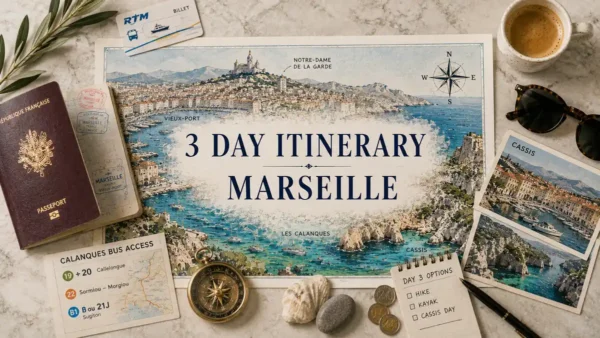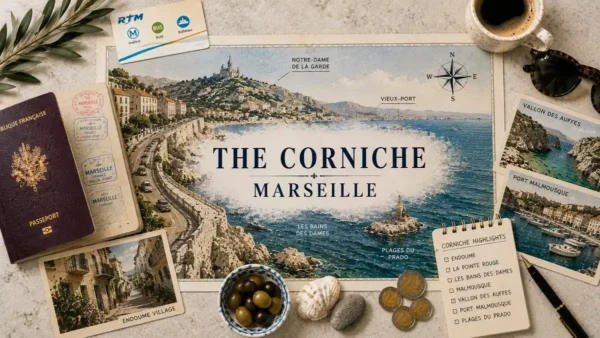
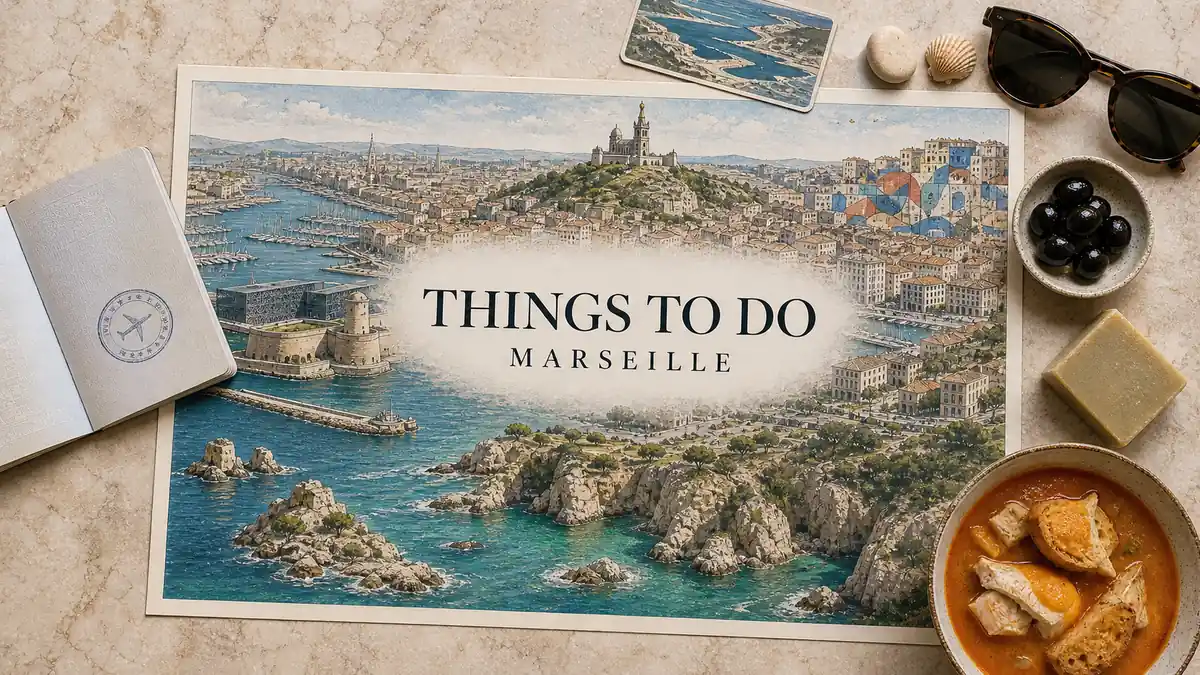
Marseille’s headline experiences are real, but their payoff depends almost entirely on which version you choose. The Calanques repay a proper outing or leave you photographing cliffs through a boat window. Notre-Dame de la Garde delivers the city’s one unmissable panorama, and the Vieux-Port quay serves the meal that disappoints more visitors than any other in the city. The gap between a great Marseille day and a flat one is rarely the list of sights. It is the execution.
This page ranks six experiences by what they actually return, says who should skip each one, and names the padding that fills the longer lists. It covers experiences, not day plans and not a ranking of places to visit — those are separate decisions with their own pages. Decide what Marseille is before deciding what to do in it, and the rest of the choices get easier.
Quick Answer
The Calanques, Notre-Dame de la Garde, and Marseille’s port-side street culture are the city’s highest-payoff experiences. Payoff hinges on version choices — boat or on foot for the Calanques — and on avoiding the tourist-fed quay restaurants. Marseille suits travelers who want a working Mediterranean port city; book capacity-limited experiences well ahead in peak summer.
Trust Layer
Tripstou attraction guide for travelers deciding whether an experience is worth doing and how to do it well. Covers value, booking versions, timing, access, and traveler fit.
Produced with AI assistance and reviewed by Alex Perrut, working in tourism since 2015, for the Tripstou editorial team. See our editorial process for details.
Last factual review: August 23, 2026.
Official sources consulted: France.fr, Atout France.
Key Takeaways
- Marseille’s payoff comes from a working port city, so match your experiences to that reality before booking anything.
- The Calanques are the city’s signature outing, and the boat-versus-foot choice decides whether you swim or only look.
- Peak-summer access to the most famous inlet needs a free advance booking, and fire risk can cancel it outright.
- Notre-Dame de la Garde’s panorama is the fastest way to understand how the city, the hills and the coast fit together.
- Real bouillabaisse is a costly two-service dish, so a bargain price on the Vieux-Port quay signals a substitute.
- Two experiences done properly beat five done at a jog, because every extra stop here costs a transfer.
Table of Contents
Marseille Is Worth Visiting — as a Port City, Not a Postcard
Marseille is worth visiting, provided you come for a working port city instead of a polished Provençal one. It is France’s oldest city and its second largest, and its draws are physical: the Calanques, the harbour, the food, the street art. Expectations, not the sights, decide the payoff.
Marseille is a working, multicultural Mediterranean port that is scruffy in places and makes no attempt to look like postcard Provence. Travelers who arrive expecting lavender-field prettiness feel let down; travelers who arrive expecting a port city get one of the most alive cities in France.
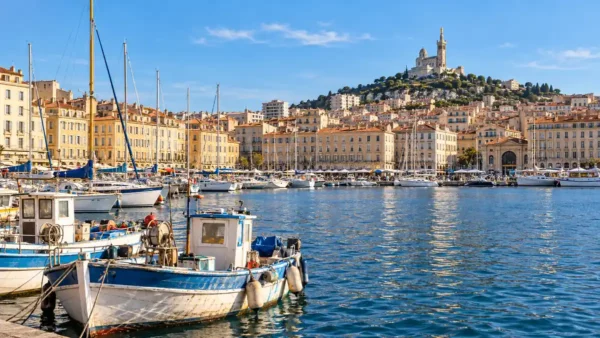
What the city is famous for is unusually concrete. Founded as the Greek colony of Massalia, it is the oldest city in France and the second largest, built around a harbour that is still the organising fact of daily life — the Vieux-Port still holds a morning fish market, sold off the boats. Its limestone inlets, the Calanques, sit inside a national park on the city’s southern edge. Its kitchens produced bouillabaisse. Its walls carry one of the country’s deepest street-art scenes.
Ranking by payoff means ranking by what an experience returns for the hours it costs, not by how often it appears on a list. That single test reorders the standard Marseille roster fast. A basilica reached by a short uphill climb outranks an island fortress that eats a boat crossing in each direction, and a free walk through two street-level quarters outranks most ticketed interiors in the city. Marseille’s best experiences are outdoors and mostly free, while its most heavily marketed ones are indoors and ticketed — an inversion that catches out travelers who plan this city the way they plan Paris.
Payoff here is measured three ways. First, the total time an experience costs door to door, transfers included, in a city whose draws are spread across hills and water. Second, whether it comes in versions that deliver genuinely different things, because picking the wrong version is how a good outing turns flat. Third, whether something else in Marseille already gives you the same thing — the test that quietly demotes the second-best harbour view.
That mix is also why Marseille holds its own among the best places to visit in France without ever competing on prettiness. Orientation, districts and where to sleep are settled in the full Marseille travel guide; this page assumes you have a base and asks only what to do with your time.
Calanques from Marseille: Boat Trip or Hike?
Take the boat to see the coastline in one outing; go on foot if you want to swim. Boat tours leave from the Vieux-Port and pass the inlets from the water. Walking in from the city’s southern edge gets you into one calanque properly, with a swim at the end.
The two versions are not variations on the same day out. They deliver different things, and the choice should follow what you came for:
- Boat from the Vieux-Port. Suits travelers with limited mobility, limited time, or a clear preference for seeing the coast in breadth. You cover a long run of cliff and inlet in one outing and come back with the rest of your day intact. The defining tradeoff: you see the calanques from the water and mostly stay aboard, so that turquoise water stays scenery.
- On foot from the city’s southern edge. Suits travelers who came for the water and can handle a hot, exposed walk over bare rock with no shade and no shops. You finish at the shoreline, swim, and stay as long as you like. The defining tradeoff is breadth for depth — one inlet, done properly, and none of the others.
The photograph that made you want the Calanques was almost certainly taken from the shore, not from a boat deck. Check which of the two experiences you are actually buying before you book anything.
The mismatch that ruins the day is booking on autopilot. Travelers who wanted a swim reserve the sightseeing boat because it is the easier thing to book, then spend the outing watching the water from a deck. Settle one question before you pay — in the sea, or looking at it — and the rest of the decision makes itself.
Access is where plans break. The best-known inlet on the Marseille side, Sugiton, is capacity-controlled in peak summer, and entry then requires a free advance booking made before you set out. Separately, the national park closes the massif outright when fire risk is high, and a closure cancels the walk on the day regardless of any booking you hold. Check the park’s status the morning you go. Boat departures also fill in peak season, so reserve ahead instead of turning up at the quay and hoping.
Worth it for: anyone who wants Marseille’s defining landscape — on foot when the swim is the point, by boat when seeing the whole coastline in one go matters more.
Tours and activities
Book skip-the-line tickets, day trips and local tours with free cancellation on most activities.
You can also browse everything on getyourguide.com.
Tripstou may earn a commission if you book through this link, at no extra cost to you.
Is Notre-Dame de la Garde Worth the Climb?
Yes — it is the one Marseille viewpoint no traveler should skip. The 19th-century neo-Byzantine basilica sits on the city’s highest hill, and the terrace around it delivers a 360-degree panorama over the rooftops, the Frioul islands and the open Mediterranean. Nothing else in the city explains its geography as fast.
The climb is genuine. The basilica sits at the top of a sustained ascent, and the final approach is stairs and slope in full sun, which matters more in high summer than any other condition. Travelers who struggle with gradients should plan the ascent, not improvise it.
Heat is the variable that decides how hard this feels. Outside high summer the ascent is a brisk walk with a reward at the top. In the middle of a hot day the same slope is punishing and the terrace offers little shade to recover in, which is how a climb that looks trivial on a map defeats people who set off at the wrong hour.
Treat the panorama as orientation, not as a photo stop. From the terrace you can see how the limestone ridges box the city in, why everything still orients to the harbour, and how far the coast runs south towards the inlets — and once you have that picture, the rest of your choices stop looking random on a map.
Which is why the common mistake here is arriving, shooting one frame and leaving. The terrace repays a slow circuit, because the view changes character as you walk around it: rooftops and hills on the inland side, islands and open sea on the other. Two minutes at the railing returns a photograph; a proper loop returns the mental map you will use for the rest of the trip.
It is skippable in exactly one case: low cloud or heavy haze. The view is the entire product, and without visibility the climb returns a church interior and little else. Crowds thin at the edges of the day, and the seaward side reads best when the light is low.
Worth it for: every visitor, first-timer or repeat — this is the one stop that makes the rest of the city legible.
Is Château d’If Worth the Boat Trip?
Château d’If is worth it for readers of The Count of Monte Cristo and few others. The island fortress is reachable only by boat from the Vieux-Port, so the visit costs a return crossing plus time on the island. The fortress itself is bare stone; the pull is literary and the harbour view.
The tradeoff is trip time, and it is heavier than it looks. Two crossings and the wait between them turn a modest fortress into one of the longest single commitments on this list, which is why it slides down the ranking despite being Marseille’s most famous individual monument. Dumas built the island’s reputation, not the architecture.
Count the whole commitment before you decide, because the crossing is only part of it. The trip out, the time on the island, the wait for a return sailing and the trip back consume a block of the day that no other experience in Marseille demands, and the fortress is a compact building — it does not expand to fill the block the way a museum quarter or a stretch of coastline would.
Skip it if the novel means nothing to you. Without the Monte Cristo association you are crossing open water to look at empty cells, and the harbour panorama you came away wanting is available from the basilica terrace for the price of a walk uphill. Readers of the book get something no other stop in Marseille can offer — the actual cell the story assigns to Edmond Dantès.
Sailings are the first thing to check. They do not merely enable the visit; they set its shape. Departures leave from the Vieux-Port and depend on sea conditions and on the season’s operating pattern, so a rough day can cancel the crossing outright and a thin schedule can hold you on the island longer than you intended. Confirm departures before you build anything around the island, and reserve ahead when the city is busy.
Worth it for: readers of Dumas, and travelers who want an hour out on the water more than they want another monument.
Is MuCEM Worth Visiting?
Yes — MuCEM is worth visiting for the site as much as the exhibitions. The museum stands at the harbour mouth, linked to Fort Saint-Jean by a high footbridge, and the fort’s ramparts and gardens give you sea, port and old town in one circuit. The walk itself is the draw.
The architecture does the heavy lifting. Crossing the footbridge from the fort to the museum puts you above open water with the harbour on one side and the Mediterranean on the other, and the fort’s terraces hold the best low-level view in the city. That circuit is the part visitors remember.
The collections are a separate decision. MuCEM’s exhibitions deal with Mediterranean civilisations, migration and shared cultural history — substantial material, genuinely rewarding if the subject interests you, flat if it does not. This is the rare museum where the outside outperforms the inside for most travelers.
So the visit splits two ways, and it is worth choosing deliberately:
- Ticketed visit. Suits travelers drawn to the exhibition subject — Mediterranean history, migration, shared culture — and to a museum that argues a case instead of parading objects. The defining tradeoff: the interior takes a real block of your day, and it only pays off if the theme genuinely interests you.
- Outside only. Suits travelers who came for the setting: the fort, the ramparts, the gardens and the footbridges over open water. The defining tradeoff: you get the views and the architecture that made MuCEM famous, and none of the content the building was designed to hold.
What people remember a week later settles it. For most travelers it is the footbridge and the water, not a display case — which is why the outdoor circuit on its own is a legitimate way to do MuCEM, and why the ticket money is better spent on a proper meal when the subject leaves you cold.
Worth it for: anyone who likes architecture, forts and harbour views; the ticket specifically for travelers already interested in Mediterranean history.
Cours Julien Street Art and Noailles Market: Marseille at Street Level
Cours Julien and Noailles are the highest-payoff free experience in Marseille. Cours Julien’s stairs and facades carry decades of layered street art; Noailles, just downhill, is the market district locals call the belly of Marseille. Both suit travelers who prefer atmosphere to sights.
Cours Julien is a quarter, not an installation. Painted stairways, shuttered facades and side streets run into cafés, record shops and terraces, and the work has been accumulating there since Marseille’s street-art movement took hold in the quarter decades ago. Nothing is roped off and nothing is ticketed.
Noailles is a working market, and that is precisely its value. The stalls and shops feed the neighbourhood, not the visitor economy, which is why the produce, the spices, the North African and Comorian groceries and the pace of the aisles feel nothing like a heritage attraction. It is the fastest way to understand that Marseille is a Mediterranean crossroads city and not a French provincial one.
If there is only room for one, split them by what you want from the walk. Cours Julien is the better hour for anyone who likes art, terraces and a quarter that looks lived-in instead of curated. Noailles is the better hour for anyone who reads a city through its food — and it is the one more likely to surprise you.
Street art is the one Marseille attraction that changes between visits. Walls get repainted, so the quarter you walk is never quite the version in the photographs you saved — which is an argument for wandering without a checklist.
Be honest about what this pairing is: atmosphere-led, not sight-led. Travelers who need a monument to stand in front of, or who want a curated route with numbered stops, will come away underwhelmed and wondering what they were supposed to be looking at. Travelers who like reading a city by walking it get the best hours of their trip here, at no cost.
Worth it for: walkers who read cities at street level — this pairing costs nothing and returns more per hour than any ticket in Marseille.
Real Bouillabaisse, Without the Quay Trap
Real bouillabaisse is an expensive, two-service dish, so a bargain price is the warning sign. It is built on several local rockfish and served in two acts: the broth first, then the fish presented whole before it is filleted. A cheap single bowl of fish stew is a different dish wearing the name.
The tell is the service, not the menu. A kitchen doing the dish properly follows the logic the city’s restaurateurs set down in their charter — local rockfish in the pot, the fish shown to the table, broth and fish served as two separate courses, with rouille and croutons alongside. Ask how it comes to the table before you order. Staff at a serious address will describe the two services without hesitating; staff at a tourist address will not know what you are asking.
The substitute version is rarely dishonest about itself, and that is what catches people out. A menu can list a soupe de poisson and a “bouillabaisse” a short step apart, and the second one arrives as a single bowl with a few pieces of fish in it. Nothing was misrepresented. The diner simply assumed the famous dish and the cheap one were the same dish.
Geography explains the rest. The substitute version lives on the Vieux-Port quay because that stretch is fed by cruise arrivals and passing footfall, and a terrace whose customers will never return has no commercial reason to buy expensive rockfish. The failure is an economics problem, not a cooking problem — which is why the same trap reappears on every tourist quay in the Mediterranean.
Ordering it well is straightforward. Choose a restaurant that treats the dish as a speciality instead of one item among forty, expect to give notice, since the fish has to be bought for you, and go hungry — this is a long meal built for sharing, and the second service is the point. If you want something quicker and cheaper, order a soupe de poisson, which is an excellent dish in its own right and honest about what it is.
Worth it for: travelers who want the city’s signature meal and will give it a whole evening; anyone after a quick lunch should order the soup instead.
What to Skip in Marseille — and How to Pick for a Short Visit
Skip anything that exists because the list needed filling — starting with the Vieux-Port quay restaurants. Marseille has roughly six experiences that genuinely repay the time. Past those, the long attraction rosters pad with minor museums and secondary parks, and the padding is where visits go flat.
Three things are worth actively down-ranking:
- The Vieux-Port quay restaurants. The harbour is worth walking; the terraces lining it are the city’s most reliable disappointment, for the reasons set out in the bouillabaisse section above. Walk the quay, photograph the boats, then eat one street back or one quarter uphill — that short move is the highest-return decision on this page.
- The fill items past the core. Soap boutiques presented as museums, minor palaces and secondary parks exist on long lists because forty entries need forty slots. They are pleasant and forgettable, and each one costs you a transfer across a hilly city. Apply one test on the spot: if you cannot say what a visit gives you that nothing else on this page gives you, it is filler.
- Anything you are only doing because a list said so. Most “Marseille disappointed me” verdicts trace back to expectation mismatch — a traveler who wanted the Riviera booked a port city, or a traveler who wanted a compact old-town stroll booked a sprawling harbour metropolis. That is a fit problem, and it is fixable before you arrive.
The picking rule for a short visit is one line: match the experience to the traveler you actually are, rather than to the length of the list. Water people go to the Calanques on foot and accept that the outing belongs to one inlet. Culture people do MuCEM, the fort circuit and the street-level quarters. Readers do Château d’If. Everybody does the basilica, because orientation makes the rest of the trip legible.
Marseille punishes the traveler who tries to do all of it. The sights are strung across hills and water, so each additional item costs a transfer, not just an hour — two experiences done properly beat five done at a jog.
Sequencing is a separate decision, and it is the one most affected by how long you have: the 2-day Marseille itinerary shows how the core compresses, and the 3-day Marseille itinerary shows what a proper Calanques outing does to the shape of a trip. If Marseille is one stop in a wider French route, our guide to the best things to do in France puts these experiences in national context.
Frequently Asked Questions
What is there to do in Le Panier?
Walk it. Le Panier is Marseille’s oldest quarter, a hillside tangle of narrow lanes, stairways and small squares above the harbour, and the payoff is wandering without a plan. No headline monument anchors it, which is exactly why an unhurried hour there beats working through a checklist of sights.
Where are the best sea-level views in Marseille?
The Corniche and Vallon des Auffes. The coastal road running south of the Vieux-Port puts the open Mediterranean at eye level, and Vallon des Auffes — a tiny fishing harbour tucked beneath a bridge — is the picture most visitors miss entirely. For the panoramic version instead, climb to Notre-Dame de la Garde.
Can you swim in the Calanques near Marseille?
Yes, if you reach a calanque on foot. The inlets have shoreline you can swim from, limestone and pebble underfoot, not beach sand, and that is the whole argument for walking in from the city’s southern edge. Sightseeing boats pass the calanques from the water, so a boat trip buys the view, not the swim.
What should you buy in Marseille?
Savon de Marseille — the city’s signature product and the souvenir with a genuine local claim. The traditional soap is sold in cut blocks and bars across the city, and a specialist shop is a better place to buy it than a quay stall aimed at cruise arrivals. Choose the plain version over perfumed gift boxes.
Is the Cours Julien street art free to see?
Yes. Cours Julien is an open quarter, not an attraction with a gate, so the murals, painted stairways and shutters cost nothing and need no booking. Guided street-art walks exist if you want the context — who painted what, and why the quarter became the city’s canvas — but the walls themselves are always open.
Can you walk up to Notre-Dame de la Garde?
Yes. The whole ascent is walkable from the harbour area, and it is one sustained climb instead of a series of short ones. Travelers who struggle with gradients or heat do better riding up and walking back down — the descent is the pleasant half, and the view comes with it the whole way.
Related Guides
- Marseille Travel Guide — orientation, districts and where to stay, plus how the city fits a wider trip.
- 2 Days in Marseille — how the core experiences compress into a short visit.
- 3 Days in Marseille — the version with room for a full Calanques outing.
- Things to Do in France — the national picture, and where Marseille’s experiences rank within it.
- Best Places to Visit in France — choosing which French destinations earn a place on your route.
Did this guide save you time or money? Tripstou is independent and reader-funded — if you'd like to give something back, you can support the site with a crypto contribution of any size.