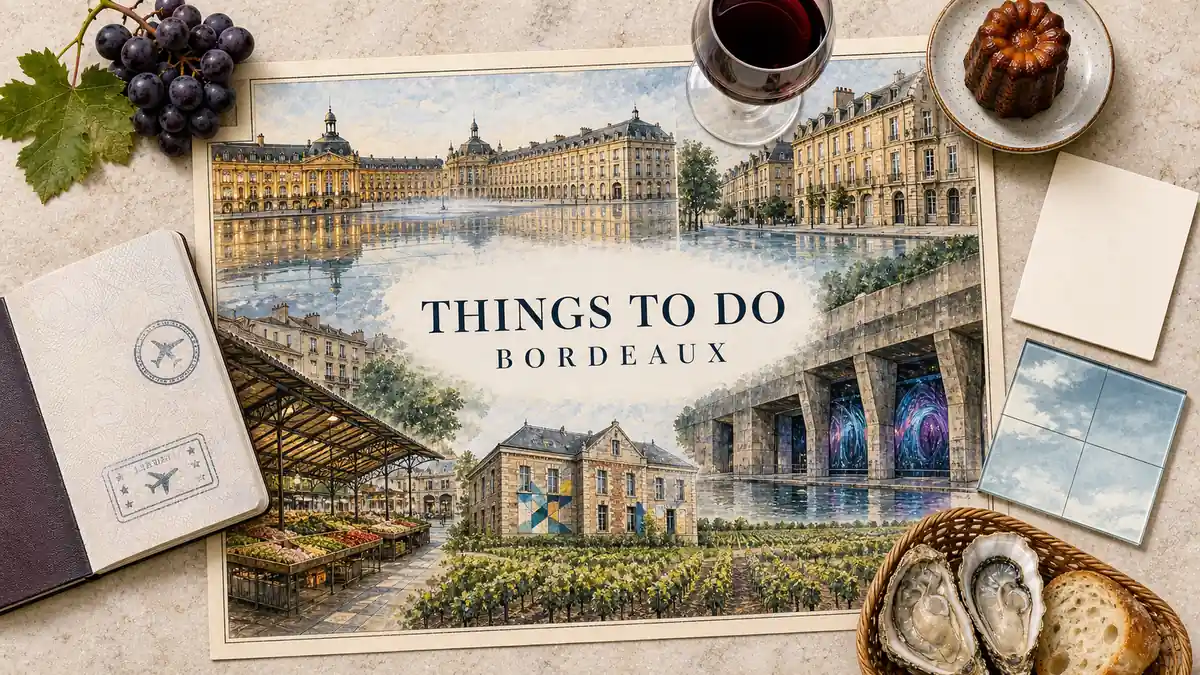
Every Bordeaux list calls everything a must-see. That is the problem this page fixes. Bordeaux has a genuine top tier — a UNESCO golden-stone waterfront, a wine scene you can drink your way through on foot, and a light show inside a submarine base — and a long tail of attractions that fill listicles without earning your afternoon. The gap between those two groups is wide once you rank by payoff for a first visit.
One structural question sits underneath the whole trip: how much of the Bordeaux wine payoff lives inside the city, and how much requires a day out among the vines. Most lists dodge it. This page answers it, ranks the rest by what each experience actually returns for the time it costs, and names the things worth skipping — including the free version to do instead.
Quick Answer
Bordeaux rewards a short list: the golden-stone riverfront, in-city wine experiences, and the submarine-base light show. Most of the wine payoff is available inside the city, so the vineyard day out is optional. Book a tasting workshop ahead in high season and walk everything else — the historic centre is compact.
Trust Layer
Tripstou attraction guide for travelers deciding whether an experience is worth doing and how to do it well. Covers value, booking versions, timing, access, and traveler fit.
Produced with AI assistance and reviewed by Alex Perrut, working in tourism since 2015, for the Tripstou editorial team. See our editorial process for details.
Last factual review: August 23, 2026.
Official sources consulted: France.fr, Atout France.
Key Takeaways
- Bordeaux’s highest-payoff experience is free: the golden-stone riverfront and the Miroir d’Eau outrank every ticketed attraction in the city.
- Most of Bordeaux’s wine payoff sits inside the city, so a vineyard day out stays optional, not obligatory.
- Go out to the vineyards for the landscape and the cellars, never because you think the city cannot pour.
- Reserve tasting workshops and peak Bassins des Lumières slots ahead in summer; the city’s wine bars stay walk-in territory.
- Skip Rue Sainte-Catherine as a destination — it is a high street, and the UNESCO centre walks far better.
- Bordeaux suits travelers who like walking, architecture and wine; anyone needing a headline monument should route elsewhere.
Table of Contents
The Best Things to Do in Bordeaux, Ranked by Payoff
Three experiences carry a first visit to Bordeaux: the golden-stone riverfront walk, in-city wine tasting, and the Bassins des Lumières. Everything else is optional, and some of it is filler. The ranking criterion on this page is payoff per hour spent, judged for a first visit.
Bordeaux is best known as a wine capital, and that reputation is only half the story. The city’s other claim is architectural: an 18th-century golden-stone waterfront curving along the Garonne, with the historic centre inscribed as a UNESCO World Heritage site. The two overlap. The wine trade built the quays, the merchant houses and the neoclassical façades that now make the walk worth taking.
Payoff per hour works as the criterion here because Bordeaux is compact and most people come for a short stay. An experience earns a place near the top when it gives you something you cannot get elsewhere in France, and gives it quickly. That test lifts the riverfront and drops the shopping street. In the national picture, Bordeaux earns its place as a city break with an unusually high floor — the best things to do in France shows where it sits among the country’s bigger draws.
The list sorts into three tiers. The top tier is worth doing on a first visit whoever you are, because none of it is available in the same form anywhere else: the waterfront, in-city wine, the submarine base. The middle tier earns its place when it matches you — the covered market for food-led travelers, Chartrons and Darwin for people who enjoy a city’s working districts. The bottom tier is the filler that every competing list still prints as a must-see.
Two traveler types move items between those tiers. Non-drinkers can lift the entire wine block out and still fill a stay, because the architecture, the market and the districts carry the city without it. Repeat visitors invert the order: they have already walked the waterfront twice, so the districts and the vineyard day rise to the top by default. Both cases are handled section by section below.
Bordeaux’s top tier is unusual in one way: the highest-payoff thing to do costs nothing and takes an afternoon, while the most heavily marketed experiences all charge admission. Ranking by ticket price would invert this list entirely.
Ranked by payoff for a first visit — what each experience returns for the hours it costs.
| The experience | Who it suits | Payoff verdict |
|---|---|---|
| Walking the riverfront and the Miroir d’Eau | Every first-time visitor, in almost any weather | Top of the ranking, and it costs nothing |
| Tasting wine inside the city centre | Curious drinkers travelling without a car | High payoff; reserve workshops ahead in summer |
| Bassins des Lumières in the submarine base | Art-curious travelers and wet afternoons | Worth it; the venue does most of the work |
| Grazing through Marché des Capucins | Food-led travelers who can manage a morning | High payoff for a small time investment |
| A vineyard half-day out to Saint-Émilion | Travelers with a spare half-day to give it | Optional; the city already covers the wine |
| Rue Sainte-Catherine as a shopping destination | Dedicated shoppers, and almost nobody else | Skip it as a plan; walk it in passing |
Taste Bordeaux Without Leaving the City
You can drink Bordeaux properly without booking a vineyard tour. The city holds a complete wine experience: a public tasting bar run by the region’s wine board, structured tasting workshops, and a dense wine-bar scene, all reachable on foot from the historic centre.
Le Bar à Vin sits inside the Maison du Vin, the 18th-century home of the CIVB, the regional wine council. It is a working bar in a grand room, and it is the lowest-friction way to taste Bordeaux by the glass. No tour, no reservation ritual, no minimum commitment.
The choice between the in-city wine versions comes down to what you want out of the hour:
- A tasting workshop at the École du Vin — best for travelers who want the region explained while they drink it. Sessions range from a couple of hours to a full day. The tradeoff is scheduling: you are committing a fixed block of a short trip, and the popular sessions fill up in high season.
- A seat at Le Bar à Vin — best for travelers who want to taste widely with zero planning. The tradeoff is that nobody is teaching you. You learn by ordering, and by asking the person pouring.
- A wine-bar crawl through the centre and Chartrons — best for evening drinkers and repeat visitors who already know what they like. The tradeoff is inconsistency: quality swings from bar to bar, and you spend part of the evening finding that out.
Booking behaves differently across the three. Reserve workshops ahead in summer, when demand is highest and sessions are limited. The bars stay walk-in territory through the year, though an early evening seat is far easier to get than a peak one.
The workshop and the bar seat are not two versions of the same thing. One teaches you what you are drinking; the other lets you drink more of it. Travelers who do both in a single trip come away understanding Bordeaux better than travelers who double down on either.
Is La Cité du Vin Worth It?
La Cité du Vin is worth it if you want wine as a global subject. The riverfront museum covers winemaking cultures worldwide rather than Bordeaux alone, through immersive, screen-led exhibits. It suits curious non-experts, families and rainy afternoons. Skip it if you came to taste — the tasting bars and workshops deliver more wine for the same hours.
The building itself is part of the appeal: a swirling glass-and-aluminium landmark on the Garonne, some distance north of the historic centre. Treat the walk or tram ride out there as part of the time cost when you decide. Wine specialists tend to find the content broad; people who know nothing about wine tend to find it the best introduction in the city.
Should You Leave the City for the Vineyards?
No, a vineyard trip is not obligatory in Bordeaux, and short trips are usually better without one. The day out buys landscape, cellars and village atmosphere — things the city cannot show you. It earns its half-day when you have time to spare and want the setting as much as the wine.
Three versions of the vineyard day out cover almost everyone who goes:
- A guided half-day tour — best for travelers without a car who want a couple of estate visits and someone else driving. The tradeoff is pace: you see the vines and the cellars, and you rarely see a village properly.
- A guided full-day tour — best for travelers who want the wine day to be the whole day, with lunch and more cellar visits built in. The tradeoff is arithmetic: a full day is a large share of a short city trip, and the city keeps offering things while you are away.
- The independent train to Saint-Émilion — best for confident, unhurried travelers who prefer wandering to being shepherded. Saint-Émilion sits at the end of a direct line, close enough to work as a half-day: a UNESCO village of limestone lanes above a monolithic church carved down into the rock, with old quarries running underneath it. The tradeoff is self-organisation — you arrange your own tastings, and the village itself is the main experience.
Whether a vineyard half-day fits at all depends on what else you are trying to do, and the 2-day Bordeaux itinerary is where that sequencing question gets resolved. Bordeaux also sits within reach of Arcachon and the Dune du Pilat, which belong to a coastal day out of their own — see the best places to visit in France for how they compare with other French destinations.
The vineyard day sells you scenery, and scenery is a real reason to go. Scenery is not, however, an upgrade to the glass: the same bottles are open back in the city, poured by people whose job is explaining them. Decide on the landscape, not the wine.
Tours and activities
Book skip-the-line tickets, day trips and local tours with free cancellation on most activities.
You can also browse everything on getyourguide.com.
Tripstou may earn a commission if you book through this link, at no extra cost to you.
Walk the Riverfront from Place de la Bourse to the Miroir d’Eau
The riverfront walk is Bordeaux’s highest-payoff experience, and it costs nothing. Place de la Bourse anchors a curved 18th-century golden-stone façade along the Garonne, with the Miroir d’Eau — the world’s largest reflecting pool — laid out in front of it inside the UNESCO historic centre.
The pool runs on a cycle. A thin film of water turns the square into a mirror of the façade behind it, then a mist rises and blanks the whole thing out, then it drains and starts again. Watching one full cycle is the point. Children run through the mist, photographers wait for the still moment between phases, and the square rearranges itself every few minutes.
The same three mistakes recur on this walk, and all of them are avoidable. The first is treating the Miroir d’Eau as a photo stop and leaving before the cycle turns, which is like walking away from a fountain before it plays. The second is arriving in the middle of a summer afternoon, when the square is at its most crowded and the light is at its flattest. The third is stopping at Place de la Bourse itself, though the golden-stone frontage and the quays carry on well past it.
The mirror is not always running, and the walk survives that. When the pool is off, the façade, the quays and the river light carry the experience on their own. The promenade along the Garonne runs past the whole golden-stone frontage with no ticket, no queue and no fixed schedule, which is what makes it the one thing to do first.
Do the walk twice if the trip allows it. Daylight is for the stone and the colour of the façades; after dark, the buildings are lit and the water goes black, and the same few hundred metres read completely differently.
This walk suits almost everyone, which is rare, and it has one honest limit: it is a looking experience, not a doing one. Travelers who need an activity attached to a place will find an hour on the quays thin, and they get more out of pairing the walk with the covered market or with the districts across the river than out of stretching it.
Bordeaux’s best hour is free and unbookable, which is exactly why competing lists bury it under ticketed attractions. Things with a price attached are easier to sell than a walk.
Are the Bassins des Lumières Worth Visiting?
Yes, the Bassins des Lumières is worth visiting, largely because of where it is. Immersive digital art is projected across the concrete pens of a WWII submarine base, billed as the world’s largest digital art centre. The venue carries the experience even when the programme leaves you cold.
The submarine base is the reason to go. It is a vast, cold, half-flooded bunker, and projecting a painter’s work across water and towering concrete walls does something no gallery can. The reflections double every image. Sound fills the pens. Most visitors remember the building longer than the show inside it.
Watch it the way the format wants. Pick a spot, sit down, and let a full loop run from start to finish. The common failure is treating the pens like gallery rooms and walking a quick lap, which turns an immersive show into a corridor of moving wallpaper. The reflections and the sound only land once you stop moving.
Fit is easy to call here. Travelers who want atmosphere, families with children who respond to scale and noise, and anyone caught out by weather all get their hours back. Art specialists who want brushwork, provenance and wall text will not, because reproduction at scale is the entire premise. Neither group is wrong about the venue — they want different things from it.
Skip it if you dislike crowds in dark rooms, or if you want to stand in front of original works. Nothing here is an original, and the format rewards atmosphere over scholarship. Travelers who find immersive projection shows gimmicky elsewhere will find this one gimmicky too, and the architecture does not change that verdict.
Reserve a slot ahead for weekends, holidays and wet afternoons, when everyone else in Bordeaux has the same idea. Quieter weekday slots give you room to sit and watch a full loop, which is how the show is meant to be taken.
The programme rotates; the submarine base does not. Judge the visit on the building and the exhibition becomes a bonus, which is the only framing that survives a change of season.
Eat Your Way Through Marché des Capucins
Marché des Capucins is where Bordeaux’s food payoff is concentrated. The city’s principal covered market is a grazing venue as much as a shopping one — oyster counters with a glass of white, market-stall lunches, and canelés, the local caramelised sweet, sold across the centre.
Treat it as a meal, not an errand. Buy a plate at one counter, a glass at another, and eat standing up with everyone else. The oyster bars are the anchor: the Arcachon beds are close by, and a dozen oysters with dry white at a market counter is the most Bordeaux thing available before noon.
The order of operations matters more than the choice. Walk the whole hall once before buying anything, because the first counter you see is rarely the one you would have picked, and the plates arrive faster than the decisions do. Then commit — one plate, one glass, standing — and go back for a second only if the first earned it.
The oyster counter is the headline, not the requirement. A covered food market gives non-oyster eaters plenty to graze on, and the canelé is sold right across the centre anyway, so nobody has to build a morning around shellfish to get the point of the place.
Go in the morning. Markets everywhere are best when the stalls are full and the traders still care, and Capucins loses energy as the day wears on. Confirm the market’s trading days before you build a morning around it, since it does not keep the same rhythm as a shop.
Two habits account for most disappointing market visits. One is arriving with a restaurant table already booked for later, which leaves you nibbling at the best food of the day. The other is turning up in the afternoon on the assumption that a market keeps shop hours, and finding the energy that made it worth visiting has already gone home.
Bordeaux’s food reputation runs through its wine, and that quietly misleads people into planning dinners and ignoring lunch. A standing plate at Capucins outperforms most of what the city serves at a table, for a fraction of the time and none of the booking.
Explore Chartrons and Darwin, Bordeaux’s Other Character
Chartrons and Darwin show the Bordeaux that the golden-stone postcard leaves out. Chartrons is the old wine-merchant quarter — antique dealers, quayside warehouses and slow café mornings. Darwin is a converted military barracks across the river, now workshops, street art, a skatepark and an alternative crowd.
Chartrons is a walking experience with a browsing rhythm. The merchants who built Bordeaux’s wine trade worked these quays, and the district kept their scale: low warehouse frontages, a long street of antique shops, a market mood that lingers mid-week. Go without a target. The payoff is the drift, and an unhurried hour returns more here than any checklist would.
Darwin is the opposite kind of visit. It occupies the shell of the Caserne Niel on the right bank and runs on reuse — co-working spaces, an organic canteen, a bike culture, and some of the biggest street-art walls in the city. Families use the skatepark; travelers use the graffiti. It is scruffy on purpose, and anyone who wants polish will not enjoy it.
If only one of them fits, choose on mood. Chartrons rewards people who like browsing, quiet streets and a slow coffee. Darwin rewards people who like noise, reuse and a city still visibly being rebuilt. Doing both on the same day is the stronger play, because the contrast is the payoff and neither district takes long on its own.
Each district has its own way of going wrong. In Chartrons it is arriving with a list, since there is no single sight to tick and the pleasure is entirely in the drift. At Darwin it is expecting a curated attraction; it is a working site with a public edge, and travelers who read scruffiness as neglect will spend the whole visit unimpressed.
Crossing the river is the cheapest way to change your impression of Bordeaux. The left bank sells you an 18th-century city; the right bank shows you the one people live in now, and seeing both in a day is what stops the trip feeling like a museum visit.
Skip These — and Do the Free Version Instead
Rue Sainte-Catherine is the skip. One of Europe’s longest pedestrian streets sounds like an attraction and functions as a high street — the same chains you have at home, laid end to end. Walk it in passing. Do not build an afternoon around it, because the shopping is ordinary and the crowd is dense.
The test that sorts a Bordeaux list is simple: would you still do it if it were the only thing you did that afternoon? Rue Sainte-Catherine fails that test. The riverfront passes it without charging you anything.
A skip on this page means one specific thing — the experience does not earn dedicated time. It does not mean the place is bad, and it does not mean you will never set foot there. Rue Sainte-Catherine is a perfectly good way to cross the centre on your way somewhere better. The afternoon is the mistake, not the street.
- Skip Rue Sainte-Catherine as a destination. Do instead: the UNESCO historic centre on foot. You get the same walking, through streets genuinely worth looking at, with no crowd funnel, no chain frontages and far better photographs. The street still works as a route between two places; it just does not work as one of them.
- Skip the vineyard day out on a very short stay. Do instead: a tasting workshop or a bar seat in the city, which returns most of the wine payoff without surrendering half your trip to a coach. The vineyards are a scenery decision, and scenery is a poor trade when the hours are scarce.
- Skip paying to get above Bordeaux. Do instead: the Miroir d’Eau cycle and the quays at dusk. The golden-stone frontage was built to be read from the quay, and that is still where it looks best — a paid vantage point charges you for distance from the thing you came to see.
Free Bordeaux is unusually strong, and that is the real answer to what to do here on no budget. The riverfront and the Miroir d’Eau, the UNESCO centre on foot, the Garonne quays after dark, Darwin’s street-art walls and a browse through Chartrons together fill more than a day without a single ticket.
None of that free set needs booking, which is why it absorbs a change of plan better than anything with a ticket attached. Weather turns, a workshop is full, a morning runs late — the free list is still there, and it is still the best thing on the page.
Is Bordeaux Worth Visiting?
Bordeaux is worth visiting, and it pays off fastest for travelers who like wine, architecture and walking. The historic centre is compact, the top experiences sit close together, and the wine access is unmatched by any other French city. It rewards a short, unhurried trip more than an ambitious one.
Route elsewhere if you want blockbuster sights or coastline. Bordeaux has no Louvre, no Riviera, no monument that stops traffic on its own. What it has is a consistently high floor: the walking is good everywhere, the eating is good almost everywhere, and the wine is good in places that do not look like they should be.
Most travelers land in one of three verdicts. People who like walking a city and drinking well get more out of Bordeaux than out of destinations twice its size. People who travel for food, markets and districts get a solid trip with the wine as a bonus they are free to decline. People building a holiday around headline sights get a pleasant stop and a persistent feeling that the main event is somewhere else.
The compactness is the underrated part. Bordeaux’s strongest experiences sit close enough together that several of them fall inside one unhurried walk, with no transport decisions attached, which is why the city forgives an unplanned trip. Destinations built around one great sight punish you for arriving without a plan. This one does not.
By the payoff criterion this page runs on, Bordeaux scores well because its strongest experiences are cheap, close and repeatable. That is a rare combination. Travelers who need a headline monument to justify a stop will feel its absence, and they are the ones who should spend those days somewhere else.
Where to stay, how to get around, when to go and what the trip costs all sit in the full Bordeaux guide. If your stay stretches long enough that these experiences need shaping into days, the 3-day Bordeaux itinerary does that work.
Frequently Asked Questions
What can you do in Bordeaux when it rains?
Bordeaux handles rain unusually well. The submarine-base art venue, the wine museum on the riverfront, the covered market and the city’s wine bars are all indoor experiences with real payoff. Book the popular light-show slots ahead on wet days, when every other visitor in the city has exactly the same instinct.
Is Bordeaux worth visiting with kids?
Yes, for families who enjoy walking cities. The Miroir d’Eau’s mist cycle is a playground children use without being told, the riverfront is flat and open, and Darwin has a skatepark. Bordeaux offers no theme-park attraction, so it suits curious children more than restless ones.
Is a Garonne river cruise worth it?
Only if you want the golden-stone frontage seen from the water, which is a genuinely different view of it. As an experience it is slower and more passive than the quayside walk, and it costs money the walk does not. Take the cruise as a second look, never as your first.
Do you need to book Bordeaux wine tastings in advance?
Structured workshops, yes — reserve those before you travel in high season, since sessions are limited and the popular ones fill first. Wine bars need nothing: walk in, and take an early evening seat for a real choice of table. Arriving unbooked in summer costs you the workshop, not the wine.
Can you enjoy Bordeaux if you don’t drink wine?
Yes. Take the wine out and Bordeaux still holds a UNESCO golden-stone waterfront, the Miroir d’Eau, a digital-art venue inside a submarine base, a covered market built for grazing, and two districts with completely different characters. Non-drinkers lose one category of experience, not the trip.
Related Guides
- Bordeaux travel guide — where to stay, getting around, when to go and what the city costs.
- 2-day Bordeaux itinerary — how these experiences fit into a short weekend stay.
- 3-day Bordeaux itinerary — the longer shape, with room for a half-day outside the city.
- Best things to do in France — where Bordeaux’s experiences sit in the national picture.
- Best places to visit in France — the destination-level ranking, including Arcachon and the southwest.
Did this guide save you time or money? Tripstou is independent and reader-funded — if you'd like to give something back, you can support the site with a crypto contribution of any size.