
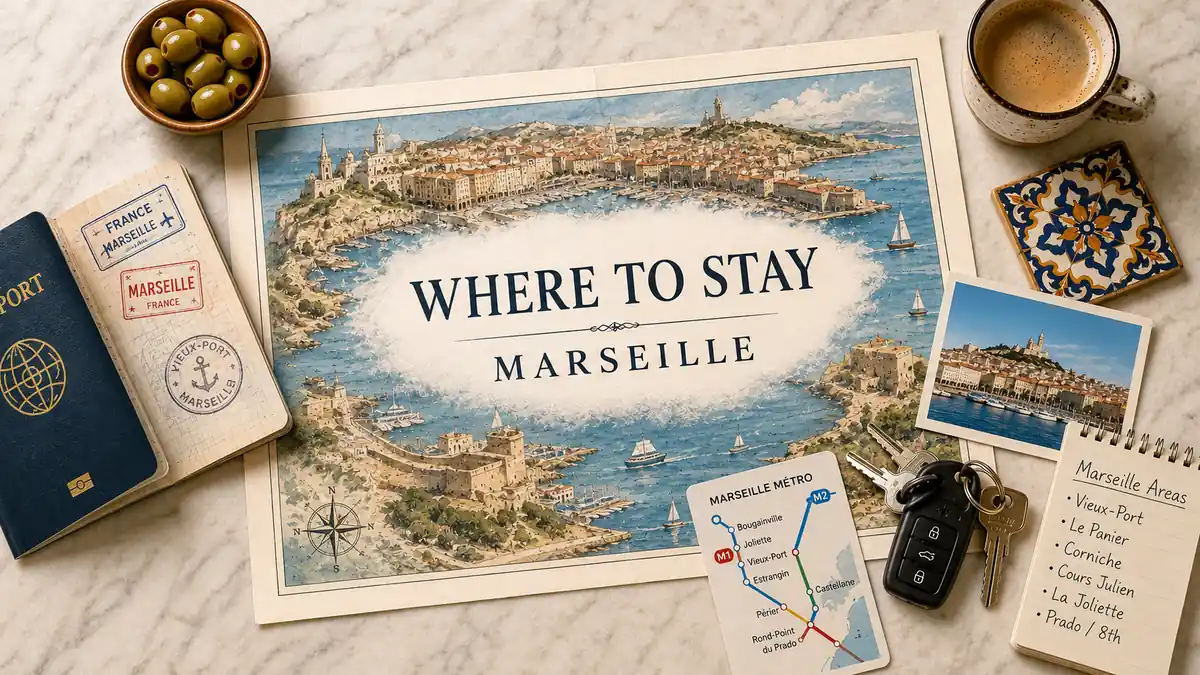
Choosing the wrong base in Marseille costs you more than a few minutes’ walk. The city climbs steeply off the water, spreads far along the coast, and changes character from one street to the next, so two addresses that look equally central on a map can produce completely different trips. The real decision runs along four lines: harbour level, the hill above it, the coast road heading south, and the redeveloped port district north. Each answers a different priority — walking convenience, atmosphere, calm and sea air, or newer rooms at a kinder price. This guide gives the verdict first, then the criteria that decide it: walk time to the core, terrain, evening noise, and transport dependency. Six areas follow at equal depth, along with the booking-side safety question and a route to the guide that matches your traveler type.
Quick Answer
The Vieux-Port is the best base in Marseille for most visitors: flat, walkable, and where transport and boat departures converge. The tradeoff is evening noise on the quays, so booking one street back buys a quieter night. The strongest alternative is the Corniche, calmer and sea-facing, if you accept bus-only access.
Trust Layer
Tripstou stay guide for travelers choosing where to base. Covers area atmosphere, budget, convenience, noise, and traveler fit.
Produced with AI assistance and reviewed by Alex Perrut, working in tourism since 2015, for the Tripstou editorial team. See our editorial process for details.
Last factual review: August 14, 2026.
Official sources consulted: France.fr, Atout France.
Key Takeaways
- The Vieux-Port is the best base for most Marseille visitors: harbour level, walkable to nearly everything, and where transport converges.
- Atmosphere and convenience pull in opposite directions here — the hill quarters deliver character, harbour level delivers effortless days.
- A bed three streets uphill quietly shrinks a short trip, because every return from dinner becomes a climb.
- The Corniche and the 7th arrondissement are bus territory — no metro line reaches them, so factor a commute in.
- La Joliette and the Cours Julien side of the hill sit at the kinder end of central Marseille’s scale.
- Booking by photo is the classic mistake — the best harbour views come from the rooms highest above it.
Table of Contents
How Marseille’s Geography Decides Where You Should Book
Marseille climbs steeply off the water, and where you sleep relative to harbour level shapes every evening of the trip. For a booker the city works in four bands: harbour level, the hill above it, the coast road south, and the modern port north. Altitude matters here as much as distance.
The arrondissement numbers do most of the orientation work for you. The Vieux-Port sits in the 1st, with Le Panier and La Joliette in the 2nd, Cours Julien and Notre-Dame-du-Mont in the 6th, Endoume and the Corniche in the 7th, and Prado and Pointe Rouge in the 8th. Read an address by its number before you read its photos.
Altitude is the criterion listing sites never show you. Marseille rises off the harbour in real gradients, and a room three streets uphill turns every return from dinner into a climb. Over a short trip that penalty compounds: you stop going back to drop bags, you take fewer breaks, and the base quietly shrinks the day. Photos flatten hills. Street view does not.
Marseille is genuinely walkable from a central base, as long as that base is at harbour level. The old town, the main shopping streets, the Opéra quarter and the boat departures all sit within an easy flat walk of the Vieux-Port. The hills, the coast road and the beaches do not — those are transport, not walking. If you want the wider picture of what each part of the city is for before you choose, the Marseille travel guide covers it.
Four criteria decide the choice, and they are the ones to carry onto a listing page: walk time to the core, terrain between you and the water, evening noise on your street, and how dependent you would be on buses or the metro. Every area below is judged on those four.
| Area (arrondissement) | How it feels day to day | Walk to the core | Transport dependency | Relative price |
|---|---|---|---|---|
| Vieux-Port and the 1st arrondissement | Busy harbour front, terraces and boat traffic | You are already standing in the core | Low — walkable, and the metro reaches it | The expensive end of the central scale |
| Le Panier, the old town hill | Narrow lanes, stairs, quiet residential corners | Minutes on foot, all of it uphill | Low, though arriving with luggage is harder | Mid-scale for a very central address |
| Corniche and Endoume, the 7th | Sea-facing, residential, low evening footfall | Too far to walk there comfortably | High — bus territory, no metro nearby | Mid to high, driven by the view |
| Cours Julien and Notre-Dame-du-Mont | Cafés, street art, animated late evenings | A short walk down, a climb back | Low — walking and the metro both work | Kinder than anything on the harbour |
| La Joliette, the modern port district | New build, flat ground, quiet after work | A flat walk or a quick ride in | Low — well connected back to the centre | The budget end of central Marseille |
| Prado and the 8th arrondissement | Beaches, parks, wide residential avenues | A commute rather than a walk | Moderate — metro axis, then local buses | Mid-scale, with more space per room |
One base is enough for a short Marseille trip. Two to three days do not justify moving hotels, because a single well-placed room at harbour level covers the whole visitable core. How the days themselves sequence belongs elsewhere — the 2 days in Marseille itinerary and the 3 days in Marseille itinerary handle pacing and route order.
Booking by photo is what goes wrong here. A harbour view in the picture usually means a climb in the legs, because the rooms with the best view are the ones sitting highest above it — check the address on a terrain map before you check the gallery.
The Vieux-Port Is the Best Overall Area to Stay in Marseille
The Vieux-Port is the best base for most visitors to Marseille: flat, walkable, and centrally connected. It is where the city’s transport lines and boat departures converge, which means the fewest transfers and the shortest walks of any area on this page. Convenience is the whole argument.
The 1st arrondissement is the address band to look for, along with the Opéra quarter immediately behind it. Both sit at harbour level, which removes the terrain penalty completely — arrivals with luggage, midday breaks and late returns all stay effortless.
Noise here is a street-level question, not a district one. The quays run late: terraces stay busy, cleaning starts early, and scooters use the waterfront as a through route. One block back from the water the same neighbourhood is markedly quieter. Filter your shortlist by the street, not by the district name. The quays and the streets directly behind them are effectively two different stays at the same address quality, and the price gap between them is smaller than the sleep gap.
On relative price the Vieux-Port sits at the expensive end of the central scale, and what you are paying for is the walk you no longer have to take. The neighbourhood itself — what surrounds you and how it works beyond the booking question — is covered in the Vieux-Port area guide.
Best for: first-time visitors who want to walk to almost everything and skip transport planning entirely.
Hotels and places to stay
Compare hotels, apartments and stays for your dates in one search.
Search hotels and stays on hotels.com →
Tripstou may earn a commission if you book through this link, at no extra cost to you.
Le Panier Suits Atmosphere-First Travelers Who Pack Light
Le Panier is Marseille’s most atmospheric base and its least convenient one with luggage. The city’s oldest quarter sits on the hill directly above the harbour, reached by stairs and slopes that no photograph prepares you for. Choose it for character; accept the climb as the price.
The 2nd arrondissement puts you minutes from the Vieux-Port on a map and a genuine climb away in practice. That gap is the entire booking decision: the walking distance is short, the physical proposition is not. Wheeled suitcases, late arrivals and anyone who tires on stairs should weigh it seriously. Travelers with a backpack barely register it.
Evenings vary street by street here. The lanes with bars are reported as lively late, while the quarter is residential at heart, so treat night-time noise as something to check on an individual listing instead of a property of the whole area.
Relative to the harbour front, Le Panier lands mid-scale — you generally pay less for the address than for a quayside room, and more for charm than for floor space. For the quarter itself, the Le Panier area guide goes into depth, and if your shortlist is down to these two, the Vieux-Port vs Le Panier comparison works through them properly; the short steer is that convenience favours the harbour and character favours the hill.
Best for: atmosphere-first travelers who pack light and do not mind stairs at the end of the night.
The Corniche Trades Convenience for Calm and Sea Views
The Corniche is the right base when calm and sea air outrank convenience. Endoume, the coast road and the 7th arrondissement give you quiet, residential streets facing the water, at the cost of depending on buses, not the metro, to reach the centre. The view is real; so is the commute.
Marseille’s two metro lines do not serve the 7th arrondissement. Endoume, the coast road and Vallon des Auffes are bus territory, and the nearest metro access sits over in the 6th and 8th, on the Castellane and Périer–Prado axis. Every trip into the centre therefore involves a bus, a long walk, or a taxi — a fine arrangement if your days are slow, a steady irritation if they are packed.
Day to day the stretch is quiet and residential, with low footfall in the evening and few visitors on the streets after dark. That suits travelers who want to read on a balcony and eat locally. It does not suit anyone who wants to step out of the lobby into a city.
Sea-facing rooms push this area mid-to-high on the relative scale, and the view is the thing you are actually buying. A sea view you reach by bus is a different purchase from a sea view you walk home to, so the Corniche only pays off when you plan to spend real time in the room. The Corniche area guide covers the stretch itself.
Best for: slow-paced trips where a quiet, sea-facing room outranks walking distance to the centre.
Cours Julien and Notre-Dame-du-Mont Are the Independent Choice
Cours Julien and Notre-Dame-du-Mont suit travelers who want bars, cafés and local evenings over harbour views. The 6th arrondissement’s independent quarter sits on the hill above the centre, with terraces, markets and street art on nearly every block. It trades polish for personality. Evenings here belong to residents.
The character is the point. Cours Julien is a raised square ringed by cafés and small restaurants, its stairways and façades layered with street art that changes constantly. Notre-Dame-du-Mont, one of the tourist office’s five featured districts, runs downhill from it through record shops, wine bars and neighbourhood markets. The evening fills up on its own schedule, without the harbour’s visitor rhythm.
Access is easy but uphill. The walk down to the Vieux-Port costs you nothing; the walk back is the climb you signed up for, and the metro shortens it when you have had enough. On the terrain criterion this quarter sits squarely in the middle — higher than the harbour, far gentler than Le Panier.
The noise is the honest tradeoff of an animated quarter. Rooms facing the square or the main bar streets will hear it, while a side street a block or two off keeps the atmosphere without the soundtrack. On relative price this side of the hill is kinder than the harbour, and the same money tends to buy more room, which is why it attracts longer stays.
Best for: independent travelers and repeat visitors who plan their evenings around bars, markets and cafés.
La Joliette Works on a Budget if You Accept a Quieter Evening
La Joliette offers Marseille’s newest and most affordable-feeling central base, at the price of quiet evenings. The regenerated port district north of the centre is flat, well connected, and built around modern blocks and offices, which empties its streets once the working day ends. Rooms are newer here.
This is the part of the 2nd arrondissement rebuilt from working docks into offices, shopping and waterfront cultural buildings. The character reads new, not historic: wide walkways, glass frontage, cruise ships on the water. How lived-in a given stretch feels depends on where exactly you land, and the district has been changing steadily, so the blocks nearest the water can read very differently from the streets behind them.
Nothing argues for La Joliette more strongly than its connectivity. It sits on the metro and puts you a short, flat walk from the top of the old centre, so you get central access without the gradients that tax almost every other option on this list. Flat ground is the underrated benefit: arrivals with luggage, late returns and travelers with mobility limits all fare better here than in the old town.
On the relative scale this is the budget end of central Marseille, where the same money buys a newer and usually larger room than it would near the harbour. Evenings are the tradeoff. Bars and restaurants cluster around the waterfront developments, the residential streets behind them go quiet early, and a night out means a short trip back into the centre.
Best for: value-focused travelers who want a modern, flat, well-connected base and are happy eating in the centre.
Prado and the 8th Put You Near the Beach, Not the Centre
Prado and the 8th arrondissement are the beach-side family base — spacious and calm, but a commute from the old city. South of the centre Marseille opens out into beaches, parks and wide residential avenues, with more room per booking than anywhere central. You trade proximity for space.
The 8th is where Marseille goes to the beach. The Prado beaches, the parks behind them and the long avenues running down to the water make this the easiest area for families: pavements are wide, streets are calm after dark, and children have somewhere to go that is not a museum queue. Apartments and family rooms are far easier to find here than near the harbour.
Unlike the Corniche, the 8th has metro access. The Castellane and Périer–Prado axis links the district back to the centre, and that is the practical difference between the two southern options — the coast road is bus territory, the Prado side is not. It is the reason a family with a stroller usually ends up here instead of on the sea road.
Distance defines the tradeoff. Nothing in the old city is walkable from here, so every evening in the centre becomes a planned trip out and back. On a two-day visit that is hard to justify. On a longer, slower, beach-shaped stay it stops mattering, and relative price lands mid-scale with the value showing up as space.
Best for: families and beach-first travelers staying several days with no need to be in the old city.
Should You Stay in the Centre or by the Sea?
Stay in the centre for a first or short visit; choose the sea when calm outranks convenience. The centre gives you walkable days and no transport planning. The coast gives you quiet, air and a view, and asks for a bus ride every time you want the city.
Three conditions settle it. Trip length: two or three days rarely survive a daily commute, while a longer stay absorbs one easily. Evening habits: if you eat out late and walk home, book the centre; if your evening is a balcony and a bottle of wine, book the coast. Transport tolerance: some travelers count a bus ride as part of the trip, others count it as lost time — be honest about which one you are. Trip length, not taste, is what usually decides this, because a short visit spends its scarcest resource on transport and a long one spends it on fatigue.
If your shortlist is already down to these two, the Vieux-Port vs Corniche comparison takes them side by side and resolves the choice in full.
Which Marseille Areas Are a Bad Idea to Book?
Almost nowhere a visitor would naturally book in Marseille is a mistake. The booking question is narrower than the walking question: you are choosing one address to sleep at and return to late, not deciding which streets you can cross. Only a small set of addresses genuinely fail that test.
Two statements cover it honestly. The northern districts sit outside the radius any visitor would book in anyway, with almost no visitor accommodation supply, so the question rarely arises in practice. And the dense market streets around Noailles and Belsunce, along with the approach to Saint-Charles station, are a different proposition to sleep beside than to walk through — crowded and commercial through the day, then empty around an address at night, which is a booking consideration, not a verdict on the area.
The walking-side question — how Marseille feels to move around, and how that shifts after dark — belongs to the Marseille safety guide, which answers it properly.
Best Areas in Marseille by Traveler Type
Every traveler type in Marseille has one clear best area, and each has its own dedicated guide. Match your type below, then follow the link for the shortlist, the streets to target and the specific reasons that kind of trip works better there. The picks match the blocks above.
- First-timers — the Vieux-Port. Everything walkable from the first hour, with no transport learning curve: where to stay in Marseille for first-time visitors.
- Couples — the harbour or the coast, depending on the evening you want. Both work, for opposite reasons: where to stay in Marseille for couples.
- Families — Prado and the 8th. Beaches, parks, larger rooms and a metro line back to the centre: where to stay in Marseille for families.
- Nightlife — Cours Julien. The bars are downstairs, so nobody crosses the city at closing time: where to stay in Marseille for nightlife.
- Budget — La Joliette. Newer rooms at the kindest central prices, with a quiet evening as the tradeoff: where to stay in Marseille on a budget.
- Luxury — the sea-facing side of the city. For the area logic see where to stay in Marseille for luxury, and for the property shortlist the best luxury hotels in Marseille.
Other Marseille Areas Worth Knowing
Several other Marseille districts work as a base, each with a reason it missed the main six. Most are narrower in appeal, further out, or thinner on accommodation, but any of them can be the right answer for a specific trip. Here is what each one actually offers.
Saint-Victor sits on the abbey side of the harbour and stays quieter while remaining close to the water and the centre. It suits travelers who want the Vieux-Port’s access without its evening volume.
Castellane and Préfecture lie inland behind the centre on the main metro axis, and function as a practical, unglamorous base with fast connections in several directions. Little atmosphere, plenty of convenience.
Les Cinq-Avenues, one of the city’s officially featured districts, is a leafy residential quarter with a settled local feel. It sits further from the harbour than most visitors want a first base to be.
La Belle de Mai is the creative and cultural quarter north of the station, better known for its arts venues than for its accommodation supply. It works mainly for travelers who already know the city.
Pointe Rouge, at the far southern end of the 8th, is a beach and marina district that is genuinely pleasant in warm weather. It is also a long way from everything else you came for.
Noailles, Belsunce and the Saint-Charles approach are best understood as booking territory rather than a district to write off: dense and commercial by day, emptier around an address at night, which makes them a different choice to sleep in than to walk through.
Frequently Asked Questions
Is the Vieux-Port noisy at night to sleep in?
Only the quayside frontage is noisy at night; the district as a whole is not. Rooms facing the water hear late terraces and early activity, while rooms facing a courtyard or a rear street on the same building stay quiet. Check orientation, not just the address.
Is it safe to stay near Marseille Saint-Charles station?
Judge it as a booking decision, not a safety verdict. The station approach is busy and commercial by day and quiet around an address after hours, which suits an early train and suits little else. Most travelers get more from a harbour-level base and a short trip to the platform.
Do you need public transport if you stay on the Corniche?
Yes, for anything in the centre. No metro line serves the 7th arrondissement, so the coast road is bus territory and the nearest metro sits inland on the Castellane and Périer–Prado axis. The stretch itself walks well, though, with coves and restaurants strung along the road.
Do you need to change hotels during a Marseille trip?
No — a short Marseille trip runs fine from one base, because a single harbour-level room reaches the whole visitable core. Moving hotels only earns its place on a longer stay that splits into two trips: city days first, then a beach-shaped stretch in the south.
Which area of Marseille is best for reaching the Calanques?
Stay on the southern side of the city for road access to the Calanques. Prado and Pointe Rouge, at the far end of the 8th, sit nearest the coastal approach. If you would rather arrive by boat, the Vieux-Port is where departures converge, which makes it the simpler base.
Related Guides
- Marseille travel guide — how the whole city fits together, and what to plan around before you book.
- Vieux-Port area guide — the harbour quarter in depth, beyond the base-selection question.
- Le Panier area guide — the old town hill, its lanes and its practical realities.
- Corniche area guide — the coast road, Endoume and what a sea-facing stay involves.
- Vieux-Port vs Corniche — the centre-or-sea decision resolved side by side.
- Marseille safety guide — the walking-side answer, including how the city changes after dark.
Did this guide save you time or money? Tripstou is independent and reader-funded — if you'd like to give something back, you can support the site with a crypto contribution of any size.