
Choosing where to stay in Marseille at the top end is not really a property problem. Spending settles the property: which building you book, what it does, and how quickly you can change your mind about it. The address is the part no spending changes — what the windows face, how you arrive, how quiet the street goes, and what sits on the other side of it.
Marseille draws that line unusually hard. The addresses with the whole city at their feet and the addresses with open water in front of them are not the same addresses, and the geography will not let you hold both. So the useful question is not which end of Marseille sounds better on a listing. It is which of those two things your trip actually runs on — and then exactly where on the chosen side to book, because here the area name and the outlook are not the same purchase.
Quick Answer
Book the sea-facing side of Marseille — the Corniche stretch in the 7th arrondissement. The address supplies an open-water outlook and a street with nothing on one side of it; your position on the stretch decides how much you get. Trips that spend their days out in the city are better served by the harbour front.
Trust Layer
Tripstou stay guide for travelers choosing where to base. Covers area atmosphere, budget, convenience, noise, and traveler fit.
Produced with AI assistance and reviewed by Alex Perrut, working in tourism since 2015, for the Tripstou editorial team. See our editorial process for details.
Last factual review: August 15, 2026.
Official sources consulted: France.fr, Atout France.
Key Takeaways
- Book the sea-facing side of Marseille: it is the one address band that supplies an open-water outlook by geography alone.
- At the top end the property is the half you choose freely, and the address is the half you inherit.
- Position on the stretch beats the area name: one street back is a residential address, not a sea-facing one.
- Count the waking hours your trip will actually spend at the address — that remainder is what the outlook is for.
- A trip booked full of things elsewhere in the city belongs on the harbour front, where arrival matters more than outlook.
- Decide the side and the position first; every property question belongs to the shortlist that works building by building.
Table of Contents
Book the Sea-Facing Side of Marseille
The sea-facing side is the address band to book: the Corniche stretch along the 7th arrondissement. It is the one part of the city where the address itself supplies the outlook — open water on one side, roughly three and a half kilometres of it — and takes half the street out of your stay.
The water off it is open sea, and the Frioul islands sit out on the horizon. That one fact does most of the work here, because the outlook is not something a building arranges for you; it is a property of which way the ground faces. What the stretch is like to walk, layer by layer, is covered in the guide to the Corniche in Marseille.
The reason this side wins is subtraction. A street with water on one side has half the neighbours, half the footfall and half the noise sources of any address set inside the city grid, and the quiet that follows is structural — it comes from the geography and not from the building. Outlook, quiet and separation arrive together, from the same feature, at the same time.
What that gives you is a base that holds up in daylight. The outlook is there at breakfast, at midday, and on the afternoon you decide not to go anywhere at all.
The Address Is the Only Part of the Booking You Can’t Upgrade
The property is the half you choose freely; the address is the half you inherit. Everything inside the building can be bought, compared or swapped. The outlook, the arrival, the quiet and the separation come with the location, and no amount of spending changes any of them.
Outlook is the first currency because this is the one traveler who is at the address in daylight. A base used only for sleeping is judged on what it is near. A base used for hours of the day is judged on what it faces — and that inverts the area logic the rest of the city runs on, where proximity to things decides everything.
Arrival is the second currency, and at this level it means the final approach: whether a vehicle reaches the door, whether the ground is flat, and whether anything between the street and the entrance has to be carried. Quiet is the third, and it is an attribute of the street, not of the building standing on it.
Separation is the fourth, and it is the one people describe badly. Argue it geographically: an address with water on one side has one direction from which nothing arrives, which leaves the street residential and low in footfall by default. It is not a mood a building projects. It is a consequence of a coastline.
In most cities the top-end question is what the building has. In Marseille it is which way the building faces, and the geography does not hand out both facings at a single address. Property selection is the other half of this decision, worked building by building in the guide to luxury hotels in Marseille. The full area survey, the criteria behind it and the hub-level verdicts live in where to stay in Marseille.
Where Exactly on the Seafront Should You Book?
Position on the stretch, not the area name, decides what your address actually gives you. The coast road faces open water and it is a working road, with traffic moving through in both directions. The address that maximises the outlook puts that road under the window, and position — not the property — is what resolves it.
Three positions exist on this side, and each one is a different booking:
- On the boulevard, facing the water. Maximum outlook, easiest arrival, least quiet. The traffic is part of the address, and it is the term you accept in exchange for having the water directly in front of you.
- One street behind. You buy the quiet and you lose the outlook. Scale drops within about one street back, and what you have booked is a residential address, not a sea-facing one — this is the thing to know before you filter a listing site by district name.
- Up the slope. Height gives the outlook back over the road and charges for it in arrival: the ground climbs steeply towards the Notre-Dame de la Garde ridge, and every return to the address is a climb. The slope band appears on listings as Roucas Blanc, described by the city’s tourist office as a low-density, panoramic and historically bourgeois hillside.
Filter by position before you filter by anything else. On this stretch, the difference between the first row and the second is the entire reason you chose the area, and it is the one variable a district-level search will never show you.
Hotels and places to stay
Compare hotels, apartments and stays for your dates in one search.
Search hotels and stays on hotels.com →
Tripstou may earn a commission if you book through this link, at no extra cost to you.
How Much of This Trip Actually Happens at the Address?
Ask how many waking hours of this trip will actually be spent at the address. That question decides the verdict. A trip with slow mornings, an afternoon back and long stretches in front of the window belongs on the sea-facing side. A trip booked full of things elsewhere in the city does not.
Count the hours honestly, day by day. Meals booked across town, museums, a boat, a day out — each of those is time the address stands empty, and empty hours do not care what the window faces. The gate is trip shape, not property quality, and it works the same way whether you are booking three nights or ten.
Occupancy is something you can estimate before you book. Write out what is already committed for each day and count what is left; that remainder is the time your address actually gets. If the remainder is large, the sea-facing side is the correct choice, and the position ruling above matters more than anything else on this page. If it is small, the harbour front is the address built for that shape of trip, and it earns that on arrival, not on outlook.
If your days are still undecided, the trip-level shape — what a Marseille trip usually contains and how much of it happens outside the base — is mapped in the Marseille travel guide.
The Harbour Front Suits the Trip That’s Out Every Day
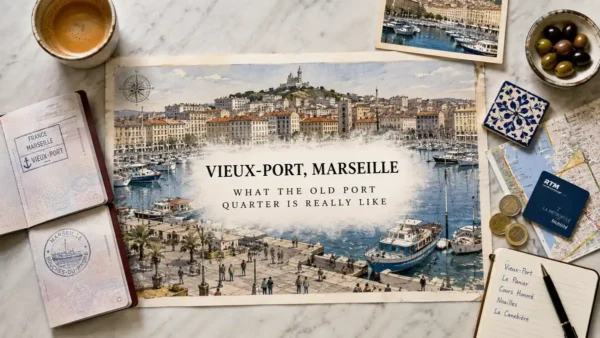
For a trip lived out in the city, the harbour front is the address that serves it. Its outlook is the port itself: busy, enclosed and city-facing. Arrival is flat and vehicle-served, the city starts at the door, and separation is nil — which, for this shape of trip, is exactly the point.
The port outlook is a real purchase in its own right. Water, working boats and a city edge in constant movement is what some travelers want from a window, and for a reader who will be out in that city from morning onward, an outlook showing the day already under way is the coherent one.
Quiet is the weakest of its four currencies. This is a working front, it stays busy, and an address here sits inside the activity by design. Arrival is its strongest: flat ground, vehicle access, and no distance at all between deciding to go out and being out. Zero separation means zero friction, and friction is the one thing this trip shape cannot absorb.
Readers still weighing this base against the city’s other main option will find that decision argued in full in Marseille’s two-base head-to-head. What the quarter is like day to day — the front itself, the streets behind it, the rhythm of the place — is covered in the guide to the Vieux-Port in Marseille.
What Are the Downsides of a Sea-Facing Base?
The address that supplies the outlook also sets three terms you accept along with it. Everything else in the city becomes a journey out. The street stays residential after dark. And the outlook belongs to the position, not to the area name, so it is possible to book the right district and get none of it.
The first term is dependency. No metro serves the 7th — the nearest sits inland — and every plan you make on the other side of the city is shaped by that from the first morning onward. It is not a deal-breaker. It is a standing constraint on spontaneity, and it grows with every extra thing you book elsewhere.
The second term is still there on the third night. Most of the road returns to residential quiet after dark, with little open on it and few people on the street, and that is the same feature that produced the quiet you booked for. The address that removed the crowd also removed the option of walking out of the door into something unplanned.
The third term is the position failure. A listing inside the district is not a listing with the outlook: a reader who booked the area name and not the position can end up one street back, in a residential address, having made the whole decision without it ever reaching the window. That is the failure case of this entire page, and it happens on the booking site, not in the city.
All three terms are one term seen from different angles. The geography that hands you the water is the same geography that holds the city at arm’s length, and you cannot accept only one half of it.
What Do People Get Wrong Booking at the Top End in Marseille?
The common error is booking the property first and the address second. That reverses the order that matters, because the property is the half you can change and the address is the half you cannot. Four versions of the mistake repeat at this level, and all four are made before arrival.
- Property first, address second. The shortlist gets built from buildings and the location is accepted afterwards, as a detail. It is the one input that cannot be revised later.
- Reading an area name as a promise of an outlook. A district is a boundary on a map, not a guarantee about what any given address inside it faces.
- Assuming anything reachable by car is reachable to the door. On the sea-facing side and its slopes vehicles do reach addresses; in the old town they often do not, and Le Panier is the clearest case — lanes a vehicle cannot enter, with stairs between the street and the door, which is why it belongs in the guide to Le Panier in Marseille and not among the bases on this page.
- Treating “water view” as one thing. The harbour’s water is the port, enclosed and full of the city. The coast road’s water is open sea. Those are two different purchases, and a listing photo flattens both into the same phrase.
Reverse the order and the booking gets simple. Decide the side, decide the position on it, and only then open the property question — because by that point every option still on the screen is already standing in the right place.
Frequently Asked Questions
Does a sea view in Marseille mean the same thing everywhere in the city?
No. Two different outlooks share one phrase. The harbour front looks at the port — enclosed water, working boats, and the city standing on every side of it. The coast road in the 7th looks at open sea, with nothing built on the far side. Check which water a listing means.
Can a car reach the door of a base on the Marseille seafront?
Usually yes, as a pattern. The coast road is a working road and the slopes above it are served by vehicle, so a car can normally reach an entrance on that side. The old-town lanes are the opposite case. Confirm the final approach for the exact address, not for the district.
Does a longer stay in Marseille change where you should book at the top end?
Yes. More nights means more hours the address is actually occupied, and that moves the balance toward outlook. A short stay is usually booked solid, so the base stands empty through most of it. Over a week, slow mornings and afternoons back at the address start doing most of the work.
Is the Marseille seafront still the right base outside the warm season?
It can be, and the calculation shifts. Out of the warm season the stretch tends to be quieter and emptier, which strengthens what the address supplies and weakens what surrounds it. If your days are indoors and elsewhere, that emptiness works against you; if they are at the base, it works for you.
Is there anywhere to eat within walking distance of a seafront base in Marseille?
Yes, though it concentrates rather than spreads. Eating on the coast road gathers into a few points along it instead of running the length of the stretch, so a base near one of those points and a base between them are different bookings. Check what sits within a short walk of the exact address.
Does arriving late at night change where you should book in Marseille?
It changes which position you book, not which side. Arriving late means the final approach is the only part of the address you meet that night, so the slope band — where every return is a climb, with luggage — is the one to think about twice. On the boulevard itself the approach is flat.
Related Guides
- Where to stay in Marseille — the full area survey, the criteria and the hub-level verdicts.
- Luxury hotels in Marseille — the property half of the decision, worked building by building.
- The Corniche in Marseille — what the coast stretch is actually like.
- The Vieux-Port in Marseille — the harbour quarter day to day.
- Le Panier in Marseille — the old quarter, its lanes and its stairs.
- Marseille’s two-base head-to-head — the matchup argued in full.
- Marseille travel guide — trip-level orientation and what a Marseille trip contains.
Did this guide save you time or money? Tripstou is independent and reader-funded — if you'd like to give something back, you can support the site with a crypto contribution of any size.