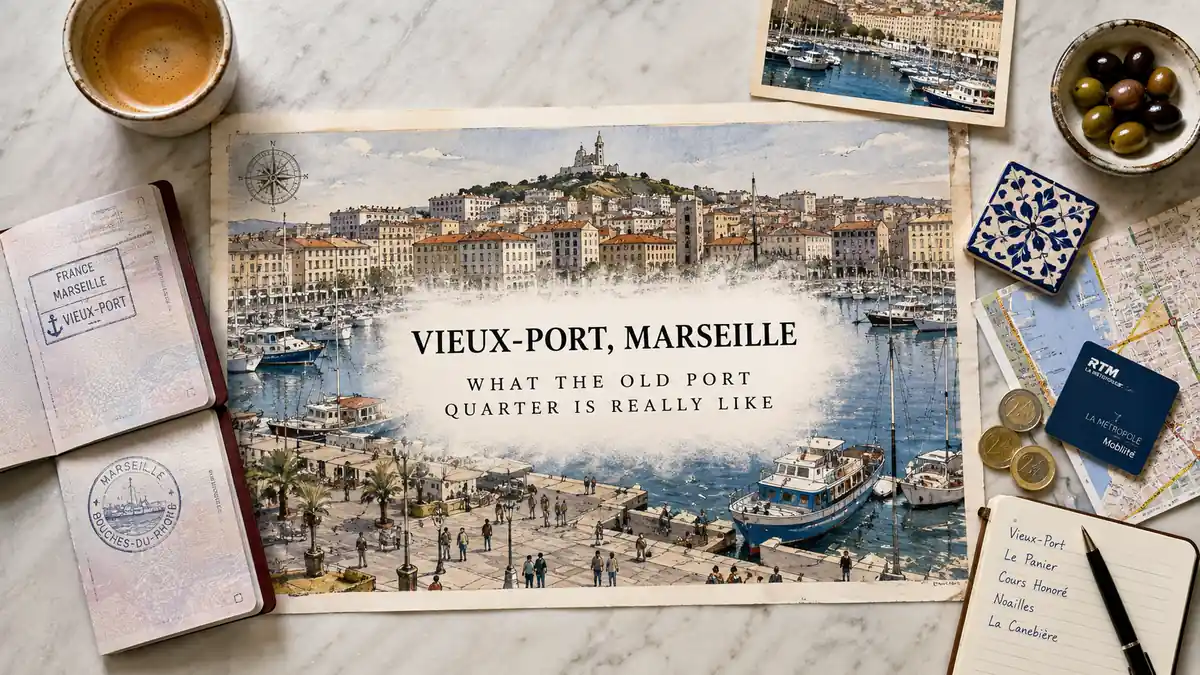
The Vieux-Port is where Marseille began and where the city still meets itself. It is a rectangle of water pushed into the middle of town: three built quays around it, one open side to the sea, and a whole city arranged along the edges. Stand at the head of it and you are at the centre of Marseille in every sense the word carries — geographic, historic and social. Knowing the landmarks around the water is the easy part. The harder part is knowing how the quarter works around you: which shore you are standing on, because the north and south sides do not feel the same; what the harbour does at dawn compared with midnight; how far the flat ground runs before the hills take over. This guide stays inside the quarter — its shape, its two shores, its rhythm and its walkable edges.
Quick Answer
The Vieux-Port is Marseille’s founding harbour and natural centre: three quays of water with the city around it. The two shores feel different — the everyday north quay against terrace-led Rive Neuve — and it quietens one street back. It suits travelers who want the city at the door; those wanting calm should aim for the streets behind.
Trust Layer
Tripstou stay guide for travelers choosing where to base. Covers area atmosphere, budget, convenience, noise, and traveler fit.
Produced with AI assistance and reviewed by Alex Perrut, working in tourism since 2015, for the Tripstou editorial team. See our editorial process for details.
Last factual review: August 14, 2026.
Official sources consulted: France.fr, Atout France.
Key Takeaways
- The Vieux-Port is three built quays around one rectangle of water, open at the mouth to the sea.
- The north quay reads as everyday city; Rive Neuve is the terrace side facing the old town.
- The quarter changes character by the hour, from a working dawn market to long evenings on the frontage.
- Character shifts within one building of the water — step a street back and the quarter turns residential.
- Flat walking rings the harbour and runs inland along the head; every other direction out of it climbs.
- The Vieux-Port suits travelers who want the city at the door and tires anyone hoping for a quiet evening.
Table of Contents
What Is the Vieux-Port, Exactly?
The Vieux-Port is Marseille’s original harbour and the centre the whole city still points at. It is a rectangle of water driven into the middle of town, built up on three sides and open on the fourth to the sea. Everything central sits along its edges or just behind them.
The city was founded on this water, and the shape of the inlet is the reason. Greek colonists from Phocaea landed here roughly 2,600 years ago and called the settlement Massalia. They stopped because the harbour was already a harbour. Nothing about the modern quarter makes sense without that: the centre of Marseille is not a square or a cathedral, it is a body of water with a city built around the rim.
Two forts hold the mouth, and they are the easiest history to read from the quays. Fort Saint-Jean stands on the north side of the entrance and Fort Saint-Nicolas on the south, both raised under Louis XIV in the 17th century, facing each other across the gap where the harbour meets the sea. They were as much about controlling the city as defending it. Look seaward from anywhere on the water and both are in the frame.
The south quay exists because of a shipyard, which is why it looks nothing like the shore opposite. Rive Neuve — the new shore — grew out of the royal arsenal and galley yards that once occupied that side, so it is later, straighter and more uniformly built than the old town across the water. The name is literal. The asymmetry between the two shores starts there and has never gone away.
The head of the port was rebuilt within living memory, which explains why it feels newer than everything around it. Marseille’s turn as European Capital of Culture cleared the quai de la Fraternité into a broad open esplanade and put Norman Foster’s Ombrière on it — a flat mirrored canopy on slim columns that reflects whoever is standing beneath it. It is where the Canebière arrives at the water, and where almost everyone reaching the harbour ends up standing first.
This page stays at quarter level. How Marseille as a whole fits together — its districts, its coastline, its scale and what the city is for — belongs to the wider Marseille travel guide.
Two Shores, Two Characters: Quai du Port and Rive Neuve
The Vieux-Port’s north and south quays work as two different quarters that happen to share a body of water. Marseille’s tourist office treats Rive Neuve as a named district in its own right, and standing on either side you can feel why. The water is one place; the shores are two.
The north shore: quai du Port
The north quay is the everyday side of the harbour. The Hôtel de Ville stands directly on the water here, and behind it the ground goes straight up into Le Panier, so the quay has the old town at its back and a working street at its front. That backdrop changes how the side reads: people cross it to get somewhere, vans unload on it, and the buildings behind are lived in more than they are looked at.
The frontage runs to cafés, bakeries and the ordinary business of a central street, with the passing traffic of a city going about its day. It is the side where the Vieux-Port stops feeling like a viewpoint and starts feeling like an address. That reading is a matter of feel, not measurement — nobody has drawn a line down the middle of the water — but it is consistent enough that most people register it within an hour of arriving.
Le Panier begins immediately behind the quay. The boundary is a change of gradient more than a distance: the flat stone of the waterfront runs out, steps start, and the lanes narrow. From the north quay you look at the old town from below, which is the clearest way to understand how this city stacked itself above its harbour.
Best for: travelers who want the old town and the market side, and do not mind the climb behind it.
The south shore: quai de Rive Neuve
Rive Neuve is the terrace side. The arsenal and galley yards that once occupied this shore left a later, straighter quay than the one opposite, and the frontage today runs to restaurants, bars and awnings facing north across the water. That orientation matters more than it sounds: this side looks at the old town, takes the light off the harbour, and gets the whole basin as its view.
La Criée anchors the middle of the quay. The national theatre occupies the former fish auction hall and has done since the early 1980s, and the building still reads as harbour architecture with a stage inside it. In front of it the pleasure-boat pontoons fill the water, masts and rigging line the edge, and the general impression is of a shore arranged for sitting down.
Above and behind, the ground climbs towards Saint-Victor, and Notre-Dame de la Garde stands on the ridge in the middle distance, visible from almost every table on this quay. The separation between the two shores is the fixed part of all this — one is a named historic district, the other is the old town’s waterfront. The adjectives are impressions. The split is not.
Most visitors treat the two shores as one place and cross between them several times a day. Which quarter you actually experience is decided by the side you sit down on, and that changes hour by hour.
Best for: travelers who want the evening side of the harbour and a flatter walk home.
What Is Around the Vieux-Port?
The Vieux-Port is ringed by a different district on every side. The old town rises behind the north quay, the theatre-and-terrace district lines the south, the Canebière and the shopping streets run inland from the head, and the forts and museum quarter hold the mouth. Four sides, four different cities.
At the head of the port, the Ombrière and its esplanade do the gathering. The mirrored canopy sits on open ground where the Canebière meets the water, and the space around it is where the quarter’s crowds collect — arriving, waiting, photographing, moving on. The fish market sets up on the quai des Belges beside it: a short line of stalls selling the morning’s catch straight off the boats. It is not a food hall and it is not staged. It is a handful of fishermen and a lot of ice.
Behind the north quay the ground goes up into Le Panier, with the Hôtel de Ville sitting on the water in front of it. The ferry boat leaves from this side, the small municipal crossing that has been carrying passengers between the two quays since 1880. It is an institution as much as a service, and it still makes the same short hop it always did.
The south side is where the quarter sits down. Rive Neuve’s frontage is terraces and restaurants facing the water, with La Criée in the old auction hall holding the middle of the quay and the pleasure-boat pontoons filling the basin in front of it. Behind and above, the ground climbs towards Saint-Victor and, higher still, Notre-Dame de la Garde on its ridge.
At the mouth, the quarter opens to the sea and to its heaviest architecture. Fort Saint-Nicolas holds the south side of the entrance and Fort Saint-Jean the north, and just beyond Fort Saint-Jean the museum quarter begins where the harbour gives onto open water. Boats for the islands and the coast leave from the quays inside the mouth, so the water in the middle of the port is never still.
None of this was arranged for a visit. The market, the ferry, the theatre and the boat traffic are working parts of the quarter that happen to be watchable, and that is most of what separates the Vieux-Port from a waterfront built for looking at.
How the Vieux-Port Moves from Morning to Night
The Vieux-Port runs a full daily cycle, and the quarter you meet depends entirely on the hour. The fish stalls and the boats come first, then commuters and deliveries, then the long midday of terraces, then the water at dusk, then late quays and an early clean-up.
Early morning belongs to work. The stalls go up on the quai des Belges before most of the quarter is awake, the boats come in behind them, and the first activity on the water is commercial and brisk. By mid-morning the fish is gone and the stone is being hosed down.
The rest of the morning is the quarter at its most ordinary, and it is the window worth catching. This is when the Vieux-Port works as an interchange and a place people cross: the metro empties onto it, buses turn at the head, the ferry shuttles, cyclists cut along the quays, and the terraces hold coffee and paperwork. Nobody is performing. If you want to see the harbour as Marseille uses it, this is the hour.
Midday and afternoon are the terrace hours, and they are lopsided. Rive Neuve faces north across the water and holds the view of the old town, so the south quay fills first and stays full, while the north quay keeps more of the through traffic. The water flattens, the pontoons clank, and the pace drops for a couple of hours.
Dusk is when the harbour earns its reputation. The light runs down the length of the water towards the mouth, Notre-Dame de la Garde catches it above the south side, and the quays fill with people who came out specifically to be there for it. The esplanade at the head is at its busiest here.
The evening then runs long, and it runs unevenly. Bar and restaurant frontage keeps the quays occupied well past dinner, especially on Rive Neuve, while stretches of the north quay thin out earlier; how loud any given corner gets depends on the street and which way it faces more than on the quarter as a whole. Late on, the middle of the water is the quiet part and the edges are not. Then the clean-up starts early, overlapping with the tail of the night, so the harbour is rarely fully silent — it hands over from one shift to the next.
The Vieux-Port’s evening is a frontage phenomenon: the sound sits on the ground floors facing the water and thins within a street of them. Two people describing the same night here can both be telling the truth. Travelers who want those late quays directly under the window can see how that reads as a base in where to stay in Marseille for nightlife.
One Block Back, It’s a Different Quarter
The Vieux-Port is not only its waterfront, and one street back it changes completely. Step off the quay into the streets behind and the volume drops, the frontage stops performing, and the quarter turns residential within a few doorways. The water is the shopfront; the depth behind it is where people live.
Behind the head of the port, the Opéra quarter takes over. Its streets are narrow, straight and densely built, running between the water and the Canebière axis, and they carry the opera house, small bars and a good deal of ordinary residential life. It is two turns from the esplanade and it does not feel like the harbour at all.
Above Rive Neuve the ground starts to climb towards Saint-Victor. The gradient is the first thing you notice; the second is the drop in people. Terraces are below and behind you, the streets are narrow and residential, and the abbey sits at the top of the slope as a fixed point. This is the quiet edge of the quarter, and it is quiet largely because it is uphill.
Behind the north quay the transition is sharper still, because the old town starts almost at once. A few doorways off the waterfront you are in the approach to Le Panier: steps, tight lanes, washing lines, and the harbour audible below but no longer visible. The change of world happens in the space of a building.
Depth is not a synonym for dull. The streets behind the quays hold the quarter’s food shops, small venues and everyday business, and the waterfront is the exception — a single ring of terraces around a neighbourhood that carries on regardless behind them.
The Vieux-Port’s depth is measured in doorways. The character change happens within one building of the water, faster than in almost any other central quarter of the city, and most descriptions of the Old Port never mention it at all.
What Can You Walk To from the Vieux-Port?
Most of central Marseille is within walking distance of the Vieux-Port quays. The flat ground hugs the water and runs inland along the head of the port, so the harbour, the old town edge, the shopping axis and the harbour mouth all connect on foot. The hills start behind both shores.
Walking out of the quarter works in four directions, and only one of them stays flat the whole way.
North, behind the quai du Port, Le Panier begins immediately. It is a short walk and an abrupt change: the flat quay gives way to steps and lanes, and the old town runs at a different speed from the water. Where the two meet, and how they weigh against each other as a base, is worked out in Vieux-Port or Le Panier.
West along the north side of the mouth, the walk runs out to Fort Saint-Jean and the museum quarter at the point where the harbour opens to the sea. It is flat, straight and waterside for its whole length, and the view reorganises itself every hundred paces.
South and west, the ground climbs. Saint-Victor and the Pharo gardens sit on the flank above Rive Neuve, and the way up to Notre-Dame de la Garde from the south side is a steady climb rather than a stroll — the basilica occupies the highest ground in central Marseille, which is precisely why it is visible from everywhere on the water. Carry on west past the Pharo and you reach the Catalans beach in about a quarter of an hour, where the coast road and the Corniche begin. That is the quarter’s edge in that direction, and the trade between a central base and a sea-facing one is settled in Vieux-Port or the Corniche.
East from the head, the Canebière runs inland into the shopping and market streets. It is flat and it is direct: the historic axis of the city continuing where the harbour stops.
The ground around the water is flat and everything behind it climbs. Treat the walks below as impressions, not measured times.
| Direction from the quays | What is there | What the walk is like |
|---|---|---|
| North, behind the quai du Port | Le Panier, the old town lanes and its steps | Short and immediate, then uphill on stairs |
| West along the north side | Fort Saint-Jean and the museum quarter at the mouth | Flat waterside walking with the sea ahead |
| South-west above Rive Neuve | Saint-Victor, the Pharo gardens and the sea flank | Gentle at first, then a proper climb |
| Up the hill on the south side | Notre-Dame de la Garde on the highest central ground | A steady climb for the whole way up |
| West past the Pharo | Les Catalans beach and the start of the Corniche | About a quarter of an hour on foot |
| East from the head of the port | The Canebière, shopping streets and market quarter | Flat and direct, straight inland from the water |
Everything inside the harbour’s flat ring is closer than it looks, and everything above it is further. That is the useful way to think about walking out of the Vieux-Port: not how far, but whether the ground stays level.
Where the Vieux-Port ends in each direction
The quarter has legible edges, and each one is a change you can feel underfoot.
- North: the quarter ends where the flat quay gives way to steps and the old town line of Le Panier begins.
- Beyond the mouth: past Fort Saint-Jean the waterfront becomes La Joliette and the modern port district.
- South-west: above and behind Rive Neuve the quarter passes into the 7th, Saint-Victor and the run out towards the coast.
- Inland: the Canebière carries the centre up into the 6th, where the harbour stops being the reference point.
Who the Vieux-Port Suits — and Who It Will Tire
The Vieux-Port suits travelers who want to open a door and be in the city already. It will tire anyone who wants a quiet evening, an unhurried street or the sense of having got away from something. The quarter is the centre, and it behaves like one.
Whether that makes it your base is a separate question, and it belongs to the page that weighs every Marseille area against the others: where to stay in Marseille. For a first visit the harbour is the obvious address, and where to stay in Marseille for first-time visitors covers what that means street by street. Couples tend to divide between the harbour’s terraces and quieter water elsewhere in the city, which where to stay in Marseille for couples works through. Families feel the crowds and the shortage of space here more than most travelers do, and where to stay in Marseille for families points them somewhere better suited. Anyone watching what they spend will find the harbour the expensive end of central Marseille — you are paying for the postcard — and where to stay in Marseille on a budget handles the alternatives. At the other end, where to stay in Marseille for luxury covers the area logic, and the best luxury hotels in Marseille covers the properties.
The honest test is how the esplanade feels at eight in the evening. If the noise reads as the city arriving, this is your quarter and you will use every hour of it. If it reads as an obstacle, the answer is one street behind the water or higher up the slope — the Vieux-Port is still the place you walk to, just not the place you come back to.
Hotels and places to stay
Compare hotels, apartments and stays for your dates in one search.
Search hotels and stays on hotels.com →
Tripstou may earn a commission if you book through this link, at no extra cost to you.
Frequently Asked Questions
What time is the fish market at the Vieux-Port?
Mornings only, and every day of the week. The stalls go up on the quai des Belges first thing and come down again through the late morning as the catch sells out, so there is no afternoon version of it. Come at the wrong hour and there is nothing to see.
What is the ferry boat across the Old Port?
It is a shortcut, not a sightseeing boat. The municipal ferry crosses the width of the harbour from the Hôtel de Ville side to the south shore, saving you the walk around the head of the port. Crossings run through the day, and the ride is over almost before it starts.
Do big ships still use the Vieux-Port?
No — commercial shipping moved north to La Joliette generations ago, and the Vieux-Port kept the small craft. What fills the water now is pleasure boats on the pontoons, excursion boats running out to the coast and the islands, and the small crossing that links the two quays.
How do you get to the Vieux-Port from Saint-Charles station?
Take metro line M1, which stops at Vieux-Port station on the harbour itself. Walking works too: the route drops down from Saint-Charles and joins the Canebière, which runs straight to the water. Both put you at the head of the port, where the esplanade and the Ombrière are.
Can you swim at the Vieux-Port?
No — the Vieux-Port is a working harbour full of moored boats, with quay walls where a beach would be. The nearest swimming is at Les Catalans, about a quarter of an hour west on foot past the Pharo, where the coast road and the Corniche begin.
Is the Vieux-Port worth visiting, and how long do you need?
Yes — it is the centre of Marseille, and you will pass through it whether you plan to or not. A slow half-day covers both quays, the head of the port and the walk out to the harbour mouth. If you are based here, the quarter stops being a visit and becomes background.
Related Guides
- Where to stay in Marseille — every area weighed against the others, with the base decision resolved.
- Vieux-Port vs Le Panier — the harbour or the hill above it, taken side by side.
- Vieux-Port vs Corniche — the centre-or-sea decision, resolved properly.
- Marseille travel guide — how the whole city fits together beyond the harbour quarter.
- Marseille for first-time visitors — the base logic when it is your first trip to the city.
- Best luxury hotels in Marseille — the property shortlist at the top end.
Did this guide save you time or money? Tripstou is independent and reader-funded — if you'd like to give something back, you can support the site with a crypto contribution of any size.