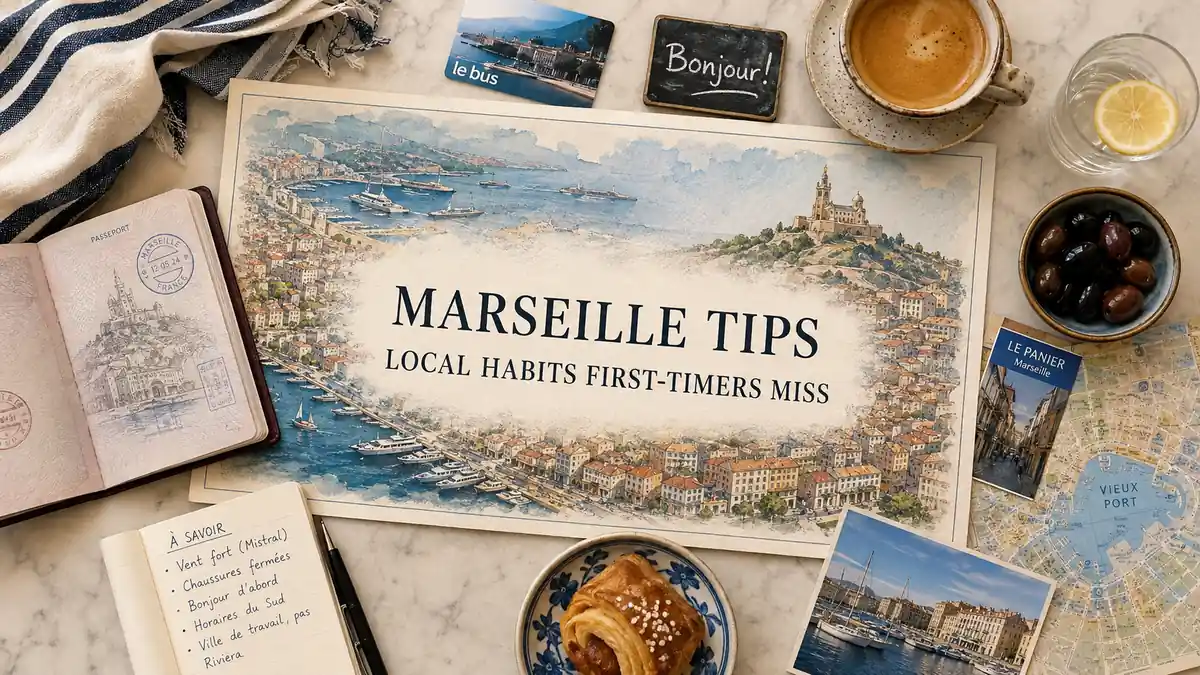
Most Marseille mistakes are behaviour mistakes, not choice mistakes. First-timers rarely regret coming; they regret dressing for a postcard Riviera on a day the mistral is blowing sideways, arriving for lunch after the kitchen has stopped serving, or opening a question with “excuse me, do you speak English?” and reading the flat answer as rudeness. The city runs on conventions that are legible once you know them and baffling before you do — southern meal timing, a greeting-first register, and a working port culture with no interest in performing charm for visitors.
This page resolves conduct: how to dress, eat, speak and pace yourself so that Marseille reads the way the people who live there experience it. It does not resolve what the trip costs, how to move around, whether the city is safe, or what to do on which day. Those questions have their own pages, and each one is linked where it belongs.
Quick Answer
Marseille rewards visitors who dress for wind, eat on southern time, and greet before asking. The mistral is the variable that reshapes a day: it changes what you do, not whether you go. Learn the handful of local conventions before arrival and the city’s bluntness reads as character, not hostility.
Trust Layer
Tripstou planning guide for travelers resolving one travel decision. Covers the main variable, traveler context, and practical tradeoffs.
Produced with AI assistance and reviewed by Alex Perrut, working in tourism since 2015, for the Tripstou editorial team. See our editorial process for details.
Last factual review: August 14, 2026.
Official sources consulted: France.fr, Atout France.
Key Takeaways
- Most first-time Marseille regrets come from behaviour — dressing, timing and tone — not from choosing the wrong city.
- A mistral day reorganises your plan instead of cancelling it: move indoors, take sheltered quays, and keep the viewpoints.
- Pack for wind and sun on the same day; a packable windproof shell and closed shoes solve most Marseille afternoons.
- Say bonjour before every question, and read Marseille’s short, fast answers as efficiency instead of rudeness.
- Eat on southern time, book anything popular, and judge bouillabaisse by its two-course service, not by a menu photograph.
- Keep the arrival afternoon small: orient from Saint-Charles down to the water and leave the marquee days for later.
Table of Contents
What Do First-Time Visitors Get Wrong About Marseille?
The core mistake is expecting Marseille to behave like the Riviera. It is a working port city, not a resort, and it shows poorly if you judge it from the Old Port alone. First-timers also underestimate the gradients, the distances between sights, and how much local directness sounds like impatience.
Each misjudgement has a behavioural fix, and they are all small:
- Expecting polish. Marseille is industrial and Mediterranean in the same frame. Stop grading it against Nice and read it as a port that happens to be beautiful in places.
- Judging from the Old Port. The harbour is the postcard and the least representative corner of the city. Walk uphill or inland before forming an opinion.
- Underestimating the terrain. The city climbs. Stairways, worn limestone kerbs and long uphill approaches turn what looks like a short hop on a map into a genuine walk.
- Reading directness as hostility. A short answer is an answer. Nobody is being curt with you specifically.
Form your opinion of Marseille from a hill. The city only makes sense from above, where you can see how the limestone ridges box it in and why it grew as a port instead of a promenade — that single change of viewpoint fixes more first impressions than any list of sights. If you want the broader picture, including when to visit and how the city fits a wider trip, the Marseille travel guide carries that argument.
Two adjacent worries belong elsewhere and are answered properly there. Marseille’s reputation raises the safety question earlier than most cities, and the honest version of how safe Marseille actually is sits on its own page. The gradients matter for one more reason: your base decides how much of the city you climb daily, which is why where to stay in Marseille is worth settling before you book.
What Does the Mistral Change About Your Day?
The mistral is a cold, dry northerly that blows for days at a stretch — plan around it, not against it. It funnels down the Rhône valley under clear skies, which is why a bright forecast can still deliver a sharp drop in felt temperature. It reorganises a day; it does not cancel one.
The wind is present year-round and strongest in winter and spring, and it rarely arrives for a single afternoon. Once it settles in, treat it as the day’s organising fact and rebuild around shelter. Local tourism guidance frames a windy day the same way: a reshuffle, never a write-off.
A mistral day favours:
- Indoor venues — museums and covered attractions absorb the hours the wind takes back.
- The sheltered north side of the Old Port, where the quays block the worst of it.
- The Corniche and the high viewpoints, because the same wind delivers extraordinary visibility.
Anything on the water is the first thing to go. Crossings from the Vieux-Port out to Château d’If and the Frioul islands run weather permitting, and a hard mistral is precisely the condition that stops them. Keep a land alternative in your pocket on windy days and you never lose an afternoon to a cancelled crossing.
The mistral’s compensation is visibility. The clearest views over the bay and out to the islands come on exactly the days that feel too windy to go out for them — which is why the sheltered-museum plan should still end on a high terrace.
What Should You Pack for Marseille’s Wind and Heat?
Pack a windproof layer, sun protection and sturdy closed shoes — Marseille runs wind and heat together. The same week can deliver a glaring, still afternoon and a northerly that makes the shade feel cold. A light shell you can stuff into a daypack solves more days here than a jumper does.
The confusion comes from treating wind and temperature as one reading. Marseille’s wind arrives dry and under a clear sky, so the sun stays strong while the felt temperature falls; a shaded seat on a breezy quay can be genuinely uncomfortable an hour after you were squinting in the glare. The bag has to cover both states at once, every day.
- A windproof shell that packs down small — the item first-timers leave at home and regret.
- Sunglasses, sunscreen and a hat that actually fastens.
- Layers you can shed and re-add, not one heavy garment.
- A daypack with a closed top, so nothing gets lifted out by a gust on the Corniche.
- Sturdy closed shoes for the default day, sandals kept for the water.
Footwear is the packing decision that carries the most weight, because the terrain is unforgiving in an ordinary way. Pavements are uneven, the old quarters are built on stairways, and the approach to Notre-Dame de la Garde is a sustained climb whichever way you take it. Grip and a closed toe matter more than ankle support here. Smooth-soled city shoes and worn limestone are a poor combination.
Most people underestimate the hat. Marseille’s sun and Marseille’s wind show up on the same afternoon, and a brimmed hat with no chin cord is a hat you will eventually chase along the seafront.
Do You Need to Speak French in Marseille?
You don’t need fluent French, but opening with a greeting before any question changes the whole exchange. English works in most visitor-facing places. What decides the tone of a conversation is whether you said bonjour first, and whether you accept a direct answer as an answer.
Marseille’s register is louder, faster and blunter than visitors expect from France, and it is routinely misread as rudeness. Speech comes at volume, sentences are short, and pleasantries get compressed. None of that signals irritation. A shopkeeper who answers your question in five words and turns to the next customer has not dismissed you; they have answered you.
Four openers cover almost every exchange:
- Bonjour — said on entering, before anything else, every time.
- Parlez-vous anglais ? — asked after the greeting, never instead of it.
- S’il vous plaît and merci — the minimum that keeps the exchange warm.
- Au revoir, bonne journée — said on the way out, including in shops where you bought nothing.
The greeting habit is a French convention before it is a Marseille one, and the full picture of nationwide etiquette, service norms and tipping lives in our France travel tips. What is local is the delivery: quicker, warmer once you are in, and far more willing to tease.
The tell that you have got the register right is being teased back. In Marseille a joke at your expense is an inclusion signal, and matching it lightly does more for you than any amount of vocabulary.
How Eating Works in Marseille: Timing, Booking and the Real Bouillabaisse
Eating well in Marseille means eating on southern time, booking anything popular, and knowing what real bouillabaisse looks like. Kitchens follow the southern rhythm, not the visitor’s. The dish that ruins the most food memories here is bouillabaisse ordered by travelers who don’t know what the genuine version does at the table.
What time do people eat, and do you need to book?
Lunch starts early and ends firmly, dinner starts late, and yes — you should book anything sit-down and popular. The midday service is a window, not a rolling option, and arriving at the hour you would eat at home is the most common way to end up with a mediocre meal on a tourist quay.
The aperitif fills the gap that catches visitors out. The stretch between the end of lunch service and the start of dinner is not empty time here — it belongs to a drink on a terrace, and that is a social habit rather than a snack. Plan a late-afternoon aperitif into the day and the late dinner stops feeling late.
Reservations are a habit, not an emergency measure. Anything small, well-regarded and sit-down expects to be booked, and walking in works far better at lunch than in the evening. Book in the morning for the same night and you will usually be fine.
How do you avoid a tourist bouillabaisse?
Judge bouillabaisse by the service, not the menu photograph. A charter-style version, following the convention drawn up decades ago by Marseille restaurateurs, is built on several local rockfish including rascasse, shows you the fish whole before it is filleted, and comes to the table in two courses: broth first, fish after.
The warning signs are consistent:
- Everything arrives at once in a single bowl, with no broth course.
- The fish is never shown — it reaches the table already filleted, unannounced.
- The pot is built on generic or non-local fish; the convention is local rockfish.
- Photographs of the dish on a board outside, on a quay where every terrace advertises the same thing.
- Nobody on the floor can explain how the dish is served before you order it.
The genuine article is a two-act meal, so the real question is whether you have the appetite and the evening for it. Most visitors who come away disappointed by bouillabaisse actually wanted a quick bowl of fish soup, which is a different and perfectly good dish sold all over the city. What such a meal does to a day’s spending is a separate question, answered in our guide to what a Marseille trip costs.
How to Behave in Marseille’s Markets and Neighbourhoods
Treat Noailles as a working market, ask before photographing people, and keep the volume down in residential streets. The market trades most mornings and it feeds the neighbourhood — visitors are guests on somebody’s grocery run. The same rule governs the stairways and courtyards of the old quarters.
Noailles is not a heritage attraction that happens to sell food. It is where a large part of central Marseille shops, at speed, in the morning, and its aisles carry the pace of that job. Stand still in the middle of a narrow lane with a camera up and you are an obstruction. Step to the side, buy something, and the atmosphere changes around you.
Photography etiquette here is simple and non-negotiable: stallholders, shoppers and residents are people, not scenery. Ask before you photograph a face or a stall, accept a refusal without negotiating, and never photograph into somebody’s doorway. Wide shots of produce are fine; portraits are borrowed, and the loan has to be requested.
The residential quarters run on the same principle. Le Panier’s lanes are lived in, with windows a step away from the paving, and the old stairways carry sound upward; conversation at terrace volume in a stairwell at night lands in three apartments at once. Terraces have their own contract — the seat comes with an order, and once you have ordered, lingering is entirely normal and nobody will hurry you.
Noailles rewards the visitor who buys something. A purchase converts you from spectator to customer, and the market’s tolerance for cameras, questions and slow foreigners rises sharply on that side of the line.
What Should You Do on Your First Day in Marseille?
Orient yourself from Saint-Charles, get data working, and keep the first afternoon deliberately small. The station sits above the centre, which makes the walk down its steps the fastest way to understand the city’s shape. Save the marquee day — the Calanques above all — for later in the trip.
The arrival afternoon does one job: calibration. Marseille reads wrong on a map, because sights that look adjacent are separated by a hill, and one unhurried walk teaches you more about pacing the rest of the trip than any list of attractions. Descend from the station, follow the slope to the water, and let the port fix your bearings. Then stop. An early dinner beats a forced third sight.
Three things are worth having settled before that walk:
- Mobile data, which should be working the moment you land — sort it in advance with the best eSIM for France instead of hunting for a shop on day one.
- How you will move around, since Marseille is a city where a car is a liability and not an asset; our guide to getting around Marseille settles that decision.
- The order of your days, which is easier to fix on arrival than to improvise: see Marseille in 2 days for the compressed version.
The Calanques are the one thing that punishes improvisation, because the massif is a day with its own preparation and its own conditions — the 3-day Marseille itinerary is where that day gets planned properly. Attempting it jet-lagged on an arrival afternoon is how travelers end up doing it badly, or not at all.
Keep the first evening in the neighbourhood you sleep in. It teaches you the local rhythm, the walk home and the nearest good bakery — three things you will use every remaining day, and none of which require a plan.
Frequently Asked Questions
Are sandals enough for walking around Marseille?
Not for a full day in the city. Sandals earn their place on the beach and at the evening table, but Marseille days rarely stay flat, and the improvised uphill detour is when they fail. Carry them as the second pair and walk the day in closed shoes with grip.
How long does the mistral usually last?
Several days at a stretch, not a single afternoon. The mistral tends to settle in and run, and it is at its most frequent in winter and spring. On a short trip that means waiting it out is rarely an option, so build the wind into the days you have.
How do you get mobile data when you arrive in Marseille?
Sort it before you land. An eSIM activated at home means data is working the moment you step off the plane or the train, which is exactly when maps and messages matter most. Our guide to the best eSIM for France covers the options for this trip.
Do you tip in restaurants in Marseille?
Tipping here follows the national convention, not a Marseille one, so there is nothing city-specific to learn. Bills and service norms work the same way in Marseille as they do anywhere in France, which is why the answer lives on our France travel tips page, alongside the rest of the country’s dining conventions.
When is the Noailles market open?
Most mornings, and mornings are when it works. Noailles is a neighbourhood grocery market, so trade builds early and thins out as local shoppers finish, and stalls set their own pattern. Treat it as a morning stop, and check locally on the day if timing matters to your plan.
How do you know if the boat to Château d’If is running today?
Check the operator on the morning of your crossing. Departures from the Vieux-Port run weather permitting, and the call to cancel rests on wind and sea state, so it is made and published the same morning, never days in advance. Keep a land alternative ready either way.
Related Guides
- Marseille Travel Guide — the broader picture: what the city is, when to visit and how it fits a wider trip.
- Where to Stay in Marseille — choosing a base, and how much of the city you climb from each one.
- Marseille Transport Guide — getting around the city and out to the coast without a car.
- Marseille Trip Cost Guide — what a trip actually costs, from meals to museums.
- Is Marseille Safe? — the reputation, the reality, and normal city awareness.
- 3 Days in Marseille — the itinerary that makes room for a proper Calanques day.
- France Travel Tips — nationwide etiquette, service norms and tipping.
Did this guide save you time or money? Tripstou is independent and reader-funded — if you'd like to give something back, you can support the site with a crypto contribution of any size.