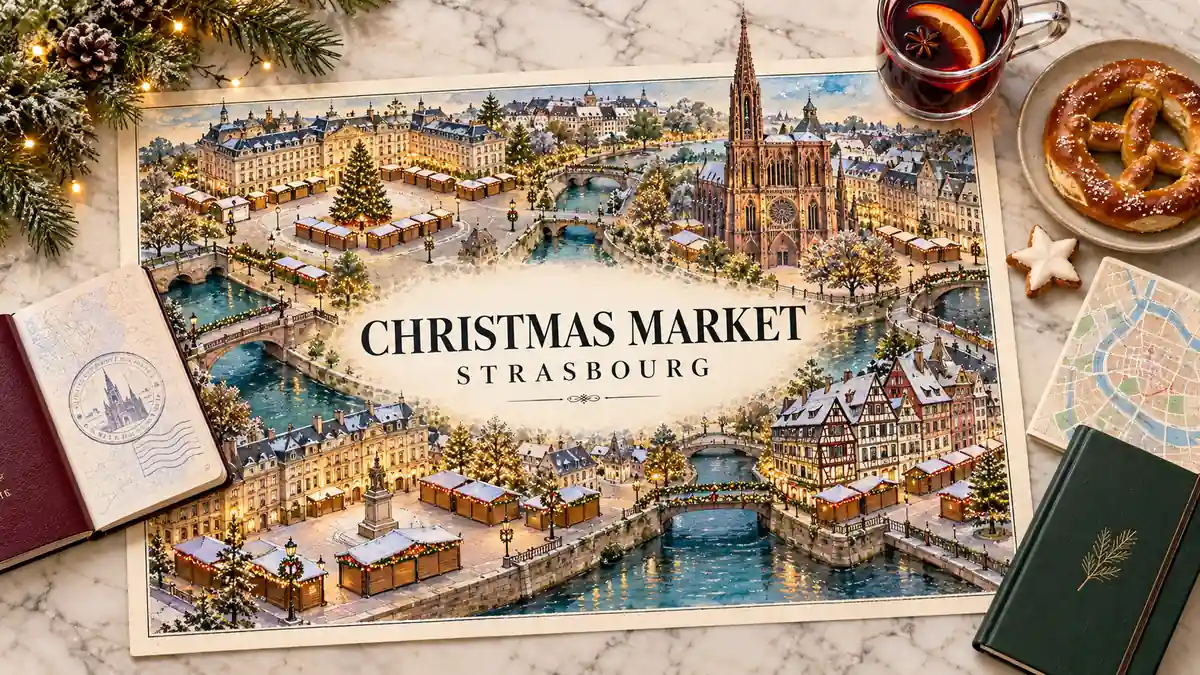
Strasbourg’s Christmas market is not one market. It is a circuit of squares spread across the Grande-Île, the river island that holds the old centre, and each square does a different job. First-timers lose their one day by treating it as a single place: they push into the Cathedral square at the busiest moment, see the Great Tree in daylight and leave before the streets light up.
This page sorts the squares by what each is best for, so you can decide which deserve your time and which you can skip. It sets out the order to walk them, the days and moments when the crowds thin, and what to eat once you are there. It then covers Colmar, the second great market of Alsace, and the wine villages beyond it that a shuttle reaches without a car. Together they turn two nights in Strasbourg into a December week.
Quick Answer
See three squares first: Place Broglie for history, Place Kléber for the Great Tree, and the Cathedral square. One full day covers the circuit if you walk it by proximity and return after dark; extra days belong to Colmar and the villages. Go on a weekday: on Saturdays, coach day-trippers fill the Cathedral square.
Trust Layer
Tripstou selection guide for travelers choosing between multiple places. Covers selection criteria, traveler fit, and trip value.
Produced with AI assistance and reviewed by Alex Perrut, working in tourism since 2015, for the Tripstou editorial team. See our editorial process for details.
Last factual review: October 1, 2026.
Official sources consulted: France.fr, Atout France, City of Strasbourg, Noël à Colmar.
Key Takeaways
- Place Broglie, Place Kléber and the Cathedral square carry Strasbourg’s market: history, the Great Tree and the most photographed stalls.
- The second loop most day-trippers miss holds the best lights at Temple-Neuf, canal settings in Petite France and producers’ food at Délices.
- One full day covers the whole circuit, but two nights lets you see the squares after the coach day-trippers leave.
- Weekdays early in the season, opening hour and late evening are the calm windows; Saturdays are the peak, especially at the Cathedral.
- Colmar is about half an hour from Strasbourg by regional train, so most visitors treat it as a day trip, not a base.
- Riquewihr, Kaysersberg and Ribeauvillé need the official shuttle from Colmar station, booked online, and their village loop runs Friday to Sunday only.
Table of Contents
Is the Strasbourg Christmas Market Worth It, and How Many Days Do You Need?
Yes: Strasbourg is the one French Christmas market worth building a trip around, and one full day covers its squares. Its tradition runs back more than four centuries and spans many squares, yet everything sits on a compact island you can cross on foot. Two nights is the comfortable stay for first-timers.
The market suits travelers who want one concentrated dose of Christmas — lights, food, crafts and old streets — within a short walk of each other. It frustrates crowd-averse visitors who arrive on the wrong day. The main squares are dense on weekend afternoons. Timing is the fix, and the crowd section below sets out how.
- One full day: the whole circuit, with stalls by daylight and the lights after dark. It fits day-trippers arriving by train from Paris or elsewhere in the region.
- Two nights: the circuit at an easy pace plus a second evening for the tree and the decorated streets. It fits most first-time visitors.
- Four days: two days in Strasbourg, one in Colmar and one in the wine villages. It fits travelers building a December week in Alsace.
A day trip sees the market; only an overnight stay sees it after the coaches leave, which is when the squares are at their best.
Strasbourg anchors the country’s market season, and our guide to the best Christmas markets in France shows how it compares with the rest. The city also rewards time beyond the stalls, which the Strasbourg travel guide covers year-round.
Broglie, Kléber and the Cathedral Are the Squares to See First
Three squares carry the market: Place Broglie for history, Place Kléber for the Great Tree, the Cathedral for the setting. Together they hold the densest run of chalets and the images people travel for. See these first, then decide how much of the second loop your time allows.
The table sets the squares side by side. Use it to weigh the anchor squares against the quieter ones before reading the detail.
| Square | Best for | When to go |
|---|---|---|
| Place Broglie | The historic Christkindelsmärik and traditional wooden chalets | Weekday mornings, before the main surge |
| Place Kléber | The Great Tree and its evening light show | After dark, when the tree is lit |
| Cathedral square | Stalls beneath the cathedral facade, the classic postcard | Weekday opening hour, never Saturday afternoon |
| Temple-Neuf and Carré d’Or | Decorated facades and the best street lights | After dark, as an evening walk |
| Petite France and Délices (Rohan terrace, Marché-aux-Poissons) | Canal-side settings and Alsatian producers for a proper meal | Mealtimes; calmer than the three main squares |
| OFF market, Place Grimmeissen | Ethical, thrift and organic gifts with a story | Any time: rarely crowded |
Place Broglie: The Christkindelsmärik, Where the Market Began
Place Broglie hosts the Christkindelsmärik, the market where Strasbourg’s Christmas tradition began, dating to 1570. Its long rows of traditional wooden chalets sell ornaments, crafts and seasonal food, and the square feels the least staged of the big three. There is no centrepiece to queue for. What sets it apart is lineage: this is the market as the city has run it for more than four centuries, so browsing matters more than any display. The square is also wide enough to absorb crowds better than the Cathedral square does.
Pick this if: you want the market as Strasbourg has always run it, with no showpiece in the middle.
Place Kléber: The Great Tree and the Evening Light Show
Place Kléber is home to the Great Tree, a decorated fir of around 30 metres that anchors the whole market. Evening light shows play across it, and the square works as the city’s meeting point and photo stop. Spectacle is what sets it apart. The chalets around the tree matter less than the tree itself, which is why the square deserves a second pass after dark even if you crossed it by day. Crowds gather fast for the shows, so arrive early and take a spot at the edge.
Pick this if: you have one evening and want the image everyone comes to Strasbourg for.
Cathedral Square: The Most Iconic Stalls and the Biggest Crush
The Cathedral square puts market stalls directly beneath the cathedral’s carved facade, the most photographed scene of the season. It is also the most congested place in the city, with narrow lanes between chalets and slow-moving crowds. Backdrop and crowd cost define it equally. The view repays a visit at opening hour or on a weekday; at a weekend peak you will shuffle more than browse. Keep the visit short, let the facade be the reason you came, and move on to the calmer squares nearby.
Pick this if: the postcard view matters more to you than elbow room.
The Squares Worth a Second Loop: Lights, Petite France, Food and Alternative Gifts
The second loop is where Strasbourg beats other markets: Temple-Neuf’s lights, Petite France, the producers and the OFF market. Most day-trippers skip these squares after the big three, yet they are calmer, more varied and often more enjoyable. Give them the hours after the anchor squares, ending with the lights after dark.
Walk the squares by proximity across the Grande-Île: start at Kléber, then Broglie, Temple-Neuf, the Cathedral, the Rohan terrace and Marché-aux-Poissons, and finish in Petite France. The OFF market at Place Grimmeissen sits apart from that line, so slot it in when you need a break. Browse stalls by daylight. Save the lights for after dark. Ending in Petite France puts you in the quietest corner of the island just as the main squares reach their evening peak.
Place du Temple-Neuf and the Carré d’Or: Where the Lights Are Best
Place du Temple-Neuf hosts the Carré d’Or market, and the streets around it carry the most elaborate decorations in the city. Shopfronts compete with oversized ornaments, garlands and lit facades, turning the streets between Temple-Neuf and the cathedral into an open-air display. The stalls are secondary here. What sets the area apart is the decor, which only works after dark, so treat it as an evening walk. It also sits between the anchor squares, which makes it easy to fold into the route without a detour.
Pick this if: you are here for decorated facades and want to photograph them lit up.
Petite France: Benjamin-Zix, Saint-Thomas and Louise-Weiss
Petite France holds smaller market sites at Place Benjamin-Zix, Place Saint-Thomas and Square Louise-Weiss, one of them a producers’ market. The draw is the setting: half-timbered houses, canals and bridges around a handful of chalets. Scale is not the point. Fewer coach groups push this far, so the lanes stay walkable when the main squares jam. The trade-off is choice, since there are far fewer stalls than at Broglie or Kléber, but the half-timbered backdrop at dusk is the most atmospheric on the island.
Pick this if: you want canals and half-timbered houses around the stalls, with fewer coach groups.
Délices at the Rohan Terrace and Marché-aux-Poissons: The Food Market
Délices at the Rohan terrace and Place du Marché-aux-Poissons gathers Alsatian producers and food stalls beside the river. It is the place to eat properly instead of grazing from chalet to chalet. Producers sell what they make. That sets it apart from the main squares, where the same stock repeats from stall to stall. Come hungry and treat it as your meal stop on the circuit; the dishes worth ordering are listed in the food section below. Its position between the Cathedral and Petite France also makes it a natural pause.
Pick this if: eating is the point and you want producers, not resellers.
The OFF Market at Place Grimmeissen: The Alternative to the Chalets
The OFF market at Place Grimmeissen is the counter-programme to the traditional chalets, built around the social and solidarity economy. Stalls focus on thrift, organic and ethically made goods, in a more contemporary spirit than the rest of the market. It feels like a different event. The square sits slightly apart from the main circuit, which keeps it calmer on busy days. The selection is smaller and less traditional, so purists may miss the ornaments, but it is the best place in the city for gifts with a story.
Pick this if: you want ethical gifts and a break from the main-square crowds.
When to Go and How to Get In Without the Crush
The market runs from late November to Christmas Eve, and weekdays early in the season are the calm ones. Crowds build through December and peak on Saturdays, when coach day-trippers arrive. Choosing your day and hour does more for the experience than any choice of square.
The season follows the same pattern every year. Stalls open in late November and close early on Christmas Eve, while the Great Tree stays up past Christmas. December is the market’s month, and our guide to the best time to visit France sets it against the rest of the year.
Pick your window from this ladder:
- Weekdays early in the season: the calmest squares and the fewest coach groups. Suits anyone with flexible dates; the trade-off is a quieter atmosphere in the evenings.
- Opening hour, any day: the squares before the surge. Suits photographers and families; the lights are not on yet.
- Late evening: the lights without the after-work crowd. Suits couples; some food stalls are already winding down.
- Saturday: the peak, with coach day-trippers filling the Cathedral square. Avoid it, or retreat to Petite France and the OFF market.
Dense crowds attract pickpockets, so keep bags zipped and in front of you.
On a Saturday you cannot avoid the crowds, only sidestep them: the quieter ends of the island — Petite France and Place Grimmeissen — stay walkable while the Cathedral square jams.
Getting in is simple once you know three things:
- Expect random checks where you cross onto the island; suitcases and backpacks are always inspected.
- The centre is closed to cars while the markets run, so take the tram to the edge of the Grande-Île and walk in; the Strasbourg transport guide covers lines and tickets.
- Beds on or near the Grande-Île go months ahead, so book early; see where to stay in Strasbourg for the areas within walking distance of the squares.
What to Eat and Drink, and How the Cup Deposit Works
Vin chaud in a returnable cup, bredele, pretzels and tarte flambée are the Strasbourg market staples. Every square sells hot wine, but the producers at Délices serve the best food. The one mechanism first-timers trip on is the cup: you pay a deposit on it, then return it or keep it.
- Vin chaud: hot spiced wine, red or white, sold at every square and the default drink of the evening.
- Bredele: small Alsatian Christmas biscuits in many shapes and flavours, sold by the bag.
- Pretzels: soft Alsatian bretzels, plain or topped, an easy snack while you walk.
- Tarte flambée (flammekueche): thin, crisp flatbread with cream, onions and bacon, best at Délices or a sit-down stall.
- Spaetzle: soft egg noodles, often baked with cheese, the warming choice on a cold night.
- Knack: the Strasbourg sausage, eaten in a bun from street stalls.
- Pain d’épices: spiced honey bread in slabs and decorated shapes, which travels well as a gift.
The cup deposit works the same way across the market. You pay a refundable deposit on top of your first drink, and the cup comes with you to the next stall. Return it at any drinks stall to get the deposit back, or drop it in a charity collection bin on the squares to donate the deposit to a Strasbourg charity. Or keep it. Many visitors take it home as a souvenir.
Eat your main meal at Délices and drink at the squares: the producers’ food is a step up, while vin chaud is the one thing every square does equally well.
A December visit also changes what else is worth doing in the city, from warming up indoors to walking the lit streets; our list of things to do in Strasbourg covers the rest.
Colmar: Day Trip or Second Base?
Colmar is about half an hour away by train, a day trip for most; base there only for the villages. Its market is smaller and prettier than Strasbourg’s, spread across a storybook old town of canals. Staying there pays off when the village shuttles become part of the plan.
Colmar’s market feels compact where Strasbourg’s feels grand. Six small markets are scattered across the old town instead of filling one big square, one of them indoors in the Koïfhus. Each one is modest on its own. Walking between them through half-timbered lanes and along the canals is the experience.
Frequent regional trains link the two cities in around half an hour, so a day trip needs little planning. Return to Strasbourg after dark if you want to see Colmar lit up and still sleep in the bigger city.
Colmar’s streets are narrow, so weekends feel fuller there than in Strasbourg even though the crowds are smaller overall. Colmar at night is the reason to stay: once the day-trippers catch their trains back, the lit canals of Little Venice empty out.
As a base, Strasbourg wins on rail links, choice of beds and the bigger market. Colmar wins on access to the village shuttles and quieter evenings. Most first-timers should sleep in Strasbourg and visit Colmar for a day. Travelers adding a village day should move to Colmar for those nights.
Tours and activities
Book skip-the-line tickets, day trips and local tours with free cancellation on most activities.
You can also browse everything on getyourguide.com.
Tripstou may earn a commission if you book through this link, at no extra cost to you.
Which Alsace Villages Can You Add Without a Car?
Riquewihr, Kaysersberg, Ribeauvillé and Eguisheim have no railway station; the official Christmas shuttle from Colmar reaches them. All four hold their own Christmas markets in wine-village settings, which makes them the natural extension of a Strasbourg trip. Without a car, the shuttle is the practical way in, and planning starts in Colmar.
The shuttle runs as a small network:
- It departs from Colmar train station; nothing leaves from Strasbourg, so take the regional train to Colmar first.
- Tickets are sold exclusively online, in advance.
- A paid day ticket allows unlimited rides on the day.
- The village loop linking Riquewihr, Kaysersberg and Ribeauvillé runs Friday to Sunday only.
- Other lines serve Eguisheim, Turckheim–Munster and Neuf-Brisach.
Riquewihr, Kaysersberg and Ribeauvillé pair naturally as one day on the loop. Riquewihr is the most complete of the wine villages. Kaysersberg sets its market beneath its castle ruins, and Ribeauvillé holds a medieval-themed market on only two December weekends, so check its days before fixing the loop. Eguisheim works on its own: a small circular village whose ringed lanes suit a half-day. Beyond December, the Alsace travel guide covers the region, and our list of things to do in Alsace picks up the villages in other seasons.
A December week fits together simply. Give Strasbourg two days, Colmar one and the villages one, and sleep in Colmar for the last nights to save the train back and forth. The Friday-to-Sunday loop sets the order of the whole week: fix the village day first and build Strasbourg and Colmar around it. Friday or Sunday beats Saturday here too.
Frequently Asked Questions
When does the Strasbourg Christmas market open and close?
The Strasbourg Christmas market opens in late November and runs until Christmas Eve, when the stalls close early. The Great Tree on Place Kléber stays up past Christmas, so a visit in the days after still catches it, though the stalls are gone. Dates and hours change each season; check the city’s official Christmas site before booking.
Is the Strasbourg Christmas market free to visit?
Yes, the Strasbourg Christmas market is free to enter, and none of the squares charges admission or needs a ticket. You pay only for what you buy: food, vin chaud, crafts and the refundable deposit on your first cup. Walking the whole circuit and watching the Great Tree’s evening light shows costs nothing at all.
Are there security checks at the Strasbourg Christmas market?
Yes, expect random checks where you cross onto the Grande-Île, the river island that holds the market squares, and suitcases and backpacks are always inspected. Carry a small bag and leave anything bulky at your hotel to keep the crossing simple. Cars are not an option either: the centre is closed to cars while the markets run, so arrive by tram or on foot.
Is the Strasbourg Christmas market good for children?
Yes, with timing. Children love the Great Tree on Place Kléber and its evening light shows, and bredele and pretzels make easy snacks. The crush is the problem, so take them at opening hour or on a weekday, skip the Cathedral square at weekends and use Petite France as the calmer stretch for small legs and pushchairs.
Strasbourg or Colmar: which Christmas market is better?
Strasbourg is the better Christmas market for scale, history and spectacle. It has more squares, the Great Tree and the tradition that began on Place Broglie. Colmar wins on compact charm, with small market sites along canals and half-timbered lanes. You do not have to choose: frequent regional trains link the two cities in about half an hour.
Can you see the Strasbourg and Colmar Christmas markets in one day?
Yes, but in a rush. The train between them takes about half an hour, so you can browse one city by day and the other at dusk. The cost is losing an evening: both markets look their best after dark, and each deserves its own night for the lights. Two days, one per city, is the better split.
Related Guides
- Strasbourg travel guide: the city beyond the market, for planning the rest of your stay.
- The best Christmas markets in France: how Strasbourg compares with the country’s other markets.
- Alsace travel guide: the region around Strasbourg and Colmar in every season.
- Things to do in Alsace: the wine villages and sights beyond the Christmas markets.
- Where to stay in Strasbourg: the areas within walking distance of the market squares.
- Strasbourg transport guide: trams, tickets and reaching the car-free centre.
- Things to do in Strasbourg: what else fills a December day in the city.
- Best time to visit France: how December compares with the rest of the year.
Did this guide save you time or money? Tripstou is independent and reader-funded — if you'd like to give something back, you can support the site with a crypto contribution of any size.