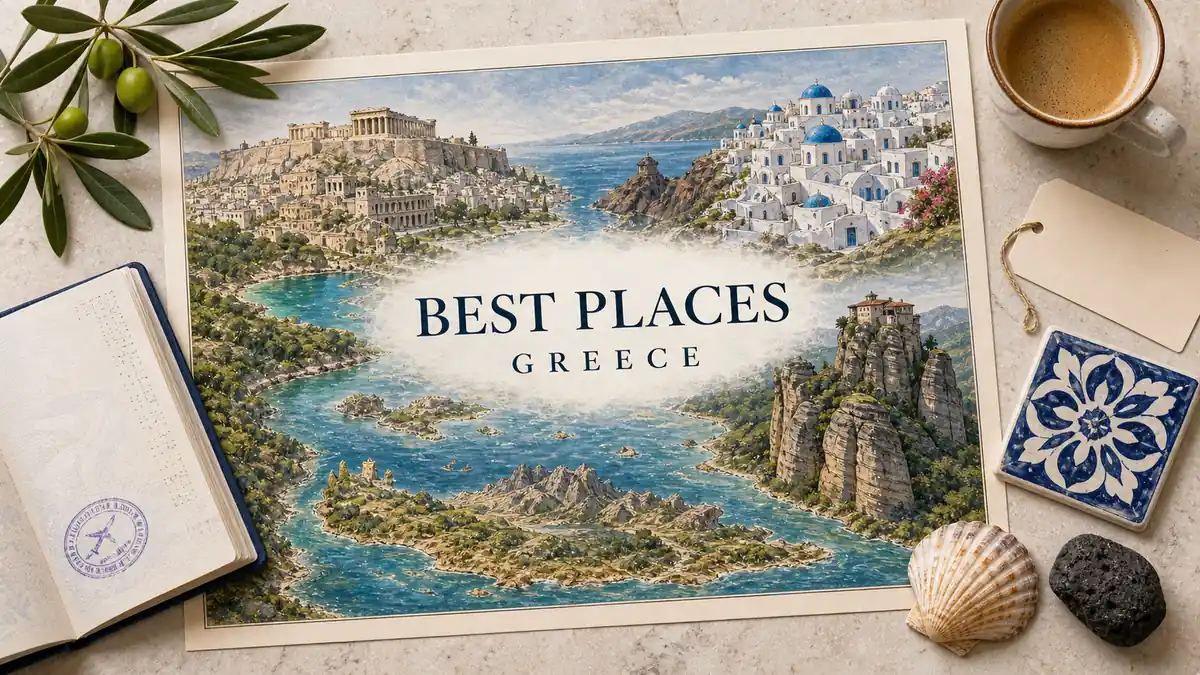
Greece is a mainland plus several hundred islands split into distinct groups, and the choice you make on day one shapes the whole trip. The classic first-timer mistake is stacking five islands into ten days, then spending the holiday in transit. This guide shortlists twelve places worth building a trip around, organised by island group and by mainland, so you can reason about distance without a map in front of you. Every pick gets the same three things: what it is, what makes it different from the others here, and who should skip it. Fewer places for longer beats more places in a rush, and that rule decides most of what follows. After the picks, there is a framework for choosing by trip length, travel style and how much moving you actually enjoy.
Quick Answer
Athens, the Cyclades, Crete and Meteora are the best places to visit in Greece. First-timers do best pairing Athens with one Cyclades island such as Santorini, Naxos or Paros, instead of spreading across several groups. Choose Corfu or Zakynthos for greener Ionian scenery, or Rhodes for history and beaches on one island.
Trust Layer
Tripstou selection guide for travelers choosing between multiple places. Covers selection criteria, traveler fit, and trip value.
Produced with AI assistance and reviewed by Alex Perrut, working in tourism since 2015, for the Tripstou editorial team. See our editorial process for details.
Last factual review: August 28, 2026.
Official sources consulted: Visit Greece, Greek Ministry of Tourism.
Key Takeaways
- A first trip works best as Athens plus one Cyclades island — Santorini for the caldera, Naxos or Paros for beaches.
- Pick one island group and stay inside it; crossing between the Cyclades and the Ionian burns days you cannot recover.
- Traveler type decides more than scenery: Naxos for families, Santorini or Milos for couples, Mykonos when nightlife is the point.
- Santorini and Mykonos trade crowds and higher costs for their signature scenes; Naxos and Paros deliver the Cyclades at lower intensity.
- Chania and western Crete carry a whole holiday from one base, which suits anyone who dislikes packing twice.
- Meteora and the Peloponnese reward history-led or returning travelers, but the mainland needs a car and time to drive.
Table of Contents
The 12 Best Places to Visit in Greece and Where to Start
A first trip to Greece should start with Athens plus one Cyclades island, either Santorini or Naxos. The twelve picks below span four island groups and the mainland. They are grouped by geography and by traveler fit, not ranked one to twelve, because the right order depends on your trip.
Start here
- Athens — the capital and main gateway, with the Acropolis and a real city stay behind it.
- Santorini — the caldera rim that sells Greece to the world, and the country’s most photographed landscape.
- Naxos — long, shallow sandy beaches and a mountain-village interior most Cyclades islands do not have.
- Paros — the balanced all-rounder and the easiest island to choose when you are choosing first.
- Chania and western Crete — the largest Greek island, so one base buys towns, mountains and coast.
Strongest alternatives
- Milos — a volcanic coastline of white rock and sea caves, best seen from a boat.
- Mykonos — the nightlife island, with beach clubs no other Cyclades island tries to match.
- Rhodes — a UNESCO-listed medieval old town attached to a long beach coast.
- Corfu — green, Venetian-flavoured and gentler than the Cyclades in every sense.
Best for a return or longer trip
- Zakynthos — cliffs, sea caves and a beach-led week on the Ionian side of the country.
- Meteora — monasteries on rock pillars, UNESCO-listed, and the mainland detour that repays the drive.
- The Peloponnese — Nafplio, Epidaurus, Mycenae and Olympia inside one self-drive loop, with a quiet coast.
The tier a place sits in matters more than any rank you could give it. A start-here pick can carry an entire Greek trip on its own, while everything in the second and third tiers assumes you already know which island group you want.
Which Greek Island Group Should You Choose?
Choose the Cyclades for a first island trip, Crete for a single base, and the Ionian for greener scenery. Then pick one group and stay inside it. Islands in the same group sit closer together, which is what keeps travel days short and leaves the holiday intact.
- The Cyclades hold Santorini, Mykonos, Naxos, Paros and Milos. They suit first-timers who want the whitewashed-village image and short hops between similar islands. The tradeoff is exposure: this is the busiest and most expensive group in peak months.
- Crete is a group of one. The largest Greek island holds Venetian harbour towns, gorges, mountains and beaches, so a whole trip can run from a single base with no island change at all. The tradeoff is scale: seeing Crete properly needs a car and time.
- The Ionian islands on the west coast include Corfu and Zakynthos. Green, softer and half-Italian in feel, they suit families and slower travelers. The tradeoff is that they look nothing like the Greece on the postcards.
- The Dodecanese sit off the south-western coast of Turkey, and Rhodes is the one that belongs on a first shortlist: a walled medieval town plus a long beach coast. The tradeoff is distance from the Cyclades, which makes combining the two a poor use of a short trip.
The Saronic islands near Athens and the Sporades further north are real options, but they do not make this shortlist for a first or second trip.
Group choice is mostly a look-and-feel choice. The Cyclades sell white and blue on bare rock; the Ionian sells green hills and Venetian towns. Travelers who pick the wrong one usually notice on day one.
Best Cyclades Islands to Visit and Who Each One Suits
Santorini leads for the caldera, Naxos and Paros for beaches and value, Milos for coastline, Mykonos for nightlife. The Cyclades are the default first island group because they concentrate the postcard version of Greece into one cluster, with enough variety inside it to build a whole trip without changing groups.
These five are not interchangeable, and the mistake is treating them as a set. Pairing Santorini with Naxos gives you the view and a proper beach week; pairing Santorini with Mykonos gives you two crowded, costly islands and no rest.
Santorini
Santorini is a collapsed volcanic caldera with towns built along its rim, and that view alone is the reason it made the list. Nothing else in Greece looks like it. What separates it from the other picks is that the landscape, not the beaches or the food, is the whole product, which is why the Santorini guide spends most of its time on where you sleep and which side you face. Skip it if crowds and higher costs feel like a bad trade for one extraordinary view, or if you want long sandy beaches. Pick this if: the caldera view is the memory you came for.
Mykonos
Mykonos is the nightlife island of the Cyclades, and it earns its place because no other Greek island runs beach clubs and late bars at this scale. The town itself is genuinely beautiful, which surprises people who expect only noise. What sets it apart is intensity: it is the most expensive island in the group and the least restful, and the Mykonos guide is built around that. Skip it if you are travelling with young children or want early nights. Pick this if: the social scene is part of the holiday, not a side effect.
Naxos
Naxos is the largest island in the Cyclades and the one that works best for families, thanks to a run of long, shallow sandy beaches along its west coast. It also has an interior most Cyclades islands lack: mountain villages, marble quarries and farmland. That combination is what makes it distinct here, and the Naxos guide covers both halves. Skip it if you want a scene, a designer beach club or a landscape that announces itself. Pick this if: you want beach days and village dinners without paying Cyclades headline prices.
Paros
Paros is the all-rounder of the Cyclades and the easiest island to choose first, because it does beaches, harbour towns and food competently without demanding anything of you. What makes it distinct is exactly that balance: no other pick here is this hard to get wrong, which is the argument the Paros guide makes. Skip it if you want one defining feature to build the trip around, since Paros has no caldera, no medieval walls and no signature coastline. Pick this if: you want a safe first Greek island base and time to decide the rest later.
Milos
Milos is a volcanic island whose coastline is the attraction, and most of that coastline is only properly seen from the water. White rock formations, sea caves and small coves ring the island. That water-first character is what separates it from Naxos and Paros, where the land does the work, and the Milos guide is organised around the difference. Skip it if you want beach-club energy, nightlife or an easy walkable base. Pick this if: you are a couple who would sooner spend the day on a boat than in a bar.
Tours and activities
Book skip-the-line tickets, day trips and local tours with free cancellation on most activities.
You can also browse everything on getyourguide.com.
Tripstou may earn a commission if you book through this link, at no extra cost to you.
Best Greek Islands Beyond the Cyclades: Crete, Corfu, Zakynthos and Rhodes
Crete wins for one base and variety, Corfu for green scenery, Zakynthos for coast, Rhodes for history. These four islands are the right call when the Cyclades look too busy, too bare or too dependent on moving between islands, and each of them can carry an entire trip without a second base.
What these four share is that none of them needs a companion island to justify the trip. That is the opposite of how a Cyclades holiday is usually planned, and it is the real reason to leave the group.
Chania and Western Crete
Chania is the harbour town of western Crete and the strongest single-base choice in Greece, because Crete is the largest Greek island and holds towns, mountains, gorges and beaches inside one landmass. The Venetian harbour is the anchor. What makes it distinct here is self-sufficiency: you unpack once and drive, which is why the Chania guide reads more like a small region than an island town. Skip it if island-to-island variety is the point of the trip, or if you will not drive. Pick this if: you want one address for the whole holiday.
Corfu
Corfu is the green island of the Ionian, and its Venetian-Italian old town is the reason it outranks its neighbours here. Cypress, olive groves and hill villages replace the bare rock of the Cyclades entirely. That softness is the difference: Corfu suits families and slower travelers who find the Cyclades hard-edged, and the Corfu guide leans into the northern coves and the inland villages. Skip it if you came for whitewashed cubic houses under blue domes, because Corfu does not look like that. Pick this if: you want green landscapes and an old town with Italian bones.
Zakynthos
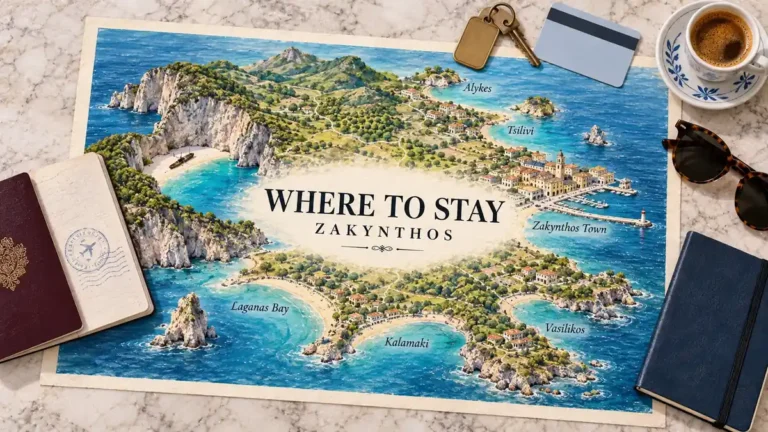
Zakynthos is the Ionian island of cliffs and sea caves, and its dramatic west coast is the single image that carries the whole island. The east side is a straightforward beach holiday. What makes it distinct is how neatly it splits: scenery on one coast, resorts on the other, a division the Zakynthos guide uses to sort where you stay. Skip it if you want town life, museums or a culture-led trip, because that is not what the island is built for. Pick this if: you want a short, sun-led week with one spectacular coastline.
Rhodes
Rhodes carries a UNESCO-listed medieval old town inside inhabited walls, and that is why it makes the list ahead of every other Dodecanese island. Few places in Europe still work that way. The distinction here is combination: Rhodes gives you history and a long beach coast on the same island, which the Rhodes guide treats as two trips in one. Skip it if you want small-island intimacy, since Rhodes is large, developed and busy in parts. Pick this if: you want ancient walls in the morning and a beach in the afternoon.
Best Places to Visit in Mainland Greece
Athens, Meteora and the Peloponnese are the mainland places that justify time away from the islands. The mainland rewards history-led travelers, self-drivers and anyone on a second Greek trip. It asks for a car and a tolerance for driving, and it gives back ancient sites and landscapes no island can match.
Meteora and the Peloponnese also pull in opposite directions on the map — one north of Athens, one south-west of it — so a first mainland leg should commit to one of them rather than half-doing both.
Athens
Athens is the capital, the main international gateway and the site of the Acropolis, and it belongs on this list as a destination, not a transit stop. Two or three nights change how the rest of the trip reads. What separates it from every other pick is that it is a working city instead of a holiday island, and the Athens guide handles it as one. Skip a long stay if the trip is short and beach-led, but do not skip the city altogether. Pick this if: you want ancient history and city dinners before the islands.
Meteora
Meteora is a UNESCO-listed cluster of monasteries built on top of sandstone pillars, and it is the mainland detour most worth the drive. The scale of the rock formations does not photograph honestly. What makes it distinct is that it is a landscape and a religious site at once, unlike anything coastal on this page, and the Meteora guide covers how to see it without rushing. Skip it on a one-week islands trip, where the detour costs more than it returns. Pick this if: you want one inland day that outshines the beaches.
The Peloponnese
The Peloponnese is the large southern peninsula holding Nafplio, Epidaurus, Mycenae and Olympia, and it packs more UNESCO-listed antiquity into one drive than anywhere else in Greece. Its coast stays quiet. What makes it distinct is that it is the only pick here designed around a car, and the Peloponnese guide is written as a driving region. Delphi lies just north of the peninsula and is often folded into the same route. Skip it if you will not rent a car. Pick this if: you want ancient sites and empty beaches on a self-drive loop.
Should You Visit the Greek Islands or the Mainland?
Choose the islands for a first trip and any beach-led holiday, and the mainland for history-led or self-drive travel. Combining both only works with two weeks, because each switch costs a moving day. With less time, one or the other gives you a better trip than a compressed version of both.
The islands win for first trips because they deliver the version of Greece most people are already imagining, and because a single island can hold an entire holiday without a second base. The mainland wins for travelers who came for antiquity, who want to drive, or who have already done a Cyclades week and want the part of the country that markets itself least.
One principle governs the combined trip: put the islands first and the mainland second. Island days depend on the sea. Mainland days depend only on the road, so a mainland leg can absorb a slipped plan that an island leg cannot.
Combining both also changes two practical things. You add moving days, which means fewer nights in each place. And you pack for three environments at once — a hot city, exposed ancient sites and the beach — which is why the Greece packing list is worth reading before a mixed trip. Country basics such as money, transport and entry rules sit in the Greece travel guide, not here.
Two weeks is the honest threshold, and the reason is attention more than distance: a mainland leg bolted onto a one-week island trip usually turns Athens into an airport hotel and Meteora into a photograph.
Fewer Places for Longer Is the Rule for Choosing Where to Go in Greece
Choose two or three bases inside one island group, plus Athens, instead of touring five islands. Three variables settle the rest: how long the trip is, what kind of traveler you are, and how much moving between places you genuinely enjoy. Get those right and the shortlist above narrows itself.
Travel style does most of the narrowing. Couples gravitate to scenery and quiet, families need shallow beaches and short transfers, and a nightlife trip has exactly one right answer in this list. Appetite for moving is the variable people misjudge most: if packing and unpacking drains you, one base beats three every time.
A base you keep for four nights is worth more than two you keep for two. The second night is when a Greek island stops being a viewpoint and starts being a place.
How Many Places Fit One Week, Ten Days or Two Weeks
Trip length sets the number of bases, not the number of sights.
- One week — Athens plus one island, or two islands inside the same group. Fits first-timers who want to arrive, settle and swim. The 7-day Greece itinerary shows how that shape works in practice.
- Ten days — Athens plus two islands in one group, or one island group plus Meteora. Fits travelers who want variety without a rushed pace. The 10-day Greece itinerary builds both versions.
- Two weeks — islands plus a full mainland leg, with room for the Peloponnese or a second island group. Fits returning visitors and anyone who dislikes cutting things. The 14-day Greece itinerary covers it.
If you are unsure which length your trip wants, the Greece itinerary guide sets the shapes side by side.
Too Many Islands Is the Mistake That Ruins First Trips
Five choices account for most disappointing Greek trips, and every one of them is made before booking.
- Too many islands. Four islands in ten days means three arrivals, three departures and very little time anywhere.
- Mixing island groups. Cyclades plus Ionian in one short trip means crossing the country twice. Stay in one group.
- Choosing by photograph. The most photographed island is not automatically the one that fits your budget, your pace or your company.
- Treating Athens as a stopover. A single night at the airport end of the trip wastes the only city on this list.
- Ignoring season and cost as selection variables. Shoulder months make the crowded islands pleasant and the quiet ones sleepy, so check when to visit Greece before locking a destination. Cost separates the picks too: Santorini and Mykonos sit at the expensive end of the country while Naxos, Paros and the Peloponnese sit well below them, and the Greece trip cost guide puts figures on that gap.
Best Places in Greece by Travel Style
First trips want Athens and Santorini or Naxos; couples want Santorini or Milos; families want Naxos. Nightlife points to Mykonos, and history points to Athens, Rhodes and the Peloponnese. The table below sets each style against its best pick, a strong alternative and the condition that should send you elsewhere.
| Travel style | Best pick and why | Strong alternative | Skip if |
|---|---|---|---|
| First trip | Athens plus Santorini, for the city and the caldera | Athens plus Naxos, for a calmer first island | You want no city time at all |
| Couples and honeymoons | Santorini, for caldera views and sunset dinners | Milos, for boat days and quiet coves | You want lively bars every night |
| Families | Naxos, for long shallow sandy beaches | Corfu, for green surroundings and gentle resorts | You want late nights and clubs |
| Nightlife | Mykonos, for beach clubs and late bars | Rhodes, for a busy town and beach mix | You are travelling with young children |
| Beach-led trips | Zakynthos, for a coast-first sun holiday | Chania and western Crete, for beach variety | You want museums and ancient sites |
| History and ancient sites | Athens, for the Acropolis and its museums | The Peloponnese, for Epidaurus, Mycenae and Olympia | You want a single beach base |
Two styles sit outside the table. Quiet trips lean toward Milos and the Peloponnese coast, both calm without being obscure. One-base trips with no moving at all point to Chania, Paros, or Athens with a single island attached.
Travel style beats scenery whenever the two disagree. A family on Santorini and a couple on Naxos will both have a decent week, and both will spend it wishing they had swapped. Once the destinations are settled, things to do in Greece covers what fills the days.
Frequently Asked Questions
How many Greek islands should you visit in one trip?
Two islands in a week and three in two weeks is the sensible ceiling, all inside one group. A useful rule is one island per four nights: fewer nights than that and you spend the stay arriving, unpacking and leaving, with little time for the place itself.
Is Santorini or Mykonos better for a first trip to Greece?
Santorini is the better first trip for most people, because the caldera is the image that brought them to Greece. Mykonos wins only if nightlife and beach clubs are the reason for the holiday. Both sit at the busy, expensive end of the Cyclades, so neither suits a quiet week.
What is the most beautiful place in Greece?
Santorini’s caldera is the most beautiful place in Greece, and no other landscape in the country competes with it directly. Meteora is the serious rival: monasteries on sandstone pillars, inland and entirely unlike the coast. Choose the caldera for sea views, Meteora for a scale that only registers in person.
Which Greek island is best if you only have one week?
Naxos or Paros is the best one-week island, because both hold beaches, villages and food without asking you to move again. Crete works too if you accept driving and stay in one corner. Pair either with two nights in Athens and the week feels complete, not rushed.
Which Greek island is best for a quiet trip?
Milos is the quietest of the main Cyclades picks, since its days revolve around boats and coves more than bars. Naxos delivers the same calm inland, in its mountain villages, while the north of Corfu suits travelers who want green surroundings. None of the three requires giving up comfort or connections.
Which places in Greece work without renting a car?
Athens and the smaller Cyclades islands work without a car, since towns, beaches and boat trips sit close together. Crete and the Peloponnese assume driving: both are large, and the coast, mountains and ancient sites that justify them sit too far apart to reach otherwise.
Related Guides
- Greece travel guide — the practical country basics behind every pick on this page.
- Greece itinerary guide — turn your shortlist into a workable route.
- Cyclades guide — the island group most first trips end up choosing.
- Crete guide — the single-base option for travelers who dislike moving.
- Things to do in Greece — what fills the days once the destinations are set.
- Best time to visit Greece — how timing changes which of these picks makes sense.
Did this guide save you time or money? Tripstou is independent and reader-funded — if you'd like to give something back, you can support the site with a crypto contribution of any size.