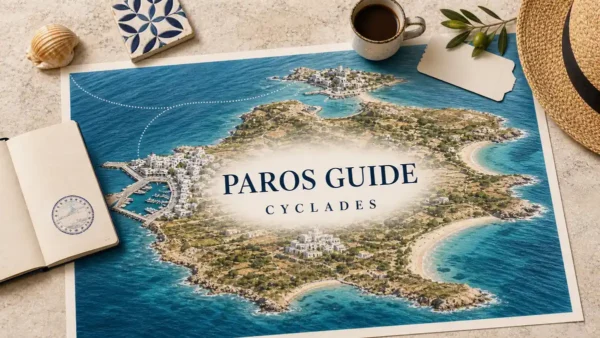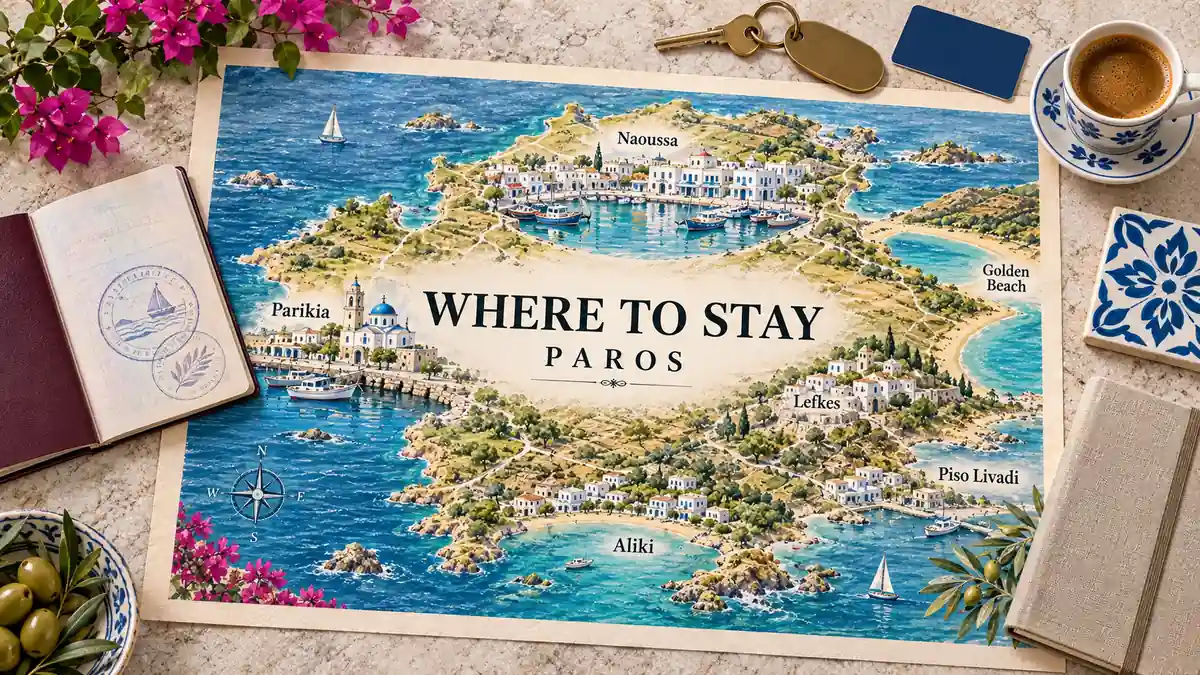
Paros is small enough that almost any base works for day trips, so the real choice is how you want your mornings and evenings to feel. Two forks decide it. The first is whether you will have a car: without one, the bus network narrows the sensible bases quickly. The second is town or beach — a lively harbour with restaurants on the doorstep, or a quiet village where the sea is the main event.
Between those forks sit the island’s two poles. Parikia is the port and bus hub where the ferry lands. Naoussa is the pretty, pricier harbour town on the north coast, with the island’s dining and nightlife. This guide gives a verdict on those two, profiles six main bases side by side, flags the areas that did not earn a full block, and ends with a map that matches each traveler type to one area.
Quick Answer
Parikia is the best overall base for most travelers: ferry port, bus hub, and it works without a car. Naoussa is prettier and holds the island’s dining and nightlife, but it is the most expensive area and the busiest in peak season. For a quiet or beach-led stay, choose Aliki on the sheltered south coast or Piso Livadi.
Trust Layer
Tripstou stay guide for travelers choosing where to base. Covers area atmosphere, budget, convenience, noise, and traveler fit.
Produced with AI assistance and reviewed by Alex Perrut, working in tourism since 2015, for the Tripstou editorial team. See our editorial process for details.
Last factual review: September 27, 2026.
Official sources consulted: Visit Greece, Greek Ministry of Tourism, KTEL Paros.
Key Takeaways
- Base in Parikia if you have no car: the ferry lands there and most KTEL bus routes start from its bus station.
- Choose Naoussa only when dining and nightlife lead, since it is the island’s most expensive area and the most crowded in July and August.
- A car-free Naoussa stay works day to day, but no bus runs direct to the airport, so airport journeys route through Parikia.
- For calm summer evenings, pick Aliki on the south coast, which sits in the lee of the meltemi that hits the north and east.
- A cheap room in Lefkes or Drios stops being a budget choice once a rental car is added to the bill.
- On a two- or three-night trip, stay where the ferry lands; split between town and beach only on longer stays.
Table of Contents
Naoussa or Parikia: which is the better base in Paros?
Parikia is the better base for most travelers; Naoussa wins only when dining and nightlife lead. Parikia is where the ferry lands and most island bus routes start, so it works without a car and keeps more budget options in play. Naoussa suits travelers with a high-end budget who want the prettiest harbour and the island’s liveliest evenings.
The Parikia-or-Naoussa question is really two questions. Do you have a car, and do you want busy evenings? If the answers are no and not especially, Parikia settles it. If you want to walk out of dinner straight into a bar and can absorb higher room prices, Naoussa earns its premium.
On a short stay, base where the ferry lands. With two or three nights, every move between towns eats into the trip, and Parikia puts you on the dock for departure day. Our plans for two days in Paros and the three-day Paros itinerary both work from that logic. On a longer stay, a split becomes worth it: a few nights in one of the two towns, then a beach or village base.
Naoussa is a seasonal town. Its restaurant and bar scene runs through roughly April to October and largely closes outside it, while Parikia keeps more of a working-town rhythm. In July and August, Naoussa’s lanes and harbour get crowded and rooms are priced to match.
Naoussa’s premium buys evenings, not access. From a Parikia base, Naoussa is a short bus ride away for dinner, while from Naoussa the trip back to the ferry is the one journey you cannot skip.
For ferries, sights and timing beyond the base question, the Paros travel guide covers the rest of the planning.
Hotels and places to stay
Compare hotels, apartments and stays for your dates in one search.
Search hotels and stays on hotels.com →
Tripstou may earn a commission if you book through this link, at no extra cost to you.
Without a car, Parikia is the base that works
Car-free travelers should base in Parikia, the island’s bus hub. Most KTEL routes start there, including direct lines to Naoussa, the coastal villages, the beaches and the airport. Naoussa is the one real alternative: it has a frequent link to Parikia and its own local lines to nearby beaches and villages. Everywhere else, a car helps.
The bases that work by bus, in order of how easily they do it:
- Parikia (the hub): suits anyone without a car, since most routes start here and the port is walkable. Trade-off: it is the busiest, most workaday base.
- Naoussa (the second hub): suits car-free travelers who want the dining scene. The bus to Parikia takes about 20 minutes and runs frequently into the evening, and local lines reach Santa Maria, Kolymbithres, Ambelas and Lefkes. Trade-off: there is no direct airport bus, so arrival day routes through Parikia.
- Aliki, Piso Livadi, Golden Beach and Drios (direct-line beach bases): possible without a car, since each has a direct line from Parikia. Trade-off: services are less frequent, so anything beyond your own beach takes planning.
KTEL fares are paid by bank card only. The missing airport–Naoussa bus is the detail that catches people out: a car-free Naoussa stay works well day to day, but the first and last journeys always pass through Parikia.
For the town itself, see our guide to staying in Parikia; for the car-free case in the north, staying in Naoussa goes deeper into the local lines.
The six main bases in Paros, compared
Paros has six main bases: Parikia, Naoussa, Aliki, Piso Livadi, Golden Beach with Drios, and Lefkes. One axis separates them. Parikia and Naoussa are town hubs with buses and evenings; Aliki, Piso Livadi and Golden Beach are quieter beach-led bases; Lefkes is the inland village for travelers with a car.
| Area | Feel | Car needed? | Relative price | Best for |
|---|---|---|---|---|
| Parikia | Working port town with an old quarter | No; ferry port and bus hub | Mid-range, with the most budget options | Short, car-free stays around the ferry |
| Naoussa | Fishing-harbour old town with dining and nightlife | No; frequent bus to Parikia | High-end, the island’s priciest area | Dining- and nightlife-led stays |
| Aliki | Small harbour village on the south coast | Helpful; direct but less frequent bus | Budget to mid-range options | Calm stays sheltered from the meltemi |
| Piso Livadi | Low-key east-coast harbour with tavernas | Helpful; direct but less frequent bus | Mostly mid-range guesthouses and small hotels | Slow harbour stays near east-coast beaches |
| Golden Beach and Drios | Long beach strip, quieter village at Drios | Helpful; direct but less frequent bus | Mostly mid-range beach accommodation | Beach-first stays where wind is welcome |
| Lefkes | Hillside inland village with marble lanes | Yes; one local line from Naoussa | Mostly mid-range village rooms | Village character over beach access |
Parikia: the port hub for short, car-free stays
Parikia is the most practical base on Paros and the right one for short, car-free trips. It is a working port town, with an old quarter of whitewashed lanes behind the harbour and a waterfront that fills up in the evening. The ferry dock, the bus station and everyday services all sit within walking distance. Prices run mid-range, and the town holds more budget rooms than any other area. The trade-off is atmosphere. Parikia feels busier and less polished than Naoussa, especially close to the port. The Parikia neighborhood guide covers which part of town suits which stay.
Best for: short, car-free stays built around the ferry and bus hub.
Naoussa: the prettiest base, and the priciest
Naoussa is the prettiest base on Paros and the most expensive one. Its old town wraps around a small fishing harbour and holds the island’s densest cluster of restaurants and bars. The bus to Parikia takes about 20 minutes, and local lines serve Santa Maria, Kolymbithres, Ambelas and Lefkes. There is no direct airport bus. Prices sit at the high end, and in July and August the lanes and harbour get crowded. Expect a seasonal scene: much of it closes outside roughly April to October. The Naoussa area guide covers where in town to stay.
Best for: dining- and nightlife-led stays on a high-end budget.
Aliki: the quiet south-coast base in the lee of the wind
Aliki is the calmest practical base on the south coast, suited to travelers who want quiet evenings and shelter from the wind. It is a small harbour village with a short waterfront of tavernas and a slow pace. A direct bus line runs to Parikia, less frequent than the Naoussa route, so a car helps. Prices run budget to mid-range. Its position in the lee of the meltemi is the main draw in high summer. The Aliki area guide covers the village in depth, and if it is a straight choice between the two, Parikia or Aliki settles it.
Best for: a calm south-coast base sheltered from the meltemi.
Piso Livadi: the calm harbour village near the east-coast beaches
Piso Livadi is a low-key harbour village on the east coast, best for travelers who want a slow pace close to the beaches on that side of the island. A small harbour and a row of tavernas set the tone, and evenings stay quiet. A direct bus line connects it to Parikia, less frequent than the Naoussa route, so a car makes day trips easier. Prices sit mostly mid-range. The east coast catches more wind than the south in high summer. Its calm, compact layout is also why it features in our guide to where families should stay in Paros.
Best for: a slow-paced harbour stay within reach of the east-coast beaches.
Golden Beach and Drios: the beach-first base for windsurfers
Golden Beach and Drios form the beach-first base on the east coast, and the right one for windsurfers. Golden Beach (Chrysi Akti) is a long sandy strip lined with low-rise accommodation, while Drios, at its southern end, is the quieter village. A direct bus line reaches both from Parikia, less often than the Naoussa route, so a car helps. Prices run mostly mid-range. The meltemi is the point here. In high summer the wind draws windsurfers, and for everyone else it is the trade-off. Evenings are quiet, with little beyond beachfront tavernas.
Best for: beach-first stays where the wind is welcome.
Lefkes: inland character, only with a car
Lefkes is the inland base for character, and it only works with a car. The hillside village sits in the centre of the island, with marble-paved lanes, whitewashed houses and noticeably cooler evenings than the coast. A local bus line links it to Naoussa, but beyond that every beach and town is a drive away. There is no beach. Prices run mostly mid-range, in small guesthouses and village rooms. It suits travelers who would sooner wake to hill views and quiet squares than step onto sand, and who are happy to drive every day.
Best for: village character over beach access, with a rental car.
Other areas worth knowing in Paros
Five more places are genuine options on Paros but did not earn a full block. Each suits a narrower traveler: Ambelas and Marpissa for quiet, Santa Maria and Parasporos for beach stays, Antiparos for a slower island feel. They work best as a second base or for travelers whose plan already points to one of them.
- Ambelas: a quiet fishing village near Naoussa, on one of Naoussa’s local bus lines. It suits travelers who want Naoussa’s restaurants close by without sleeping in the crowds.
- Santa Maria and Kolymbithres: beach stays on the Naoussa side of the island, served by Naoussa’s local lines. They suit beach-led trips that accept the windier north.
- Parasporos and Livadia: beach areas close to Parikia, with a direct bus line to Parasporos. They suit travelers who want Parikia’s convenience with sand nearby.
- Marpissa and Prodromos: inland villages near Piso Livadi that need a car. They suit a quiet, traditional village stay with the east-coast beaches a short drive away.
- Antiparos: a separate island reached from Pounda in a few minutes, with a direct bus from Parikia to Pounda. It suits a slower pace, though every Paros outing adds a ferry step.
For how a second base fits a wider route, the guide to planning a Paros trip covers ferries and timing.
Which side of Paros is less windy in summer?
The south coast around Aliki is the least windy side of Paros in summer. It sits in the lee of the meltemi, the northerly wind of high summer in the Cyclades. The north and east catch far more of it, including the Naoussa bay beaches and Golden Beach. Wind-sensitive travelers should lean south.
The pattern shapes the base choice in two opposite ways. Travelers who want calm water and still evenings are better served by Aliki. Windsurfers want the reverse, which is why Golden Beach and Drios fill with them in high summer.
Town bases feel the wind less than beach bases. In Parikia or Naoussa, a gusty day changes which beach you head for; in Golden Beach, it changes the whole day. Lefkes sits inland, away from exposed sand, but it has no beach to lose.
Plan around it. On a windy day, a car lets you switch coasts.
Where to Stay in Paros on a Budget
Parikia, Aliki and Piso Livadi hold most of the island’s budget and mid-range options. Naoussa is the high-end area, with the highest prices on Paros and the sharpest peak-season rise. Budget travelers do best in Parikia, where cheaper rooms sit beside the bus hub, so the savings are not spent on a rental car.
- Budget: simple rooms and guesthouses, taverna meals and buses instead of a car. Parikia is kindest to this style, with Aliki as the quieter fallback. Naoussa is punishing for it in peak season.
- Mid-range: small hotels in Aliki, Piso Livadi, Golden Beach or Lefkes, with a rental car for part of the stay. This is where Paros offers the widest choice.
- High-end: Naoussa’s design-led hotels and harbour dining, or a sea-view boutique stay elsewhere on the island. Our shortlist of boutique hotels in Paros covers this tier.
Peak season raises prices everywhere, hardest in Naoussa. Book early for July and August.
A cheap room that needs a car is not a budget base. Once a rental is added, a low-priced room in Lefkes or Drios can cost more overall than a plain room in Parikia with the bus station at the door.
Best Areas in Paros by Traveler Type
The map below matches each traveler type to one best area in Paros. It compresses the page into one line per type. Parikia covers first-timers and car-free trips, Naoussa covers dining and nightlife, Aliki and Piso Livadi cover quiet stays, and Golden Beach and Lefkes serve narrower needs.
- First-time visitors: Parikia, because the ferry and buses start there; see our advice for first-time visitors to Paros.
- No car: Parikia, the hub where most bus routes start.
- Dining and nightlife: Naoussa, home to the island’s liveliest evenings.
- Couples wanting the prettiest setting: Naoussa, for its harbour and old town.
- Families: Piso Livadi or Aliki, for calm harbours and quiet evenings; see Paros with kids.
- Quiet and sheltered: Aliki, in the lee of the summer wind.
- Beach and windsurfing: Golden Beach, where the wind is the attraction.
- Village character with a car: Lefkes, for inland lanes and cooler evenings.
- Slower island-hopping feel: Antiparos, a few minutes across from Pounda.
- Boutique-hotel-led stay: start from the boutique hotel shortlist and pick the area second.
Frequently Asked Questions
Do you need a car in Paros?
Not for a Parikia or Naoussa base, where buses cover the main routes. A car earns its cost when you stay in a beach village such as Drios or Piso Livadi, base in Lefkes, or want to switch coasts on a windy day. Renting for part of the stay, not the whole trip, is often enough.
Is it better to stay in Paros or Antiparos?
Paros is better for most trips, with more areas, more accommodation choice and the main ferry port for onward travel. Antiparos suits travelers who want a slower, smaller island and accept an extra step: every outing to Paros means the short crossing from Pounda, which takes a few minutes, then a bus or car onward.
How long does the bus from Parikia to Naoussa take?
The bus from Parikia to Naoussa takes about 20 minutes. Services run frequently into the evening in season, and fares are paid by bank card only. That short link is why staying in one town and having dinner in the other is easy, even on a car-free trip around Paros.
Is Naoussa too busy in July and August?
Naoussa is at its busiest in July and August, with crowded lanes, a full harbour and the island’s highest room prices. It suits travelers who want that buzz. If crowds are the worry, base in Parikia and visit Naoussa for dinner, or choose Aliki on the quieter south coast.
Should you split your stay in Paros between two areas?
Only on a longer stay. On two or three nights, one base near the ferry saves packing and transfer time, and Parikia suits that best. With a week or more, a split works well: a few nights in Parikia or Naoussa, then a quieter beach or village base such as Aliki, Piso Livadi or Lefkes.
Is Golden Beach a good place to stay if you do not windsurf?
It can be, if you want a beach-first stay and do not mind wind. Golden Beach faces the meltemi in high summer, so beach days can be gusty. Drios, at the southern end, adds a quieter village feel for evenings. Wind-sensitive travelers who want calm water do better in Aliki on the south coast.
Related Guides
- Staying in Parikia — the port town’s areas in depth, for car-free and short stays.
- Staying in Naoussa — where to base in the island’s dining and nightlife town.
- Staying in Aliki — the sheltered south-coast village in more depth.
- Parikia or Aliki — the head-to-head for travelers torn between hub and quiet.
- Where to stay in Paros for first-timers — the first-visit base decision, resolved.
- Where families should stay in Paros — bases that work with children.
- Boutique hotels in Paros — the hotel shortlist once the area is chosen.
- Paros travel guide — ferries, sights and timing for the whole island.
Did this guide save you time or money? Tripstou is independent and reader-funded — if you'd like to give something back, you can support the site with a crypto contribution of any size.