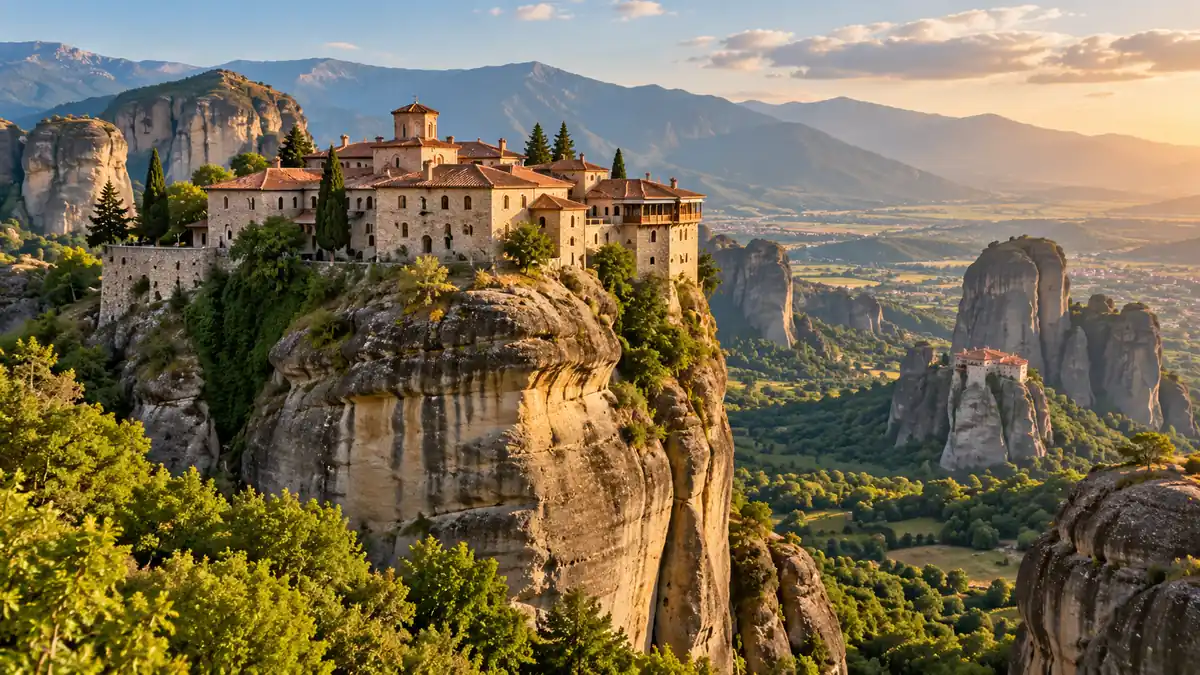
Meteora is worth the trip: working Orthodox monasteries sit on top of sandstone pillars above Kalambaka in Thessaly, so you get a living religious site and one of Greece’s great landscapes in the same visit. Plan on one night in Kalambaka or Kastraki; a same-day return from Athens is possible but leaves little time inside. Each monastery closes on a different weekday, so a single day means choosing among the ones open that day, while an overnight or two days gives you all of them plus sunset or sunrise over the rocks.
This guide is organised around that closure-day logic: work out which monasteries are open on your dates first, and the questions of how long to stay, where to sleep and how to get up the hill answer themselves.
On This Page
Is Meteora Worth Visiting?
Meteora is worth visiting for travelers drawn to religious history, landscape photography or walking. The payoff is rare: monasteries still in daily use, perched on rock towers, with views between them that change by the hour. It suits less well if you are short on time and dislike long transfers, or if stairs are hard for you, since only St. Stephen can be reached without a climb.
Meteora is a UNESCO World Heritage Site, and it is not a museum. Monks and nuns live in the monasteries, services still take place, and visiting hours are set around that life. The Great Meteoron, the largest of them, was founded by the monk Athanasios around 1340.
The visit rewards slowness. The interiors are small and dense with frescoes, and the time between them, on the road or on the old footpaths, is half the experience. If you are still deciding where Meteora fits among your options, compare it with the best places to visit in Greece before committing the days.
How Meteora Is Laid Out: Monastery Road, Villages and Footpaths
Meteora is compact. One road loops past the six working monasteries above two settlements: Kalambaka, the town where trains and buses arrive, and Kastraki, the village tucked right under the rocks. Old footpaths link both villages to the monasteries, so the area works on foot as well as by road.
The monastery road
Six monasteries are still active out of the 24 that once stood on the rocks: the Great Meteoron, Varlaam, St. Stephen (Agios Stefanos), Holy Trinity (Agia Triada), Roussanou and St. Nicholas Anapafsas. Roussanou and St. Stephen are nunneries; the others are home to monks.
The Great Meteoron and Varlaam stand close together, which makes them a natural pair on any visit. St. Stephen is the one you can walk straight into from the road. Inside, expect frescoed churches and small museums; outside, the viewpoints along the road between monasteries are as memorable as the interiors.
The road is the part to prioritise for first-time visitors, families and travelers who prefer to see a lot in a short stay.
Footpaths, hermit caves and sunset viewpoints
The best sunset in Meteora is watched from the viewpoints along the monastery road, and that view is the reason many people stay the night. As the light drops, the rock towers turn gold and the monasteries go dark against them.
The walking side of Meteora is older than the road. Footpaths climb from Kastraki and Kalambaka up to the monasteries, and the rock faces are pocked with hermit caves where monks once lived. Guided sunset and hermit-cave walks start in Kalambaka for those who want the stories along with the route, and you can reserve a sunset spot ahead in busy months. Hikers and photographers get the most out of this side of Meteora.
Kalambaka is the practical town with the station and most of the services; Kastraki is the quieter village closer to the trailheads. Which one makes the better base is the question of the stay section below.
Which Meteora Monasteries Are Closed on Which Day?
Every Meteora monastery shuts on its own weekday: the Great Meteoron on Tuesday in summer and three days a week in winter, Roussanou on Wednesday, Holy Trinity on Thursday, Varlaam on Friday and St. Stephen on Monday. The day you visit therefore decides which interiors you can see. St. Nicholas Anapafsas has no reliably published closure day, so check it locally.
| Monastery | Closed in summer | Closed in winter | Getting in |
|---|---|---|---|
| Great Meteoron | Tuesday | Tuesday, Wednesday and Thursday | Stairs and uphill path |
| Varlaam | Friday | Friday (confirm locally) | 195 steps |
| Holy Trinity (Agia Triada) | Thursday | Thursday | 149 steps |
| Roussanou (nunnery) | Wednesday | Wednesday | Stairs and uphill path |
| St. Stephen (Agios Stefanos, nunnery) | Monday | Monday | Bridge from the road, the easiest access |
| St. Nicholas Anapafsas | Check locally | Check locally | Stairs and uphill path |
Hours matter as much as days. The Great Meteoron closes earliest, by mid-afternoon in summer, and winter hours are shorter at every monastery. Each monastery sets its own switch between summer and winter seasons, and the hours are kept strictly. That is why the Greek tourism board itself advises calling ahead and spreading the visits over two or more days.
Midweek in winter is the thinnest stretch. On Wednesday and Thursday the Great Meteoron is shut alongside that day’s regular closure, so a winter day trip landing midweek sees noticeably fewer interiors than the same trip at the weekend.
One Day or Two in Meteora?
One night is the strongest first trip to Meteora. Arrive in the afternoon for a sunset viewpoint, then do the monastery road the next morning around that day’s closures. A same-day trip from Athens only works as a long guided day, and it fits in just a few interiors.
- A day trip covers the road loop and a handful of interiors. From Athens it is a long day with much of it spent in transit; from Thessaloniki it is noticeably easier. It fits travelers with a fixed base who would sooner see Meteora briefly than not at all.
- One night adds the evening light and an early start, so you can pick monasteries freely by the day’s closures. This is the plan for most first-time visitors.
- Two nights or more leave room for the footpaths, a second chance at any monastery closed on your first day, and the Christmas or Easter services. Hikers and anyone travelling in winter gain the most from the extra day.
For one day, pick by weekday using the closure table, then start with the Great Meteoron, because it closes first. Varlaam is close by, so it follows naturally. Finish at St. Stephen: it is the easiest to reach, which helps at the end of a day when legs are tired.
Guided two-day trips from Athens also exist for those who want the overnight without arranging it, and you can book a two-day trip with the hotel night included. If you are fitting Meteora into a longer route, start from planning a full Greece itinerary so its days do not crowd out the rest.
Tours and activities
Book skip-the-line tickets, day trips and local tours with free cancellation on most activities.
You can also browse everything on getyourguide.com.
Tripstou may earn a commission if you book through this link, at no extra cost to you.
How to Get to Meteora From Athens or Thessaloniki
Kalambaka is the gateway to Meteora. From Athens the usual choices are the train with a replacement bus for the last leg, the KTEL intercity bus via Trikala, a car, or a guided day trip; Thessaloniki is the closer starting point.
- Train: yes, you can get to Meteora by rail. Take the train to Palaiofarsalos, where Hellenic Train runs a replacement bus for the final leg to Kalambaka. It is a long journey that makes a same-day return from Athens tiring, so it works best for travelers staying at least one night.
- KTEL bus: intercity buses reach Kalambaka with a change at Trikala. It works when the train connection does not suit your day, at the cost of the change.
- Car: a long drive from Athens, shorter from Thessaloniki. Driving is the road-tripper’s choice when Meteora is one of several mainland stops, and it frees you to time each monastery around its hours.
- Guided day trip: removes all the logistics, but you lose the slack to work around closure days and the evening light. The full-day coach trip from Thessaloniki is a popular way to do it: the shorter run makes it a comfortable day, with time for several monasteries and the viewpoints between them. From Athens the same idea means a much longer day; weigh it against other day trips from Athens before choosing.
Getting Around Meteora Without a Car
Without a car, a taxi or the seasonal local bus covers the climb from Kalambaka to the monasteries, and the footpaths let fit walkers skip both.
- Short on time or linking monasteries: take a taxi. The ride from Kalambaka up to the monasteries is about 7 km and takes about 10 minutes, and a taxi one way pairs well with walking back down.
- Visiting between spring and late autumn: the local bus runs from Kalambaka to the monasteries from 15 March to 30 November. There is no service outside that window, so winter visitors rely on taxis, tours or their own feet.
- Fit and happy on stairs: walk the old footpaths up from Kastraki or Kalambaka. It is the most rewarding way in, though the climbs are steep and the paths get hot by midday in summer.
- Wanting someone else to handle it: half-day and small-group minibus tours leave from Kalambaka and string several monasteries and viewpoints together, so nobody in the group has to drive or plan the route.
- Arriving by car anyway: your own wheels let you time each monastery to its hours and closure day without waiting on anyone.
A guided morning is the simplest answer for travelers who arrive by train in the afternoon and leave the next day: you can book a morning minibus tour from Kalambaka for the day after you arrive.
Should You Stay in Kalambaka or Kastraki?
Stay in Kalambaka if you arrive by train or bus and want restaurants and services close at hand; stay in Kastraki if you are a walker or a sunset-chaser who wants to sleep right under the rocks and closer to the trailheads.
Kalambaka is the working town. The station and bus stop are there, along with most of the shops, places to eat and practical services, which makes arrival and departure simpler, especially on public transport.
Kastraki trades convenience for atmosphere. It is smaller and quieter, the rock towers rise directly above the rooftops, and the footpaths to the monasteries start nearby, which suits early starts and evening walks.
The choice is low-risk. The two are a short walk or taxi ride apart, so a base in one never cuts you off from the other.
Spring and Autumn Are the Best Times to Visit Meteora
Spring and autumn are the best times to visit Meteora: the walking weather is at its best and the monasteries keep their full summer schedules. Summer works but is hot on the stairs and footpaths. Winter brings mist, slippery trails, shorter hours and more closure days, along with the solemn Christmas season.
Summer is fine for travelers who stick to the monastery road and start early. Winter rewards those who want the misty, quiet version of Meteora and can be flexible, since the local bus stops running outside its season. Easter is especially solemn in Meteora, and it is busy for the same reason.
For a month-by-month view across the country, see the best time to visit Greece.
Meteora Dress Code and How Much Climbing to Expect
Cover your shoulders, wear long trousers if you are a man and a long skirt if you are a woman, and expect stairs at every monastery except St. Stephen, which is reached by a bridge from the road.
- Shoulders: covered for everyone.
- Men: long trousers.
- Women: long skirts.
- Forgot something: skirts and scarves are typically provided at the entrance.
Varlaam, with 195 steps, and Holy Trinity, with 149, are the heaviest climbs. The others also involve stairs and uphill paths. St. Stephen is the monastery to choose for limited mobility, since the stone bridge from the road leads straight in.
Etiquette is simple and taken seriously. Keep quiet in the churches, be courteous to the monks and nuns whose home this is, and keep to the hours: closing time is when the door shuts, not when to start leaving.
What a Meteora Trip Costs, by Travel Style
Meteora is an inexpensive place to visit once you are there. The main costs are getting to Kalambaka and the night’s stay, plus a small entry fee at each monastery, paid at the door.
On a tight budget, Meteora is kind. Public transport gets you to Kalambaka, the seasonal bus or your own legs get you to the monasteries, and a simple guesthouse in town or in Kastraki covers the night. Choosing which monasteries to enter is the only real spending decision on the hill.
A comfortable middle adds taxis between monasteries and a hotel with a view of the rocks. Those two choices buy time and the evening light, which matter more here than in most places.
A higher-spend trip pays for convenience: a guided day trip or a two-day tour from Athens, or private transfers. The money goes on removing logistics, since Meteora itself has little luxury to spend it on.
Meteora Works Best as an Overnight Stop on a Mainland Route
Most travelers visit Meteora as a one- or two-night stop on a mainland loop, often combined with Delphi or placed between Athens and Thessaloniki. A standalone trip suits those who come specifically for the monasteries or the hiking.
As an add-on, Meteora breaks up the long run north from Athens and turns a driving day into a highlight; a Greece road trip through the mainland is the natural frame for it. Delphi and Meteora are a common pairing on these loops.
Trip length decides whether it fits. In a 7-day Greece itinerary Meteora competes hard with Athens and an island; with 10 days in Greece it slots in comfortably as an overnight; across two weeks in Greece it can take two nights alongside the islands.
Meteora also sits close to quieter places in mainland Greece that see far fewer visitors. For the wider picture of the country, start with our Greece travel guide.
Plan Meteora Around These Points
- Check which monasteries are closed on your travel dates before booking anything, because each one shuts on its own weekday and the Great Meteoron closes three days a week in winter.
- One night in Kalambaka or Kastraki beats a same-day return from Athens, adding the evening light over the rocks and a free choice of monasteries the next morning.
- On a one-day visit, start at the Great Meteoron because it closes earliest, add nearby Varlaam, and finish at St. Stephen.
- St. Stephen is the monastery for limited mobility, reached by a bridge from the road, while Varlaam (195 steps) and Holy Trinity (149) are the steepest climbs.
- The local bus from Kalambaka up to the monasteries runs only from 15 March to 30 November, so winter visitors need a taxi, a tour or the footpaths.
- Monastery dress means covered shoulders, long trousers for men and long skirts for women, with skirts and scarves typically provided at the entrance.
How We Checked This Guide
This page plans a Meteora visit: which monasteries open on which day, whether to sleep in Kalambaka or Kastraki, how to get there and up the hill, the seasons and the dress code. It is not a monastery history, a timed itinerary, a train timetable or a roundup of hotels and tours.
Alex Perrut, working in tourism since 2015, went over the closure days and transport options for the Tripstou editorial team; the guide was written with AI assistance under our editorial process.
Official sources consulted: Visit Greece, Tourist Information Center of the Municipality of Meteora, Hellenic Train.
Did this guide save you time or money? Tripstou is independent and reader-funded — if you'd like to give something back, you can support the site with a crypto contribution of any size.