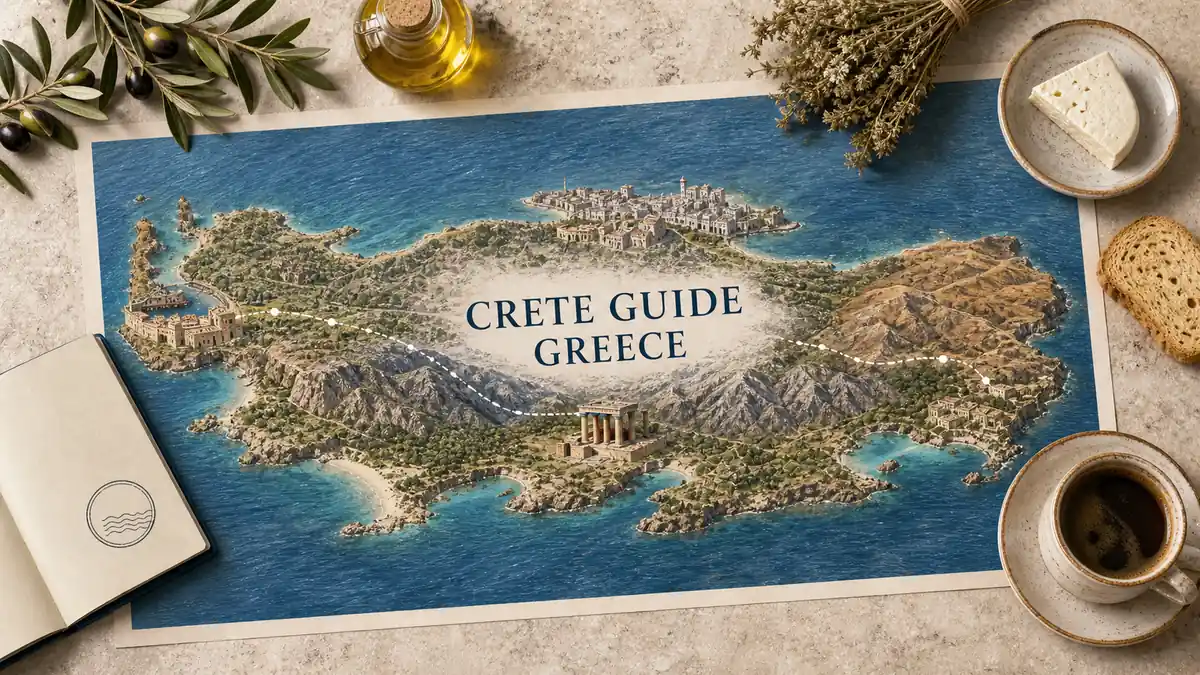
Crete is Greece’s largest island, and the standard planning mistake is treating it like one. Travelers arrive with an island mental model: one town, one beach, everything a short hop away. What they find is a destination with a mountain range down its middle, three distinct regions, two international airports and a cuisine locals treat as its own tradition. Planning it like a small country works. Planning it like a small island does not.
You have already chosen Crete. This guide resolves what comes next: which part of the island to base in, how many days it deserves, how to get there and which airport to use, whether you need a car, and when to go. Sight-by-sight depth lives on our Crete attraction pages; this page decides the shape of the trip.
Quick Answer
Crete is Greece’s largest island and easily fills an entire trip on its own. The real decisions are which part to base in — west, centre or east — and how many days to give it. First-timers do best basing in the west around Chania, adding a second base only on longer trips.
Trust Layer
Tripstou region guide for travelers planning a regional trip. Covers sub-areas, trip shape, base strategy, timing, and mobility tradeoffs.
Produced with AI assistance and reviewed by Alex Perrut, working in tourism since 2015, for the Tripstou editorial team. See our editorial process for details.
Last factual review: August 29, 2026.
Official sources consulted: Visit Greece, Greek Ministry of Tourism.
Key Takeaways
- Crete works as a whole trip in itself, so plan one part of the island properly and leave the rest for later.
- Base in the west around Chania for a first visit; the centre suits history, the east suits quiet, the south suits escape.
- Give the island the best part of a week for one base, and closer to two weeks if you want both ends.
- A car unlocks the interior, the south coast and the best beaches; buses serve the north-coast towns perfectly well.
- Flying into one airport and out of the other turns the island’s length into a route instead of a backtrack.
- Crete’s warm season starts earlier and holds later than most of Greece, which widens your choice of dates.
Table of Contents
Crete Is Big Enough to Be the Whole Trip
Crete is worth a trip of its own — Greece’s largest island, big enough to be organised into distinct regions. Its west, centre and east feel like separate destinations, split further by a mountain spine that keeps the north and south coasts in different worlds. Plan parts of it, never all of it.
The small-island mental model is what breaks Crete trips. On a compact island you pick one town and everything worth seeing is a short hop away. Here, the towns strung along the north coast — Chania, Rethymno, Heraklion, Agios Nikolaos, Sitia — are genuinely separate bases, and crossing from the western end to the eastern end is a multi-day undertaking, not an afternoon. Mountain ranges run the island’s length and push most routes onto the coasts, which is why getting to the south is a decision in itself and not a detour.
Crete suits travelers who like to settle in. If your instinct is to bank a place and move on, the island turns into a sequence of long transfers between the things you came for. It rewards the opposite instinct — one region, worked properly, with the rest saved for a second visit. Which island to pick is a question this page assumes you have already resolved; the full comparison sits in our guide to the Greek islands, and the national planning picture in the Greece travel guide.
The island’s scale also makes it unusually easy to travel alone. Its bases are working towns with year-round populations, real transport and evening life, so you are rarely the only visitor on a street after dark. Our solo female travel guide to Greece covers the national patterns worth reading before you go.
Crete punishes ambition and rewards editing. The travelers who enjoy it most decide which two thirds of the island to leave out before they book anything.
How Crete Divides: West, Centre, East and South Coast
The west suits first-timers, the centre suits history and logistics, the east suits quiet, and the south suits escape. Each part of Crete has its own character, its own road logic, and its own natural base town. Choosing between them is the first real decision of the trip, and it matters more than any single sight.
West Crete — the postcard side, and the one most people picture when they imagine the island. Its anchor experiences are the pale-water lagoons at Balos and Elafonisi and the gorge country inland, including the walk down the Samaria Gorge from the Omalos plateau to Agia Roumeli on the south coast, which is reached on foot or by boat. Chania is the natural base. Those beaches are famous nationally, and the selection logic across the country lives in our guide to the best beaches in Greece. Best for: first-time visitors who want the classic version of Crete without changing hotels.
Central Crete — the island’s history and its engine room in the same stretch of coast. Knossos, the Minoan palace, sits just outside Heraklion, and the island’s museums, ports and onward connections cluster here too. Rethymno gives the centre its atmosphere; Heraklion gives it its logistics. Pick between them by deciding what you want to walk out of the door into. Best for: history-led trips and travelers who need the widest onward connections.
Eastern Crete — drier, lower-key and noticeably less trafficked, with a coastline of small harbours and sheltered gulfs. Agios Nikolaos is the natural base, with the fortified island of Spinalonga offshore and Sitia further out as the quiet end of the island. Development thins the further east you go. Best for: repeat visitors and anyone who wants beach days without the crowds.
The south coast — reached over the mountains, and a different island once you arrive. Villages sit where the road runs out, some of them only reachable by boat, and the gorge routes from the interior come down to the sea along this side. There is no single base town; you choose a village and stay in it. Best for: travelers whose priority is switching off completely.
Where to Base Yourself in Crete
Base in the west, around Chania, for a first trip to Crete. It combines an atmospheric harbour town with the island’s best-known beaches and its gorge country, so you get variety without long drives. The centre wins if Minoan history leads your trip; the east wins if you want quiet; the south wins if you want to disappear.
| Base | Who it suits | What it puts you near |
|---|---|---|
| Chania | First-time visitors who want variety from one base | Old harbour, western lagoon beaches, gorge country |
| Rethymno | Travelers who want atmosphere with central road access | Venetian old town, long town beach, mountain villages |
| Heraklion | History-led trips needing the widest onward connections | Knossos, the archaeological museum, the main transport hub |
| Agios Nikolaos | Repeat visitors chasing quieter beaches and small harbours | Sheltered gulf swimming, Spinalonga, the road east to Sitia |
| South coast villages | Travelers whose priority is genuinely switching off | Gorge exits, boat-only beaches, empty stretches of coast |
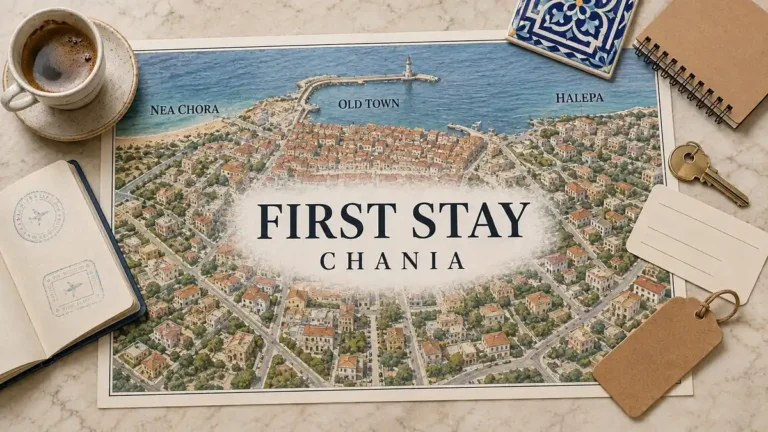
Chania is the only base on that list that earns a guide of its own, and it is where most first trips should start — the detail on neighbourhoods, the old town and how to use it as a base sits in our Chania guide. The other four are chosen the same way: decide what you want within easy reach on a normal day, then book the town closest to it. Do not split a short trip between two of them.
What you pay to stay depends far more on when you come than on which of these towns you pick, since the island’s calendar swings harder than its geography does. Our Greece trip cost guide handles the budget side across the country.
Chania or Heraklion: Which Base Wins for a First Trip?
Chania wins for a first trip; Heraklion wins if Minoan history is the reason you came. Chania gives you a Venetian harbour town you will want to walk every evening, plus the western beaches and gorges within day-trip reach. Heraklion is the island’s transport and archaeology capital, with Knossos on its doorstep, and it is the more practical base if you are moving on to another island afterwards. The tradeoff is atmosphere: Heraklion is a busy working city, and travelers who came for postcard Crete tend to feel that immediately.
Hotels and places to stay
Compare hotels, apartments and stays for your dates in one search.
Search hotels and stays on hotels.com →
Tripstou may earn a commission if you book through this link, at no extra cost to you.
How Many Days Do You Need in Crete?
Crete needs the best part of a week to justify the journey, and closer to two for both ends. Shorter trips still work, but only if you commit to one part of the island and stop trying to see the rest. Length here is really a question of how many bases you can justify unpacking in.
- A long weekend — one base, one region, no crossing the island. This is Crete as an add-on to a wider Greece trip, and it works if you accept it as a preview.
- Around a week — one base worked properly, with day trips running out in every direction from it. This is the default first Crete trip and the length most travelers should book.
- Ten days to two weeks — two bases, typically one in the west and one in the centre or east, with a genuine change of landscape between them. Enough time to include the south coast without rushing it.
None of those tiers is an itinerary, and deliberately so. If you want the day-by-day version, start with our Greece itinerary planner and then the length that matches your trip — 7 days in Greece, 10 days in Greece or 14 days in Greece.
Crete also inverts the usual Greek trip logic. On the smaller islands the pleasure comes from movement, and a compact base like Paros is designed to be paired with hops to its neighbours. Crete gives you that variety internally, without a single boat. That is the whole argument for staying put: the island already contains the change of scene you would otherwise go looking for.
Should You Stay in One Base or Move?
Stay in one base for anything under a week, and move once for anything longer. A single base removes the packing days that quietly eat short trips, and Crete’s north-coast towns all support day trips in several directions. The tradeoff is reach — from one base, the far end of the island stays out of range, and no amount of early starts fixes that. Travelers who want both ends usually solve it by flying into one airport and out of the other, which is covered next.
Getting to Crete: Fly, Ferry, and Which Airport to Choose
Flying is the fastest way in for most travelers, into either Chania or Heraklion. Both are international airports on the north coast, and both are served from Athens when no direct route works from home. The ferry from Athens is the alternative, and it runs year-round. Choose your airport by choosing your base first.
Chania serves the west, Heraklion serves the centre and the east, and Sitia is a smaller third airport at the quiet end of the island. Direct international flights are seasonal in character and thin out at the edges of the year, which is when routing via Athens becomes the normal way in. Check both airports before booking; the cheaper arrival is often not the closer one.
The sea route matters more than travelers expect. The Athens link runs all year, and seasonal connections tie Crete to the southern Cyclades — enough that arriving by boat and leaving by plane, or the reverse, is a legitimate way to build the trip. Routes, crossings and how island connections actually chain together are covered in our Greek island hopping guide.
The most useful planning move on this page is the open-jaw booking: fly into Chania, out of Heraklion. It converts the island’s length from a problem into a route, because you never drive the same coast twice. On a two-week trip that asymmetry is worth more than any single day you would save elsewhere.
Should You Fly Into Chania or Heraklion?
Fly into Chania if you are basing in the west, and into Heraklion for the centre, the east or a trip built around Knossos. The rule is simply to land where you sleep, since transfers between the two ends of the north coast are long enough to cost you a day. If you are splitting the trip across two bases, book them as separate arrival and departure airports and let the itinerary run one way.
Do You Need a Car in Crete?
Yes, if you plan to see more than one part of Crete. A car is the practical default here, because the island’s interior, south coast and best beaches sit off the public network. Without one you can still have a good trip — it just becomes a north-coast trip, built around the towns the buses connect.
The bus network is genuinely useful along the north coast, linking the main towns west to east with the kind of frequency that makes a car-free trip workable. Coverage thins fast once you leave that corridor. Mountain villages, the south coast and the smaller beaches are where the timetable stops being a plan and starts being a constraint, and that is exactly where the island is at its most rewarding.
The cost of the freedom is the driving itself. Roads over the mountains are narrow, slow and heavily switchbacked, so any crossing takes longer than the map suggests, and the west-to-east run is a route to design rather than a transfer to squeeze in. Route order, stops and how to string the drive together properly are handled in our Greece road trip guide. Before you drive or take taxis anywhere in the country, our guide to common scams in Greece covers the patterns worth recognising.
Renting is a question of what you want to reach, not of what it costs. Travelers who want two beaches and a harbour town will not miss a car; travelers who came for gorges, villages and the south will spend the trip negotiating around not having one.
When to Visit Crete
Late spring and early autumn are the best times to visit Crete. The island sits further south than the rest of Greece, so its warm season starts earlier and holds later, and the shoulder months behave like high season elsewhere. Summer is hot and crowded; winter closes much of the coast down.
That longer season is Crete’s real timing advantage. Swimming weather arrives before the mainland’s and lingers after the Cyclades have started to shut for the year, which makes the island the sensible choice when your dates fall outside the standard Greek summer. The south coast holds warmth longest, and it is the part of Crete most worth planning a late trip around.
Mountain access is the counterweight. Gorge walking and the high interior are seasonal by nature, dependent on conditions and on official access decisions, so a trip built around the interior needs its dates confirmed with the site itself before anything is booked. Coastal Crete stays open for far longer than the mountains do.
The national picture — regional differences, festivals and how the Greek calendar shapes prices — sits in our guide to the best time to visit Greece. Whatever season you land in, the island asks for layers and proper footwear more than most Greek destinations, which our Greece packing list accounts for.
What Defines Crete: Minoan Sites, Gorges, Beaches and Food
Crete is defined by four things: Minoan ruins, gorge country, headline beaches and a cuisine of its own. The Minoans left their palace capital here, mountains carved walking routes down to the sea, and the coast holds lagoons people plan whole trips around. The food is the part travelers underestimate.
Five names carry most of the island’s identity. Knossos, just outside Heraklion, is the Minoan palace and the reason central Crete draws history travelers. The Samaria Gorge cuts from the Omalos plateau down to Agia Roumeli on the south coast, ending at a village reached on foot or by boat. Spinalonga is the fortified island off the eastern gulf. Balos and Elafonisi are the western lagoons that account for a large share of the photographs that brought you here in the first place.
Each of those deserves more room than a regional guide can give it, which is why the depth lives elsewhere: opening logistics, tickets, walking practicalities and how to fit them into a day are in our things to do in Crete guide, and the quieter alternatives to all of them in Crete’s hidden gems. The gorge and the boat trips are also where the guided-versus-independent question surfaces properly, and that decision is resolved on the same pages.
Cretan food is a regional tradition in its own right, not a local accent on Greek cooking. The island grows and makes most of what it eats — olive oil, greens, cheeses, honey, rusks — and the mountain villages take that seriously enough that eating well inland is easier than eating well on a resort strip. Dish by dish, our Greek food guide covers what to order. For where Crete sits among the country’s headline destinations, see our roundup of the best places to visit in Greece.
Frequently Asked Questions
Can you visit Crete without a car?
Yes. A car-free Crete trip works if you base in a north-coast town and build the trip around it, since the bus network follows that corridor. You will reach the main towns and their beaches comfortably, but the mountain villages and most of the south coast stay out of practical range.
Is Crete expensive compared with the rest of Greece?
Crete sits around the middle of the Greek range, not at the expensive end. Its size works in your favour: it has a year-round economy, working towns and a broad spread of places to stay, so options exist at most levels. What you pay depends far more on season than on base.
Is Crete a good first trip to Greece?
Yes, for travelers who want one destination done well. Crete gives you a harbour town, beaches, mountains, ruins and a distinct food culture without a single boat transfer, which makes it an unusually low-friction first trip. It suits you less well if your idea of Greece is hopping between small islands.
Can you day trip from Crete to Santorini?
Treat it as a no. The crossing eats the day at both ends, and Crete holds enough variety of its own to make leaving it a poor trade. If you want both islands, split the trip and sleep on each one instead of commuting between them.
Is Crete worth visiting outside the summer months?
Yes, and more so than most Greek islands. Its main towns have year-round populations, so they stay open and liveable when smaller islands wind down for winter. The resort strips do close, and the high interior is seasonal, so an off-season trip works best from a town, not a beach.
Is the south coast of Crete worth crossing the mountains for?
Only if quiet is genuinely what you came for. The crossing is slow and the villages at the end are small, with limited services and some reachable only by boat. That isolation is the entire appeal, but travelers who want variety near their base are better served on the north coast.
Related Guides
- Chania guide — the west’s base town in depth, including where to stay and how to use it.
- Things to do in Crete — the island’s headline sites, gorges and beaches with the practical detail.
- Hidden gems in Crete — the quieter alternatives once the famous names are booked out.
- Greek islands guide — how Crete compares with the rest of the archipelago.
- Greece road trip guide — the route-level treatment of the west-to-east drive.
- Best time to visit Greece — the national seasonality picture behind Crete’s longer season.
Did this guide save you time or money? Tripstou is independent and reader-funded — if you'd like to give something back, you can support the site with a crypto contribution of any size.