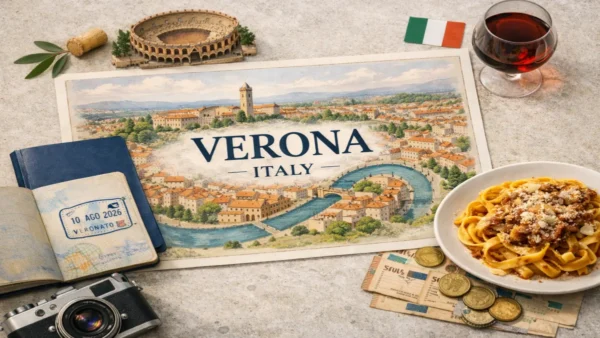
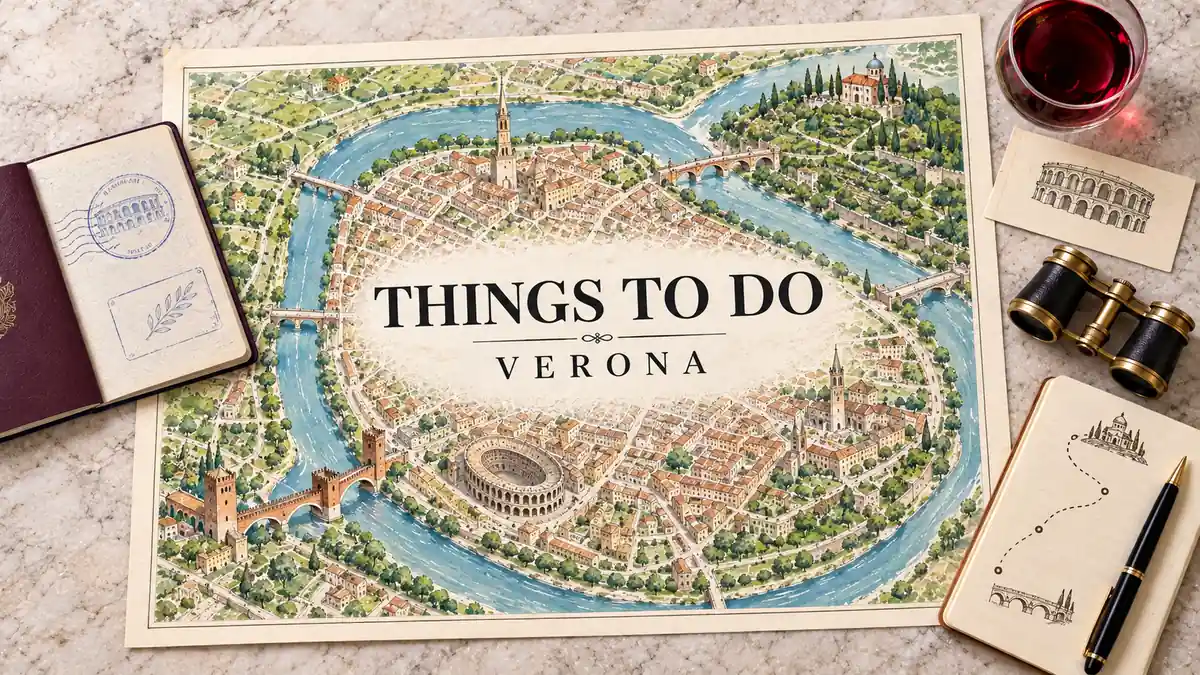
Verona is usually a one- or two-day stop, so the job here is choosing, not collecting. The city packs more famous sights into its compact centre than a short stay can absorb, and several of them reward good timing far more than a long visit.
This page groups the experiences by type — the Arena, the balcony, the viewpoints, the old town on foot, the quiet corners, food and wine, and the lake — and gives each one a verdict: whether it earns the hours, who it suits, and how to book or time it.
Two booking realities shape every plan. An Arena opera night is a ticketed summer evening you secure in advance. Juliet’s House can only be booked online, with entry through Teatro Nuovo on a nearby square. How long to stay, when to come and how to arrive are questions for the Verona guide.
Quick Answer
A summer opera night at the Arena is the Verona experience worth building a stop around. With one day, add Juliet’s House on a booked first slot, the Castel San Pietro sunset and the old town on foot. A second day adds Valpolicella or Lake Garda. Book the opera and Juliet’s House ahead; the rest is free or walk-up.
Trust Layer
Tripstou selection guide for travelers choosing between multiple places. Covers selection criteria, traveler fit, and trip value.
Produced with AI assistance and reviewed by Alex Perrut, working in tourism since 2015, for the Tripstou editorial team. See our editorial process for details.
Last factual review: September 18, 2026.
Official sources consulted: Italia.it, ENIT, Visit Verona, Fondazione Arena di Verona.
Key Takeaways
- A summer opera night at the Arena beats the daytime visit; outside the festival season, the daytime visit still earns an hour.
- Juliet’s House is booked online only, entered through Teatro Nuovo on Piazzetta Navona, and needs a reserved slot even with the VeronaCard.
- Castel San Pietro at sunset is Verona’s best viewpoint; the terrace is free, and the funicular up is not covered by the VeronaCard.
- The free old-town loop through the piazzas, over Ponte Pietra and along the Adige delivers more per hour than a midday balcony queue.
- With a second day, add a Valpolicella wine tasting or a half-day at Sirmione on Lake Garda; one-day visitors should skip both.
- The VeronaCard pays off with the Arena, Juliet’s House and two or three more paid sites in 24 hours, not for centre-only walking.
Table of Contents
An opera night at the Arena is the experience to build Verona around
An opera night at the Arena is Verona’s best experience, and it beats the daytime visit for most travelers. The reason is the setting: the Roman amphitheatre becomes the stage, so you watch a production inside the monument itself. Outside the summer festival, the daytime visit is the only option and still earns an hour.
The two Arena experiences answer different questions. The daytime visit shows you the building. The opera night shows you what the building is for, with a full audience on the same stone tiers the Romans built. If your dates fall in the festival season and you can stay one evening, that evening is where the Arena belongs.
The cheapest opera seats hide a catch. The unnumbered steps sell the full spectacle at the lowest band, but only to early arrivals: the central spots go first, and a late arrival pays the cheap price for the worst angle.
Daytime Arena visit
The daytime visit puts you inside a 1st-century Roman amphitheatre that still works as a venue. That alone earns it a place on the list. You walk the stone tiers, climb high enough to look down into the oval, and take in the scale of a structure built to hold a whole city’s crowd.
What sets it apart from Verona’s other Roman sites is completeness. The Teatro Romano and the street-level ruins are fragments; the Arena is intact and in use, so it reads as a living building. Hours shift on opera days, so check the schedule before you plan around it. Entry is covered by the VeronaCard. An hour is enough. Staying longer adds little that the first circuit of the tiers has not already shown you.
Pick this if: you are in Verona outside the summer festival, or leaving before evening, and still want to stand inside the Arena.
Opera night at the Arena
The opera night is the experience the Arena was built for: a full production staged under the open sky, with the audience ringed around the tiers. Performances begin as dusk falls. Where you sit decides what kind of night you have.
- Unnumbered stone steps: the cheapest band, first come, first seated. Suits budget travelers happy to arrive early. The tradeoff is hard stone all evening, so bring a cushion.
- Numbered sectors: a reserved place at a higher band. Suits travelers who want certainty without arriving early. The tradeoff is the price.
- Stalls: the most expensive band, closest to the stage. Suits opera lovers who came for the singing. Smart dress is preferred here, with no shorts, tank tops or thong sandals for men.
There is no compulsory dress code elsewhere. The rules that catch people out are simpler:
- No food, drink or large bags inside.
- Tickets are non-refundable and non-exchangeable.
Pick this if: you can give Verona a summer evening and want the experience most visitors remember the city by.
Tours and activities
Book skip-the-line tickets, day trips and local tours with free cancellation on most activities.
You can also browse everything on getyourguide.com.
Tripstou may earn a commission if you book through this link, at no extra cost to you.
Juliet’s House is worth it only on a booked first slot
Juliet’s House is worth it only if you book the first slot of the day. The courtyard is small and fills fast, so a midday visit means shuffling through a crowd for a photo of the balcony. Entry is only via Teatro Nuovo, with online tickets and mandatory booking, even with the VeronaCard.
The verdict is conditional because the experience is. Juliet’s House sells a scene — the courtyard, the balcony, the bronze statue, the ritual of the photo — and a scene only works with space around it. Timing is the whole value here. The courtyard has no second room to absorb a crowd, so the same ticket buys a quiet scene at opening and a queue for a selfie by late morning.
Juliet’s House and the balcony
The visit is a booked, timed entry through Teatro Nuovo on Piazzetta Navona, into the courtyard below the famous balcony. There are two ticket types: courtyard-only, and a house-included ticket that adds the rooms upstairs. The balcony itself is a 20th-century addition. That matters for expectations: you come for the story and the setting, and the architecture is secondary.
How to book it:
- Buy online at museiverona.com. There is no ticket office on site.
- Book even with the VeronaCard: card entry still needs a reserved slot.
- Enter through Teatro Nuovo on Piazzetta Navona.
- Choose the first slot of the day for the emptiest courtyard.
Skip it if Shakespeare means little to you or you have only half a day. The hour it takes is better spent on the old-town walk, which passes close by anyway.
Pick this if: Romeo and Juliet is part of why Verona is on your route and you can commit to an early booked slot.
Best viewpoints: Castel San Pietro at sunset, Torre dei Lamberti by day
Castel San Pietro at sunset is Verona’s best viewpoint, and the terrace costs nothing. From the hill you see the old town, its towers and the bend of the Adige in one frame. Torre dei Lamberti is the daytime alternative inside the centre. Reach the hill by funicular or on foot from the Ponte Pietra side.
The two viewpoints are not rivals. They show different things. The hill gives you the whole city as a picture, framed by the river. The tower puts you directly above the piazzas, close enough to watch the market below. Pick by time of day and by what you want to see.
Sunset from Castel San Pietro
The Castel San Pietro terrace is the view on every Verona postcard, and at sunset it earns that reputation. The light drops behind the old town, the towers go dark against the sky and the river catches the last of it. The terrace is free. Arrive before sunset, because the best stretch of wall fills early on clear evenings.
- Funicular: a short ride for a small fare, cheaper one-way than return. Suits anyone saving their legs for the evening. It is not covered by the VeronaCard.
- Steps: free, a steady climb from the Ponte Pietra side. Suits walkers who like arriving on foot. The tradeoff is heat and effort on summer evenings.
Ride up and walk down. The one-way fare is the cheaper ticket, and the descent is where the views across the river keep opening.
Pick this if: you want one view of Verona and can be on the hill as the light fades.
Climbing Torre dei Lamberti
Torre dei Lamberti is the tallest viewpoint inside the old town, and its strength is proximity. From the top, Piazza delle Erbe and Piazza dei Signori sit right below you, with the rooftops and bell towers spreading out on every side. The hill cannot show you that. It sees the city from across the river, while the tower sees it from within.
- Stairs: included in the entry. Suits travelers happy to climb. The tradeoff is a long, steady ascent.
- Lift: a small extra charge, even for VeronaCard holders. Suits anyone saving energy for the rest of the day. The tradeoff is the added cost.
Entry carries a modest fee and is covered by the VeronaCard. It works best by day, when the piazzas below are busy and the detail is sharp.
Pick this if: you are already in Piazza delle Erbe and want height without leaving the centre.
The old town on foot is the experience most visitors underrate
The old town on foot is Verona’s best free experience, and the one to keep even on a half-day. Piazza delle Erbe, Piazza dei Signori, Ponte Pietra and the riverbank sit within a compact loop. Walking it costs nothing, needs no booking and shows the city between the headline sights.
Most visitors treat the walk as the gap between tickets. It is the connective thread of this whole page. Juliet’s House, Torre dei Lamberti and the funicular all sit on or beside the loop, so walking it well is how a short stop fits in more. Traffic is limited in much of the centre. That makes the walk pleasant as well as practical.
This page covers what to do once you are there. How long to stay, when to come and how to arrive are covered in the Verona guide.
Piazza delle Erbe to Piazza dei Signori
Piazza delle Erbe is Verona’s everyday stage: a long market square lined with painted façades, café tables and stalls, on the site of the old Roman forum. Its appeal is that it is lived in. Locals cross it on the way to work, and it fills again at aperitivo time.
Step through the archway to Piazza dei Signori and the mood changes. The civic square of the Scaliger lords is quieter and more formal, with Dante’s statue at its centre. Walking from one to the other takes a minute, and the contrast is the experience. Go in the morning for the market. Come back in the evening for a spritz on one of the terraces.
Pick this if: you want Verona’s daily life — the market by morning, a spritz by evening — without buying a ticket.
Ponte Pietra and the Adige riverside walk
Ponte Pietra is Verona’s Roman bridge, and crossing it is one of the city’s most rewarding free experiences. The stone arches span the Adige where it bends around the old town, with the hillside of the Teatro Romano and Castel San Pietro rising on the far bank.
What makes it distinct is the river itself. Every other pick on this page keeps you among buildings; this one opens the city up. Cross the bridge, then follow the riverside path in either direction to see the old town from the water’s edge. The walk works at any hour. It is especially calm early in the morning and after dark, when the bridge is lit and the tour groups have gone.
Pick this if: you like cities best from their riverbanks and want a walk with no fixed destination.
Castelvecchio and its bridge
Castelvecchio is the fortress of the Scaliger lords, and it pairs a castle, a bridge and an art museum in one experience. The crenellated brick bridge over the Adige is free to walk across and is one of the most photographed spots in the city.
Inside, the civic museum is the reason to buy a ticket. Carlo Scarpa’s modern redesign threads walkways, stairs and ramparts through the old castle, so moving through the building is as much the point as the medieval sculpture and paintings on display. It sits west of the main piazzas, a short walk from the loop. Entry is covered by the VeronaCard. Allow at least an hour for the museum itself.
Pick this if: you want one museum in Verona and prefer a building that is as much the exhibit as the art inside it.
Quieter and unusual experiences in Verona
Giardino Giusti is the best quiet experience in Verona, and the one to add first with a second day. The Teatro Romano and a self-guided detail hunt follow close behind. They suit travelers with time to spare and anyone who wants Verona without the balcony crowd. Each one trades a headline for space.
These experiences share one quality: they reward curiosity more than a checklist does. Most sit across the river or in side streets the main flow of visitors skips. None needs booking. Add them once the headline set is covered, or swap one in when the centre gets too crowded.
Giardino Giusti
Giardino Giusti is a Renaissance garden across the river from the old town, and what it offers is calm. Geometric hedges and gravel paths lead to a long avenue of tall cypresses, then up to an upper terrace with a view back over the rooftops and towers.
It is distinct from every other pick here because it is green. After a morning of stone piazzas, the garden changes the pace completely, and the terrace view comes without a queue or a crowd. Entry carries a modest fee. The garden is compact, and an hour covers it comfortably with time to sit. Visitors expecting grand fountains or vast grounds may find it small; the appeal is in the layout and the quiet.
Pick this if: you need an hour of calm between the busy sights and still want a view at the end of it.
Teatro Romano and the archaeological museum
The Teatro Romano is Verona’s Roman theatre, built into the hillside on the far side of the Adige, and the setting does most of the work. The stone seating faces back across the river toward the old town, so the ruins come with one of the best low-level views in the city.
The archaeological museum sits above the theatre and holds the sculpture, mosaics and inscriptions found around Roman Verona. What separates it from the Arena is atmosphere: it is quieter, less complete and far less visited, which makes it easier to take in slowly. Entry is covered by the VeronaCard. Pair it with Ponte Pietra, which lands you almost at the gate. Few sites in Verona reward a slow hour as well.
Pick this if: you hold the VeronaCard and want a Roman site without the Arena’s crowds.
The detail hunt: whale rib, street-level Roman ruins, Scaliger Tombs and the Biblioteca Capitolare
The detail hunt turns the centre into a self-guided search for the oddities most visitors walk past. It needs no ticket for most stops and no fixed route. Its strength is that it rewards attention instead of stamina:
- The whale rib: hanging under the Arco della Costa, the archway between Piazza delle Erbe and Piazza dei Signori.
- Street-level Roman ruins: remains of the Roman city visible below street level through openings in the old-town pavement.
- The Scaliger Tombs: the Gothic tombs of the Della Scala lords, beside the church of Santa Maria Antica and visible from the street.
- The Biblioteca Capitolare: one of the oldest working libraries in the world, near the Duomo. Opening days are limited, so check before you go.
It works in gaps: ten minutes here, twenty there.
Pick this if: you enjoy the small, odd corners of a city more than its famous sights.
Verona’s church circuit
Verona’s church circuit links three very different churches into one experience: San Zeno, Sant’Anastasia and the Duomo. The case for it is range. Together they cover Romanesque, Gothic and later styles within a short walk or bus ride of each other.
San Zeno is the standout, a Romanesque basilica west of the centre known for its bronze doors and its calm cloister. Sant’Anastasia is the great Gothic church of the old town, tall and richly painted inside. The Duomo, near the river, completes the set. The main churches charge a modest entry fee. The circuit takes a morning if you include San Zeno, which sits outside the main loop. It suits travelers who enjoy interiors and quiet more than viewpoints and crowds.
Pick this if: Romanesque and Gothic interiors move you more than any view does.
Food and wine experiences: Amarone, Valpolicella and Verona’s own dishes
A Valpolicella tasting is the food-and-wine experience worth a half-day from Verona. In the city itself, the experience is the local table: an osteria lunch built around Amarone and the dishes that go with it. With one day, taste in town; with two, go out to the valley.
Wine is where Verona stops being a sightseeing city. The Valpolicella hills start just outside town, so the wine region is part of the same trip, with no need to plan a separate one. For the wider picture, the things to do in Italy guide places Valpolicella among the country’s other food and wine experiences.
Valpolicella and Amarone wine tour
A Valpolicella wine tour takes you into the valley minutes from the city, and Amarone is the draw. This rich red is made from grapes dried before pressing, and tasting it at the estate that makes it is a very different experience from ordering a glass in town.
- Guided tour: transport and tastings arranged. Suits non-drivers and first-timers in the region. The tradeoff is a fixed set of wineries and a group pace.
- Self-arranged tasting: book wineries directly and travel with a designated driver or taxi. Suits travelers who want specific producers. The tradeoff is handling bookings yourself, since many estates receive visitors by appointment.
Against the city picks, it swaps piazzas for landscape: terraced vineyards, villas and small villages. It fills a half-day, so it belongs on a second day.
Pick this if: wine is one of the reasons you travel and you have a free half-day.
Eating Verona: local dishes, food tour or cooking class
Eating in Verona is an experience in itself, built on the osteria habit: a glass of local wine, a few small plates and a slow meal. The dishes to look for are specific to the city. Risotto all’Amarone is cooked with the region’s great red. Pastissada is a long-simmered stew traditionally made with horse meat and served with polenta.
Unlike the wine tour, it needs no transport or planning, and you can do it at every meal. A food tour earns its time for one-day visitors who want the dishes explained and a few osterie pointed out quickly. A cooking class suits travelers with a spare morning who want to take a recipe home. Everyone else can simply eat well. That alone makes this one of the easiest experiences to fit in.
Pick this if: you judge a city by its table and want to taste dishes you will not find outside the Veneto.
Lake Garda from Verona works as a half-day experience
Lake Garda works from Verona as a half-day to the Sirmione side, not as a full lake tour. A regional train reaches Peschiera del Garda or Desenzano in under half an hour, then a boat or bus covers the last stretch. One-day visitors should skip it; the city deserves the time.
The half-day works because it stays small: one peninsula, one castle, one lakefront. Trying to see more of the lake from Verona turns an easy outing into a long day of connections. If the lake tempts you into a longer stay in the north, the best places to visit in Italy guide helps you place it among other stops.
Sirmione and the southern shore in a half-day
Sirmione is the lake half-day to choose, and the setting sells it: a narrow peninsula reaching into the water, entered past a moated castle. You walk the lanes of the old village, head out toward the Roman villa ruins at the tip and spend time on the lakefront.
- Train plus boat or bus: the independent option. Suits travelers who like setting their own pace. The tradeoff is managing connections, and boats get busy in summer.
- Organised tour: transport handled from Verona. Suits travelers short on time who want no logistics. The tradeoff is a fixed schedule and less time where you would linger.
Sirmione’s castle was built by the same Scaliger dynasty as Castelvecchio. That makes the lake half-day a continuation of Verona’s story instead of a break from it.
Pick this if: you have a second day and want water and open views after a day of city streets.
Train and bus tickets
Compare routes, schedules and prices across rail and bus operators in one search, with mobile tickets on your phone.
New to Omio? Code NEW10 takes 10% off your first booking — or APPNEW10 if you book inside the Omio app. Both apply to bookings up to €80.
Search routes and compare prices on Omio →
Tripstou may earn a commission if you book through this link, at no extra cost to you.
Is the VeronaCard worth it, and what must you book ahead?
The VeronaCard pays off if you visit the Arena, Juliet’s House and two or three more sites within 24 hours. It does not pay off if you mostly walk the centre. Only two experiences must be booked ahead: an Arena opera night and a Juliet’s House slot. Everything else is walk-up or free.
The card comes in 24-hour and 48-hour versions. It includes the ATV city buses and one free entry per site to the main civic sites, among them the Arena, Juliet’s House, Castelvecchio, the Roman Theatre archaeological museum and Torre dei Lamberti. The official price is €33 for 24 hours and €38 for 48 hours, as listed by the Verona tourism office.
- VeronaCard 24h: suits a one-day stop that includes the Arena, Juliet’s House and two or three more paid sites. The tradeoff is one entry per site, and Juliet’s House still needs a booked slot.
- VeronaCard 48h: suits two-day visitors spreading civic sites across both days and using city buses. The tradeoff is that it only beats the 24-hour card if day two includes paid sites.
- Individual tickets: suit walkers doing one or two paid sites. The tradeoff is paying per entry with no buses included.
The card does not cover the Castel San Pietro funicular or the airport shuttle, and the Torre dei Lamberti lift is a small extra. Juliet’s House is where the card most often disappoints. It covers entry but not the slot, so card holders who skip booking are turned away like everyone else.
| Experience | Book ahead? | VeronaCard covers it? | Timing tip |
|---|---|---|---|
| Arena opera night | Yes, tickets are non-refundable and non-exchangeable | No, opera tickets are sold separately | Arrive early for the unnumbered steps |
| Arena daytime visit | No, walk-up entry works | Yes, one entry is included | Hours shift on opera days; check first |
| Juliet’s House | Yes, online only at museiverona.com | Entry yes, but a slot is still required | Book the first slot of the day |
| Castel San Pietro | No, the terrace is free | The funicular is not covered by the card | Arrive before sunset on clear evenings |
| Torre dei Lamberti | No, walk-up entry works | Yes, but the lift is extra | Go by day for the piazzas below |
| Castelvecchio museum | No, walk-up entry works | Yes, one entry is included | Allow at least an hour inside |
The 24-hour or 48-hour choice only matters once your days are in order. The two-day Verona itinerary sorts that out.
Frequently Asked Questions
Does the VeronaCard cover the Arena opera and the funicular?
No to both. The VeronaCard covers the daytime Arena visit, not tickets for the summer opera festival, and it excludes the Castel San Pietro funicular and the airport shuttle. It does include ATV city buses and one entry to each main civic site, while the Torre dei Lamberti lift costs a small extra.
What are the best free things to do in Verona?
Verona’s best free experience is the old-town walk, from Piazza delle Erbe to Piazza dei Signori and over Ponte Pietra. Follow the Adige riverbank, cross the Castelvecchio bridge and climb the steps to the Castel San Pietro terrace for sunset. Juliet’s House is not one of them: even the courtyard needs a booked ticket.
Can you walk everywhere in Verona?
Yes, the historic centre is compact enough to walk, and traffic is limited in much of it. The only uphill stretches are the Castel San Pietro hill, which also has a funicular, and the upper terrace of Giardino Giusti. San Zeno is a longer walk west, and ATV city buses cover the outskirts.
What can you do in Verona at night?
In summer, the best night out in Verona is an opera at the Arena, which begins as dusk falls. Any evening, take an aperitivo on Piazza delle Erbe, cross the lit Ponte Pietra and walk the Adige riverbank once the tour groups have gone. An osteria dinner with Amarone rounds it off.
What happens at the Arena opera if it rains?
Rain does not automatically cancel an Arena opera night. The festival can hold a performance back while the weather clears, with delays of up to 150 minutes allowed, so do not leave at the first shower. Tickets are non-refundable and non-exchangeable, so read the official festival FAQ on cancelled performances before you buy.
Related Guides
This page resolves what to do in Verona; the planning, the order of your days and the wider Italian picture live on these pages.
- Verona guide — how long to stay, when to come and how to arrive.
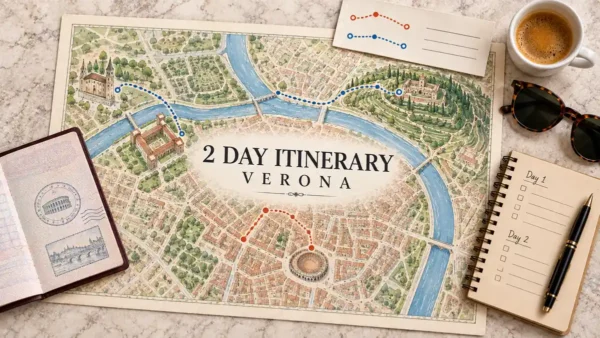
- Two-day Verona itinerary — how to put these experiences in order across a short stay.
- Where to stay in Verona — the areas that keep these sights within walking distance.
- Things to do in Italy — the national view of experiences worth planning a trip around.
- Best places to visit in Italy — where Verona and Lake Garda sit among Italian destinations.
- Venice day trips and the wider region — the area east of the city, and how it is usually planned.
Did this guide save you time or money? Tripstou is independent and reader-funded — if you'd like to give something back, you can support the site with a crypto contribution of any size.