Choosing a base in Palermo is a two-part decision, and most guides resolve only half of it. The first fork is whether you sleep inside the Centro Storico — walkable, atmospheric, uneven — or in the calmer nineteenth-century grid north of it. The second is whether you arrive with a rental car, because the centre sits inside a camera-enforced restricted zone that can turn a cheap hotel into an expensive one. Comfort after dark runs underneath both questions. Several quarters that are a pleasure at noon empty out by late evening, and a street that feels lively on a food tour can feel very different on the walk back to your door. This guide profiles each candidate area the same way: who it suits, what it feels like day to day, what is within walking reach, and where it sits on price. Every area block ends with one condition label, so you can skim straight to the trip that matches yours.
Quick Answer
La Kalsa, in the Centro Storico, is the best area to stay in Palermo for first-timers. The trade-off is atmosphere against sleep: the market quarters are cheaper and rawer, and they empty out at night. Choose Politeama or Via Libertà for calm and easy transfers; Mondello only if the beach outranks the city.
Trust Layer
Tripstou stay guide for travelers choosing where to base. Covers area atmosphere, budget, convenience, noise, and traveler fit.
Produced with AI assistance and reviewed by Alex Perrut, working in tourism since 2015, for the Tripstou editorial team. See our editorial process for details.
Last factual review: September 19, 2026.
Official sources consulted: Italia.it, ENIT, the Italian National Tourist Board.
Key Takeaways
- La Kalsa is the first-timer’s base: restored, walkable to almost everything, and still populated on the walk home after dinner.
- The Centro Storico is four quarters, not one neighbourhood, and they differ far more by night than by distance.
- Ballarò and the inner Albergheria lanes are the cheapest beds in Palermo and the emptiest streets after the market closes.
- Politeama and Via Libertà buy quiet nights, lifts and easy transfers, at the cost of sleeping outside old Palermo.
- Mondello suits beach-first summer trips only; from there every sight in the city becomes a bus or taxi ride.
- With a rental car, stay outside the restricted zone or book a hotel that registers your plate before you arrive.
Table of Contents
La Kalsa in the Centro Storico is the best area to stay in Palermo for first-timers
La Kalsa is the area to book on a first visit to Palermo. It sits inside the Centro Storico, so the cathedral, the markets and the opera house are all reachable on foot, and its restored squares stay populated in the evening instead of shutting down after dinner.
The historic centre as a whole is the right answer for a first trip because Palermo’s value is concentrated and walkable. Almost everything a short stay is built around — the Quattro Canti, the cathedral, the two big markets, the opera houses, the waterfront edge — sits inside a compact grid you can cross on foot without planning anything. Public transport is the weak link in this city, so a base out in the residential districts converts every outing into a bus or a taxi and quietly eats the trip. If you want to see exactly what that walking radius buys, our guide to things to do in Palermo lays the sights out by district.
In Palermo the cheaper room two districts out is rarely cheaper, because there is no fast metro spine to rescue it. You pay the difference back in taxis and in the evenings you decide not to bother with.
The honest limit is that the Centro Storico is loud and worn. Scooters run late, the building stock is old, and renovation quality swings hard from one address to the next — a beautifully restored palazzo apartment can sit above a street nobody has touched in decades. Read the room description carefully. A façade photograph tells you nothing about the night.
This verdict has exceptions, and each one has its own section below. Light sleepers should look at Politeama. Anyone arriving with a rental car should read the restricted-zone rules before booking anything inside the old walls. Beach-first trips belong in Mondello, with the access cost understood in advance.
Hotels and places to stay
Compare hotels, apartments and stays for your dates in one search.
Search hotels and stays on hotels.com →
Tripstou may earn a commission if you book through this link, at no extra cost to you.
The four districts of the Centro Storico and which one to book
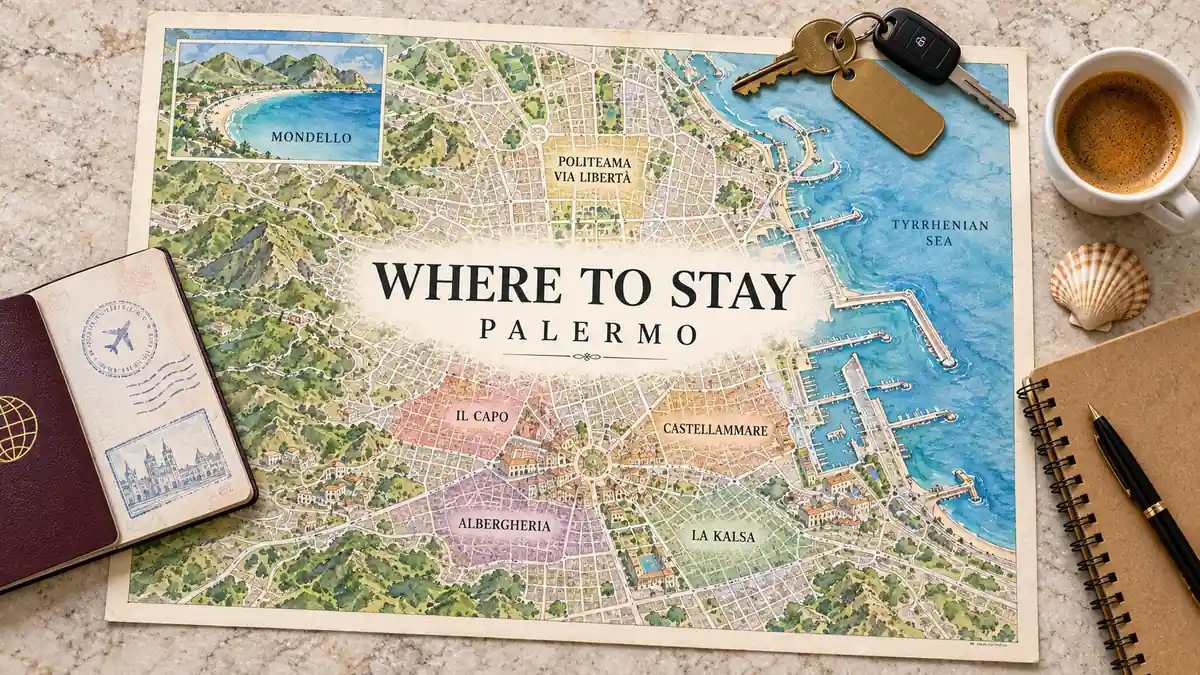
The Centro Storico is four quarters, not one neighbourhood, and they differ more than most guides admit. The Quattro Canti crossroads splits them: Albergheria and Ballarò to the southwest, Il Capo to the northwest, Castellammare and the Vucciria to the northeast, La Kalsa to the southeast. Pick by how you want your evenings to feel.
All four quarters touch each other, so this choice is about character and not about distance — you can walk from Ballarò to Kalsa without thinking about it. What changes between them is the night. The market quarters live by day and shut down after dark; the Vucciria has become a drinking square; Kalsa has been restored into something that stays awake and stays comfortable. Money tracks the same line, and the rawer the quarter, the cheaper the room.
Albergheria and Ballarò: market energy by day, quiet by night
Albergheria and Ballarò suit budget travelers who are out of the room from breakfast until late. The Ballarò market runs through the quarter and gives it the rawest street life in the city: produce stalls, grilled-offal counters, shouting, a genuinely working neighbourhood with nothing curated about it. Nothing here is polished. The lanes are narrow and the building stock is the most worn in the centre, so the photography is superb and the pavements are not. Everything in the historic core is a short walk away, the cathedral and the Quattro Canti included. Rooms sit at the budget end of Palermo’s range, and the gap against the restored addresses in Kalsa is real money on a week-long stay. The catch arrives when the market packs up: shutters come down, the lanes empty, and the walk home is dark and silent in a way first-timers often find uncomfortable.
Best for: budget travelers who spend their evenings elsewhere.
Il Capo: the compromise district near the Teatro Massimo
Il Capo works for travelers who want a market quarter with an easy exit to calmer streets. It is the historic centre’s other great food market, but it borders the Politeama grid near the Teatro Massimo, so a couple of blocks take you out of medieval lanes and onto lit boulevards. Day to day it is busy, food-led and noticeably less touristed than the Vucciria, with stalls that serve the neighbourhood before they serve visitors. Everything central is on foot, and the walk north to the theatres and the shopping streets is short and flat. Prices sit in the mid-range, above Ballarò and below the restored palazzo conversions in Kalsa. What Il Capo does not give you is an evening of its own. Its own streets quieten early, and you borrow your nights from the districts on either side.
Best for: travelers who want a central address with a calm street around the corner.
Castellammare and Vucciria: liveliest nights, lightest sleep
Castellammare and the Vucciria have the loudest nights in the historic centre, which is simultaneously the draw and the problem. The Vucciria’s old market square has turned into the city’s open-air drinking quarter: crowds across the piazza, music, street food, an energy that is genuinely memorable from the square and genuinely unbearable from a room above it. Bring earplugs. Castellammare’s wider streets toward the port are calmer and hold a good share of the district’s accommodation, which is where to look if you want the square nearby and not underneath you. Everything central is walkable and the waterfront is close. Prices sit in the mid-range. The warnings are honest ones: a room facing the piazza will not give you a quiet night, and dense late crowds are the classic setting for pickpocketing, so carry your things accordingly.
Best for: nightlife-first couples and groups who intend to be in the square until it closes.
La Kalsa: redeveloped, walkable and the safest first-timer bet
La Kalsa is the historic centre’s most comfortable overnight base and this page’s default recommendation. The quarter runs from the Quattro Canti down to the waterfront and has been steadily restored: reopened squares, gardens, museums and restaurant terraces that keep people on the street through the evening. Rough edges remain. This is old Palermo and not a resort district, but the main squares and connecting axes stay populated and lit well after dinner, which is the practical difference that matters when you are walking back to your door. Walking reach is excellent in every direction, and the seafront promenade is close enough to use daily. Prices sit above the market quarters and roughly level with Politeama. The one real cost of Kalsa is exactly that: a restored, in-demand quarter is never the cheap way to sleep in the centre.
Best for: first-timers who want the historic centre without a difficult walk home.
Pick the wrong quarter here and you do not lose walking time — you lose your evenings. The real choice you are making is what your own street sounds like at eleven at night.
Politeama and Via Libertà are the calm, connected alternative to the historic core
Politeama and Via Libertà are where you sleep well in Palermo and still walk into the old town. The nineteenth-century grid north of the historic centre is ordered, lit and quiet after dark, with wide pavements and reliable building stock. It suits light sleepers, longer stays and first-timers who want the city in measured doses.
Day to day the district reads as a different city altogether: boulevards, designer and chain shopping along Via Libertà, cafés around the Teatro Politeama, and an evening passeggiata that fills the pavements without filling your room with noise. Buildings here have lifts, insulation and rooms that face gardens. Nothing here is medieval.
Convenience is the strongest argument for it. The Quattro Canti is a short, flat walk down the main axis, so you are never cut off from the historic centre, and the airport bus stop sits near Politeama, which makes arrival and departure with luggage straightforward — our Palermo guide covers the airport connection itself. Rooms are business-grade more often than characterful, and prices sit above the market quarters and broadly level with La Kalsa.
What you give up is atmosphere: you sleep in nineteenth-century Palermo and commute into the medieval one. On a two- or three-night trip that commute is a genuine cost, because the old town’s best hours are early morning and late evening — precisely the two moments you are least likely to make the walk.
Best for: light sleepers and travelers who want calm nights and easy transfers.
Should you stay in Mondello or in the city centre?
Stay in the centre if you came for Palermo; choose Mondello only when the beach is the point. Mondello is a seaside district northwest of the city, separate from the core and reached by road, so every sight you came for becomes an outing instead of a walk. High-summer beach trips are the exception.
Mondello feels like a resort town that happens to share a bus map with a capital city. The sand is genuinely good. Pale shallow water, Liberty-era bathing houses on the front, seafood restaurants along the promenade and a summer crowd that is heavily Palermitan — it is a pleasant place to be, and it is not in any meaningful sense the city you booked a flight to see.
The access cost is the whole argument. Mondello sits outside the city proper, so reaching the cathedral or the markets means a bus or a taxi each way, and repeating that twice a day wears thin fast on a short trip. Seasonality compounds it. The district peaks in high summer and then goes quiet, with reduced beach services out of season and much less reason to be out there at all. Prices follow the same curve, running mid-range for most of the year and high-end at the peak.
Mondello works as a day and struggles as a base, because the geometry is asymmetric: the beach is an easy ride from any central address, while the city is a chore from the beach once you are in sandals and the afternoon is gone.
Best for: beach-first summer trips and families who want sea over streets.
Is the historic centre safe to stay in at night, and which areas should you avoid?
Yes, with one condition: stay on the lit main axes and in La Kalsa. The historic centre is a sound place to sleep, and what decides comfort is whether your own street is still populated when you walk back after dinner. The market quarters are the ones that change character.
One test settles most bookings here: would you be happy walking back to that door at eleven at night? Applied quarter by quarter, the answers are consistent.
- La Kalsa and the Quattro Canti axes — restaurants, bars and foot traffic keep them active well past dinner.
- Castellammare and the Vucciria — lively and crowded late; the real exposure is pickpocketing in the press of people.
- Ballarò and the inner Albergheria lanes — the market is the life of the quarter, and when it packs up the streets go dark and empty.
- Politeama and Via Libertà — calm, lit and residential all evening.
The places to avoid sleeping in are the deep market lanes and any address several turns off a lit axis. Those rooms look like bargains on a booking map, and they are priced that way for a reason. Book the street, not the district.
Kalsa and the Vucciria are both shifting as restoration and nightlife spread outward, so a quarter written off in an older guidebook can read very differently in person. Check the exact address on a satellite view and against recent photographs before you commit.
Where to stay in Palermo if you have a rental car
With a car, base in Politeama, Via Libertà or Mondello, or book a centre hotel that registers your plate. Palermo’s historic centre sits inside a camera-enforced limited traffic zone, and driving in without the hotel having registered you is the most expensive booking mistake on this page. Never improvise.
The zone works on plates and cameras. Access to the centre is restricted during weekday daytime hours, hotels inside the zone can register a guest’s plate so the cameras read the car as authorised, and Sundays are generally freer. Confirm the procedure with your hotel at the time of booking and send them the plate number. Get it in writing. A verbal yes at reception, after you have already driven in past the cameras, is worth nothing.
- Keep the car and stay outside the zone. Politeama, Via Libertà or Mondello let you drive in and out freely, and you pay for a garage or hotel parking. Best when the car is central to the whole trip.
- Stay inside the centre and hand over the plate. Book only a hotel that both registers your plate and offers parking, since garage space in the old town is scarce and priced accordingly. Best when the city is the trip and the car is a leftover.
- Drop the car and collect it later. Return it at the airport or a city depot for your Palermo nights, then pick it up on the days you drive out. Best when the driving days are the minority.
The cheapest fix is usually to not own the car on the nights you are in the city. Palermo is one of the few Italian bases where a rental is worth interrupting instead of parking, because the old town gives you nothing to drive to and charges you for the privilege of storing it.
Cefalù, Monreale and the Madonie are why most visitors rent at all, and our guide to visiting Palermo covers those day trips and the arrival logistics behind them.
Best areas in Palermo by traveler type
Each traveler type has one obvious answer here, and only the car changes the map. First-timers take La Kalsa, calm-seekers Politeama, nightlife the Vucciria, budget trips Ballarò, and beach-first summer trips Mondello. The table below pairs each type with its area and the trade-off attached to it.
| Traveler type | Book here | The trade-off |
|---|---|---|
| First-timer | La Kalsa, in the Centro Storico | Restored and walkable, priced above the market quarters |
| Couple | La Kalsa, or Castellammare near the port | Atmosphere either way; Vucciria nights reach the room |
| Family | Politeama and the Via Libertà grid | Space, lifts and quiet, at the cost of atmosphere |
| Solo traveler | La Kalsa or the edges of Il Capo | Central and sociable; keep to the lit axes late |
| Rental-car traveler | Politeama, Via Libertà or Mondello | Free to drive, further from the old town on foot |
Families have the clearest case for leaving the historic centre. Politeama gives you lifts, larger rooms, level pavements for a pushchair and streets that are quiet at bedtime; take Kalsa instead when the children are older and the city itself is the point, and Mondello in high summer, when an afternoon on the sand buys back the whole morning for sightseeing.
Couples split on a single question: how loud do you want the night to be? Kalsa offers restored squares and a walk along the water; Castellammare and the Vucciria offer a piazza that is still going long after you would have gone to bed. Solo travelers do best in Kalsa or on the calmer edges of Il Capo, where streets stay populated and a lit axis is always close on the way back. Bedtimes separate these travelers more than budgets do.
How many nights all of this deserves is a separate question, and our 2 days in Palermo itinerary shows what a short stay realistically covers and how the pacing shifts when your base sits outside the walls.
Frequently Asked Questions
How much does a hotel in Palermo cost per night?
Rates move with season and address, but the ranking between areas holds. Ballarò and Albergheria are the cheapest beds in the city, Il Capo and Castellammare sit mid-range, La Kalsa and Politeama run above them, and Mondello peaks in high summer. Book the cheap quarters only if you are out until late.
Is it a good idea to stay near Palermo Centrale station?
Only if you are catching early trains. The station area is well connected and often cheap, but it works as a transit district, not as a base you want to walk back to after dinner. For a short city trip, book the Centro Storico instead.
Can you walk from Politeama to the historic centre?
Yes, easily. Politeama sits directly north of the Centro Storico, and the main axis runs flat and straight down to the Quattro Canti, so the walk is short and needs no planning. It is the reason the district works as a base: you sleep in the quiet grid and still arrive on foot.
Is Mondello worth staying in outside summer?
Not for most trips. Out of season Mondello goes quiet, beach services thin out, and the sand is the only reason to be there — which leaves you commuting into the city for everything. Base in the centre and treat Mondello as an afternoon whenever the weather cooperates.
Is Palermo a good base for day trips to Cefalù and Monreale?
Yes, and any central area works. Both sit close enough to Palermo to be done and returned from in a day, so the choice of quarter changes nothing about whether the trips are possible. Pick your base on evenings and comfort, then sort the transport separately.
Related Guides
- Palermo travel guide — arrival from the airport, the best time to visit, what a trip costs, and the day trips to Cefalù and Monreale.
- Things to do in Palermo — what each quarter puts within walking distance, mapped sight by sight.
- 2 days in Palermo — how a short stay is paced, and what your choice of base changes about it.
- Sicily travel guide — where Palermo sits on the island, and what else earns nights.
- Italy trip cost — what a bed in these quarters takes from the wider budget.
- Italy travel guide — the country-level planning layer behind a single-city stay.
Did this guide save you time or money? Tripstou is independent and reader-funded — if you'd like to give something back, you can support the site with a crypto contribution of any size.