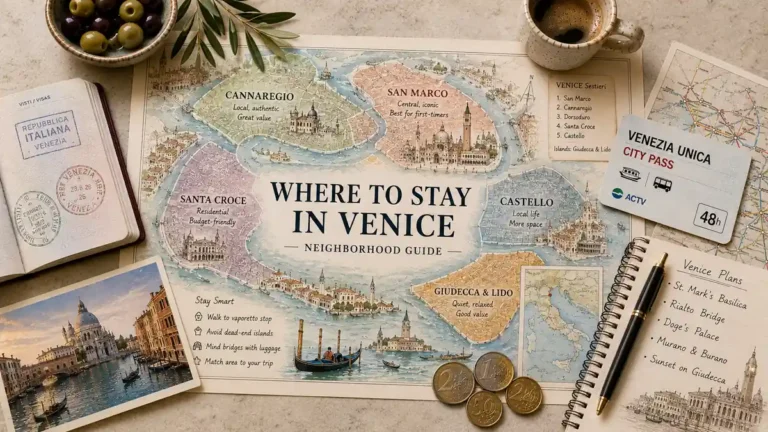
Venice is the natural gateway to the Veneto, and it makes an unusually easy base for exploring the region around it. From a single hotel in the historic center, you can reach a fan of nearby towns — Verona, Padua, Vicenza, Treviso, and more — by direct train, then be back for dinner on the canals. This guide treats Venice as a base and routes you outward: which day trips are worth the ride, how far each one is, and how to reach them without renting a car. It also settles the trip-shape questions that shape everything else — how many days to give the region, whether the lagoon islands count as a day trip, and when a single Venice base beats adding a night somewhere else. The aim is orientation, not a fixed itinerary: enough to build the right shape for your trip before you book.
Quick Answer
Yes — Venice is an excellent single base, with direct trains reaching a fan of Veneto towns. The real questions are how many days you have and whether one Venice base beats adding a night nearby. Verona and Padua make the strongest first day trips; base in Venice and ride out by train.
Trust Layer
Tripstou region guide for travelers planning a regional trip. Covers sub-areas, trip shape, base strategy, timing, and mobility tradeoffs.
Produced with AI assistance and reviewed by Alex Perrut, working in tourism since 2015, for the Tripstou editorial team. See our editorial process for details.
Last factual review: July 15, 2026.
Official sources consulted: italia.it, enit.it.
Key Takeaways
- Venice works as a strong single base — you can day-trip across the Veneto and sleep in the same room every night.
- Verona and Padua are the two strongest day trips; both are direct train hops from Venezia Santa Lucia.
- Skip the rental car — trains reach nearly every day-trip town, and Venice itself is entirely car-free anyway.
- Plan three to five days: two for Venice, plus roughly one more per mainland town you want to add.
- The lagoon islands (Murano, Burano, Torcello) are a Venice half-day, not a mainland day trip.
- Add a night nearby only if you’re continuing west toward Verona and Lake Garda; otherwise one base wins.
Table of Contents
Is Venice a Good Base for Exploring the Veneto?
Venice is an excellent single base for exploring the Veneto. Most nearby towns sit on the same rail spine, with direct trains from Venezia Santa Lucia reaching Padua, Vicenza, and Verona without a change. You unpack once, then day-trip out and back, keeping your evenings in Venice itself.
The geography does the work here. Venice anchors the eastern end of a dense rail corridor that runs west across the whole region, and the standard day-trip towns are strung along it like beads. That means most trips are a walk to the station, one ride out, and the same ride home — no hotel changes, no luggage drag, no route planning beyond a departure time.
The main tradeoff is Venice itself: it is expensive and busy, so a base here costs more per night than a mainland town would. For most travelers that premium buys the evenings in a car-free city with no rival, and it is worth it. Budget-focused planners who mostly want the Veneto towns, not Venice at night, are the exception — they may prefer a cheaper mainland base and treat Venice as one of the day trips.
Book trains from Venezia Santa Lucia, not Venezia Mestre. Santa Lucia sits inside the historic city, so you skip the extra bus or tram hop across the causeway that a Mestre base forces onto every single morning.
The Best Day Trips from Venice and How Far Each Is
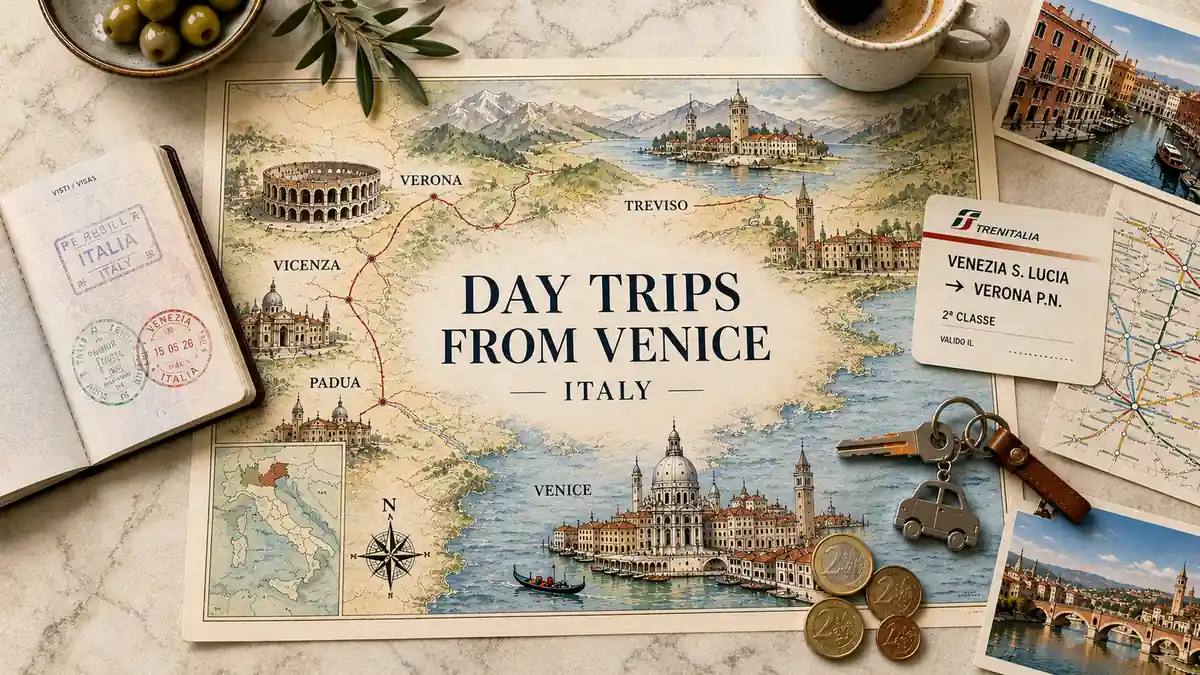
The strongest day trips from Venice are Verona and Padua, both quick direct-train hops. Beyond those, Vicenza, Treviso, and Bassano del Grappa fill out the fan, while Lake Garda’s eastern edge and the Dolomites gateway sit at the far, longer end. Most cluster within roughly two hours each way.
The core set breaks down into a handful of towns, each with its own character and a clear traveler fit. All connect from Venice by train, and none needs a car.
- Padua (Padova) — a lively university city just west of Venice, home to Giotto’s Scrovegni Chapel frescoes and one of Europe’s oldest botanical gardens. Best for: a short, easy first day trip close to Venice.
- Vicenza — the Palladian city, an open-air catalogue of Renaissance architecture centered on the Teatro Olimpico and Palladio’s villas. Best for: architecture and design travelers on an easy half-day loop.
- Treviso — a quiet, canal-laced town that feels like a smaller Venice without the crush, and the home turf of Prosecco and tiramisu. Best for: travelers who want canals and cicchetti without the crowds.
- Verona — the marquee stop, with a Roman arena that still stages summer opera and the romance the city has marketed for centuries. Best for: a headline destination worth a longer ride.
- Bassano del Grappa — a foothills town at the mouth of the Dolomites, wrapped around Palladio’s covered wooden bridge over the Brenta. Best for: an alpine-edge day with grappa and mountain views.
Lake Garda and the Dolomites sit at the outer limit of what a day trip can honestly hold. Garda’s eastern shore is reachable, and the Dolomites are a gateway hop away, but both eat most of the day in transit — treat them as a stretch, covered in more detail in the FAQ below. Summer is when the headline towns crowd hardest, so if you can flex your dates, check the wider best time to visit Italy before locking a season.
| Town | Rough train time each way | Best for |
|---|---|---|
| Padua | About 25–40 minutes | A short, easy first day trip |
| Treviso | Around 30–40 minutes | Quiet canals and local food |
| Vicenza | Roughly 45 minutes to an hour | Palladian architecture and design |
| Bassano del Grappa | About 1 to 1.5 hours | Alpine-edge day near the Dolomites |
| Verona | Roughly 1.25 to 2.25 hours | Marquee stop worth the longer ride |
Times are broad ranges and swing with whether you catch a fast or regional service; verify live before you travel.
Verona and Vicenza share the same westbound line, so you can chain them into one ambitious day; Padua and Treviso sit on branches heading different directions and don’t pair as cleanly.
Padua vs Verona as a Venice Day Trip
Choose Padua for a short, easy day close to Venice, and Verona when you want the marquee destination and don’t mind a longer ride. Padua rewards travelers who value proximity and a relaxed pace — the frescoes and porticoed streets fill a half or full day without a taxing journey. Verona asks for more transit time but delivers a bigger-name payoff: the Roman arena, the old center, and summer opera. The one tradeoff line: Verona’s ride is long enough that pairing it with another town in the same day gets tight.
Tours and activities
Book skip-the-line tickets, day trips and local tours with free cancellation on most activities.
You can also browse everything on getyourguide.com.
Tripstou may earn a commission if you book through this link, at no extra cost to you.
Reaching the Day Trips by Train Without a Car
Trains cover nearly all the Venice day trips, so a car is unnecessary and usually a liability. Fast and regional services fan out from Venezia Santa Lucia across the Veneto, and the main towns sit directly on those lines. Driving mostly adds parking costs and collides with Venice’s car-free reality.
The practical picture is simple. Venice’s own island has no cars at all, so a rental means parking on the mainland at Piazzale Roma or Mestre and then still catching a boat or tram into the city — you pay for a car you can’t bring home. For the day trips, the station is walkable or a short vaporetto ride, and the towns’ historic centers are compact once you arrive.
Two service types run the corridor: faster long-distance trains that reach Verona and Vicenza quickest, and regional trains that stop everywhere, including smaller towns like Bassano del Grappa. Regionals are cheaper and need no seat reservation; fast trains save time to the farther stops. Fares and timings shift, so treat any figure as a range and check a live source such as the national or regional rail operator before you buy.
A car earns its keep only for the outer edges — deep Dolomites valleys or scattered Lake Garda villages that trains and buses reach slowly. For the standard fan of Veneto day trips, it stays parked and costs you money.
Train and bus tickets
Compare routes, schedules and prices across rail and bus operators in one search, with mobile tickets on your phone.
New to Omio? Code NEW10 takes 10% off your first booking — or APPNEW10 if you book inside the Omio app. Both apply to bookings up to €80.
Search routes and compare prices on Omio →
Tripstou may earn a commission if you book through this link, at no extra cost to you.
How Many Days You Need for Venice and Around
Plan three to five days for Venice and around. Two days cover Venice itself; each strong day trip you add — Verona, Padua, or Vicenza — wants another. Three days suit a first visit with one day trip, while five let you pair the lagoon with two or three mainland towns.
How the region resolves depends on how much of the Veneto you want beyond the city. The tiers below run from a tight taste to a full regional base.
- 2 days — Venice and the lagoon only, no mainland day trips. Buys the essential city and one lagoon half-day. Fits travelers passing through on a wider Italy route.
- 3 days — Venice plus one day trip, usually Verona or Padua. Buys the city at a saner pace and one mainland taste. Fits most first-timers who want more than just Venice.
- 4–5 days — Venice plus two or three day trips and the lagoon. Buys a genuine feel for the region, not just its capital. Fits travelers using Venice as a true regional base.
The lagoon islands quietly change this math. Because Murano, Burano, and Torcello are part of Venice rather than a mainland trip, most people fold that half-day into an arrival or departure afternoon — so it rarely costs you a full day-trip slot. If you want to see where a Venice stint fits into a longer national trip, the Italy itinerary guide handles route order.
Lagoon Half-Day or Mainland Day Trip?
The lagoon islands are a Venice half-day, not a mainland day trip. Murano, Burano, and Torcello sit inside the city’s own waterways, reached by vaporetto in well under an hour. A mainland day out to Verona or Padua is a separate, full-day decision on a different transport system entirely.
The distinction matters for planning because the two draw on different time budgets. The lagoon is a boat loop you can start after a lazy morning and still be back for dinner; a mainland town is a train-out, walk-around, train-back commitment that owns most of your daylight. Confusing the two is how people overstuff a day.
A useful way to slot them: use the lagoon for a half-day when you want beauty with low effort — glassblowing on Murano, the painted houses of Burano — and reserve full days for the mainland when you want a different city. The islands are covered in depth in the dedicated Venice travel guide; this page keeps them as a half-day mention and routes you there for the detail.
One Base in Venice or Add a Night Nearby?
One base in Venice works for most trips, and you rarely need to move hotels. Direct trains put the main towns within a day’s reach and back, so a second base adds packing and cost for little gain. Add a night nearby only when you push west toward Verona and Lake Garda.
For a Venice-plus-Veneto trip, staying put is the efficient shape. The out-and-back rhythm means you lose nothing by sleeping in the same room every night, and you gain Venice’s evenings, which are its best hours once the day crowds thin. Hauling luggage to a second hotel for one or two nights usually costs more time than it saves.
The exception is directional. If your trip continues west after Venice — Verona, Lake Garda, then onward to Milan — a night in Verona can make sense as a bridge, because you’re moving through anyway. As a pure out-and-back from Venice, though, that extra checkout wipes out the time the earlier start was supposed to buy. For sequencing a multi-stop route rather than a single base, the Italy itinerary guide covers the order.
Hotels and places to stay
Compare hotels, apartments and stays for your dates in one search.
Search hotels and stays on hotels.com →
Tripstou may earn a commission if you book through this link, at no extra cost to you.
Frequently Asked Questions
Can you do a day trip to the Dolomites from Venice?
Yes, but it’s a long, ambitious day. The nearest Dolomites gateway towns are roughly a couple of hours out by train plus a connecting bus, so you spend most of the day in transit. It works as a scenic taste, but an overnight nearby serves the mountains far better.
Is Lake Garda a day trip from Venice?
Lake Garda’s eastern shore is a doable day trip, though a stretch. Towns like Peschiera and Desenzano sit roughly one and a half to two hours out by train, near Verona’s line. Expect most of your daylight in transit, so pair it with Verona or give the lake its own day.
What is the closest town to Venice?
Padua is the closest major day-trip town, just west of Venice on the main rail line. Direct trains reach it in well under an hour, making it the easiest first day trip. Treviso sits about the same distance to the north and is nearly as quick to reach.
Do you need a car for day trips from Venice?
No, and a car is more hassle than help here. Venice itself is entirely car-free, so a rental means parking on the mainland and still catching a boat or tram into the city. Every standard day-trip town has a station in its center, so the train is simpler and cheaper.
Is Bologna a realistic day trip from Venice?
Yes, Bologna is a realistic if longer day trip. Fast trains link it to Venice in roughly one and a half hours, putting its arcades, food scene, and towers within a full day’s reach. It sits outside the Veneto but rewards travelers who want a bigger city beyond the region.
Related Guides
- Venice travel guide — the city itself and the lagoon islands in depth.
- Italy itinerary guide — how to sequence Venice into a wider national route.
- Best time to visit Italy — weather, crowds, and season by region.
- Best places to visit in Italy — where the Veneto sits among Italy’s regions.
- Italy travel guide — the country-wide planning hub.
Did this guide save you time or money? Tripstou is independent and reader-funded — if you'd like to give something back, you can support the site with a crypto contribution of any size.