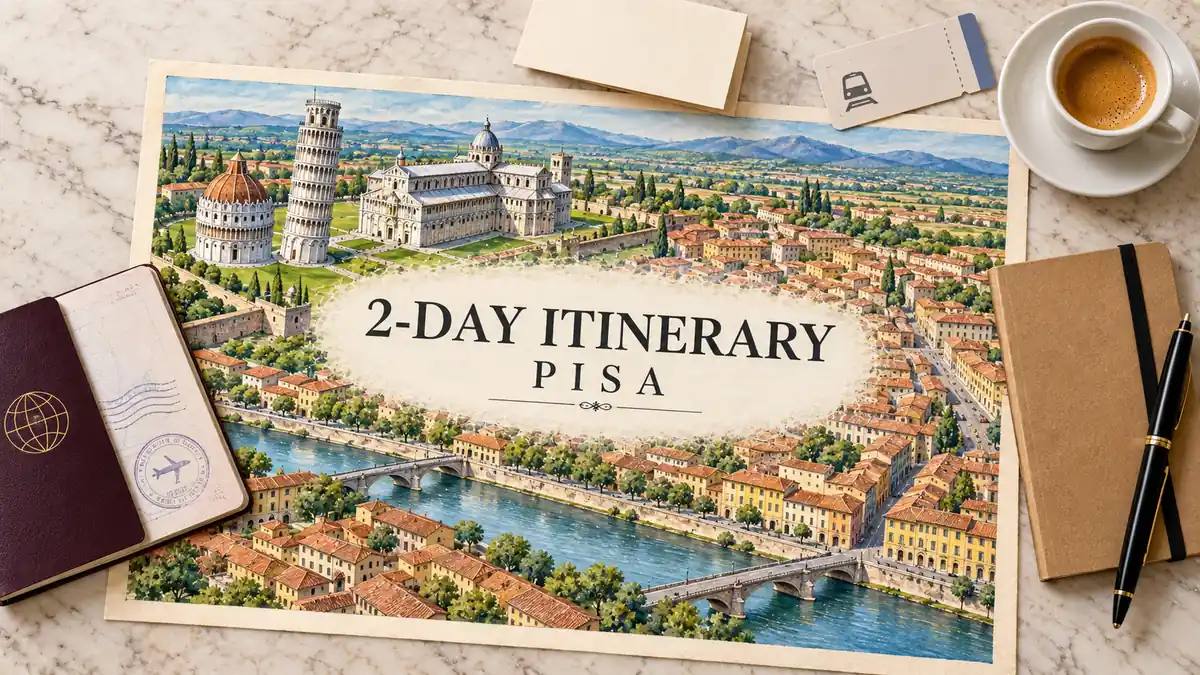
Your two days in Pisa are already booked — a PSA flight either side, an apartment for two nights, or a Tuscany leg without a car. The open questions are order, what fills day 2, and what needs booking now. This page answers those three. Piazza dei Miracoli is a half-day, not a two-day subject, so nothing here pads the square into forty-eight hours. Day 1 runs monuments first, the working city after lunch, the Arno at dusk. Day 2 is a fork you decide: a slower second day in Pisa, or a train out with the travel times in front of you. What this page does not do: pick your hotel, inventory every sight, or default you into a wine tour. Those belong on other pages, and each is linked where it matters.
Quick Answer
Two days in Pisa work if day 2 is a real decision, not filler. Piazza dei Miracoli is a half-day, so day 1 covers the monuments and the old town, and day 2 either slows down in Pisa or takes a train out, Lucca being the nearest. Best for PSA flyers, families and car-free Tuscany trips.
Trust Layer
Tripstou itinerary guide for travelers planning a route. Covers pacing, stop count, stop order, base logic, and trip length.
Produced with AI assistance and reviewed by Alex Perrut, working in tourism since 2015, for the Tripstou editorial team. See our editorial process for details.
Last factual review: September 22, 2026.
Official sources consulted: Italia.it, ENIT — Italian National Tourism Agency.
Key Takeaways
- Piazza dei Miracoli is a half-day, so plan day 1 as monuments first, the old town after lunch.
- Book the Leaning Tower’s timed slot well before you travel; a morning slot is what day 1 is built on.
- Day 2 is a fork, not filler: a slower second Pisa day, or a train out to Lucca.
- Rail day trips rank by time: Viareggio under twenty minutes, Lucca about half an hour, Florence under an hour.
- When day 1 slips, cut the second monument first and the old-town walk next; never the tower slot.
- Two days suit PSA flyers, families and car-free Tuscany trips; the second Pisa day absorbs flight fragments.
Table of Contents
Is Two Days in Pisa Too Much?
Two days in Pisa are not too much, provided you treat day 2 as a decision and not a repeat. Piazza dei Miracoli takes a half-day. The second day is the part you design — a slower pass through the city, or a train out to somewhere the square cannot match.
The arithmetic is short. The tower, the cathedral, the baptistery and the Camposanto stand inside one walled square, a few minutes apart, and a visitor moving at a normal pace clears them in a morning. Nothing else in Pisa asks for that concentration of time. This is why so many two-day itineraries pad: they stretch one morning across two days by adding a museum nobody asked for and a second lap of the same lawn.
Two days becomes too much only when you expected two days of monuments. Treat the square as a morning, the old town as an afternoon and the second day as a slot you fill on purpose, and the length holds up comfortably. If you are still deciding how many nights Pisa deserves inside a bigger trip, how long Pisa deserves is settled in our Pisa guide; this page assumes the two days are already booked.
The travelers who find Pisa empty on day 2 are almost always the ones who saved nothing for it — the whole square done on the arrival afternoon, then a free day with the headline act already spent.
The Two Days at a Glance: How the Route Fits Together
Day 1 runs monuments first, the old town after lunch, the Arno at dusk. Day 2 is a fork: a second, slower Pisa day, or a train out. The order is deliberate — it keeps the square in its quiet hours and the walking city in the hours it is actually alive.
- Day 1 morning: Piazza dei Miracoli — the monuments before the groups.
- Day 1 afternoon: centro storico — the working city.
- Day 1 evening: the Lungarni — the river at dusk.
- Day 2, branch A: Pisa again — market, quieter museums, Marina di Pisa.
- Day 2, branch B: the train — Lucca first, then further by time.
Which side of the Arno you sleep on changes this route a little. A base on the north bank, between the monuments and Borgo Stretto, puts you inside the walking city and lets you reach the square on foot before it fills; the station side trades that for a shorter walk to the platform, which only matters on a branch-B day 2. Our guide to where to stay in Pisa resolves that choice properly, with areas and tradeoffs.
Inside a wider Tuscan trip, these two days sit naturally at the start or the end of the leg, because the airport and the main line are both here. Our Tuscany guide shows where Pisa fits against Florence, Siena and the coast.
Day 1: Piazza dei Miracoli Before the Coach Groups Arrive
Go to Piazza dei Miracoli first thing and leave the old town for the afternoon. Coach groups concentrate from late morning to early afternoon; the square is calmest at the edges of the day. By the time it fills, you are already walking streets the coaches never reach.
Morning: the tower, the cathedral and the square before the crowds
You wake for the first of two nights with one fixed appointment: the tower slot booked before you travelled. Take it early. The cathedral and one of the baptistery or the Camposanto fill the rest of the morning, and that is the right ceiling — the whole square is a morning’s work, not a day’s.
The crowd pattern is predictable without being clockwork: calm first thing, busiest through the middle of the day when the coaches unload, calm again late. Opening days differ between the monuments and change through the year, so confirm them with the sight detail in things to do in Pisa before you fix the morning. The onward move is on foot, south out of the walls towards the city.
Afternoon: Piazza dei Cavalieri and the centro storico
Walk south from the square and Pisa changes register within five minutes. This is the afternoon’s whole purpose: the working city behind the postcard, a university town of students, shops and a market. Piazza dei Cavalieri is the anchor — a civic square with a painted facade and a grand staircase — and Borgo Stretto, the arcaded spine running down to the river, is the walk that connects it to everything else.
Two or three hours cover it at a browsing pace, with no ticket required and nothing to book. The onward move is short: from the bottom of Borgo Stretto the Arno is a couple of minutes away, which is exactly where the evening starts.
Evening: the Lungarni and Piazza delle Vettovaglie
The Arno is an evening subject, not a daytime one. The Lungarni — the embankment streets running along both banks — face each other across the water, so the light lands on one side and the view sits on the other, and dusk is the hour when that works. Cross a bridge, walk one bank out and the other back, and the whole thing takes under an hour.
Piazza delle Vettovaglie, the arcaded market square a block from the north bank, is where the evening lands afterwards: market stalls by day, aperitivo tables by night, and a crowd that is more local than the square you started in. This closes day 1 without a transfer, a ticket or a plan.
Pisa’s two halves never peak at the same hour. The square is best before the city wakes; the river is best after the city stops working. Run them in the opposite order and you get the weaker version of both.
Book the Leaning Tower Slot Before You Land
Tower entry runs on timed slots, and the slot you want should be booked well before you travel. Arrival-day booking is where two-day Pisa plans break. In high season the morning slots go first, and a morning slot is what the whole day-1 order depends on.
Pick a morning slot and everything behind it falls into place. If only an afternoon slot is left, swap the blocks: centro storico in the morning, the square in the afternoon, and accept a busier climb. The evening on the Arno does not move either way.
If no slot is left at all, day 1 still works. The other monuments in the square do not depend on the tower slot, and the square itself is free to stand in — you lose the climb, not the morning. Ticket types and current conditions sit with the full list of Pisa’s sights, which is the page to check last before you book.
Tours and activities
Book skip-the-line tickets, day trips and local tours with free cancellation on most activities.
You can also browse everything on getyourguide.com.
Tripstou may earn a commission if you book through this link, at no extra cost to you.
Day 2: Stay in Pisa or Take the Train Out?
Day 2 is a decision, not a leftover. Either you spend a slower second day in Pisa, or you take a train out, with Lucca about half an hour away. Pick by how day 1 ended: energy left at dusk points to the train, unfinished streets point to staying.
The two branches cost different things. A second Pisa day is cheap in effort — no departure to catch, no return to watch, no bags — and it suits families, slow travelers and anyone whose day 1 started late. A train day is a fuller day bought with an early start and a fixed return, and it is the right call for travelers who felt finished with Pisa by the first evening. Neither branch needs a paid tour; both run on foot and on public rail.
The honest test is what you were doing as day 1 ran out of light. Still finding streets you had not walked? Pisa has a second day in it. Circling back to the same stretch of river for the third time? It does not.
Staying in Pisa: the market, the quieter museums and Marina di Pisa
You are on your second of two nights in the same base, so nothing moves and nothing needs packing. The morning belongs to the market streets and Piazza delle Vettovaglie in daylight, which is a different square from the one you drank in — produce, fish, bread and a working crowd.
Mid-morning, take one museum the coach groups skip. The Museo Nazionale di San Matteo on the river and Palazzo Blu are the two worth naming; one is enough for a slow day, and which of them suits you is a question for things to do in Pisa, where opening days and collections are covered properly.
The afternoon goes to the coast. Marina di Pisa sits where the Arno meets the sea, reachable by local bus or by bike along the riverside path, and the ride out is half the point — flat, green and completely unlike the morning. The onward move is back into town for the evening, which is the same evening you already know how to spend.
Taking the train: Lucca first, then the rest by travel time
Lucca is the default day out from Pisa, and it earns the position: a walled old town you can circle on foot or by bike, compact enough that no plan is needed, and close enough that a late return costs nothing. Everything else is a question of how much of the day you are willing to spend on the train.
Journey times are approximate and vary by service — treat them as ranges and check before travelling.
| Destination | Approximate journey time | What the day is for | Who it suits |
|---|---|---|---|
| Viareggio | Under twenty minutes each way | A beach afternoon and a seafront promenade | Families wanting the shortest possible hop |
| Lucca | About half an hour each way | A walled old town circled on foot | Anyone wanting a full day without rushing |
| Florence | Under an hour each way | One museum or one quarter, not the city | Repeat visitors who accept a long day |
| Cinque Terre | About an hour and a half each way | Coast villages and one walking stretch | Early starters travelling light to Monterosso |
Florence as a day trip from Pisa is possible, and it is a long day for a thin slice of the city. You will get one museum or one neighbourhood, queue for the privilege, and return knowing you saw a sample. That is a fair trade for a repeat visitor and a poor one for a first visit, because Florence earns nights of its own — where it belongs is inside a longer Italy route. If the trip stays inside Tuscany, our Tuscany guide shows which of these towns deserve a base instead of a day out.
Train and bus tickets
Compare routes, schedules and prices across rail and bus operators in one search, with mobile tickets on your phone.
New to Omio? Code NEW10 takes 10% off your first booking — or APPNEW10 if you book inside the Omio app. Both apply to bookings up to €80.
Search routes and compare prices on Omio →
Tripstou may earn a commission if you book through this link, at no extra cost to you.
How to Adapt When the Day Slips: What to Cut First
If day 1 starts late, keep the tower slot and the cathedral and cut the rest of the square. The old-town walk moves to day 2, which has room for it. The route is built so cuts come off the bottom — protect the morning in the square and everything after it can shift.
Cut in this order:
- First: the Camposanto or the baptistery — see one of the two, not both, and the morning stays intact.
- Next: the centro storico afternoon, which a branch-A day 2 absorbs without damage.
- Then: Marina di Pisa — the most droppable half-day on this page, and the easiest to miss without regret.
- Never: the tower slot. It is timed, it does not reschedule around you, and the day is built on it.
If a third day appears, add in this order:
- A Lucca half-day, if day 2 stayed in Pisa — the closest thing to a free upgrade on this route.
- A second night before moving on, which turns a rushed departure morning into a slow breakfast.
- The museum you skipped, kept for the third morning instead of squeezed into day 1.
Where these two days sit in a bigger trip — the first stop after a PSA landing, or the quiet leg between the coast and Florence — is a question our Italy itinerary answers with the rest of the route attached.
Who Two Days in Pisa Suits
Two days suit anyone flying through Pisa, travelling with children, or building a Tuscany trip without a car. Each of those has a reason the length works: a flight that strands half a day, a pace that needs slack, or a base that puts the trains within walking distance of bed.
Travelers flying through PSA get the clearest case. An afternoon arrival or a morning departure eats a half-day at each end, so two nights in Pisa are really one full day plus two fragments — and branch A, the second Pisa day, absorbs those fragments without a train to miss. Plan day 2 as a half-day from the start and it will not disappoint.
Families and slow travelers land on the same branch for a different reason: the second day has no transitions in it. The market, a single museum and the ride out to Marina di Pisa are a full day’s worth of movement at a child’s pace, all from the same base, with no departure that has to be caught.
A car-free Tuscany leg is the case for branch B. Pisa’s station is the junction for the coast, Lucca and Florence, so the second day becomes a rail day out and the two nights double as a transport hub — the only profile here where the train is the point rather than the option.
If you are not tied to two nights, Pisa does compress into one: the monuments in the morning, the old town and the river after. That version skips the fork entirely, which is the whole difference; our Pisa guide settles how long the city deserves inside your trip. Crowd levels also swing far more by month than by hour, and that is a separate decision — the best time to visit Italy covers the seasonal side.
Frequently Asked Questions
Is one day enough for Pisa?
One day covers Pisa’s headline sights comfortably: the monuments in the morning, the old town and the Arno after. Two days buy the fork — a slower second pass through the city, or a train out to Lucca or the coast. One day means skipping that choice entirely.
What is there to do in Pisa besides the Leaning Tower?
Plenty, once you leave the square: Piazza dei Cavalieri and the arcaded Borgo Stretto, the market stalls of Piazza delle Vettovaglie, the Lungarni at dusk, two riverside museums most visitors miss, and Marina di Pisa where the Arno reaches the sea. Most of it is free to walk.
Is climbing the Leaning Tower worth it on a two-day trip?
Worth it if you book the slot; skip it without regret if you cannot. The climb is short, spiral and genuinely tilted, and the view over the square and the cathedral roof is the payoff. The square itself is free to stand in, and the other monuments do not need the tower.
Do you need a car for two days in Pisa?
No. Both days run on foot and on public transport: the monuments, the old town and the Arno are within walking distance of each other, day trips leave from Pisa Centrale by train, and Marina di Pisa is reachable by local bus or bike. A car mostly adds parking problems.
Can you visit Cinque Terre as a day trip from Pisa?
Yes, but it is the longest day on this page: roughly an hour and a half each way to Monterosso, which leaves one village and one walking stretch, not five. It works when day 1 ended early and you travel light. Otherwise Lucca or Viareggio give a fuller day.
Is Marina di Pisa worth visiting?
Worth it as a half-day on a second Pisa day, not as a swap for the monuments. It is where the Arno meets the sea, reached by local bus or by bike along the riverside path, and the flat green ride out is half the appeal.
Related Guides
- Pisa travel guide — how long the city deserves, arrival logistics and what a stay costs.
- Things to do in Pisa — the sight-by-sight detail this route deliberately leaves out.
- Where to stay in Pisa — which side of the Arno fits your route, area by area.
- Tuscany guide — where Pisa sits against Florence, Siena and the coast.
- Italy itinerary — how these two days slot into a longer national route.
- Best time to visit Italy — crowd levels and season, month by month.
Did this guide save you time or money? Tripstou is independent and reader-funded — if you'd like to give something back, you can support the site with a crypto contribution of any size.