Turin has more worthwhile experiences than a short stay can absorb, and two of the best need booking before you arrive. The job of this page is choosing. Museo Egizio sells tickets only online, and the Mole Antonelliana’s glass lift is worth a booked slot, so a trip planned on arrival can miss both.
Turin’s experiences also differ in kind from those of Rome or Florence: this was the royal Savoy capital, it treats coffee, chocolate and vermouth as daily rituals, and it carries Italy’s car and cinema heritage.
Each experience below is grouped by type — museums, royal palaces, views, food and drink, car heritage and day trips — with who it suits and whether to book it. The first section sorts the unmissable from the experiences that reward a longer stay.
Quick Answer
Turin’s unmissable experiences are Museo Egizio, the Mole Antonelliana lift, a bicerin in a historic café and a hilltop view. The rest sorts by interest — palaces, cars, food, day trips — and Egizio sells tickets only online, so book before travelling. Food-focused travelers should weight the café, aperitivo and market circuit over a second museum.
Trust Layer
Tripstou selection guide for travelers choosing between multiple places. Covers selection criteria, traveler fit, and trip value.
Produced with AI assistance and reviewed by Alex Perrut, working in tourism since 2015, for the Tripstou editorial team. See our editorial process for details.
Last factual review: September 19, 2026.
Official sources consulted: Italia.it, ENIT, Museo Egizio, Turismo Torino e Provincia.
Key Takeaways
- Museo Egizio, the Mole Antonelliana lift, a bicerin in a historic café and one hilltop view are the four to protect on a short stay.
- Only Museo Egizio, sold exclusively online through its official site, and a Mole lift slot are worth booking before you travel.
- The Torino+Piemonte Card is a counting decision: each museum counts once and the 24-hour card allows three free entries, so tally paid visits first.
- Turin’s food rituals — bicerin, afternoon chocolate, early-evening vermouth and a Porta Palazzo morning — slot between sights and deserve the same planning as museums.
- With a third day, add the Lingotto rooftop track or the Automobile Museum; the Cinema Museum doubles as the rainy-day and family pick.
- Choose one royal day — Palazzo Reale in town or Venaria Reale outside it — and give any spare day to the Sacra or the Langhe.
Table of Contents
Which Turin experiences are unmissable on a short trip?
Museo Egizio, the Mole Antonelliana lift, a bicerin at a historic café and one hilltop view are unmissable. Together they cover what sets Turin apart: a world-class collection, the city’s signature landmark, its café ritual and the Alpine skyline. A first-timer with one or two days should protect all four before adding palaces or car museums.
These four earn priority because each is hard to replace. A palace interior can stand in for another palace interior on a short trip. Nothing stands in for the ride up through the Mole’s dome. What a longer stay buys is breadth, not a better version of the same four:
- One day: the four unmissables, which fill the day once Egizio’s entry time is fixed. Suits a stopover or a first taste of the city. The tradeoff is choosing one hill and leaving the palaces for another trip.
- Two days: adds royal Turin, the vermouth aperitivo and a morning at the Porta Palazzo market. Suits most first-time visitors. The tradeoff is that car heritage and day trips still wait.
- Three days or more: adds the car heritage half-day and one day trip — Venaria Reale, the Sacra di San Michele or the Langhe. Suits travelers with a specialist interest in cars, wine or Baroque palaces. The tradeoff is giving up a city day for a day out.
Egizio sets the shape of a short stay. Its booked entry is the one fixed point, so plan the Mole, the café and the hill around it, never the reverse.
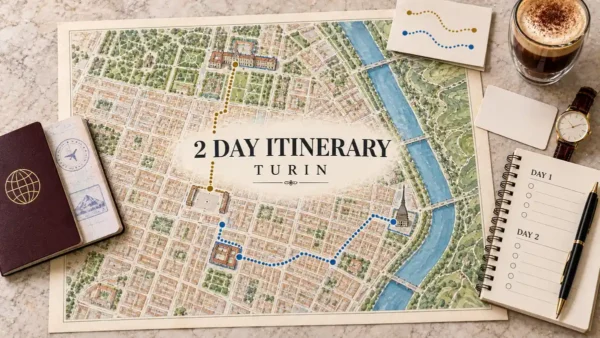
This page ranks experiences; it does not put them in order. The two-day Turin itinerary turns this shortlist into a day-by-day plan. Whether Turin suits your trip at all, and how to arrive, is covered in our Turin city guide.
Museo Egizio and the Mole Antonelliana are Turin’s two must-book museums
Museo Egizio and the Mole Antonelliana are the two Turin museums worth booking before you travel. Egizio sells tickets only online, through the museum’s official site. At the Mole, the glass panoramic lift is the experience, and a booked slot means you ride at a time you chose instead of the next free one.
The two answer different appetites. Egizio is depth: a long visit among one of the great ancient collections. The Mole is spectacle. You ride up through the dome and the whole city opens out below. Most first-timers want both, and on a short stay they rarely fit comfortably into the same morning.
The Mole’s lift and its cinema museum are separate experiences under one roof, so decide which one you came for before choosing a ticket.
Museo Egizio
Museo Egizio is the museum to build a Turin day around, and its collection is the reason. Statues, papyri, coffins and the contents of whole tombs fill several floors, in a museum devoted entirely to ancient Egypt. The gallery of monumental royal statues is the room most visitors remember.
What sets it apart from the Mole is depth. You do not tick it off in an hour. A proper visit takes at least half a day, and it rewards anyone who reads the labels. Tickets are sold only online, through the museum’s official site. Book before you travel, buy only from the official shop, and treat your entry time as the fixed point of the day.
Pick this if: ancient history is the one museum subject you would cross a city for.
The Mole Antonelliana lift and the National Cinema Museum
The glass lift inside the Mole Antonelliana is the experience here: a cabin that rises through the open centre of the dome to a panoramic terrace above the rooftops. On a clear day the view runs from the grid of the historic centre to the Alps. Book a slot for the lift, because the lift is what most visitors come for.
The National Cinema Museum fills the building below, and it is what makes the Mole distinct from Egizio. It is playful where Egizio is scholarly: film sets, early optical devices, posters and a vast central hall under the dome where projections play. It is also the rainy-day hedge. The lift view depends on the weather; the museum does not.
Pick this if: you want the city’s signature view and a museum that entertains the whole group, children included.
Royal Turin: Palazzo Reale, Palazzo Madama and Piazza Castello
Choose Palazzo Reale and the Royal Museums first if royal Turin gets one slot in your trip. The complex gathers the Savoy apartments, the armoury, a picture gallery and gardens side by side. Palazzo Madama suits a shorter stop: it stands in the middle of Piazza Castello, and the building itself tells the city’s history in layers.
The two palaces face each other across the same square, so the choice is about time more than distance. Royal Turin rewards stamina. The Royal Museums fill a morning on their own, and pairing them with Egizio on the same day turns both into a rush. Palazzo Madama is the one that fits between other sights.
Palazzo Reale and the Royal Museums
Palazzo Reale was the main residence of the House of Savoy, and walking its state apartments is the closest Turin comes to a royal court experience. Gilded ballrooms, throne rooms and private chambers run in sequence, and the Royal Museums extend the visit into the Royal Armoury, the Galleria Sabauda picture collection and the Royal Gardens behind the palace.
Next to Palazzo Madama, this is the long option, easily a morning on its own. It suits travelers who enjoy lavish interiors, arms and armour or Old Master paintings. Pace it with care: the armoury and the gallery are each a museum in their own right, and trying to see everything at speed flattens all three.
Pick this if: you want one royal interior in Turin and have a full morning to give it.
Palazzo Madama and Piazza Castello
Palazzo Madama is a building that reads like a timeline: Roman gate towers became a medieval castle, and Filippo Juvarra later gave it a Baroque façade and a grand staircase. Inside, the Civic Museum of Ancient Art holds the collection, but the building itself is as much the exhibit.
Its distinct strength is location. Piazza Castello is the hinge of the historic centre, so the palace slots into a walk. The Duomo stands just beyond the square, with the chapel linked to the Shroud of Turin (covered in the FAQ below). Further on, the Roman gate of Porta Palatina and the lanes of the Quadrilatero Romano make a free extension on foot. Small cafés and restaurants line the way.
Pick this if: you prefer architecture you can walk around and a palace that fits between other sights.
Where are the best views in Turin?
Monte dei Cappuccini and Superga give Turin’s best views, one near the centre and one far above it. Cappuccini is a short climb from the Po for the city-and-Alps panorama. Superga is a half-day outing by historic rack tramway to a hilltop basilica. The Mole terrace, covered above, is the third, from inside the city.
Cappuccini shows you Turin. Superga shows you where Turin sits, between the river plain and the Alps. With one free evening, the closer hill wins; with a free morning and an interest in the journey itself, Superga is the better outing.
Monte dei Cappuccini
Monte dei Cappuccini is the easiest great view in Turin: a short walk up from the Po riverbank to a church terrace looking straight back across the river at the city. The Mole rises out of the rooftops in front of you, and on clear days the Alps line the horizon behind. The terrace is free to visit.
It differs from Superga in effort and timing. There is no ride to plan and no timetable to check, so it fits at the end of a sightseeing day. Sunset is when it earns its reputation. The former convent beside the terrace also houses the National Mountain Museum, a fitting stop given the peaks on the skyline.
Pick this if: you have one free evening and want the city view without a half-day outing.
Basilica di Superga by rack tramway
The ride is half the Superga experience. A historic rack tramway climbs from Sassi, on the edge of the city, up the wooded hill to the basilica, hauling itself up the slope on a toothed rail. Check the timetable before you go; it is sometimes replaced by a bus during works.
At the top, Juvarra’s Baroque basilica holds the royal tombs of the House of Savoy, and its terrace looks over the whole city to the Alps. Football fans also come for the memorial to the Grande Torino team, lost when their plane crashed into the hill. Cappuccini puts you face to face with the rooftops; from Superga, the city becomes a map below you.
Pick this if: the journey up matters to you as much as the view from the top.
Turin’s food and drink rituals are experiences in their own right
A bicerin, a chocolate café stop, a vermouth aperitivo and a morning market are Turin’s food rituals worth planning around. Each belongs to a time of day, so they fit around the museums instead of competing with them. Food-focused travelers should treat them as the main event; everyone else can fold one or two into the gaps.
The rituals map onto the day: the market in the morning, a bicerin or chocolate in the afternoon, vermouth at dusk. That is the local rhythm. Following it costs no extra time, because each ritual doubles as the break between sights. Turin’s cafés sell time as much as coffee, and a slow afternoon stop is how you pace a museum-heavy day.
For how these rituals sit among food experiences across the country, see the guide to things to do in Italy.
Bicerin at Caffè Al Bicerin
Drinking a bicerin at the café most associated with it is the Turin ritual in one glass. The drink layers espresso, thick hot chocolate and cream in a small glass, and you sip it unstirred so the three stay distinct. Caffè Al Bicerin, a tiny historic café facing the Santuario della Consolata, is the place tied to its name.
You come for the room as much as the drink. It has only a handful of small tables, so expect to wait at busy times and to sit close to strangers. Most cafés in the centre serve their own version, which helps if the queue is long. Stir it and it becomes an ordinary mocha.
Pick this if: you want the one drink that belongs to Turin and to no other city.
Chocolate and the historic café circuit
Turin’s chocolate culture works as a circuit you walk, with no single address at its centre. The city is the home of gianduja, the smooth blend of chocolate and hazelnut, shaped into the wrapped gianduiotto sold in chocolate shops across the centre. Chocolatiers such as Guido Gobino turn a stroll into a tasting route.
The historic cafés under the porticoes carry the other half of the ritual. The merenda reale — hot chocolate served with small pastries, a habit of the Savoy court — is the way to use them: slowly, in the afternoon, between sights. Piazza San Carlo and the Galleria Subalpina hold some of the grandest rooms. The bicerin is one drink in one café. This is an afternoon you design yourself.
Pick this if: you like to graze through a city’s sweet side over a whole unhurried afternoon.
Vermouth aperitivo
Vermouth is Turin’s aperitivo, a fortified, herb-infused wine with deep roots in the city. The ritual happens in the early evening: a vermouth served neat, over ice or in a cocktail, with snacks brought to the table or laid out along the bar. Historic bars and newer vermouth specialists both keep it alive.
It differs from the café circuit in mood and hour. The cafés belong to the afternoon and to conversation over pastries; aperitivo is the city winding down after work, and it takes nothing away from your sightseeing hours. It suits couples, solo travelers and anyone who prefers a slow evening to a formal dinner. Ask for a local vermouth by name.
Pick this if: your ideal evening starts with a drink and a plate of snacks and has no fixed end.
Porta Palazzo market and Eataly Lingotto
Porta Palazzo is one of Europe’s largest open-air markets, and a morning there is Turin’s most local food experience. Stalls of produce, cheese, cured meat and bread fill the square Monday to Saturday, with covered halls alongside. Go in the morning, when the traders are busiest and the square is at its loudest.
Eataly Lingotto is the indoor alternative, and the contrast is the point. The original Eataly opened here, in a former industrial building, and it gathers Italian producers, counters and restaurants under one roof. It works on a rainy day or with children, when an open square is harder going. It also sits close to the car heritage sites below.
Pick this if: you judge a city by its ingredients and would sooner shop and taste than sit down to a meal.
Lingotto, Pista 500 and the Automobile Museum: Turin’s car heritage
Turin’s car heritage is worth half a day, even for travelers who never think about cars. The National Automobile Museum tells the story of the car through its collection. The Lingotto rooftop offers something rarer: the former Fiat test track, now a garden walk, with the Pinacoteca Agnelli beside it. Choose the museum for machines, Lingotto for place.
Lingotto is the rare car site that wins over people with no interest in cars. A test track on the roof of a former factory is architecture and social history as much as engineering. The Automobile Museum, by contrast, rewards curiosity about the machines themselves. Both sit south of the centre, so doing the pair together is straightforward.
Football fans have a separate interest match in Juventus, whose stadium and club museum sit outside the historic centre. Treat it as a pilgrimage for supporters. For everyone else, the car heritage is the better use of the half-day. Check the club’s official channels for tour and match access before planning around it.
National Automobile Museum
The National Automobile Museum is the story of the car told in one building, from early horseless carriages to racing cars and design icons. Its strength is presentation: the displays set the cars in their social context, so the visit reads as a history of how people moved and lived. Italian marques are well represented, as you would expect in Fiat’s home city.
What makes it distinct from Lingotto is focus. This is the collection; Lingotto is the setting. It sits by the Po, near Lingotto, so the two pair easily. It is also a strong rainy-day and family choice. Most of the visit is indoors, and children tend to engage quickly with the vehicles.
Pick this if: you want the full history of the car in one sitting, under one roof.
The Lingotto rooftop track and Pinacoteca Agnelli
Walking the rooftop test track of the Lingotto is one of Turin’s strangest and best experiences. Fiat built the factory with a track on its roof, where finished cars were driven for testing, and the banked curves are still there. Today La Pista 500 is a rooftop garden planted along the track, with views across the city to the hills.
The Pinacoteca Agnelli sits on the same roof and adds art to the engineering, with a collection gathered by the Agnelli family and a programme of exhibitions. The museum shows you the cars; here you stand where Turin’s car age happened. It suits architecture lovers, photographers and anyone who likes an unusual view.
Pick this if: industrial architecture and unexpected rooftops interest you more than the cars themselves.
What do you need to book ahead in Turin, and does a city card change that?
Only Museo Egizio tickets and a Mole Antonelliana lift slot are worth booking before you travel. Egizio sells tickets only online, and the lift is the experience most visitors come to the Mole for. The Torino+Piemonte Card is a counting decision, not a default buy: it pays off only if you enter several paid museums within its hours.
The book-ahead list is short:
- Museo Egizio: book before you travel, only through the museum’s official online shop.
- Mole Antonelliana lift: book a lift slot so the view happens at a time you choose.
- Palazzo Reale, Palazzo Madama and the Automobile Museum: check booking conditions on each museum’s official site before you go.
- Superga rack tramway: no booking, but check the timetable before you go; it is sometimes replaced by a bus during works.
- Monte dei Cappuccini, Porta Palazzo, cafés and aperitivo: walk-in experiences with nothing to reserve.
The Torino+Piemonte Card follows four rules, and together they decide its value. It activates at the first QR scan. It then runs for consecutive hours, in 24-, 48-, 72- and 120-hour versions. Each museum counts once. The 24-hour card is capped at three free entries.
So count before you buy. List the paid museums you will actually enter within the card’s hours, confirm each is included on the official site, and compare. Scan the card at the first museum of a full sightseeing day: the hours start at activation, so a card first used at an evening visit wastes most of its first day. Book Egizio and the Mole lift through their own official channels either way.
| Experience | Who it suits | Book ahead? | Where on this page |
|---|---|---|---|
| Museo Egizio | History lovers and first-time visitors to Turin | Yes, online only through the official site | See the must-book museums section |
| Mole Antonelliana lift | View seekers, film fans and families | Recommended; book a lift slot in advance | See the must-book museums section |
| Palazzo Reale and the Royal Museums | Travelers who love palace interiors and paintings | Check booking conditions on the official site | See the royal Turin section |
| Superga rack tramway | Travelers who enjoy the ride as much as the view | No booking; check the timetable before you go | See the best views section |
| Vermouth aperitivo | Couples, solo travelers and slow-evening lovers | No, walk in during the early evening | See the food and drink section |
| National Automobile Museum | Car fans, families and rainy-day visitors | Check booking conditions on the official site | See the car heritage section |
Once the booked items are fixed, the two-day Turin itinerary slots them into your days.
Day-trip experiences within easy reach: Venaria Reale, Sacra di San Michele and the Langhe
Venaria Reale, the Sacra di San Michele and the Langhe wine towns are the day trips worth a city day. Each rewards a different traveler: Venaria suits palace lovers, the Sacra suits walkers and anyone drawn to dramatic settings, and the Langhe suits wine and food travelers. Take one only if the city’s unmissables are already covered.
- Venaria Reale: the Savoy hunting residence just outside the city, with vast Baroque halls and formal gardens. Suits travelers who loved Palazzo Reale and want its grander country counterpart. The tradeoff is more palace, so skip it if one royal interior was enough.
- Sacra di San Michele: a medieval abbey built on a rocky summit at the mouth of the Susa Valley, with long views across the plain. Suits walkers and travelers who like dramatic settings. The tradeoff is the climb and the logistics; it fills the outing on its own.
- The Langhe wine towns: the hills of Barolo, Barbaresco and Alba, with wineries, hilltop villages and truffle country. Suits wine and food travelers. The tradeoff is spread: the towns are scattered across the hills, so one day samples the region at best.
Venaria and Palazzo Reale overlap more than most visitors expect. Pick one royal day, and give the other to the Sacra or the Langhe. Superga, covered in the views section, is the closest hilltop outing and needs only half a day.
How to reach each one is covered in our Turin city guide. If Turin is one stop on a longer trip, the guide to the best places to visit in Italy helps you choose the next leg.
Tours and activities
Book skip-the-line tickets, day trips and local tours with free cancellation on most activities.
You can also browse everything on getyourguide.com.
Tripstou may earn a commission if you book through this link, at no extra cost to you.
Frequently Asked Questions
Is the Torino+Piemonte Card worth it for a short stay?
It is worth it only for a museum-heavy trip. If you will enter several paid museums on consecutive days, the card can pay off; if your plan centres on cafés, views and one or two museums, single tickets are simpler. Book Museo Egizio through its official site whatever card you hold.
What are the best free things to do in Turin?
Walking the city is the best free experience. The porticoes and Piazza San Carlo, the Roman gate of Porta Palatina and the Quadrilatero Romano lanes, the Po riverside and Parco del Valentino, the terrace at Monte dei Cappuccini and a morning at Porta Palazzo market all cost nothing to enjoy.
What can you do in Turin when it rains?
Rain barely dents a Turin trip, because many of its strongest experiences are indoors. Head for Museo Egizio, the National Cinema Museum or the Royal Museums, add the National Automobile Museum or Eataly Lingotto, and walk between cafés under the porticoes, which keep much of the centre covered. Save the lift and the hills for a clear day.
What are the best things to do in Turin with kids?
The National Cinema Museum inside the Mole is the strongest pick for children, followed by the glass lift, the National Automobile Museum and the rack tramway ride up to Superga. Between sights, a hot chocolate or a gianduiotto from a chocolate shop turns a museum day into something younger travelers look forward to.
Can you see the Shroud of Turin?
Not on a normal visit. The Shroud is kept in Turin’s Duomo, but the cloth itself stays out of public view and is shown only during rare public expositions announced by the Church. You can still enter the cathedral and see where it is kept, which fits naturally into a walk from Piazza Castello.
Do you need a guided tour for Turin’s main experiences?
No, most of Turin works well self-guided. A guided visit adds the most at Museo Egizio and the Royal Museums, where the collections are vast and context changes what you notice. Views, cafés, markets and the car heritage sites need no guide, so spend any tour budget on one of those two.
Related Guides
This page resolves what to do in Turin; the planning, the order of your days and the wider Italian picture live on these pages.
- Turin city guide — whether Turin fits your trip, how to arrive and how to reach the day trips.
- Two-day Turin itinerary — how to put these experiences in order across a short stay.
- Where to stay in Turin — the areas that keep these sights within walking distance.
- Things to do in Italy — the national view of experiences worth planning a trip around.
- Best places to visit in Italy — where Turin sits among Italian destinations on a longer route.
Did this guide save you time or money? Tripstou is independent and reader-funded — if you'd like to give something back, you can support the site with a crypto contribution of any size.