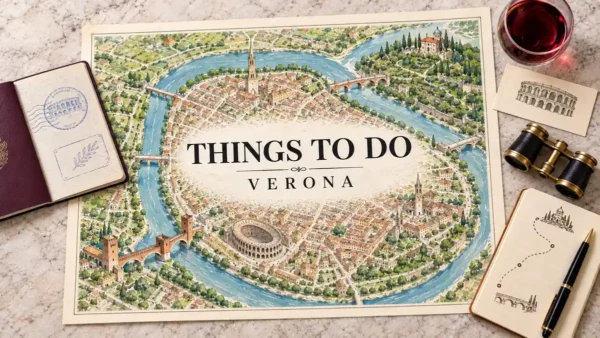
Most travelers reach Verona by train from Venice or Milan, arriving at Verona Porta Nuova, which sits outside the city walls about 20 minutes on foot from Piazza Bra and the Arena. Fast trains take about 1 hour 15 minutes from Venice and about 1 hour 10 minutes from Milan. One full day covers the core, and one to two nights is the comfortable first visit. The core is compact: the Roman Arena, Piazza delle Erbe, Juliet’s House (Casa di Giulietta), and Ponte Pietra with the climb to Castel San Pietro above it. The one thing that changes the plan is the Arena opera festival, which fills summer evenings from mid-June to mid-September.
This page is for a first trip, often one stop on a route that links Venice, Milan and Lake Garda. It takes you from the train platform to a decision on nights, season, base, budget and day trips, with the entry prices and closing days checked on the official pages.
Quick Answer
Verona is worth the trip: a compact, walkable Roman and medieval city built around the Arena, Piazza delle Erbe and Ponte Pietra. One full day covers the core, while one or two nights add the evening piazzas and a Lake Garda trip. It suits rail-based northern Italy trips, couples and summer opera lovers, who should book ahead.
How We Checked This Guide
Scope: a first trip to Verona, from arrival to nights, season, base, entry prices and day trips. Not a sights ranking, itinerary or hotel guide.
Drafted with AI assistance; fares, entry prices and closing days were checked on the operators’ own pages by Alex Perrut, in tourism since 2015, for the Tripstou editorial team. See our editorial process.
Official sources consulted: ATV Verona, Arena di Verona, Visit Verona, Torre dei Lamberti, Chiese Verona, Italo.
How to Get to Verona From Venice, Milan or the Airport
For most long-haul travelers, the way to Verona is to fly into Venice or Milan and take the train to Verona Porta Nuova. Italo and Frecciarossa fast trains take about 1 hour 15 minutes from Venice and about 1 hour 10 minutes from Milan; regional trains are slower and cheaper. Verona’s own airport mainly serves European flights, many of them seasonal.
Flying into Venice or Milan
The train is the default arrival, and the gateway follows your route. Venice suits a trip that continues west through the Veneto or ends at Lake Garda. Milan suits a trip that starts in Lombardy or the Italian lakes.
Fast trains save real time on both lines, and their cheapest fares are sold weeks ahead with no refund, so book them once your dates are fixed. Regional trains have a flat fare, no seat reservation and take roughly twice as long, which matters less on the short Venice hop than on the longer run from Milan. Check the entry rules that apply to your passport before booking.
If Verona is one stop on a longer route, our Italy travel guide covers planning the rest of the country.
From Verona airport
Verona’s airport, Valerio Catullo (VRN), sits at Villafranca, south-west of the city, and the Airlink bus connects it to Porta Nuova. The ride takes about 15 minutes, buses run every 20 minutes, and a single costs €7. Buy the ticket at the machine in arrivals, online, in the Ticket Bus Verona app or on board. The Verona Card does not cover the Airlink.
Getting around on foot
Verona’s centre is walked, not ridden. Porta Nuova lies outside the walls, about 20 minutes on foot to Piazza Bra, and from there every core sight is within a short stroll.
City buses matter mainly for the station and the airport link. An ATV urban ticket costs €1.50 for 90 minutes when bought from a machine, a tobacconist or the Ticket Bus Verona app, €2 on board, and a day ticket is €5. The one climb worth saving your legs on is Castel San Pietro, where a short funicular runs up from the riverbank near Ponte Pietra for €2 one way or €3 return. A heavy bag is the only real reason to take a bus or taxi from the station into the walls.
What Is Verona Known For?
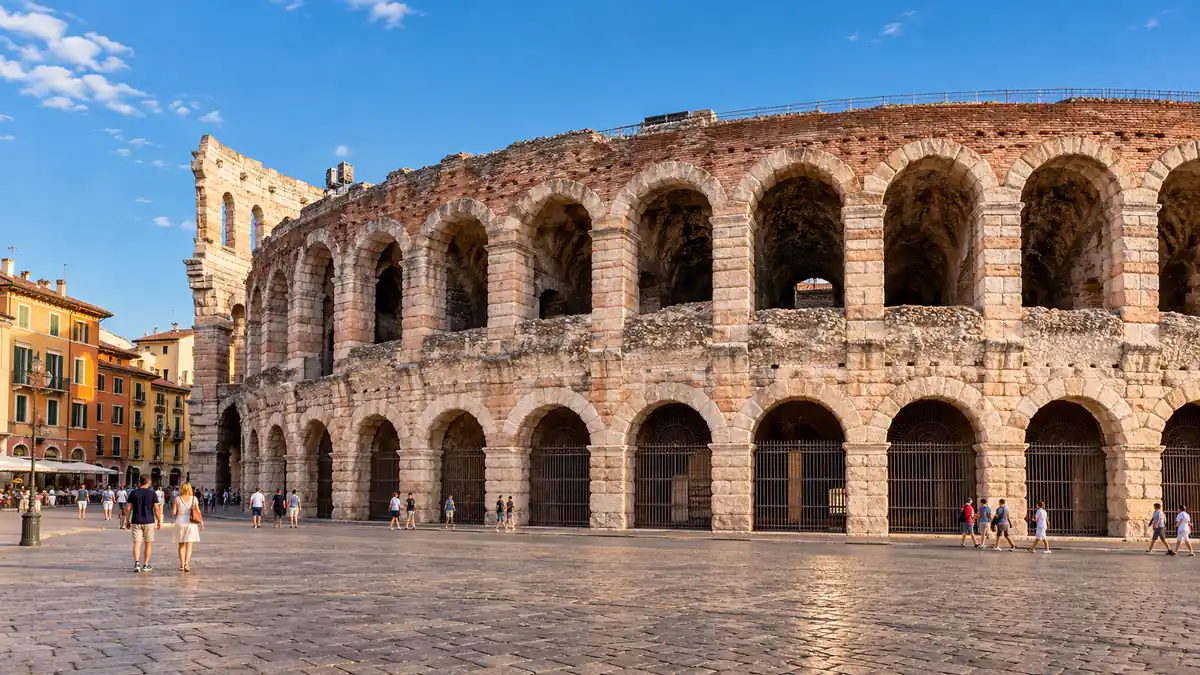
Verona is known for its Roman Arena on Piazza Bra, still used as an opera stage, for Piazza delle Erbe and Juliet’s House (book fast-track entry) in the medieval core, and for the bend of the Adige crossed by Ponte Pietra below Castel San Pietro. Together they make a city you read on foot, Roman stone first and medieval towers after.
The walk usually starts at Piazza Bra, the wide square of cafés facing the Arena, a Roman amphitheatre whose arches still hold summer audiences. Via Mazzini leads north into the old core; a guided walk covers the same ground with the stories attached (book a small-group walk).
Piazza delle Erbe sits on the site of the Roman forum, ringed by frescoed houses and overlooked by the Torre dei Lamberti, whose 84-metre top is reached by stairs or lift for €6. A few steps away, Casa di Giulietta draws crowds to its balcony and courtyard; entry is now through the Teatro Nuovo on Piazzetta Navona with a timed online ticket, €5 for the courtyard and €12 with the house. Behind the market square, the quieter Piazza dei Signori opens onto the Arche Scaligere, the Gothic tombs of the Della Scala family who ruled medieval Verona, which you see for free through their iron railings.
Across Ponte Pietra, the hill of Castel San Pietro gives the classic view back over the river and the rooftops, with the Roman Theatre and its archaeological museum at the foot of the climb. Downstream, the brick fortress of Castelvecchio guards the Ponte Scaligero, its crenellated bridge, and houses the city’s main art museum. The outer pair takes more effort and repays it: the Romanesque Basilica di San Zeno to the west, and Giardino Giusti, a terraced Renaissance garden, across the river in Veronetta.
Second-tier Verona is churches and palaces: the striped Gothic interior of Sant’Anastasia, the Duomo with its Titian altarpiece, San Fermo’s two stacked churches near the river, and Palazzo Maffei on Piazza delle Erbe, now a private art collection with a rooftop over the square. The four main churches, San Zeno, Sant’Anastasia, the Duomo and San Fermo, share one €8 pass sold at the door, or €4 each.
How to visit each of these, and what is worth paying for, is set out in things to do in Verona.
Verona Rewards an Overnight More Than a Day Trip
Verona is worth visiting, and it pays off most when you sleep there. Day-trippers fill the centre from late morning to late afternoon. The evening, when Piazza delle Erbe and the Arena area empty out and the bars along the Adige fill with locals, is the Verona most visitors never see.
The city works best for first-timers who want a calmer Italian city than Venice, with real streets, shops and neighbourhoods around the sights. Couples get the evening squares, the river and a romantic reputation that, Juliet aside, the city earns honestly. Opera lovers have the strongest reason of all to plan around Verona: a summer night inside a Roman amphitheatre has no equivalent elsewhere in Italy.
Rail-based trips gain the most. Verona sits on the main line between Venice and Milan and on the line north towards the Alps, so a stop here costs little time. It suits less the traveler whose priority is big museum collections; Castelvecchio is worthwhile, but nothing here rivals Florence or Rome for art.
Most visitors overrate Juliet’s House and underrate the walk from Ponte Pietra up to Castel San Pietro at dusk, which gives the view that explains the whole city.
To set Verona against Italy’s other stops, see the best places to visit in Italy.
How Many Days Do You Need in Verona?
One full day covers Verona’s core sights, and two days, with one or two nights, is the comfortable first visit. Stay longer only if you use Verona as a base for Lake Garda, Vicenza or Padua.
| Stay | What it covers | Who it fits |
|---|---|---|
| Day trip from Venice or Milan | The Arena, Piazza delle Erbe, Juliet’s House and Ponte Pietra, at a steady pace | Travelers short on time with a fixed base elsewhere |
| One night | The core plus an evening in the piazzas and a morning before the crowds | Rail trips passing between Venice and Milan |
| Two nights | The core, Castel San Pietro, San Zeno and Giardino Giusti, or an opera night | Most first-timers and couples |
| Three or more nights | Verona plus day trips to Lake Garda, Vicenza, Padua or Mantua | Travelers who want one base and short train rides |
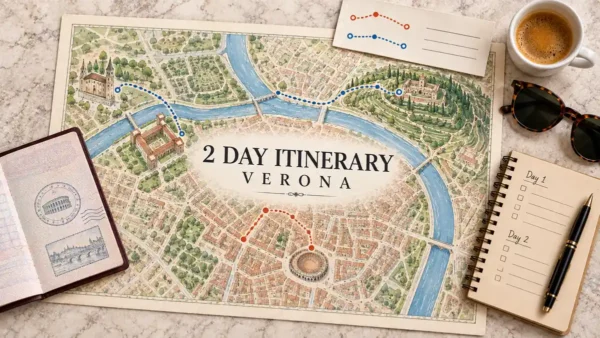
A workable two-day shape, for those who want the order and not just the list:
- Day 1: Piazza Bra and the Arena when it opens, Via Mazzini to Piazza delle Erbe, the Lamberti tower, Piazza dei Signori and the Scaliger tombs, Juliet’s House at your booked slot, then Sant’Anastasia and the Duomo before an evening aperitivo back on Piazza delle Erbe.
- Day 2: Castelvecchio and the Ponte Scaligero, San Zeno, lunch near the river, then Ponte Pietra, the Roman Theatre and the climb or funicular to Castel San Pietro for the late-afternoon view, with Giardino Giusti on the way back if the light holds.
The day trip is the most common choice and the one that shortchanges the city. A single night costs little extra on a rail route and changes the visit, because it gives you both the empty evening and the quiet morning.
For a paced plan across two days, use a two-day Verona itinerary. To fit Verona into a longer trip, start from a wider Italy itinerary.
Spring and Early Autumn Suit Verona Best, Summer Belongs to the Opera
April to May and September to October give Verona its best walking weather with fewer crowds. Mid-June to mid-September is opera season, which brings heat, crowds and the Arena’s summer nights. Winter is quiet and cold, with a Christmas market on Piazza Bra and Piazza dei Signori from late November to just after Christmas.
Spring is the easy pick for a first trip. The days are warm enough for the riverside and the climb to Castel San Pietro, and Lake Garda is waking up for day trips. The one spring week to watch is Vinitaly, the wine fair in April, when the city’s rooms sell out and rates jump.
Summer is hot in the stone centre, and the city is at its busiest. Come in summer for the opera, not despite it: the festival is the reason to accept the heat and the competition for rooms.
Early autumn repeats spring’s advantages, with the grape harvest in the surrounding Valpolicella hills and warm evenings that outlast the crowds. Winter suits travelers who want the sights to themselves and do not mind short days.
For the Italy-wide picture, read the best time to visit Italy.
Booking the Arena opera
The Arena opera festival runs from mid-June to mid-September, and it is the one part of a Verona trip to book early. Tickets for each season go on sale in the spring of the year before on the Arena’s official site, with early-booking discounts through the autumn, and popular weekend dates tend to go first. The unnumbered stone steps start at €22 and are the cheapest way in; numbered seats and the stalls cost several times more. Pick the opera night before the hotel: the performance is the fixed point, and the rest of the stay arranges itself around it. On performance days the Arena is closed to daytime visits, so see the inside on another morning.
Tours and activities
Book skip-the-line tickets, day trips and local tours with free cancellation on most activities.
You can also browse everything on getyourguide.com.
Tripstou may earn a commission if you book through this link, at no extra cost to you.
Where to Base Yourself in Verona
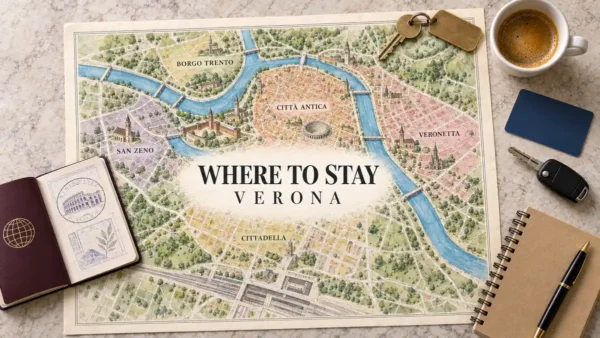
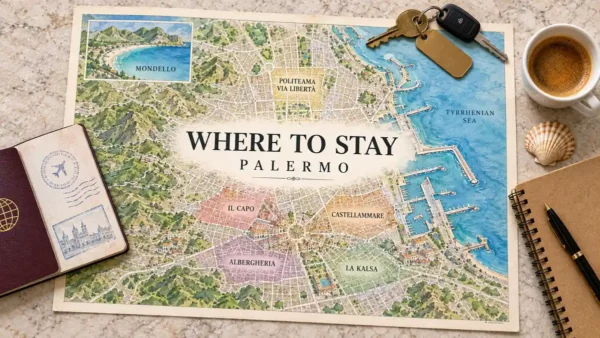
First-timers should sleep inside the walls, between Piazza Bra and Piazza delle Erbe, for walkability and evenings. Veronetta, across the Adige, is the value and local-feel choice, and the area around Porta Nuova suits rail-heavy plans.
- Inside the walls (Piazza Bra to Piazza delle Erbe): everything on foot, evenings on the doorstep and the Arena a short walk after an opera night. You pay the highest room rates in the city, and summer weekends are the hardest to book. Hotel Due Torri is the grand old address by Sant’Anastasia; Hotel Accademia, Hotel Giulietta e Romeo and Albergo Mazzanti are the classic mid-range picks a few streets from the Arena; Hotel Milano & SPA has a rooftop bar facing the amphitheatre; Relais Balcone di Giulietta puts you beside the balcony itself.
- Veronetta: a university quarter on the east bank with cheaper rooms, local bars and Giardino Giusti close by, a bridge away from the centre. It suits travelers who want a lived-in feel and accept a slightly longer walk back at night. Guesthouses such as Veronetta House are the typical offer here; full-service hotels are rare on this bank.
- Near Porta Nuova: the practical base for day trips and early departures, with the Airlink and trains at the door. The streets are plainer, and every evening in the centre starts with a 20-minute walk. Hotel Indigo Verona Grand Hotel Des Arts sits on the avenue between the station and Piazza Bra; Novo Hotel Rossi is the straightforward station hotel.
Drivers should know that the whole historic centre is a camera-enforced ZTL: a hotel inside it must register your plate before you arrive, or you park outside the walls and walk in.
Street-level detail and hotel picks for each area are in where to stay in Verona.
Hotels and places to stay
Compare hotels, apartments and stays for your dates in one search.
Search hotels and stays on hotels.com →
Tripstou may earn a commission if you book through this link, at no extra cost to you.
What a Verona Trip Costs: Entry Prices and Travel Styles
Verona’s costs depend mostly on where you sleep and whether you book an opera night. The sights are cheap by Italian standards: the Lamberti tower is €6, Juliet’s House €12 (€5 for the courtyard alone), Giardino Giusti €14, the funicular €3 return and the four-church pass €8, so a full first day of paid entries runs to about €43 before the Arena and Castelvecchio, whose prices are set by the civic museums. The Verona Card bundles the Arena, Castelvecchio, Lamberti by the stairs, Juliet’s House, the Roman Theatre museum, the churches and the city buses for €33 (24 hours) or €38 (48 hours); it only discounts Giardino Giusti.
The centre needs no daily transport spend, and an aperitivo in a piazza bar is an everyday pleasure, not a splurge. The city punishes late bookers who want a central room in opera season or during Vinitaly, when demand for the old town peaks.
A tight budget works well here. It means a hostel or a simple room in Veronetta or near the station, lunch from bakeries and the market stalls on Piazza delle Erbe, the €22 stone steps if you want the opera, and walking everywhere. Much of the city is seen from the street, and the best view in town, from Castel San Pietro, costs nothing if you climb on foot.
A comfortable middle buys a hotel inside the walls, sit-down dinners in trattorias, the Verona Card for a day of entries and a train day trip to Lake Garda. This is the style the city rewards most, because the central location saves time as well as transport.
A high-end trip buys a boutique hotel near Piazza Bra, numbered Arena seats, wine-led dinners and perhaps a Valpolicella winery visit by car or tour. In summer, the room is where most of that budget goes.
For figures by budget, see what a trip to Italy costs.
Lake Garda Is the Easiest Day Trip From Verona
Lake Garda at Peschiera del Garda is the shortest real day trip from Verona, about 15 minutes by train, with Desenzano a little further. Vicenza, Padua and Mantua are easy rail day trips, Venice works as a long day on a fast train, and Milan is better as a transfer than a day trip.
| Destination | Approx. train time | As a day trip |
|---|---|---|
| Peschiera del Garda | About 15 minutes | Easy |
| Desenzano del Garda | About 20–30 minutes | Easy |
| Vicenza | About 25–40 minutes | Easy |
| Padua | About 40–60 minutes | Easy |
| Mantua | About 40–60 minutes | Easy |
| Venice | About 1 hour 15 minutes (fast); about 2 hours or more (regional) | Long but workable on a fast train |
| Bologna | About 1–1.5 hours | Workable |
| Trento | About 1–1.5 hours | Borderline |
| Milan | About 1 hour 10 minutes (fast); about 2 hours (regional) | Better as a transfer |
Train time alone does not settle the borderline cases. Milan is too big for a few hours to do it justice, so it works better as the start or end of the trip. Trento is close enough, but the reason to go north is usually the mountains beyond it, and they need a night.
Peschiera’s station is a short walk from the lake shore, so the Garda trip needs no bus or ferry unless you want one. That is why it is the half-day add-on that even a one-night stay can fit. Sirmione, the lake’s postcard peninsula, is a bus ride on from Peschiera, and the Valpolicella wine villages and Soave, with its walled hilltop castle, are the two trips that need a car or a tour rather than a train.
To decide what each Veneto city deserves, use the Venice and Veneto region guide.
What to Know Before a First Trip to Verona
Verona’s food is Veneto cooking with a wine cellar attached. The dishes to look for are risotto all’Amarone, cooked with the Valpolicella’s heavy red; pastissada de caval, a horse-meat stew that is the city’s oldest recipe; bigoli, the thick local pasta; bollito misto with pearà, the pepper-and-bread sauce that belongs to Verona alone; and pandoro, the Christmas cake that was invented here. The wines are Valpolicella and Amarone from the hills north of the city, Soave from the east, and Lugana from the Garda shore.
For where to eat them: Antica Bottega del Vino, off Via Mazzini, is the historic wine bar for risotto all’Amarone and a wine list the size of a ledger; Trattoria Al Pompiere, behind Juliet’s House, does the traditional plates at trattoria prices; Caffè Monte Baldo serves Venetian-style cicchetti with wines by the glass; Locanda 4 Cuochi is the modern take on the same kitchen; and Pasticceria Flego, with a branch on Corso Porta Borsari, makes the almond torta russa. Casa Perbellini is the city’s two-star table for the one big night. Restaurants open for dinner from about 7 pm, and an aperitivo on Piazza delle Erbe fills the hour before.
Six things first-timers get wrong:
- Juliet’s House has no ticket office. Entry is online only, through the Teatro Nuovo on Piazzetta Navona, and Verona Card holders must book a slot too. The courtyard is €5 and the house €12; the balcony is a 1930s addition, so set expectations accordingly.
- The civic museums close on Monday. The Arena, Castelvecchio and the Roman Theatre museum all shut on Mondays, and the Arena also closes to daytime visits on opera days. Juliet’s House opens Monday afternoons only.
- Churches are not open all day. The four Chiese Vive churches suspend visits during services and open on Sundays only from 1 pm; the €8 pass is sold at the door and lasts 90 days.
- Validate the bus ticket, and buy it before boarding. A pre-bought 90-minute ticket is €1.50, on board it is €2, and an unvalidated ticket counts as none.
- Do not drive into the centre. The ZTL cameras fine every unregistered plate; have the hotel register yours in advance or leave the car outside the walls.
- Book the opera before the room. In summer the performance date fixes the trip; in April, Vinitaly does the same to hotel prices.
Verona in Brief
- Long-haul travelers usually fly into Venice or Milan and take the train to Verona Porta Nuova, about 1 hour 15 minutes from Venice and 1 hour 10 minutes from Milan on fast trains, then a 20-minute walk to the Arena.
- Arriving at Verona’s own airport, the Airlink bus reaches Porta Nuova in about 15 minutes for €7.
- One full day covers the core sights, but a night or two adds the empty evening piazzas and the quiet morning that day-trippers miss.
- A summer visit should be built around the Arena opera festival: tickets go on sale in the spring of the year before, stone steps start at €22, so fix the opera night before booking the hotel.
- Sleep inside the walls for evenings on foot, in Veronetta for cheaper rooms and a local feel, or near Porta Nuova for rail-heavy plans.
- The Verona Card is €33 for 24 hours or €38 for 48 hours with city buses included; Juliet’s House is €12 and online only, the Lamberti tower €6, the four-church pass €8.
- Lake Garda at Peschiera, about 15 minutes by train, is the easiest day trip, while Milan works better as a transfer than as a day out.
Before You Book Verona
Is the Verona Card worth it?
The Verona Card costs €33 for 24 hours or €38 for 48 hours and includes the Arena, Castelvecchio, the Lamberti tower by the stairs, Juliet’s House, the Roman Theatre museum, the four main churches and the ATV city buses. Paying separately, the Lamberti tower is €6, Juliet’s House €12 and the four-church pass €8, so the card pays off when you enter the Arena, Castelvecchio and two or three of the others within its window. Giardino Giusti is only discounted, and Juliet’s House still needs an online booking.
Is Verona a good base for northern Italy?
Yes, for Lake Garda, Vicenza, Padua and Mantua, all within about an hour of Porta Nuova by train. It works less well for Milan, which deserves its own nights, for a Venice-heavy plan, where the daily round trips add up, and for the Dolomites, which need an overnight further north.
How do I get from Verona airport to the city centre?
Take the Airlink bus from the arrivals terminal to Verona Porta Nuova station: about 15 minutes, every 20 minutes, €7 single. From Porta Nuova the Arena is a 20-minute walk, or an ATV city bus ticket costs €1.50 bought in advance and €2 on board. The Verona Card covers city buses but not the Airlink.
Can I buy Juliet’s House tickets at the door?
No. Entry is through the Teatro Nuovo on Piazzetta Navona with a timed online ticket: €5 for the courtyard and balcony view, €12 including the house museum. There is no ticket office on site, and Verona Card holders must also book a slot. The house opens at 2 pm on Mondays and at 9 am on other days.
Did this guide save you time or money? Tripstou is independent and reader-funded — if you'd like to give something back, you can support the site with a crypto contribution of any size.