Travel to the Bordeaux region repays days beyond the city. A walkable medieval wine village, the grand estates of the Médoc and an Atlantic coast crowned by the Dune du Pilat all sit within easy reach of one base. The default shape is simple: sleep in Bordeaux, reach Saint-Émilion and Arcachon Bay by train without a car, and see the Médoc by car or on a tour. Whether you drive decides almost everything else, from where you sleep to how many estates you can visit.
This page is for a first-timer, probably arriving by TGV from Paris and possibly not planning to drive in France. It settles which parts of the region to pick, where to sleep, whether you need a car in each area, how long to stay and how château visits actually work.
Decide These Before You Go
- Bordeaux is the natural base for a car-free trip, because every regional train to the wine villages and the coast starts there.
- The Médoc is the one part of the region where you need a car or a guided tour, since its estates are spread along the road and rarely within walking distance of a station.
- A single night in Saint-Émilion is the best upgrade to a city base: you get the village lanes after the day-trippers have gone.
- Most estates take visitors by appointment and many close in August, so book visits ahead and aim for a weekday.
- Vineyards are at their best in late spring and early autumn, while Arcachon Bay and the Dune du Pilat belong to summer.
- Four or five days is the strongest first trip, long enough for the city, Saint-Émilion and either the Médoc or the coast.
On This Page
Is the Bordeaux Wine Region Worth Visiting Beyond the City?
Yes: the Bordeaux wine region is worth visiting beyond the city because it puts three very different trips inside one compact area. Saint-Émilion is a medieval village you walk through among the vines, the Médoc is a line of grand estates along the estuary, and Arcachon Bay is an oyster-and-dune coast on the Atlantic. Travelers who like wine, food and a day at the sea get the most from it.
The region is not a single wine theme park. Half its appeal is that a morning in a cellar and an afternoon on a dune fit into the same trip, without changing base. That mix is what separates it from wine regions that are vines and nothing else.
The trade-off is real for anyone who only wants the city. Bordeaux alone makes a fine short break, but stopping there means missing the village, the estates and the coast that give the region its character.
Food gives the region a second reason to stay. Arcachon Bay oysters and the small caramelised canelé cakes are the local hooks; the French food guide covers what to order and where it fits in a French trip. To see how the region ranks against the rest of the country, start with the best places to visit in France.
Right Bank, Médoc or Arcachon Bay: What Each Part of the Region Is For
The Bordeaux region splits into three main blocks with different jobs. The Right Bank is for a walkable wine village among the vines, the Médoc is for grand estates along the château route, and Arcachon Bay is for the coast, oysters and the dune. Quieter corners south and north of the city fill a longer trip.
| Sub-area | Character | Natural base | Car needed? | Who it suits |
|---|---|---|---|---|
| Right Bank | Medieval village with an underground church, small family estates | Saint-Émilion or Bordeaux | No | First-timers without a car |
| Médoc | Grand estates on the Route des Châteaux, flat and spread out | Bordeaux, or a château with rooms | For estates | Drivers and committed wine lovers |
| Arcachon Bay | Oyster coast, beaches, pine forest and the Dune du Pilat | Arcachon | No | Summer travelers and families |
| Graves & Sauternes | Estates close to the city, sweet-wine country | Bordeaux | Partly | Short stays with a free half day |
| Entre-Deux-Mers | Rolling, quiet vineyards made for cycling | Bordeaux | Partly | Cyclists and repeat visitors |
The Left Bank and Right Bank labels matter here only as a travel device: the river splits the estate country of the Médoc from the village country around Saint-Émilion. For what that split means in the glass, see France’s wine regions compared.
Saint-Émilion and the Right Bank
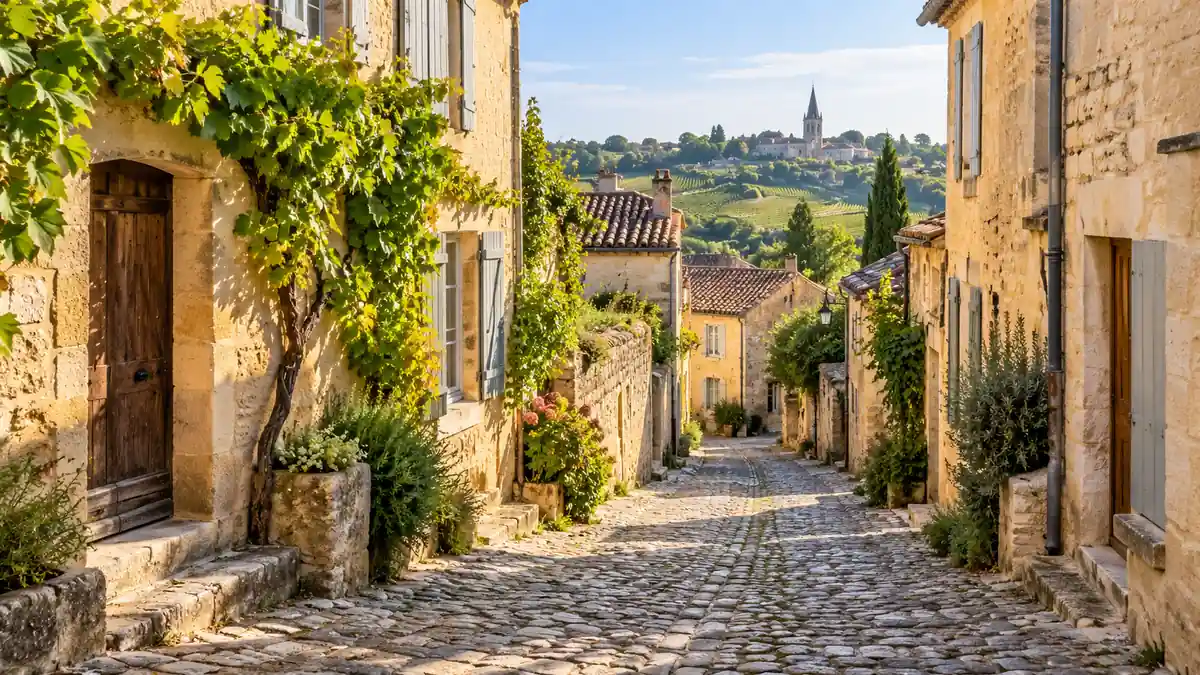
Saint-Émilion is the region’s essential stop: a medieval hilltop village of limestone lanes, ringed by vineyards that run right up to its walls. It works on foot, which is why it suits a traveler without a car better than any other wine area here.
The anchor experience is underground. The Monolithic Church, carved out of the rock, and the catacombs can only be seen on a guided tour run by the Saint-Émilion tourist office. The tour runs in English, and written translations are available on request, so book it through the tourist office when you plan the day.
Estates come to you in Saint-Émilion. Several sit on the slopes at the very edge of the village, close enough to walk to for a vineyard tour and tasting, and the village itself is lined with wine shops. Travelers who want a grander cellar can reserve an estate visit at one of the classified properties nearby.
Pomerol and the river town of Libourne sit just beyond, quieter and more agricultural. The Right Bank fits the traveler who wants one complete wine day, village included, with no driving at all.
The Médoc and the Route des Châteaux
The Médoc is estate country: a long, flat peninsula north of Bordeaux where famous châteaux line the Route des Châteaux through villages such as Margaux and Pauillac. There is no village centre to wander here as in Saint-Émilion. The draw is the architecture of the great estates and the cellars behind them.
Distances are the catch. Estates are spread along the road, and each visit is its own stop. The Médoc rewards the traveler who already loves Bordeaux wine and wants to see where the names on the labels are made.
Arcachon Bay, the Dune du Pilat and Cap Ferret
Arcachon Bay is the region’s coast: a sheltered bay of oyster farms and beaches, with the Dune du Pilat at its southern edge. The dune is the highest in Europe, according to its official Grand Site, and the climb rewards you with the bay on one side and pine forest on the other.
Arcachon itself is a seaside town with a long promenade, and oysters are eaten fresh around the bay. Cap Ferret faces it across the water, a narrower, wilder peninsula reached by boat. In summer the bay works as a base of its own, not just a day trip. For the coast beyond the bay, see the best beaches in France.
Quieter corners south and north of the city
A longer trip can add one of these smaller areas:
- Graves and Pessac-Léognan, just south of the city, put serious estates closest to Bordeaux.
- Sauternes, further south, is sweet-wine country of quiet villages and golden estates.
- Entre-Deux-Mers, between the two rivers, is rolling, peaceful vineyard land made for cycling.
- Blaye, on the estuary north of the city, has a fortified citadel overlooking the water.
- Lacanau, on the open Atlantic, is a surf and lake coast wilder than Arcachon Bay.
Do You Need a Car in the Bordeaux Wine Region?
You do not need a car for Saint-Émilion or Arcachon Bay: a regional train gets you there, and a walk, a bus or a boat does the rest. The closest vineyards to the city need no car either. The Médoc is the exception: if you want to see more than one estate, you need a car or a tour.
The Médoc is the only part of the region where a car changes what you can see. Everywhere else it mostly adds a parking problem and a passenger who cannot taste.
Saint-Émilion by regional train
Saint-Émilion is a short regional train ride from Bordeaux Saint-Jean, the city’s main station. The village station sits below and outside the village, so the last stretch is an uphill walk through the vines. Wear shoes that can handle a slope, and plan to walk back down at the end of the day.
The Médoc needs wheels or a guide
The Médoc needs a car or a guided tour for estate-hopping. A regional line serves Margaux and Pauillac stations, which gets you into the area, but the estates are spread along the road and rarely within easy walking distance of a platform.
Driving brings its own trade-off: whoever drives tastes little or nothing, and each estate is a separate drive along the peninsula. A tour solves both problems, and the full-day trips that pair Saint-Émilion with Margaux let you book a day trip that covers both banks without a car.
Arcachon, the dune and Cap Ferret car-free
Arcachon Bay is fully reachable without a car. The route runs like this:
- The TER regional train from Bordeaux to Arcachon, the end of the line, takes about 50 minutes, according to the official Dune du Pilat site.
- From Arcachon, Baïa bus line 3 toward Plage de la Salie stops at “Dune du Pilat” in about 25 minutes; it runs year-round except on Sundays and public holidays.
- The 101 Express bus adds a summer link, from Arcachon station or La Teste-de-Buch market, in July and August only.
- Access to the dune is free on foot, by bike or by bus; drivers pay for the car park, and roadside parking is prohibited.
- The boat shuttle from Arcachon’s Jetée Thiers to Cap Ferret’s Jetée Bélisaire takes about 30 minutes per crossing; a return booking requires choosing your return time.
Closer vineyards by tram and bike
Yes, both Pessac-Léognan and Entre-Deux-Mers are reachable without a car. Pessac-Léognan’s estates start at the city’s edge, within reach of Bordeaux’s tram. Entre-Deux-Mers is bike country, with quiet lanes between vineyards.
Travelers combining Bordeaux with other regions without ever renting a car can build the whole trip on rail; the France by train itinerary shows how the region fits a car-free route.
Tours and activities
Book skip-the-line tickets, day trips and local tours with free cancellation on most activities.
You can also browse everything on getyourguide.com.
Tripstou may earn a commission if you book through this link, at no extra cost to you.
Where to Base Yourself: Bordeaux, Saint-Émilion or the Coast
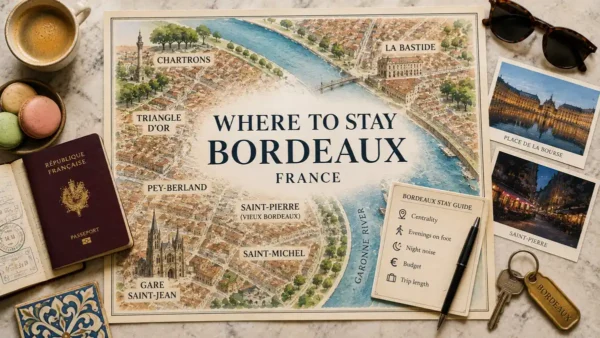
Bordeaux is the default base for travelers without a car, because every regional train starts there. One night in Saint-Émilion is the upgrade: you get the village after the day-trippers leave. In summer, Arcachon Bay works as a base of its own for the coast.
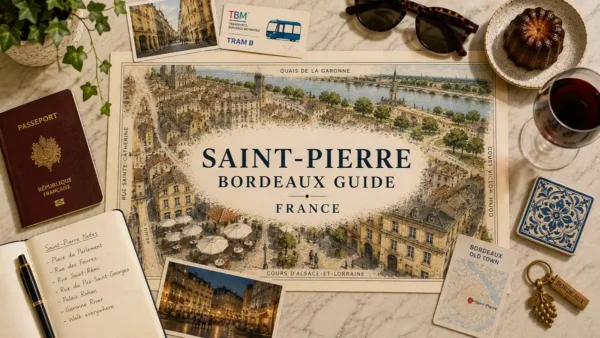
The city earns its place as a base for practical reasons: trains, restaurants and the widest choice of rooms. What to see and where to stay inside it belong to the Bordeaux city guide; this page treats the city only as the hub for the region.
Drivers have a different option. Many estates outside the city offer rooms, and a night at a château with rooms puts you among the vines for an early start on the Médoc or the Right Bank.
Moving bases costs packing time; a single base costs evening atmosphere. A night in Saint-Émilion trades one repack for the village lit up at dusk, with the lanes to yourself, which is a better deal than a second hotel move anywhere else in the region.
Hotels and places to stay
Compare hotels, apartments and stays for your dates in one search.
Search hotels and stays on hotels.com →
Tripstou may earn a commission if you book through this link, at no extra cost to you.
How Many Days Do You Need in the Bordeaux Region?
Four or five days is the strongest first trip to the Bordeaux region, because it covers the city, Saint-Émilion and either the Médoc or the coast without rushing. Two or three days buys the city plus one wine day; about a week adds a coastal base or a second wine base.
- A short stay, two or three days: the city and one wine day, most simply Saint-Émilion by train. Enough for a weekend or a stop on a longer France trip.
- A medium stay, four or five days: the city, Saint-Émilion with a night in the village, and either the Médoc by car or tour, or a day on Arcachon Bay and the dune. Most first-timers belong here.
- A longer stay, about a week: add a few nights on Arcachon Bay in summer, or a second wine base for drivers covering the Médoc and the quieter corners. This turns the region into a standalone wine-and-coast holiday.
The medium stay wins because it holds both halves of the region. A day among the vines and a day on the coast show why Bordeaux is more than a wine name, and the Saint-Émilion night keeps the trip from feeling like a string of day trips.
The region also slots into a longer France trip. Drivers can fold it into a France road trip route down the Atlantic side. On a 10-day France itinerary it usually takes a short stay; with two weeks in France, a medium stay fits comfortably.
How Château Visits Work: Appointments, Tours or Self-Guided
Most Bordeaux estates take visitors by appointment, so choose your format before you go. The three options are a self-guided Saint-Émilion day, a group tour from Bordeaux, or appointments you book yourself and reach by car.
- Self-guided in Saint-Émilion: take the train, walk the village and visit estates at its edge. Independent travelers on a budget get the most from it; you see fewer famous names, and the underground church still needs its guided tour.
- A group tour from Bordeaux: the format most visitors choose, usually a Saint-Émilion half day, sometimes paired with the Médoc on a full day. It suits first-timers without a car; you give up control of which estates you see.
- Booked appointments by car: you pick the estates, including famous Médoc names. This is the format for wine lovers who know what they want; someone has to drive, and each visit has to be arranged ahead.
A group tour from Bordeaux removes the appointment problem entirely, which is why it suits a first trip better than a hired car. The afternoon formats that combine the village with a classified estate are the easiest to fit around a city day, and you can book a half-day tour without arranging anything with the estates yourself.
The mechanics favour planning ahead. Book estate visits in advance, especially for well-known properties. Many estates close in August, access is limited during the harvest, and weekend opening is limited too, so a weekday in late spring or early autumn gives you the widest choice.
Late Spring and Early Autumn Suit the Vineyards; Summer Belongs to the Coast
Late spring and September to October are the best times for Bordeaux wine country, while summer is the season for Arcachon Bay. The harvest, roughly September into October, is the most beautiful time in the vines, but it also cuts access to many châteaux.
The harvest does not hit the whole region at once. The Right Bank usually picks before the Médoc, so an early-autumn trip may find Saint-Émilion busy in the vines while Médoc estates are still receiving visitors, or the reverse later on.
Summer is the coast’s season, with the 101 Express bus to the dune running only in July and August; August is also when many estates close, as covered under château visits above. Winter is quiet, with fewer services on the coast and a slower pace in the villages. For national timing, see the best time to visit France.
What a Bordeaux Region Trip Costs by Spend Style
The Bordeaux region is kind to a tight budget when you travel by regional train and spend self-guided days in Saint-Émilion. It gets expensive with private tours, a hired driver, château rooms and the summer coast.
A tight budget means a city base, train day trips to Saint-Émilion and Arcachon, the bus to the dune and tastings at village estates. A comfortable middle adds a night in Saint-Émilion and a group tour for the Médoc. A high-end trip buys a private driver, appointments at famous estates and nights in château rooms or by the bay in summer.
For budget figures across a French trip, see what a France trip costs.
Who the Bordeaux Region Suits, and Whether to Pair It With Paris
The Bordeaux region suits wine travelers, food travelers, couples and road-trippers. It works as a standalone trip of its own, or as an add-on to Paris by TGV.
Wine travelers get the deepest pull from the Médoc estates and the classified properties around Saint-Émilion. Food travelers come for the oysters of Arcachon Bay and the cafés of the village squares. Couples find their trip in a quiet night in Saint-Émilion and an evening by the bay. Road-trippers get the most freedom, linking the Médoc, Sauternes and the coast on their own schedule.
Pairing it with Paris is straightforward: Bordeaux is on the high-speed line from Paris, so the region slots in after a few days in the capital. The Paris region guide covers the first half of that trip, and the France itinerary planner shows how to balance the two. With one week in France, Paris plus a short Bordeaux stay is the realistic split.
For a wine-led trip elsewhere in France, the Alsace wine route guide offers villages on a smaller scale, with no coast but a tighter, more walkable route.
How We Checked This Guide
This guide shapes a trip through Gironde wine country and Arcachon Bay (which areas to pick, where to sleep and whether you need a car); it is not the Bordeaux city guide, a day-by-day itinerary or a roundup of châteaux and hotels.
Alex Perrut, working in tourism since 2015, went over the transport routes and visit rules here for the Tripstou editorial team, and the page was written with AI assistance; our editorial process sets out the steps.
Official sources consulted: Grand Site Dune du Pilat, Saint-Émilion Tourist Office, UBA Bateliers Arcachonnais.
Beyond the Bordeaux Region
- Best places to visit in France: see how the region compares with the rest of the country.
- France travel guide: the country-level planner for a first trip.
- Lyon region guide: another food-led region, reached by rail across the country.
- Normandy guide: a second coastal region for a longer western France trip.
- French Riviera guide: the Mediterranean alternative for a beach-led trip.
- French Alps guide: mountains instead of vines, for a contrast trip.
- France packing list: what to bring for vineyard walks and the dune.
- Common scams in France: what to watch for in stations and busy towns.
- Solo female travel safety in France: practical safety for travelling alone.
Did this guide save you time or money? Tripstou is independent and reader-funded — if you'd like to give something back, you can support the site with a crypto contribution of any size.