Two contradictory ideas follow Marseille around. The first says southern France is expensive, all yacht harbours and Riviera prices. The second says Marseille is the rough, cheap one — the exception to the coast. Both are wrong in useful ways, and neither helps when you are sizing a budget before you commit to dates.
This page gives you the number. Two honest daily bands per person, what those bands scale to across a two-day break, a three-day break and a full week, and where the money actually lands once you are there. It also gives you the one truth that separates a Marseille budget from any other French city budget: you pay for the water, not the city. The headline sights cost almost nothing. The boats do.
Quick Answer
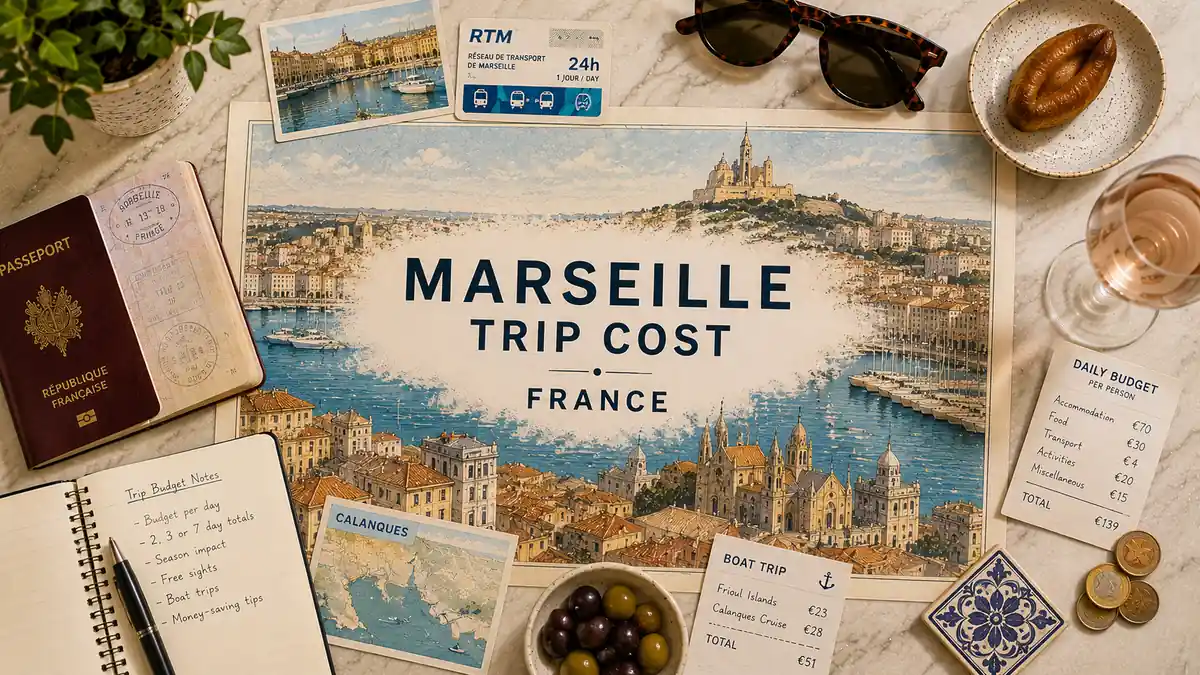
A Marseille trip costs roughly €55–100 per person per day if you are budget-conscious, and €145–200 mid-range, excluding flights. Season and how much sea time you buy move that number more than the city does. Marseille runs cheaper than Paris or Nice for the same standard, partly because its headline sights are free.
Trust Layer
Tripstou planning guide for travelers resolving one travel decision. Covers the main variable, traveler context, and practical tradeoffs.
Produced with AI assistance and reviewed by Alex Perrut, working in tourism since 2015, for the Tripstou editorial team. See our editorial process for details.
Last factual review: August 14, 2026.
Official sources consulted: France.fr, Atout France.
Key Takeaways
- Budget roughly €55–100 per person per day, or €145–200 mid-range, excluding flights and before peak summer breaks both bands.
- Season is the single biggest lever on a Marseille budget, and it moves accommodation hardest of all the categories.
- Marseille’s headline sights cost nothing, so trimming museums barely helps — the money sits in beds and boats.
- Boat trips are priced per person per outing, which makes sea days the fastest way to grow a total.
- Trip totals here are plain multiplication of the two daily bands, so trip length works purely as a multiplier.
- Marseille runs cheaper than Paris or Nice for the same standard, mainly because it carries fewer high-end options.
Table of Contents
How Much Does a Trip to Marseille Cost Per Day?
A Marseille trip costs roughly €55–100 per person per day budget-conscious and €145–200 mid-range, excluding flights. Both bands are shoulder-season baselines covering a bed, food, local movement and a normal amount of sightseeing. Peak summer pushes both bands upward, and neither figure includes getting to France.
A per-day number averages uneven days. A Marseille day built around a boat outing costs several times a Marseille day spent walking up to the basilica and swimming off a city beach, and both are perfectly normal days. The band describes the trip divided by nights, so treat it as a total to be shaped, not as a daily allowance to be spent evenly.
Decide in advance which days are boat days. That is the part the average is hiding, and it is the one line you fully control before you arrive.
Two people do not cost exactly twice one person. The room splits between you, so the accommodation line barely moves when the second traveler arrives. Food, boat tickets and paid entries scale straight per head. A couple therefore lands somewhere below twice a solo total, and the longer the trip, the wider that gap opens.
Luxury sits outside these bands on purpose. Once you move into the top hotels and private boat charters, the ceiling is set entirely by what you choose to book, and no honest daily figure describes it. The two tiers above cover the trips almost everyone actually takes.
Trip totals below are plain multiplication of the daily bands, per person, excluding flights.
| Trip length | Budget-conscious, per person | Mid-range, per person |
|---|---|---|
| One day on the ground | Roughly €55–100 for the day | Roughly €145–200 for the day |
| A two-day city break | Roughly €110–200 in total | Roughly €290–400 in total |
| A three-day city break | Roughly €165–300 in total | Roughly €435–600 in total |
| A full week in Marseille | Roughly €385–700 in total | Roughly €1,015–1,400 in total |
What Do 2 Days, 3 Days or a Week in Marseille Add Up To?
A two-day Marseille break runs roughly €110–200 per person budget-conscious and €290–400 mid-range. A three-day break lands at roughly €165–300 and €435–600 respectively. Every total here is plain multiplication of the daily bands above, stated as such. Flights are excluded throughout.
Trip length works as a multiplier on the bands, and nothing more. The cluster’s two standard trip shapes map onto it directly: the 2 days in Marseille itinerary is the compressed city version, and the 3 days in Marseille itinerary adds the Calanques day. Pick your tier, multiply by nights, and you have the shape of the bill before you plan a single stop.
A week does not scale as cleanly. Accommodation and food keep running at the daily rate, so the honest arithmetic gives roughly €385–700 budget-conscious and €1,015–1,400 mid-range across seven days. Sightseeing flattens almost immediately, because the free list does not charge more on day six than on day one.
The water line behaves differently again: it scales per outing, not per day. Two boat trips across a week cost exactly what two boat trips across a three-day break cost. That is why a week in Marseille usually works out cheaper per day than a weekend does — the discretionary purchases you were always going to make spread across more nights.
Is Marseille Expensive?
Marseille is not expensive by French city standards. It is a working port city with a normal urban price floor, so the everyday cost of a bed, a meal and a coffee sits below what the same standard buys in Paris or Nice. The pattern holds across categories, not just on hotel rates.
Marseille reads cheaper because its high end is thinner. The floor is normal. Paris and Nice both carry deep luxury inventory that pulls their whole market upward, while Marseille has less of it, and the gap between a very good place and a very expensive one stays narrower here. You reach the top of what the city offers sooner, and it costs less when you get there.
Cheaper than Paris still means a real urban price floor. Central summer rates in Marseille behave like central summer rates anywhere on the Mediterranean, and the saving shows up as a lower ceiling, not a bargain basement. For how the city sits as a destination overall, the Marseille travel guide carries that verdict.
Nationally, Marseille sits comfortably below the average that Paris drags upward, which is the pattern the France travel budget picture covers region by region.
Where the Money Goes: Accommodation, Food, Transport and Tax
Accommodation and food carry almost the whole bill in Marseille. Local transport and sightseeing barely register by comparison, and the tourist tax is a small per-night addition collected at the property. Boat trips are the one discretionary line that can rival either of them.
How much are hotels in Marseille per night?
Marseille accommodation splits into three broad bands per night, all of them shoulder-season baselines:
- Hostel dorm bed — roughly €25–50
- Budget hotel or guesthouse double — roughly €45–100
- Mid-range hotel or apartment — roughly €70–130
Peak summer breaks all three. The cheap end of each band effectively disappears in July and August, and the bands themselves stop being a reliable guide once the coast fills up. Book early for those weeks or accept the top of the range.
Base choice is the second lever on this line, after standard. Which part of the city you book changes what a given band buys you, and where to stay in Marseille works through how the areas differ.
How much should you budget for food in Marseille?
Budget food in Marseille by occasion, not by day. A bakery or market snack runs from a euro or two to about €4. A lunch formule — the fixed-price two-course deal most restaurants run at midday — is roughly €10–15 indicative, and a casual sit-down dinner is roughly €25–35 indicative. Both ranges move with the neighbourhood and the season.
Eat your one big meal at lunch. The formule exists at midday and largely vanishes in the evening, which makes meal timing the cheapest structural saving available on the food line.
Bouillabaisse sits outside all of this. At the restaurants that make the real version it is a set-piece occasion dish, priced well above a normal dinner, and no daily food average absorbs it.
Local transport is a small line in a Marseille budget
Local transport barely moves the total. The city core is walkable, most of what you came for sits inside it or just beyond, and the network fills the gaps instead of carrying the trip. Fares, ticket types and passes all live at getting around Marseille, which is the page to read before you buy anything.
Is there a tourist tax in Marseille?
Yes. Marseille charges a tourist tax per person, per night, on every paid stay. The rate scales with the category of accommodation, and a departmental levy is added on top of the city rate. The property usually collects it at check-in or check-out, so it lands as a small extra on arrival and not inside the booking headline.
Spending money abroad
A Wise account converts your money at the mid-market exchange rate and shows every fee upfront, with a card you can spend in the local currency.
Check Wise’s rates and fees for your currency →
Tripstou may earn a commission if you sign up through this link, at no extra cost to you.
Marseille’s Headline Sights Are Mostly Free
Marseille’s municipal museums are free all year for their permanent collections. Notre-Dame de la Garde, the city beaches and access to the Calanques cost nothing either, which makes the attractions line structurally small in a Marseille budget. Ticketed exceptions exist, and they are few.
The officially free core covers most of what people come for:
- Notre-Dame de la Garde, the basilica on the hill
- All city beaches, including Catalans, Prado and Pointe Rouge
- Access to the Calanques national park
- Parc Borély, Palais Longchamp, Parc Pastré and the Palais du Pharo gardens
- The Fort Saint-Jean footbridge
The ticketed exceptions stay modest. MuCEM starts from €11 at full rate, with free entry for under-18s and free admission on the first Sunday of each month. Municipal temporary exhibitions are tiered at €6, €9 or €12 full rate, with reduced rates of €3, €5 and €8, plus free categories that include under-18s, EU students aged 18–26 and the first Sunday of each month. Tiers follow the programme, so check the exhibition, not the building.
First-timers over-budget this line badly. The habit comes from other French cities, where museums are the expensive part of a day and a pass starts to make sense. Marseille inverts that, and cutting sightseeing here saves you almost nothing — the money you are looking for is in the bed and the boat.
The Water Is Where Marseille Charges You
A half-day Calanques cruise from the Vieux-Port typically runs about €25–40 per adult. Boat trips, crossings and sea days are the real discretionary line in a Marseille budget, because the city itself asks for so little. Each outing is a per-person purchase, so a family scales fast.
Longer circuits sit at the top of that range. The shorter round trips out to the nearer calanques come in at the bottom; the routes that push further along the coast and stay out longer reach the top. Child and family rates exist with most operators and are worth asking about, though the discount structures vary too much to plan around in advance.
Château d’If is where the arithmetic catches people out. Entry to the monument is €7 at the current published full rate, and the boat is not included — the crossing from the Vieux-Port is a separate purchase of about €11 return on one operator’s published fare. Free-entry categories apply to the monument itself, covering under-18s, EU residents aged 18–25, and the first Sunday of each month from November through March. None of them cover the crossing, which everyone pays for.
Château d’If is the one Marseille sight where the price you look up is the smaller half of what you actually spend. Budget the boat first.
Sea days multiply across a trip in a way city days never do. Two boat outings on a three-day break can add more to your total than every museum, church and park on the itinerary put together, and that is the choice the daily band is really measuring.
When Is Marseille Cheapest to Visit?
Marseille is cheapest from December to February and most expensive from June to August. June and September are the value window: materially cheaper than high summer while the sea is still warm enough to swim. Season moves a Marseille budget more than any other choice you control.
Season hits accommodation hardest, and accommodation is what makes the whole budget move. The bands quoted above are shoulder-season baselines. At the top of summer, a central room can run close to double what the same room costs in the quiet months, and the cheap end of each band simply stops being available.
Deep winter is materially cheaper across every category. The tradeoff is real. The sea is not swimmable, boat schedules thin out, and the mistral makes the exposed coast genuinely unpleasant — you save on the parts of the trip that cost money and lose the parts that were free.
June and September earn their reputation by breaking that correlation. They deliver summer sea temperatures at something close to shoulder-season prices, for a few weeks on either side of the crowd peak, which is the only window where the two things you want stop competing.
What Moves a Marseille Budget — and How to Spend Less
Season is the top lever, followed by accommodation standard and base. How much water you buy comes next, then trip length, then eating pattern. That ranking is also the savings order: fix the timing first, and the four levers below it get much easier to leave alone.
The full ranking, strongest first:
- Season — the largest swing, and the only lever that moves every other line at once
- Accommodation standard and base — which band you book, and which part of the city you book it in
- How much water you buy — boat trips are priced per person, per outing
- Trip length — a straight multiplier on whichever daily band you sit in
- Eating pattern — mainly a question of where your main meal of the day falls
Spending less in Marseille rarely means downgrading the trip, because the expensive parts are optional and the good parts are free. Travel the value window and put the accommodation savings straight into the water. Take the formule at lunch and keep evenings light. Lean on the free list — the basilica, the beaches and the national park are the trip, and they cost nothing.
First-timers get two lines wrong in opposite directions. They over-budget museums, which are mostly free, and under-budget boat trips and peak-summer beds, which are the two lines that genuinely move a total. Correcting both usually rebalances a budget without changing a single plan.
Moving a trip out of August into June often frees enough on the bed alone to pay for a Calanques cruise outright. Most people trade the other way without ever noticing they did it.
For the on-the-ground practicalities that sit outside the budget itself, Marseille travel tips covers what to know before you land.
Frequently Asked Questions
How much does a trip to Marseille cost for two people?
Take the per-person band, double it, then subtract what you no longer pay twice — the bed. Two people share one room, so only food, boat tickets and paid entries scale per head. Doubling gives you a safe ceiling; the real total lands under it, and further under it on longer trips.
Does a daily budget for Marseille include flights?
No. The daily bands on this page exclude flights entirely, and they cover a bed, food, local movement and a normal amount of sightseeing. Getting to France is a separate line you price yourself, and so is the run in from the airport. Boat outings sit on top as discretionary spending.
Are the beaches in Marseille free?
Yes. Every city beach is freely accessible, including Catalans, Prado and Pointe Rouge, and there is no entry ticket to buy. Access to the Calanques national park is free too. What still costs is reaching the beaches further south, plus anything you choose to rent or buy once you are on the sand.
Is the Marseille City Pass worth it?
Usually not, and the reason is specific to Marseille. A city pass bundles transport, museum entries, a boat crossing or a paid attraction and guided tours — but the municipal museums it covers are already free all year. That removes most of the value a pass normally delivers, so buy it only for heavy transport and boat use.
How much does bouillabaisse cost in Marseille?
Well above a normal sit-down dinner, and it works best as a planned decision, not an impulse. Treat it as its own budget line, decide before the trip whether it is in or out, and price the rest of your eating around that choice. A single occasion meal can reshape a three-day food budget on its own.
Related Guides
- Marseille travel guide — where the city sits as a destination and what the trip is actually for.
- Where to stay in Marseille — how the areas differ and what each band buys you in them.
- 2 days in Marseille itinerary — the compressed city route the two-day totals above assume.
- 3 days in Marseille itinerary — the three-day version, with the Calanques day added.
- Getting around Marseille — fares, ticket types and passes, the only page that carries them.
- Marseille travel tips — practical preparation, local habits and what first-timers misjudge.
- France travel budget — the national picture and how regions differ in cost.
Did this guide save you time or money? Tripstou is independent and reader-funded — if you'd like to give something back, you can support the site with a crypto contribution of any size.