Three days in Marseille is really two decisions, not one. The first is how to compress the city into 48 hours without gutting it. The second is what to do with the day that is left over — and that is where most itineraries go vague, handing you a menu and walking away.
This route answers both. Days 1 and 2 stay in the city core, on foot, in a fixed order. Day 3 leaves it: out to the Calanques massif, the limestone coast that starts where the neighbourhoods stop. The committed, weather-dependent day goes last on purpose.
The third day is also the real fork. You can walk into a calanque and swim from the rock, paddle in by kayak, or take the coast the easy way with a day in Cassis. Each suits a different traveler, and each fails under different conditions. What follows sequences the route, then resolves the fork.
Quick Answer
Three days is the right length for Marseille: two in the city core, one on the Calanques coast. The third day is the fork — hike the massif, kayak it, or take a Cassis day — and it goes last because weather decides it. Walk it if you are steady on rough ground; Cassis is the fallback.
Trust Layer
Tripstou itinerary guide for travelers planning a route. Covers pacing, stop count, stop order, base logic, and trip length.
Produced with AI assistance and reviewed by Alex Perrut, working in tourism since 2015, for the Tripstou editorial team. See our editorial process for details.
Last factual review: August 14, 2026.
Official sources consulted: France.fr, Atout France.
Key Takeaways
- Give Marseille two days for the city core and the third to the coast, keeping the same base all three nights.
- The third day earns its place by putting you inside a calanque on foot, which forty-eight hours cannot buy.
- Put the Calanques day last: it is the only day weather or a closure can cancel outright.
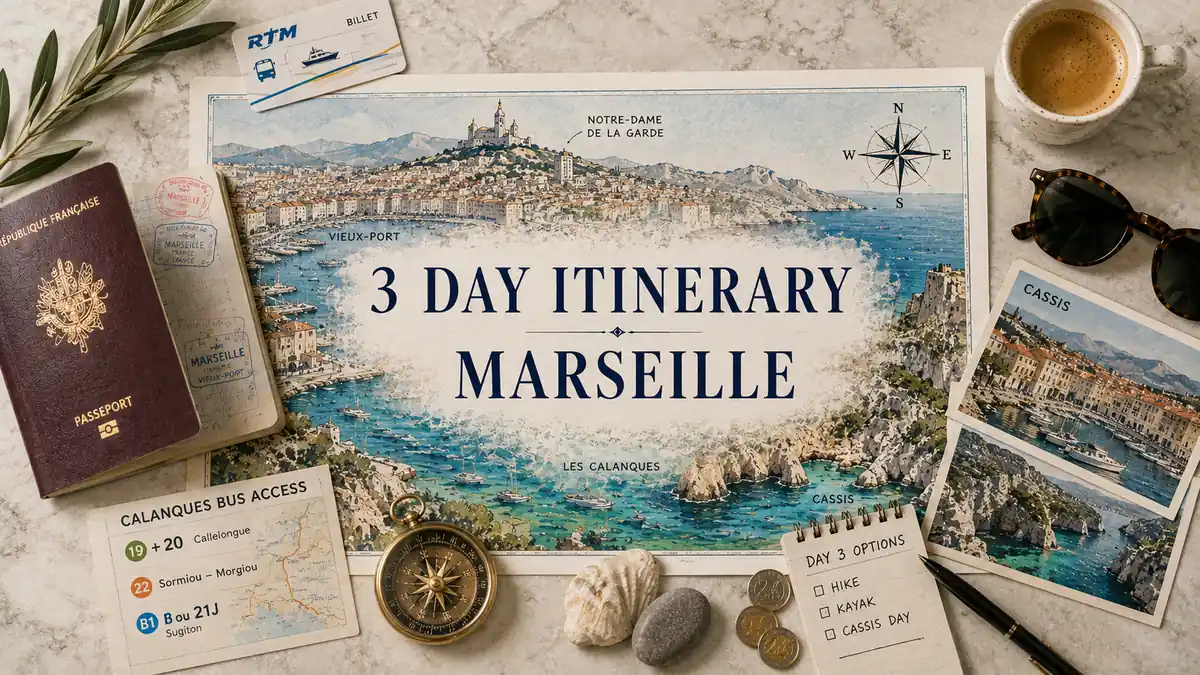
- Reach every trailhead by ordinary city bus — 19 plus 20 for Callelongue, 22 for Sormiou and Morgiou, B1 or 21 J for Sugiton.
- Reserve Sugiton for a summer walk and check the day’s fire-risk colour before you leave for the bus.
- Swap a closed massif for a Cassis day on the same coast, not for an inland trip to Provence.
Table of Contents
Is Three Days Enough for Marseille?
Yes — three days is the comfortable length for Marseille. Two days cover the city core on foot, and the third unlocks the Calanques massif, which a 48-hour trip can only see from a boat deck. The extra day changes what the trip is, not just how long it runs.
The third day buys three things two days cannot: a trail into a calanque, a swim from the rock at the bottom of it, and a stretch of coast that sits outside the city entirely. Two days sees that coast. Three walks into it. If your dates will not stretch, the compressed version still holds together on its own — that is the job of the 48-hour Marseille itinerary, which trades the massif on foot for a boat view of it from the water.
Three days is also where the trip stops feeling rushed. Two days force the sea day and the viewpoint climb into the same afternoon; three lets each city day end at the water instead of sprinting there. The extra night, the extra meals and the extra fares change the arithmetic, and what a Marseille trip actually costs is settled on its own page.
The third day is the only one you cannot improvise. The massif closes outright on high-risk days and Sugiton needs a summer reservation, so it is the day you check first and book first, even though you walk it last.
The Three-Day Route at a Glance
The route runs city on foot, then sea, then the massif. Day 1 walks the old town downhill to the Vieux-Port, Day 2 takes the water and the viewpoints, and Day 3 leaves town for the Calanques or the coast at Cassis. One base holds all three.
- Day 1: Le Panier → Vieux-Port — the old town, downhill.
- Day 2: Frioul → Corniche → Notre-Dame de la Garde — the sea, ending high.
- Day 3: the Calanques massif or Cassis — the coast, on foot.
Day 3 sits last because it is the only day something outside your control can cancel. A red fire-risk day shuts the massif completely, and a hard mistral makes both the boat crossings and the exposed trails miserable. The city days run in almost any weather.
Putting the fragile day at the end gives you information the reverse order cannot: by Day 3 you have watched the weather for 48 hours, you know how the wind is behaving, and you can check the day’s access status before you commit to it. Flip the sequence and a bad first morning costs you the entire reason you added a third day, with no slack left to recover it.
Days 1 and 2: The City, Compressed
Days 1 and 2 are the city core in a fixed order: old town first, sea second. Day 1 walks downhill from Le Panier to the Vieux-Port. Day 2 goes out to the islands, along the Corniche, and up to Notre-Dame de la Garde to close the trip’s city half from above.
- Day 1 — Le Panier down to the Vieux-Port. Start high in the old town while the streets are still quiet, drop through the Vieille Charité and La Major, and land at MuCEM and Fort Saint-Jean where the walk meets the sea. The day ends at the port, which is also where dinner is.
- Day 2 — the islands, then the Corniche. Take the boat out to Château d’If and Frioul in the morning, when the crossing is calmest and the light is on the city. Come back along the Corniche past Vallon des Auffes, then finish with the climb to Notre-Dame de la Garde for the whole coastline at once.
This is a pacing plan, not a tour. Every stop on it has an interior, a history and a queue, and none of that fits inside a two-day compression — the depth lives in the full Marseille guide, which is where to go when you want to know what is inside MuCEM or how much of an afternoon the climb to the basilica really takes. Two days means choosing outsides over insides at almost every stop.
Evenings stay walkable from where you sleep. The Vieux-Port arc and the Cours Julien side stay busy late, while some streets around the main station empty out fast once the shops shut, and how Marseille actually feels at night covers which is which. Book dinner on foot from the base and the compressed days stay compressed.
Day 3: The Calanques on Foot
Day 3 goes to the Calanques on foot: one trailhead, one bus, one walk, one swim. The massif starts at the edge of the city, so an ordinary city bus is the whole approach. You walk in over white limestone, swim from the rock at the bottom, and walk back out the same way.
The hike earns the third day in a way a third city day cannot. Marseille’s museums and viewpoints are already spent by the end of Day 2, and the massif is the one thing in reach that a 48-hour trip has to skip. The trade is honest and worth stating plainly: walking in buys you the water, the shade of the cliff and the silence from inside a calanque, while the cruise boats — which belong to the shorter trip — buy the shape of the coastline from outside. Cruise boats do not land. Walking or paddling is how anyone gets into the water there.
The massif is not a park with facilities, and its rules are enforced, not advisory. There is no drinking water anywhere inside it, so everything you drink goes into your bag before you leave the city. Open shoes are prohibited on the trails, and smoking is banned throughout. Emergency number is 112, and the My Calanques app is the real-time check on whether the massif is open at all.
The swim is what decides whether the day was worth it. Walk in without planning to get in the water and you have taken a hot limestone hike with a view; the calanque only pays properly from inside it, so pack for swimming even if the morning looks marginal.
How to Reach the Trailheads Without a Car
Three ordinary bus routes reach the three usable trailheads. For Callelongue, take bus 19 from Place Castellane to Madrague de Montredon, then bus 20 to the end of the road. For Sormiou and Morgiou, take bus 22 from the Prado roundabout to Les Baumettes. For Sugiton, take bus B1 or 21 J to the stop named “Luminy PN des Calanques”.
Driving in is the weaker option even when you have a car. Vehicle access on the calanque roads is restricted from spring through the autumn holidays, and parking at Callelongue, Sormiou and Morgiou is limited in any case, which is why the park and the city both push public transport to the trailheads. Tickets, passes and how the network fits together are covered in the guide to Marseille tickets and transport passes.
Which Calanque Should You Hike?
Pick the trailhead that matches your walking, not the one with the best photographs. Three options cover almost everyone, and each one suits a clearly different walker.
Callelongue is the easiest entry. The coastal path picks up at the end of the bus line and stays close to the water, so you can walk as far as your legs and the heat allow, then turn around without having committed to a full crossing.
Sormiou and Morgiou deliver the classic calanque floor. These are the postcard inlets with a beach at the bottom and cliffs on both sides, and the walk down is steeper and stonier than the maps suggest — worth it if you are confident on loose ground.
Sugiton gives the quickest trail access. Luminy sits at the edge of the massif and the walk in is short by Calanques standards, which is exactly why it carries the reservation rule in summer.
Do You Need to Book the Calanques — and Can They Close?
Yes to both, and they are two separate rules. Sugiton is reservation-only during the summer season; the reservation is free, and without it you do not walk in. That rule applies to Sugiton specifically, not to the whole massif.
Closure is the second rule and it overrides everything. On a red fire-risk day, access to the massif is forbidden entirely, including on foot, from every trailhead. The risk colour is set day by day, so confirm it on the morning of your hike through the My Calanques app before you get on the bus.
Hike, Kayak, or a Cassis Day: Choosing Your Day 3
Hike if you handle rough ground, kayak if you want the water, take Cassis if you want neither. All three keep the day on the coast, which is the point of the third day. Inland Provence — Aix, Avignon, the lavender routes — is the option to drop: it spends most of the day travelling.
| Day 3 option | Time cost | Getting there | Weather risk | Who it suits |
|---|---|---|---|---|
| Calanques on foot | Half a day walking, most of a day out | City bus to a trailhead, then walk in | Cancelled outright on red-risk days | Walkers steady on loose, steep limestone |
| Kayak into the coves | A guided session plus travel either side | Meet on the coast and paddle from there | Wind and sea state cancel it first | Confident swimmers wanting water-level cliffs |
| Cassis day trip | A full, unhurried day out of the city | Train to the outlying station, or a direct bus | Works in most weather, town stays open | Anyone wanting the coast without scrambling |
| Inland Provence | Most of the day spent in transit | Longer connections away from the coast | Weather-proof, but it leaves the sea behind | Better saved for a longer Provence trip |
The hike is the default because it is the only option that puts you inside the massif on your own terms. Kayaking is the water-level version of the same coastline: you paddle along cliff walls and into coves the trails look down on, and it suits confident swimmers who would enjoy the sea more than the climb. Cassis is the low-effort coastal day, with a working port, the Cap Canaille cliffs behind it and boat access to the calanques from the eastern side.
The Aix question resolves inside the same logic. Cassis keeps the third day on the coast that the whole route is building towards, while Aix spends it inland on a different kind of trip altogether. Neither is a bad day out. Only one of them finishes the route you started.
Kayaking and hiking are not the same coastline seen twice. The paddle gives you the cliff wall and the sea caves at eye level; the trail gives you the calanque floor and the drop from above. Choose the one you want to remember, because a single day does not hold both.
Tours and activities
Book skip-the-line tickets, day trips and local tours with free cancellation on most activities.
You can also browse everything on getyourguide.com.
Tripstou may earn a commission if you book through this link, at no extra cost to you.
How a Cassis Day Trip Works
Cassis is a quick train to an outlying station, or a slower bus straight into the centre. The train is the faster ride, but the station sits outside Cassis and needs an onward leg to reach the port. The bus takes longer and drops you in the town itself.
That station gap decides the mode more often than the journey time does. Travelling with a group, small children or beach gear, the train’s speed advantage disappears into the onward connection at the far end, so the bus that lands centrally usually wins the day. Travelling light and starting early, the train still buys you a longer morning in Cassis. Either way, plan the return before you settle in for lunch.
Cassis works as a full day because the town gives you a shape without a schedule. The port carries the eating and the wandering, the Cap Canaille cliffs sit behind it as the backdrop, and boats run out to the calanques from the Cassis side for anyone who wants the inlets without the walk in. That is the coast without the scramble — the opposite of what the hiking day asks of you.
Should You Change Hotels for Three Days?
No — keep one Marseille base for all three nights. Three days does not justify a relocation. Every day of this route, including the Cassis option, is a day-trip that starts and ends in the city, and a hotel move burns exactly the hours the third day exists to buy.
A night in Cassis is tempting and it still fails on time. You check out, carry bags through a transfer, check in again, and lose an afternoon on both ends of the move for one evening in a smaller town. The Calanques trailheads are city bus rides from Marseille, so relocating gains nothing on the hiking day either. One base, three nights, no logistics.
Which part of Marseille to book is the real question, and it changes the character of the trip more than the hotel itself does. Area trade-offs, from the port arc to the quieter slopes behind it, are resolved in the guide to where to stay in Marseille.
Hotels and places to stay
Compare hotels, apartments and stays for your dates in one search.
Search hotels and stays on hotels.com →
Tripstou may earn a commission if you book through this link, at no extra cost to you.
How to Adapt This Route When Plans Break — or Days Change
If the massif closes or the weather turns, Day 3 becomes the Cassis day or the city depth you skipped. The route is built so only one day can break, and it always has two replacements ready. Nothing else in the sequence moves.
- Massif closed on the morning of. Switch to Cassis. It is the same coast, reachable the same day, with no reservation to unwind.
- Mistral or heavy rain. Give Day 3 back to the city and spend it inside the stops the compressed days walked past.
- Down to two days. The committed out-of-town day is the first cut, every time. You are on the 48-hour route, and the city core survives intact.
- Four days or more. The coast gets the extra day before the city does — a second trailhead, or the long version of Frioul.
That order is worth keeping. The third day is the one with a dependency on conditions, so it absorbs every disruption; the city days stay fixed because they are the part of the trip that always works. Check the risk colour and the forecast the night before, then again in the morning, and you will rarely lose more than one plan.
Wind is the variable most visitors underestimate here, and packing for it is a different exercise from packing for a warm coast — prep, layers and mistral habits are covered in the Marseille travel tips. Pack for the hike the night before, so a green morning does not cost you the early bus.
Frequently Asked Questions
How long does the Sugiton hike take?
Plan a half-day for the round trip from Luminy, including time in the water at the bottom. Sugiton has the shortest walk in of the main trailheads, but you drop to sea level and climb back, and the return is the slow half. Summer walks need the free reservation first.
What do you need to bring to hike the Calanques?
Water first: the park sets a minimum of 1.5 litres per person for a half-day, doubled in heat, and there is no drinking water inside the massif. Bring closed, sturdy shoes — open shoes are prohibited on the trails — plus sun cover, swim kit and everything you plan to eat.
Where can you swim in the Calanques?
You swim at the bottom of the inlet, where the trail meets the water. Sormiou and Morgiou have small beaches at the calanque floor; elsewhere you get in from the rock. Carry swim kit whichever trailhead you pick, because the water is the whole payoff of the walk.
When is the best time of year to hike the Calanques?
Spring and autumn walk best: the heat is manageable and the summer reservation rule has not kicked in. Summer brings the Sugiton reservation requirement and the highest closure risk, because a red fire-risk day shuts the massif to walkers entirely. Winter walks well on clear, still days.
Is Cassis worth a full day?
Yes for anyone treating Day 3 as a coastal day out, and no for anyone who came to walk. Cassis fills a full day at a slow pace and needs no reservation, no risk-colour check and no scrambling — which is exactly why it doubles as the backup when the massif closes.
Can you visit the Calanques and Cassis on the same day?
Yes, but combining them turns a good day into a rushed one. The trailheads sit on the Marseille side of the massif and Cassis on the far side, so doing both means two transfers and no real time in either. Treat them as alternatives, not as a double bill.
Related Guides
- Marseille travel guide — city orientation and the attraction depth the compressed Days 1 and 2 skip past.
- 2 days in Marseille itinerary — the 48-hour version of this route and what it drops.
- Where to stay in Marseille — area trade-offs behind the single-base rule.
- Getting around Marseille — tickets, passes and how the bus network works before the trailhead ride.
- Marseille trip cost — what three days adds up to, category by category.
- Marseille travel tips — prep, packing and the mistral, before you go.
Did this guide save you time or money? Tripstou is independent and reader-funded — if you'd like to give something back, you can support the site with a crypto contribution of any size.