Two days in Marseille is enough to see the city properly — but only if the route is built in the right order. The city is not compact. Its highlights split into a dense walkable old town and a stretched-out sea-facing arc, and mixing the two across both days wastes the trip in transit.
This guide gives one route, sequenced: Day 1 on foot through the historic centre, Day 2 out to the islands, the Corniche and the basilica. It answers the question every 48-hour visitor asks — whether the Calanques fit — and it says what to cut when your train arrives late or the mistral blows.
No day-trip padding, no attraction inventory. Just the route order, the reason behind it, and the flex rules that keep it working.
Quick Answer
Two days covers Marseille’s core: Day 1 the historic centre on foot, Day 2 the sea, islands and basilica. The Calanques are the swing factor — a short boat cruise from the Vieux-Port fits, hiking them does not. Base near the Vieux-Port and the whole route runs from one spot, which suits first-timers and weekend-breakers.
Trust Layer
Tripstou itinerary guide for travelers planning a route. Covers pacing, stop count, stop order, base logic, and trip length.
Produced with AI assistance and reviewed by Alex Perrut, working in tourism since 2015, for the Tripstou editorial team. See our editorial process for details.
Last factual review: August 14, 2026.
Official sources consulted: France.fr, Atout France.
Key Takeaways
- Two days buys six to eight anchor stops in the city core — not the Calanques on foot, and no day trips.
- Day 1 walks the historic core downhill from Le Panier to the Vieux-Port, needing no transport at all.
- Day 2 goes seaward — the Château d’If ferry, the Corniche, then Notre-Dame de la Garde as the closing view.
- A Vieux-Port boat cruise puts the Calanques inside 48 hours; hiking the massif needs a third day instead.
- Base yourself near the Vieux-Port and never relocate: both days start on the quay, so no transfers.
- When time shrinks, cut the Château d’If crossing first and protect Le Panier and the basilica finale.
Table of Contents
Is Two Days Enough for Marseille?
Two days is enough for Marseille’s city core, and not enough for anything beyond it. You get the historic centre, the port, the islands and the basilica at a walking pace that still leaves room for a long lunch. The Calanques on foot and every regional day trip fall outside that window.
Plan for six to eight anchor stops across the two days, not twelve. Marseille’s sights sit at real distances from each other, and the honest arithmetic is three to four meaningful stops per day plus meals and one long sit-down view. Push past that and you spend the weekend queueing and walking, remembering none of it.
This route suits first-timers and weekend-breakers above all. TGV arrivals land at Saint-Charles in the middle of the city and can be walking the route almost straight away; flight arrivals lose a chunk of the first afternoon to the airport run, which usually costs one Day 1 stop. Families with small children and anyone travelling in high-summer heat should assume the slower version of this same order, not a different route.
What two days asks you to give up is the Calanques massif on foot, Cassis, Aix-en-Provence and the lavender country inland. All of them are real losses. None of them justifies breaking a 48-hour trip, because half a day of driving out and back would gut both city days. If you also want the financial shape of the weekend, what two days in Marseille costs is a separate calculation.
The real constraint in Marseille is not hours — it is how many times you cross the city. This route crosses it once, which is why 48 hours holds together here when the same length feels frantic in a bigger French city.
The 2-Day Marseille Route at a Glance
Day 1 is compact and entirely walkable; Day 2 is spread out and moves by boat and bus. That order matters: the old town rewards fresh legs and an early start, while the sea-facing day depends on weather you can only judge on the morning it arrives.
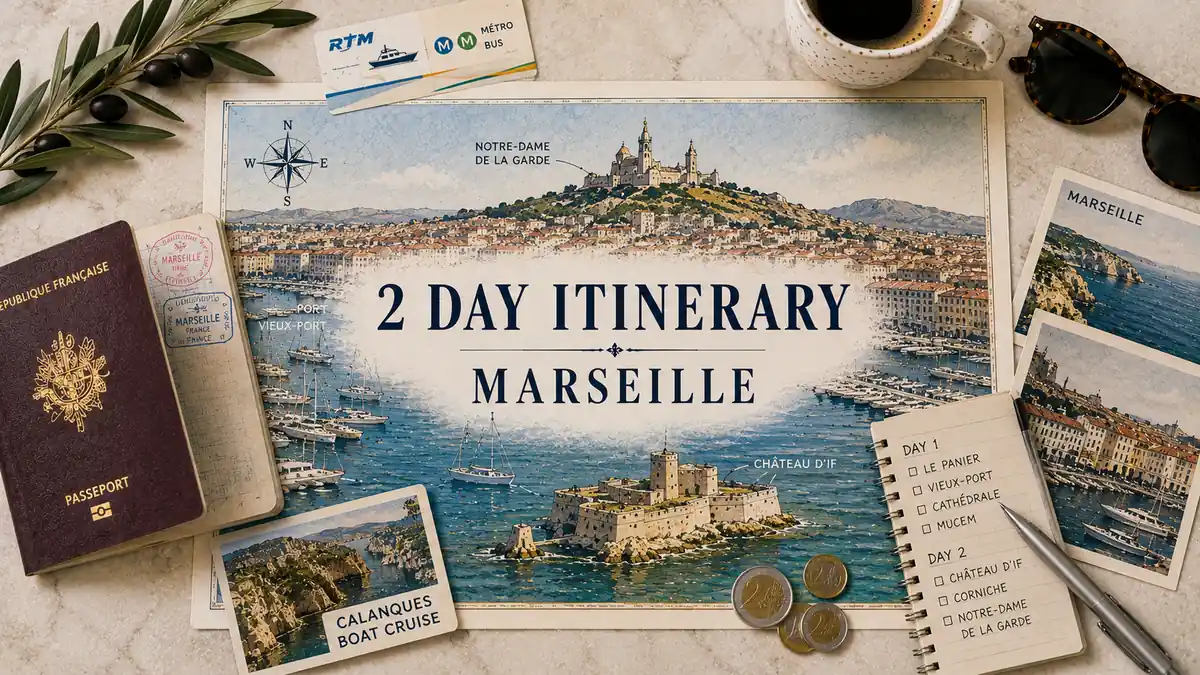
- Day 1 morning: Le Panier and La Vieille Charité — the old town on foot.
- Day 1 afternoon and evening: Cathédrale de la Major, MuCEM, Fort Saint-Jean, Vieux-Port — waterfront and dinner.
- Day 2 morning: ferry from the Vieux-Port to Château d’If and the Frioul Islands — the city seen from the sea.
- Day 2 afternoon and evening: Corniche, Vallon des Auffes, Notre-Dame de la Garde — the closing viewpoint.
Day 1 needs no transport at all. Le Panier, the Major, the MuCEM footbridges and the Vieux-Port quays form one continuous stretch, and the longest single leg is a 15–20 minute walk. The rest is short hops. Day 2 uses exactly two moving parts: the ferry out of the Vieux-Port in the morning, and one bus or metro leg to reach the Corniche and later the basilica hill. Ticket types, passes and the airport connection are their own subject — see getting around Marseille before you buy anything.
Reversing the two days is the one change that quietly breaks the route. The boat morning is the weather-dependent block, and placing it on Day 2 means you decide with a forecast you can actually act on, with a full indoor alternative still available in the centre.
Day 1: The Historic Core on Foot
Day 1 runs downhill from Le Panier to the Vieux-Port and never doubles back. Start in the old town, drop through La Vieille Charité and the Major to the waterfront museums, then finish at the port where the evening already is. The whole day is walking distance, with no timetable organising it.
Le Panier is the start because it is the highest and the earliest-good part of the day. Marseille’s oldest quarter is a knot of stepped lanes, painted facades and small squares, and it works best before the tour groups arrive and before the light goes flat. Give it an unhurried hour of wandering with no fixed target. La Vieille Charité sits inside it — a 17th-century almshouse built around an arcaded courtyard and a domed chapel, now housing museums — and it is the natural point to stop moving for a while. Check current opening days before you build the morning around any museum here.
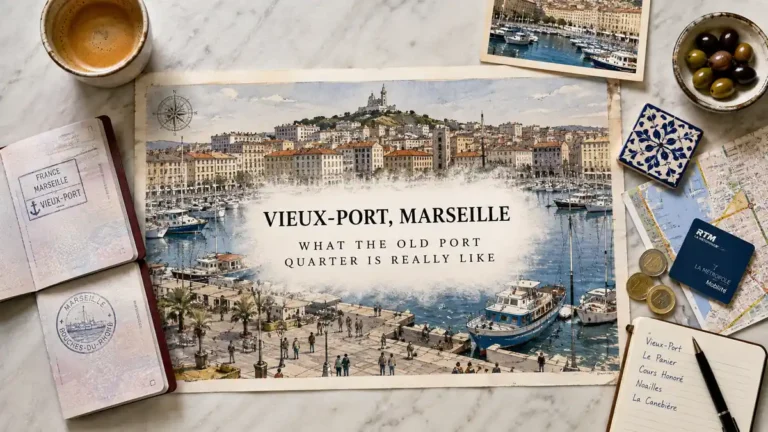
From the Charité you walk down to the Cathédrale de la Major, which marks the switch from old town to waterfront. It is the visual hinge of the day: striped stone, enormous scale, and the first proper sight of the harbour beyond it. A few minutes further on are the MuCEM and Fort Saint-Jean, connected by the footbridges that are the best free walk in the city. Even without going inside, the fort’s ramparts and the bridge crossing earn the stop on route position alone.
The day ends at the Vieux-Port, which you reach along the quay rather than through the streets behind it. This is where the sequence pays off: you arrive on foot, at dusk, at the place where the city eats. Nothing here needs a ticket. Evenings split two ways — stay portside for the classic view and the fish restaurants, or walk a short uphill stretch to Cours Julien for the bar and street-art side of Marseille. Both are ordinary evening moves for visitors, though Cours Julien and the streets around it feel busier and better lit on weekends; if you want the fuller picture, read Marseille at night.
Every stop above is here for its position in the walk, not its ranking. For depth on what is actually inside each one, use the full Marseille guide.
Day 2: The Sea, the Islands and the City’s High Point
Day 2 goes out to sea in the morning and climbs to the basilica at the end. The ferry to Château d’If and the Frioul Islands leaves from the Vieux-Port, the Corniche and Vallon des Auffes fill the afternoon, and Notre-Dame de la Garde closes the trip with the whole city underneath you.
The morning crossing is short — Château d’If sits close enough offshore that the boat ride is a sightseeing leg in itself, with the fortress island and then the Frioul archipelago beyond it. Departures leave from the Vieux-Port quay through the day, and both the season and the sea state decide how many actually run; rough water or a strong mistral can suspend them outright. Treat the crossing as something to confirm on the morning itself, not something to plan a fixed hour around.
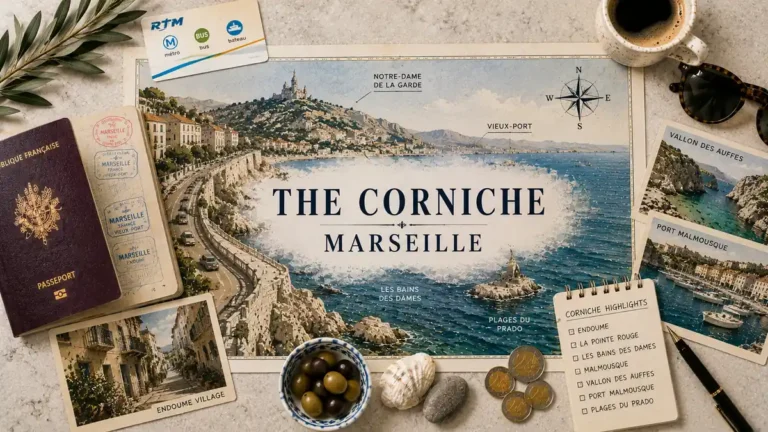
The afternoon is the Corniche: a long seafront road with the Mediterranean on one side and the city climbing away on the other. Walk a stretch of it and drop into Vallon des Auffes, a miniature fishing cove wedged under a road bridge, which is the best twenty minutes on the route for the effort involved. The order is not interchangeable. The boat has to be a morning because of light and sea state, and the basilica has to be last because it is the view that makes sense once you can recognise everything in it.
Are Château d’If and the Frioul Islands Worth a Half-Day?
Château d’If is worth a half-day on a first visit, and easy to skip on a short or rushed one. The island fortress of The Count of Monte Cristo is the draw, but the real value is the return view of Marseille rising behind the harbour. Frioul adds bare, sun-bleached coastline and swimming coves for anyone with an appetite for a longer morning.
Skip both if your trip is running on 36 hours instead of 48, if the sea is up, or if you would rather spend the morning inside the MuCEM. The crossing plus the island time is a committed block, and the one thing it cannot be is short. Nervous sailors and travelers with mobility limits should also weigh the boarding and the uneven island paths before committing the morning.
Notre-Dame de la Garde: Worth It, and When to Go Up
Notre-Dame de la Garde is worth going up, and worth going up last. The basilica crowns the city’s highest point and is Marseille’s most visited site, and the panorama takes in the port, the islands you sailed to that morning and the coastline you walked in the afternoon — which is exactly why it lands harder at the end of two days than at the start.
Getting up is a choice between a steep uphill walk from the port side and a bus that does the climb for you. The walk is genuinely steep and takes a good stretch of the afternoon out of you; the bus is the sensible option if your legs have already done Day 1 and the Corniche. Late afternoon into the golden hour is the strongest window for light and the softest for crowds, since the morning coach traffic has cleared by then. Confirm which days the basilica is open before you pin the finale on it.
Can You See the Calanques in Two Days?
You can see the Calanques in two days by boat, but not on foot. A cruise leaves from the Vieux-Port, runs a half-day at most, and shows you the inlets from the water. Hiking into the massif is a full day with its own transport and access rules, and that needs a third day.
A Calanques cruise is deck viewing, not a landing. Landing is banned park-wide, so what you buy is the approach: boats run out along the coast, turn into a sequence of limestone inlets, and hold position long enough for photographs. Shorter trips cover the nearest calanques and get you back for lunch; longer ones push further along the coast and take most of a half-day. Some operators build in an open-water swim stop, which is the only way you touch the water on this version.
Access to the massif itself runs on a seasonal prefectural regime. In the dry, high-fire-risk months the authorities publish a daily colour-coded risk level that governs whether trails and access roads are open, closed, or open only in a limited window. For a 48-hour visitor that cuts one way: a land visit is a plan that can be cancelled the evening before, while a boat departure from the Vieux-Port is a much steadier bet.
| Decision factor | Boat cruise within two days | Hiking day with a third day |
|---|---|---|
| Time it takes | Half a day at most, from the Vieux-Port | A committed full day, transport included |
| What you actually get | The coastline’s shape, seen from the deck | Inlets from above, and swimming from the rock |
| Reliability of the plan | Depends mainly on sea state that morning | Subject to seasonal fire-risk access rules |
| Who it suits | First-timers and weekend-breakers on 48 hours | Walkers with a third day to spend |
If you have more time, the Calanques on foot is the first thing that a third day should buy — along with the coast beyond the city that a 48-hour route deliberately leaves alone. That is a different trip shape with a different base logic, and it is planned in the 3 days in Marseille itinerary.
The boat and the trail are not smaller and larger versions of one experience. The cruise sells you the coastline’s shape from outside; the hike sells you the water and the silence from inside. For 48 hours, buying the shape is the right trade — just do not book the cruise expecting the trail.
Tours and activities
Book skip-the-line tickets, day trips and local tours with free cancellation on most activities.
You can also browse everything on getyourguide.com.
Tripstou may earn a commission if you book through this link, at no extra cost to you.
Where to Base Yourself for Two Days
Base near the Vieux-Port and do not move hotels. Both days start on the port — Day 1 walks straight up into Le Panier, Day 2 boards the ferry at the quay — so a single central base removes every transfer from a trip that has no spare time to absorb one.
The route logic does the arguing here. A port-side base puts the Day 1 walk, the Day 2 departure point, the evening restaurants and the Saint-Charles connection all within a short walk or one short hop, which is what makes a two-day plan survive a delayed train. Two days has no room for a relocation. Which specific area, building type and trade-off suits you is a longer decision, resolved in where to stay in Marseille.
Hotels and places to stay
Compare hotels, apartments and stays for your dates in one search.
Search hotels and stays on hotels.com →
Tripstou may earn a commission if you book through this link, at no extra cost to you.
How to Adapt This Route
Cut this route from the edges, never from the middle. The Day 1 walk and Notre-Dame de la Garde are the core and stay in every version. The boat morning, the Corniche stretch and the second museum are the flexible parts, and they absorb late arrivals, bad weather and a slower pace without collapsing the trip.
When time shrinks:
- Cut the Château d’If and Frioul crossing first — it is the single largest removable block and the only one that leaves no hole in the day.
- Cut a museum interior next, keeping the MuCEM and Fort Saint-Jean footbridge walk, which costs nothing and needs no opening hours.
- Shorten the Corniche to just Vallon des Auffes, reached by bus in each direction.
- Protect the Le Panier morning and the basilica finale in every version. The basilica never gets cut.
When time grows, one thing gets added before anything else: the Calanques day on foot, planned as a third day in the guide already linked above. Do not stretch the two-day route to reach for it.
A late TGV or evening flight arrival means Day 1 starts after lunch. Compress it to Le Panier, the Major and the waterfront walk, keep the Vieux-Port evening, and push La Vieille Charité into Day 2’s afternoon in place of part of the Corniche. A mistral day or a rain day is the other common rewrite: swap the boat morning for indoor culture — the MuCEM, La Vieille Charité, or the Palais Longchamp with its park at the far end of the city — and keep the basilica for whichever of the two afternoons clears up. Travelling at a slower pace works the same way, one stop lighter per half-day, with the walking legs replaced by the bus.
The mistake most 48-hour visitors make is deciding too late. Look at the wind and sea in the evening on Day 1, choose the boat morning or the museum morning then, and Day 2 runs cleanly instead of stalling at the quay. For packing, etiquette and the practical prep that makes those calls easier, see the Marseille travel tips.
Frequently Asked Questions
How many days do you need in Marseille?
Two days is the practical minimum for Marseille’s city core. One day covers only the Vieux-Port, Le Panier and the basilica at speed. Two days adds the sea, the islands and the Corniche without rushing. A third day is what buys the Calanques on foot.
Can you walk everywhere in Marseille in two days?
No — Day 1 is fully walkable, Day 2 is not. The historic core connects on foot from Le Panier down to the Vieux-Port, and it runs downhill the whole way. Day 2 breaks that pattern with a ferry to the islands and one bus or metro leg toward the basilica.
Is Marseille worth visiting for a weekend?
Marseille rewards a weekend if you want a working port city with a rough edge, not a polished postcard one. Travelers who like markets, harbour walking, sea views and lived-in neighbourhoods get a lot from 48 hours. Anyone expecting manicured Provençal charm will find Marseille harder work than they hoped.
What is the best time of year for a short trip to Marseille?
Late spring and early autumn suit a two-day Marseille trip best. The heat is manageable for a walking day, the sea is usually calm enough for the boat morning, and the crowds at the basilica thin out. High summer works but is hot and busy; winter is quiet but the mistral can shut the boat morning down.
What do you need to book in advance for a two-day Marseille trip?
Very little — the boat trips are the only part of this route worth arranging ahead. A Calanques cruise or the Château d’If crossing can fill up in the warm months, and both hinge on sea conditions. The walking spine of the route needs no booking at all.
Should you take the Château d’If ferry or a Calanques cruise on Day 2?
Both boats want the same morning: take the ferry on a first visit, the cruise for the coastline. Château d’If and Frioul give you the city from the water and a landmark you can walk on. The Calanques cruise gives you limestone inlets from the deck, with no landing anywhere.
Related Guides
- Marseille travel guide — city orientation, attraction depth and what each stop on this route actually holds.
- 3 days in Marseille itinerary — the extended route, including the Calanques on foot and the coast beyond the city.
- Where to stay in Marseille — area logic and trade-offs behind the single Vieux-Port base.
- Getting around Marseille — metro, bus, ferry and tickets for the two moving parts of Day 2.
- Marseille trip cost — what a short city trip adds up to, category by category.
- Marseille travel tips — practical prep, etiquette and mistral packing before you go.
Did this guide save you time or money? Tripstou is independent and reader-funded — if you'd like to give something back, you can support the site with a crypto contribution of any size.