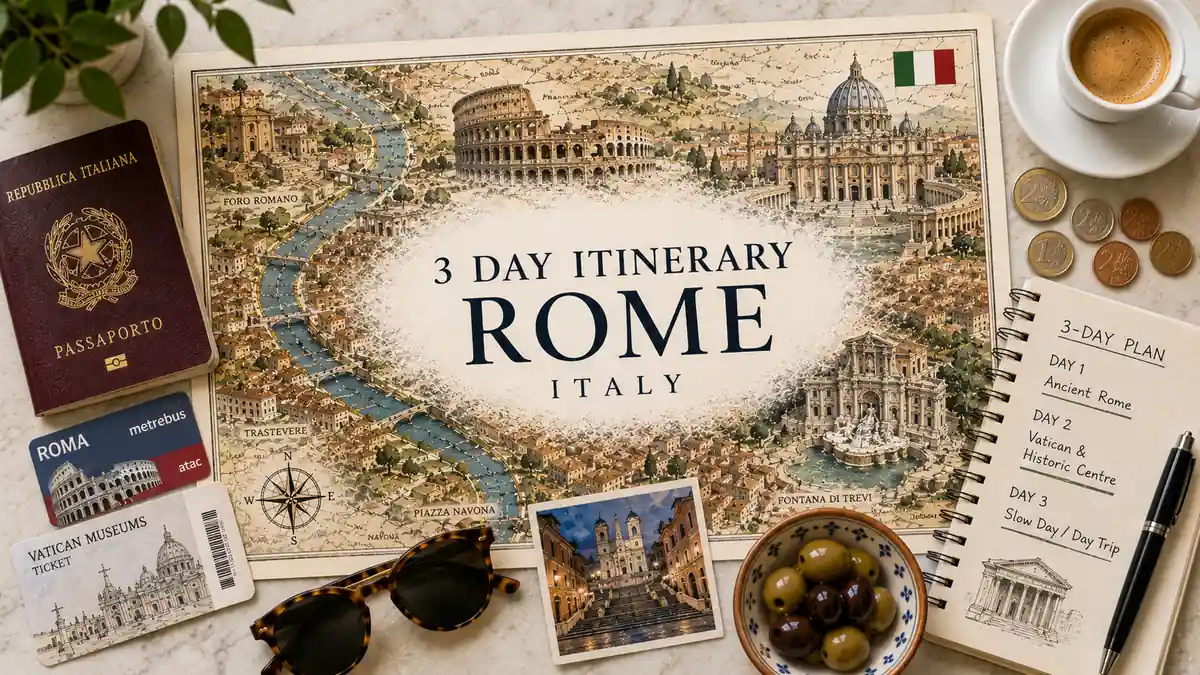
Three days is the sweet spot for a first visit to Rome. It is long enough to walk through the Colosseum, stand under Michelangelo’s ceiling, and throw a coin in the Trevi Fountain without sprinting between them — but only if you plan the route by proximity instead of by wish list. Rome’s problem is not too few sights; it is sights scattered across a dense, walkable centre that rewards grouping and punishes zig-zagging. This guide lays out a day-by-day route built around that logic: one walkable zone per day, the big-ticket sights booked ahead, and early starts to stay in front of the crowds. Day 1 and Day 2 carry the non-negotiables. Day 3 is what sets this apart from a two-day trip — a slower, flexible day you shape to your own pace. Follow it in order and you see Rome’s core without ever crossing the city twice.
Quick Answer
Spend Day 1 on Ancient Rome, Day 2 on the Vatican and historic centre, Day 3 on a slower add. Group each day by proximity and book the Colosseum, Vatican, and Borghese Gallery ahead to skip the queues. Three days suits first-timers who want the icons plus one unhurried day.
Trust Layer
Tripstou itinerary guide for travelers planning a route. Covers pacing, stop count, stop order, base logic, and trip length.
Produced with AI assistance and reviewed by Alex Perrut, working in tourism since 2015, for the Tripstou editorial team. See our editorial process for details.
Last factual review: July 15, 2026.
Official sources consulted: italia.it, enit.it.
Key Takeaways
- Split the trip as Ancient Rome on Day 1, the Vatican and historic centre on Day 2, and a slower Day 3.
- Group each day into one walkable zone so you see Rome’s core without ever crossing the city twice.
- Book the Colosseum, Vatican Museums, and Borghese Gallery ahead of time — the Borghese reservation is mandatory and sells out.
- Treat three days as two days of non-negotiables plus one slower day you shape to your own pace.
- Start each day early so you enter the Colosseum and Vatican before the queues and crowds build.
- This route suits first-time visitors who want Rome’s icons plus one unhurried day, not a packed checklist.
Table of Contents
Is 3 Days Enough for Rome?
Yes — three days is enough for Rome’s core without rushing. Two of those days carry the non-negotiables — Ancient Rome and the Vatican — and the third gives you room to slow down. The trick is grouping each day by proximity so you walk one zone instead of crossing the city.
The best way to picture it is “two days plus one.” The first two days are close to fixed: the Colosseum and Forum fill one, the Vatican and historic centre fill the other. If you only have 48 hours, that pair is the whole trip — which is exactly the case our 2 days in rome plan makes. The third day is the luxury a shorter visit cannot afford: a morning you are not racing through, a gallery you booked weeks ago, a long lunch in Trastevere.
The third day earns its keep only if you protect the slower pace. Cram it with more sights and you have simply built a rushed two-day trip with an extra ticket attached. For broader context on the city beyond this route — neighbourhoods, seasons, and how the pieces fit — the rome guide is the hub this itinerary sits under.
Your 3-Day Rome Route at a Glance
The route runs in three moves: Ancient Rome, then Vatican and historic centre, then a slower day. Each day sits inside one walkable zone, so you see the icons in logical order without crossing the city. Day 3 stays flexible — depth, a neighbourhood, or a half-day trip, depending on your pace.
- Day 1 → Ancient Rome → the empire’s monumental core
- Day 2 → Vatican and historic centre → art, faith, and famous piazzas
- Day 3 → your choice → depth at a slower pace
| Day | Main focus | Pace |
|---|---|---|
| Day 1 | Colosseum, Roman Forum, and Palatine Hill | Full day in one zone |
| Day 2 | Vatican, then the historic centre | Half-day, then easy walking |
| Day 3 | One deeper, slower experience | Unhurried pace, a single anchor |
How to Structure 3 Days in Rome Without Backtracking
Cluster by neighbourhood and see one zone per day. Rome’s core sights fall into three tight groups, so the route almost designs itself: Ancient Rome in the south-east, the Vatican in the west, and the historic centre in the middle. Walk each group in proximity order and you never double back.
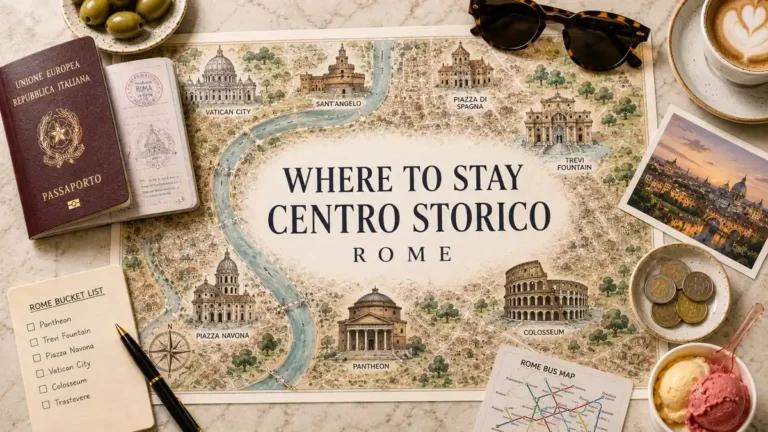
Rome punishes backtracking more than most capitals. The Vatican and the Colosseum sit on opposite edges of the centre, so splitting either across two days doubles your transit for no gain. Keeping each zone whole is also why a central base matters — sleep near the historic centre and every day starts and ends on foot. Our guide to where to stay in Rome covers which areas keep this route walkable.
Two habits protect the plan: start early, and book the busiest sights before you arrive. Early starts put you inside the Colosseum and the Vatican before the queues form, and advance tickets mean you walk past the line instead of standing in it.
| Sight | Book ahead? | Why it matters |
|---|---|---|
| Colosseum and Forum | Yes, book a timed entry | Combined ticket, queues build fast from opening |
| Vatican Museums | Yes, book a dated slot | Skip long entry lines, especially in peak months |
| Borghese Gallery | Yes, reservation is mandatory | Timed slots are capped and sell out early |
Tours and activities
Book skip-the-line tickets, day trips and local tours with free cancellation on most activities.
You can also browse everything on getyourguide.com.
Tripstou may earn a commission if you book through this link, at no extra cost to you.
Day 1: Ancient Rome — Colosseum, Forum, and Palatine
Start early at the Colosseum, then walk straight into the Roman Forum and Palatine Hill. These three form one archaeological zone, usually covered by a single combined ticket, so your whole morning stays in one place. Reserve a timed Colosseum entry ahead and arrive near opening to beat the queues.
The day flows as one continuous walk with no transit in the middle:
- Colosseum at opening, with a timed entry booked ahead
- Roman Forum next, allowing roughly two to three hours to wander
- Palatine Hill above the Forum for the views and imperial ruins
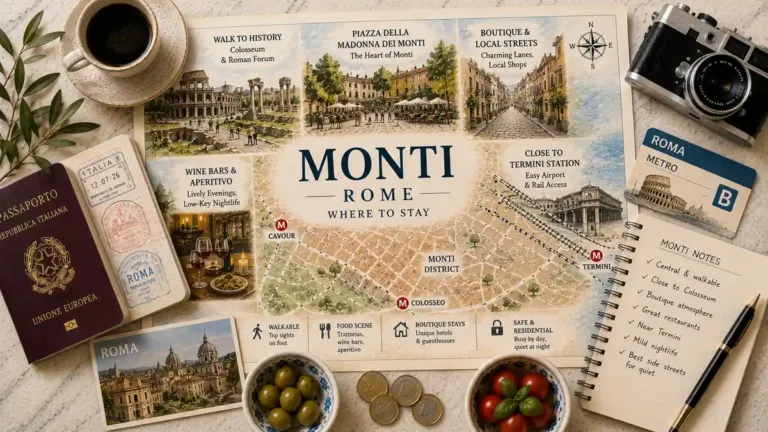
- Evening: stroll to nearby Monti or Campo de’ Fiori for dinner
Keep the anchor sights to these two or three and resist adding more. This is a route, not a ranking — if you want to weigh up churches, museums, and viewpoints beyond the Ancient Rome core, the deep-dives in things to do in Rome cover the choices. The Forum is where most people lose time; a loose two-to-three-hour window keeps the afternoon open without turning the visit into a march.
Day 2: Vatican City and the Historic Centre
Spend the morning at the Vatican and the afternoon in the historic centre. Move through the Vatican Museums to the Sistine Chapel and into St. Peter’s Basilica as one continuous half-day. After lunch, the Pantheon, Trevi Fountain, Piazza Navona, and Spanish Steps sit within an easy walk of each other.
The Vatican works best as a single morning block, in this order:
- Morning: Vatican Museums, then the Sistine Chapel, then St. Peter’s Basilica
- Midday: lunch near the Vatican before crossing into the centre
- Afternoon: Pantheon, then Trevi Fountain, Piazza Navona, and the Spanish Steps
- Evening: dinner around Piazza Navona or the surrounding lanes
Book the Vatican Museums with a dated entry — it is the queue that eats mornings, and a timed slot lets you flow straight through to the Sistine Chapel. The afternoon cluster needs no tickets and no plan beyond a rough loop: the four landmarks sit a few minutes apart, so you wander rather than commute, closing the day at whichever piazza suits dinner.
Day 3: What the Extra Day Buys You
Day 3 is your flexible, slower day — pick one deeper experience. The extra day buys pace, not a longer checklist: choose the Borghese Gallery, the Trastevere neighbourhood, the Appian Way, or a light half-day trip. Whatever you choose, keep it to one anchor so the day stays unhurried.
Four ways to spend it, depending on what you want more of:
- Borghese Gallery — a compact masterpiece collection needing an advance timed reservation
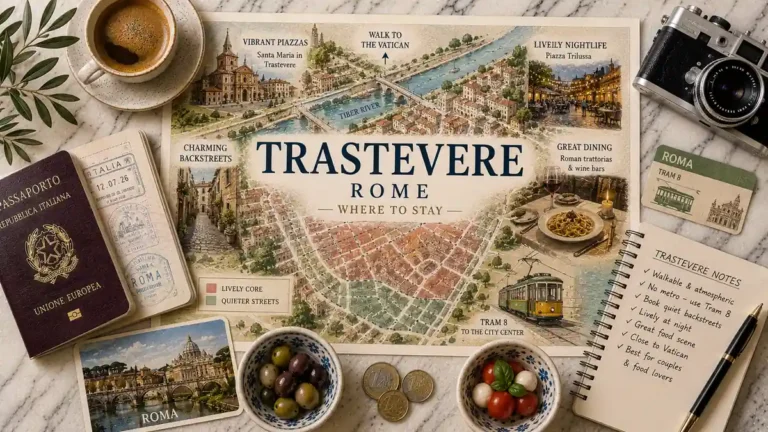
- Trastevere — a slow morning of lanes, markets, and long lunches
- Appian Way — ancient road, catacombs, and green space away from the crowds
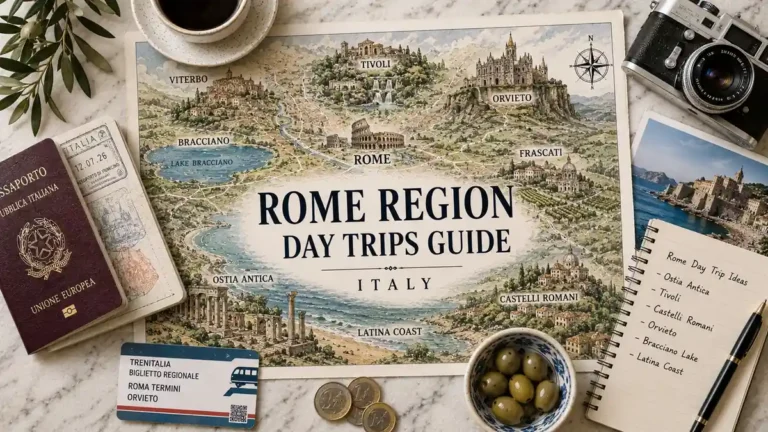
- Half-day trip — a light excursion such as Ostia Antica or Tivoli
The Borghese Gallery is the one Day-3 option you cannot decide on the morning of — its timed-slot system caps numbers and sells out, so lock it before you fly. The others are walk-up choices you can pick by mood. Since Day 3 is also where booking discipline and a gallery ticket add to the budget, our breakdown of how much 3 days in Rome costs covers where the money goes.
How to Adapt This Route for 2 or 4 Days
To shorten, drop Day 3; to extend, build outward from it. Day 3 is the flex lever in this route, so you adjust length by adding or removing it whole — never by thinning the two core days. Two days keeps the icons; four days adds a day trip or a wider Italy leg.
Cutting to two days:
- Drop Day 3 entirely and keep Days 1 and 2 exactly as written
- Do not thin the core days — the early Colosseum and Vatican starts stay
Growing to four days:
- Add a day trip such as Ostia Antica, Tivoli, or further afield
- Or extend into a wider route beyond the city
Adding a fourth day rewards you more outside Rome than inside it — the city’s core fits in three, so a fourth is better spent reaching beyond it. If Rome is one stop in a longer trip, our Italy itinerary shows how to sequence it with other cities without doubling back across the country.
Frequently Asked Questions
Do I need to book the Colosseum and Vatican in advance?
Yes, book both ahead of time. The Colosseum uses timed entry and the Vatican Museums sell dated slots, and queues at each build quickly from opening, especially in peak months. Advance tickets let you walk past the line. The Borghese Gallery goes further — its reservation is mandatory, not optional.
How many days do you really need in Rome?
Two days cover Rome’s non-negotiables — Ancient Rome and the Vatican — but three is the comfortable minimum for a first visit. The third day adds breathing room rather than more sights, letting you slow down instead of racing. If you only have 48 hours, the compressed two-day plan still works.
Can you do a day trip on your third day in Rome?
Yes, a light half-day trip works well on Day 3, once the core sights are done. Nearby options like Ostia Antica or Tivoli give you a change of scene without a long journey. Keep it to a half day so the trip stays relaxed instead of becoming another packed march.
Should you visit the Vatican or Ancient Rome first?
Either order works, but this route puts Ancient Rome on Day 1 and the Vatican on Day 2. The sequence matters less than your booking slots: build the days around whichever timed entries you secure. If your Vatican slot lands on the first morning, simply flip the two days.
How early should you start each day in Rome?
Aim to reach the first big sight at or near opening, early in the morning. The Colosseum and Vatican draw the longest queues within an hour of opening, so an early start puts you inside before the crowds. Afternoons are better spent on the walkable piazza clusters that need no tickets.
How much walking does a 3-day Rome itinerary involve?
Expect a lot of walking, since the route is built to be covered on foot. Each day stays inside one walkable zone, so you stroll between sights instead of taking transit, but the cobblestones and long museum floors add up. Comfortable shoes and an unhurried pace make all three days easier.
Related Guides
- Rome travel guide — the hub with neighbourhoods, seasons, and city context
- 2 days in Rome itinerary — the shorter version of this route
- Where to stay in Rome — central bases that keep the route walkable
- Rome trip cost — what three days adds up to, tickets included
- Things to do in Rome — attraction deep-dives beyond the core route
- Italy itinerary — sequencing Rome into a wider Italy trip
Did this guide save you time or money? Tripstou is independent and reader-funded — if you'd like to give something back, you can support the site with a crypto contribution of any size.