The region around Rome is Lazio, and it is worth adding whenever your trip has days to spare beyond the city. Without leaving the region you get Etruscan tombs, Renaissance villas, hill-town wine country, volcanic lakes and a summer coast with islands offshore. The one variable that changes the plan is distance from the city: the Alban Hills and Tivoli work from a hotel in Rome, while Tuscia in the north and the southern coast earn a night or two of their own, and usually a car.
This guide walks that decision in order: which part of Lazio fits your interests, whether it needs a second base, and how season, transport and budget shape the trip.
Is the region around Rome worth adding to your trip?
Yes, for anyone with spare days beyond the city. Lazio, the region that surrounds Rome, is strongest on Etruscan history, villas and gardens, hill towns with their own wine, volcanic lakes, and a summer coast with the Pontine Islands offshore. The one traveler who should skip it is the one on a very short first stay in Rome, where the city alone fills every day.
Administratively the region is split into five provinces: Rome, Viterbo, Rieti, Latina and Frosinone. For planning, the split that matters is simpler. The hills and villas close to the city behave like Rome’s countryside, and the further corners — rural Tuscia, the beach towns of the south, the mountains around Rieti — behave like a separate destination.
That is why Lazio is far more often an add-on to Rome than a trip in its own right. Most visitors arrive for the capital and bolt a few days of the region onto it. If you are still weighing Lazio against Tuscany, Campania or the north, start with choosing between Italy’s regions, and keep our Italy travel guide open for the country-level basics.
Lazio’s areas compared: character, base and whether you need a car
Lazio splits into a handful of travel choices around Rome: the city itself as a base, the Castelli Romani hills with Tivoli, Tuscia to the north, and the southern coast with its islands. They differ mainly in how far they pull you from a Rome hotel. The hills sit close enough to visit and come back; Tuscia and the coast are worth sleeping in.
| Area | Character and highlights | Natural base | Suits | Car? |
|---|---|---|---|---|
| Rome as base | Capital city and hub of the regional network | Rome | Short stays, travelers without a car | No |
| Castelli Romani and Tivoli | Wine towns, crater lakes, Villa d’Este’s gardens | Rome or Frascati | Food, wine and garden lovers | Not needed |
| Tuscia | Rural and medieval: Civita di Bagnoregio, Etruscan tombs | Viterbo or Lake Bolsena | Slow travel and Etruscan history | Near-essential |
| Southern coast and Pontine Islands | Beach towns, a national park, Ponza by ferry | Sperlonga or Gaeta | Summer beach and island trips | Helpful |
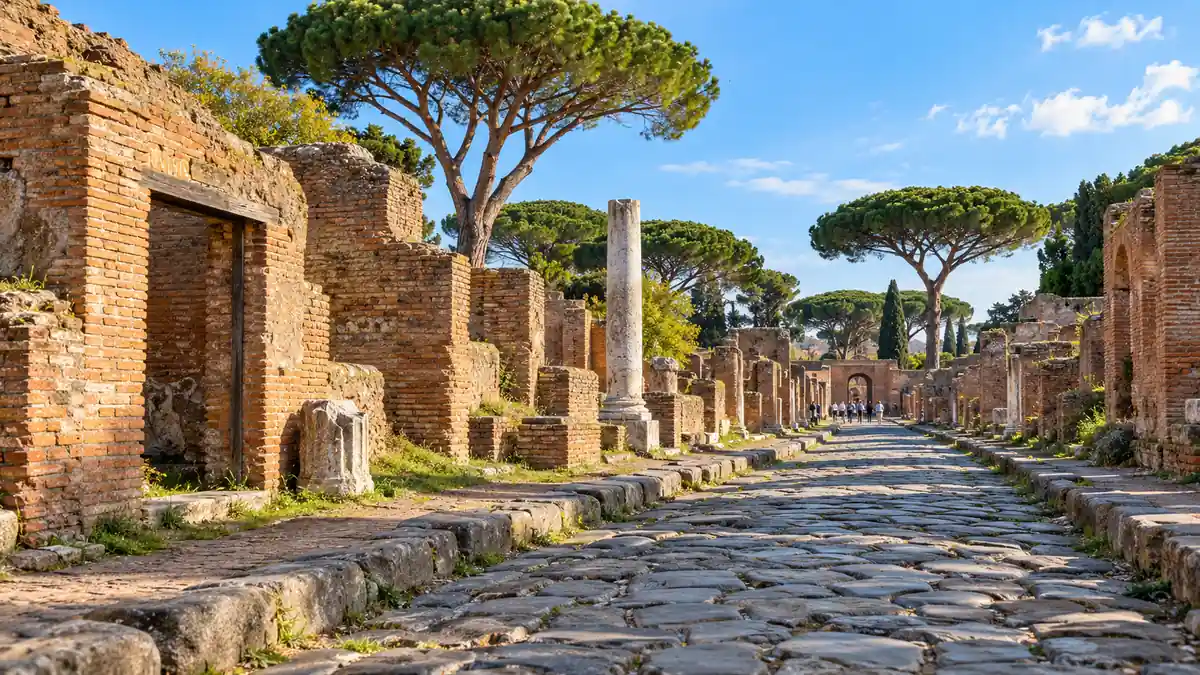
Beyond these, Lazio has corners that suit a return visit. Rieti and the Sabina hills offer mountains and the Abbey of Farfa; Ciociaria, south-east of Rome, has the hill towns of Anagni, Ferentino and Fumone. Closer in, Ostia Antica, Lake Bracciano and the Appian Way (UNESCO-listed) work as outings on the city’s edge.
Castelli Romani and Tivoli are the countryside you can do from Rome
The Alban Hills towns and Tivoli are the part of Lazio that works without moving hotel. South-east of Rome, the Castelli Romani are wine towns gathered around crater lakes; to the east, Tivoli holds a Renaissance villa and a Roman one.
Frascati is the name most travelers know, for its wine and its views over the plain towards Rome. Castel Gandolfo looks down on Lake Albano, Genzano and Lanuvio sit further along the hills, and Lake Nemi lies in a smaller crater nearby. The towns are close enough to one another that the hills read as one area, best taken slowly, with a long lunch in the middle of the day. Rome is the natural base; one night in Frascati turns the visit into an evening among the vineyards.
Tivoli pairs two very different villas. Villa d’Este, UNESCO-listed, is the Renaissance garden of terraces and fountains; Villa Adriana is the vast country estate of the emperor Hadrian below the town. Tivoli is on Rome’s regional rail network, so a guide is optional, though some travelers book a guided villa visit to see both estates in one outing. Food, wine and garden travelers without a car get the most from this corner of the region.
Tours and activities
Book skip-the-line tickets, day trips and local tours with free cancellation on most activities.
You can also browse everything on getyourguide.com.
Tripstou may earn a commission if you book through this link, at no extra cost to you.
Tuscia, north of Rome, rewards a night or two and a car
Northern Lazio is the slow, rural side of the region: medieval Viterbo, Civita di Bagnoregio on its ridge, volcanic lakes and Etruscan tombs. It is spread out, and its best places sit between the towns that trains and buses reach. A base in Viterbo or on Lake Bolsena beats returning to Rome every night.
Viterbo, Civita di Bagnoregio and the volcanic lakes
Viterbo is the base that holds Tuscia together. Its medieval centre makes evenings there worth having, and its thermal springs give it the one strong winter case in inland Lazio.
Civita di Bagnoregio is the sight that brings most visitors north. The village sits alone on its ridge, and you enter it on foot over a bridge; entry is ticketed. Without a car the journey is the planning point, a train and then a bus, covered step by step in the questions below.
The volcanic lakes give the area its softer side. Lake Bolsena, a broad lake in an old volcanic crater, has lakeside towns that make an easy base. Lake Vico is a volcanic nature reserve in the Cimini hills. Around them, Caprarola, Bomarzo, Bagnaia and the hill villages of Sutri and Calcata fill the days. Each is a short stop, and stringing several together is what makes a car worth having here.
Etruscan Lazio: Tarquinia and Cerveteri
Tarquinia and Cerveteri hold the Etruscan necropolises that UNESCO lists, and they are the strongest reason history travelers come to Lazio. They play different roles in a trip. Cerveteri sits close enough to Rome to visit from the city. Tarquinia, further up the coast, fits a stay in Tuscia or a coastal drive north.
Cerveteri is the Etruscan site for a Rome hotel; Tarquinia is the one that pays back a night in Tuscia. Slow-countryside travelers who will drive, and who care about the Etruscans more than the beaches, will find Tuscia the most rewarding part of the region.
The southern coast and the Pontine Islands are a summer trip of their own
South of Rome, the Ulysses Riviera, Circeo and the island of Ponza make a beach-and-island choice that needs its own nights. It is a warm-month trip, and in August Romans fill it. The coast is too far from the city to treat as a quick outing, and the islands even more so.
- Sperlonga, Gaeta and Terracina: the beach towns of the Ulysses Riviera, each with an old centre above the sea. Sperlonga or Gaeta makes the natural base. Sperlonga has no station of its own; the nearest is Fondi-Sperlonga on the Rome–Naples line, with a bus into town. Couples and families who want a beach base with an old town attached will be happiest here.
- Circeo National Park: the protected coast between Anzio and Terracina. Walkers and nature lovers get more from it than sunbathers.
- Gardens of Ninfa: a celebrated garden inland from the coast. Garden travelers will plan their whole southern leg around it.
- Ponza and the Pontine Islands: Ponza, Ventotene and Palmarola, reached by ferry. Clear water and boat days are the draw, and the islands deserve their own nights; the ferry question is answered below.
Rome alone or Rome plus a second base?
Keep Rome as your only base on a short trip, and for the hills, Tivoli, Ostia Antica and Cerveteri. Add a second base only for Tuscia or the coast, because those areas lose most of the day to the back-and-forth from the city. Moving hotel costs you half a day; in return you gain evenings in the countryside instead of on a regional train.
- Short stay: Rome only, plus one outing into the region. For picking that outing, see which outings around Rome fit a single day; the same guide covers Pompeii, Naples, Florence and Tuscany, which lie outside Lazio.
- Medium stay: Rome, then a few nights in one area. That means Tuscia or the coast, or Frascati if the hills are what you came for.
- Longer stay: Rome, then Tuscia, then the coast, linked by a hire car.
Outside Rome, the bases that work are Frascati for the hills, Viterbo or a Bolsena lakeside town for Tuscia, and Sperlonga or Gaeta for the coast. In Tuscia, an agriturismo is the countryside stay type to look for. Rome itself stays the hub because the regional network starts there; for where to stay in the city and what to see, use our Rome guide to its neighbourhoods and sights.
Hotels and places to stay
Compare hotels, apartments and stays for your dates in one search.
Search hotels and stays on hotels.com →
Tripstou may earn a commission if you book through this link, at no extra cost to you.
Spring and autumn suit inland Lazio; summer belongs to the coast
The season decides the area. Hill towns and Tuscia are at their best in spring and autumn, the coast and islands in summer, and Viterbo’s thermal springs are the case for winter. August is the month to treat carefully on the coast, when Romans head to their own beaches.
Inland summers are hot, and walking a ridge village at midday is hard work. The beach season, by contrast, is what the southern coast exists for, and island ferries run a summer-led service. For month-level detail across the country, see month-by-month timing for Italy.
Do you need a car in Lazio?
Not for Rome, the hills or Tivoli. For rural Tuscia, the lakes and the coast villages, a car is near-essential: trains and Cotral buses reach the main towns, but not much between them.
- Regional trains from Rome: Tivoli, Viterbo and Civitavecchia are on the regional rail network. This is the easy option for a traveler who stays based in Rome and visits one town at a time; the limit is that the train stops at the town and goes no further.
- Cotral buses: Lazio’s regional bus operator covers the links between towns that the railway skips. Budget travelers with patience manage well on them, at the cost of planning around the timetable.
- A hire car: the way to string Tuscia’s villages, lakes and tombs together, or to hop between beach towns. Collect it as you leave Rome; driving into the centre of the city is the part to avoid.
Civita di Bagnoregio shows how the public-transport version works: a train, then a bus, then a walk, as the questions below explain.
What a stay in the Lazio countryside costs by travel style
Outside August, countryside and coastal stays generally run cheaper than central Rome. The cost lever is the car and the season, not the area you pick.
On a tight budget, Rome stays the base and the region comes in one outing at a time, by train and bus, which usually keeps the spend close to a city trip. The comfortable middle is an agriturismo in Tuscia plus a hire car: the room is generally better value than in Rome, and the car becomes the main extra cost. The high end is a coastal hotel or a stay on Ponza in high summer.
August turns Lazio’s usual price logic upside down. The coast, normally the relaxed side of the region, becomes the most expensive and most crowded part of it, and that hits every spend style, not only the luxury one.
The strongest first Lazio trip pairs Rome with one countryside base
For a first visit, Rome plus one area beats sampling all of them: Tuscia for history and countryside, the coast if you travel in summer. Lazio works best as an add-on to Rome, and as a standalone trip only for return visitors and slow travelers.
The region rewards particular interests. History travelers will find their trip in the Etruscan sites and Tivoli’s villas; wine lovers in the Castelli Romani; walkers in Circeo and the Rieti mountains; beach and boat travelers on the Ulysses Riviera and Ponza. It suits less those who want city life every evening, or a first-timer with only a few days in Rome.
Within a wider Italy trip, Lazio extends the Rome leg before you head north or south. To fit it into a wider Italy route, plan the regional nights straight after the city, so the car is collected as you leave Rome and dropped wherever the route continues.
Lazio Beyond Rome, in Short
- A hotel in Rome is enough for the Castelli Romani, Tivoli, Ostia Antica and Cerveteri, so a short trip needs no second base.
- Tuscia repays a night or two in Viterbo or on Lake Bolsena plus a hire car, because its villages, lakes and tombs lie between the towns that trains reach.
- The southern coast and the Pontine Islands are a summer trip with nights of their own, and in August Romans fill them and push up prices across every budget.
- Inland Lazio — the hill towns and Tuscia — is at its best in spring and autumn, when the midday heat no longer makes ridge villages hard work.
- A first visit works best as Rome plus one countryside base: Tuscia for history and rural evenings, the coast if you travel in summer.
Questions About Lazio’s Lakes, Islands and Civita
How do you get to Civita di Bagnoregio from Rome?
Take a train from Rome to Viterbo or Orvieto, then a Cotral bus to Bagnoregio, and finish on foot over the footbridge into Civita. Those are the two stations the village’s official site gives for the journey; Orvieto sits just over the border in Umbria. Entry to Civita is ticketed, and the official site sells tickets online. With a car, Civita slots easily into a stay based in Viterbo or on Lake Bolsena.
How do you get to Ponza from Rome?
Travel from Rome to the Lazio coast, then cross to Ponza by ferry. The service is summer-led, so the island is a warm-month trip, and the journey there and back takes enough of the day that Ponza works best with at least one night on the island, ideally paired with a coastal stay in Sperlonga or Gaeta.
Which lakes near Rome are worth visiting?
Bracciano, Albano, Nemi, Bolsena and Vico are the lakes worth the trip, and they split by distance from Rome. Lake Bracciano, on the city’s edge, is volcanic and good for swimming, canoeing and sailing. Lakes Albano and Nemi fill craters in the Castelli Romani, so they pair naturally with the hill towns. Further north in Tuscia, Lake Bolsena has lakeside towns that work as a base, and Lake Vico is a volcanic nature reserve in the Cimini hills.
Scope and Sources
This page helps you plan Lazio around Rome: which area to add, how many nights it needs and how to get around. It is not a Rome city guide, a ranked list of day trips, a day-by-day route or a hotel roundup.
Alex Perrut, working in tourism since 2015, went over this regional guide for the Tripstou editorial team after it was written with AI assistance; our editorial process sets out the steps.
Official sources consulted: Italia.it, the Italian National Tourism Portal, Visit Lazio and the Civita di Bagnoregio official site.
Did this guide save you time or money? Tripstou is independent and reader-funded — if you'd like to give something back, you can support the site with a crypto contribution of any size.