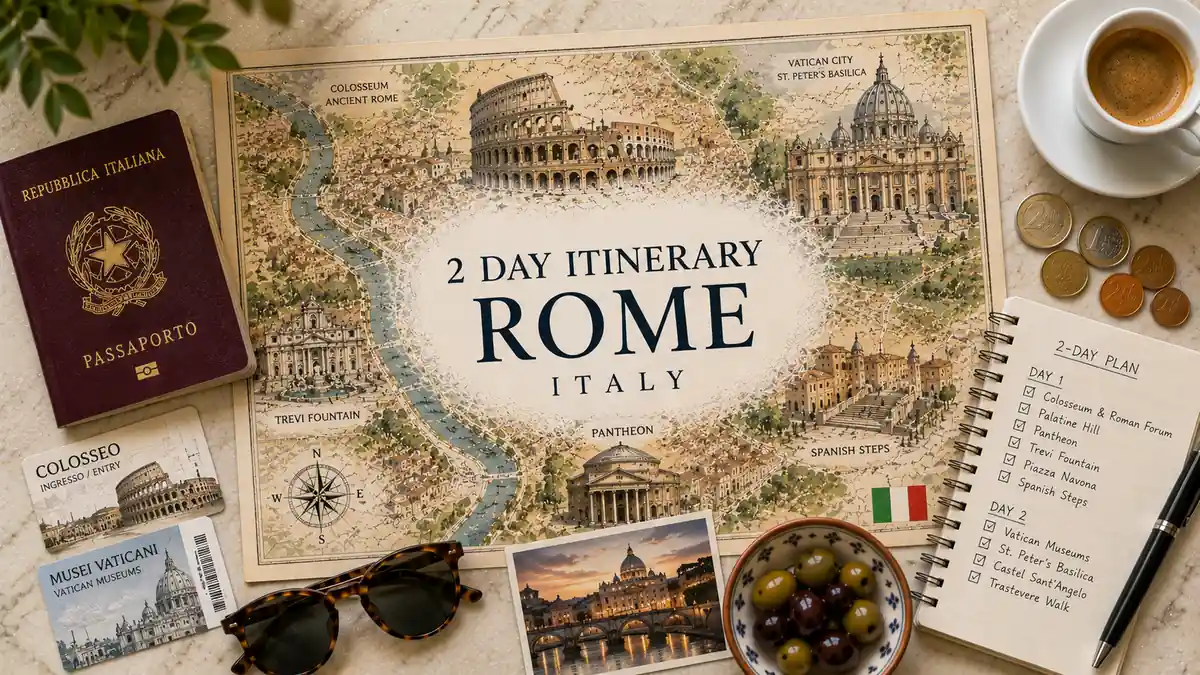
Two days in Rome forces a hard compromise: the city holds far more than any 48-hour window can absorb, and most itineraries respond by cramming a scattered wish-list that has you crossing the center twice a day. This route does the opposite. It picks the sights that define a first visit, then orders them by geography so each day flows as a single walkable arc — no doubling back, no wasted crossings, no afternoon lost to a bus. Day 1 takes on Ancient Rome and the historic center; Day 2 covers the Vatican and the streets of northern Rome. Along the way you get a clear verdict on whether two days is genuinely enough, exactly what to see in each half-day block, and honest rules for adapting the plan if your time runs shorter or longer. It is built for first-timers who want Rome’s essentials without a spreadsheet — and who want to enjoy the walk.
Quick Answer
Yes — two days covers Rome’s essential sights on a tight, walkable day-by-day route. The split does the work: Day 1 is Ancient Rome and the historic center, Day 2 is the Vatican and northern Rome, each walked in order to avoid backtracking. It suits first-timers who accept a fast pace; book Colosseum and Vatican entry ahead.
Trust Layer
Tripstou itinerary guide for travelers planning a route. Covers pacing, stop count, stop order, base logic, and trip length.
Produced with AI assistance and reviewed by Alex Perrut, working in tourism since 2015, for the Tripstou editorial team. See our editorial process for details.
Last factual review: July 15, 2026.
Official sources consulted: italia.it, enit.it.
Key Takeaways
- Two days is enough for Rome’s headline sights if you trade depth for breadth and start each morning early.
- The split does the work: Day 1 is Ancient Rome and the historic center, Day 2 is the Vatican and northern Rome.
- Each day walks as one directional arc, so nearby sights are grouped and you never cross the city twice.
- Book Colosseum and Vatican entry in advance; walk-up queues are the fastest way to lose a half-day.
- Slow mornings, museum deep-dives, and day trips to Ostia or the coast do not fit and need a third day.
- The route suits first-timers who want six landmarks seen well over twenty rushed and photographed in passing.
Table of Contents
Can You Really See Rome in 2 Days?
Yes, two days is enough to see Rome’s headline sights — as long as you accept depth traded for breadth. A fixed order and an early start matter more than extra hours. Two days covers the Colosseum, the Vatican, and the historic center without leaving you sprinting between them.
The honest tradeoff is depth, not coverage. You will stand inside the Colosseum and the Sistine Chapel, but you won’t linger for hours in either, and smaller museums drop off the list entirely. First-timers gain the most from this pace, because the goal is seeing Rome’s defining places once, in the right sequence.
The pace suits travelers who want six landmarks seen well over twenty in a blur. It works against anyone who wants slow mornings, a museum deep-dive, or a day trip to Ostia or the coast — those need a third day.
What actually limits two days isn’t distance — it’s the two ticketed giants. The Colosseum and the Vatican each swallow a morning, so the real constraint is fitting both in without losing a half-day to a queue.
The 2-Day Rome Route at a Glance
The route splits cleanly: Day 1 covers Ancient Rome and the center, Day 2 the Vatican and northern Rome. Each day runs as one walkable arc from morning to evening, moving in a single direction so you never cross the city twice. Below is the whole route in miniature.
- Day 1 morning: Colosseum, Roman Forum, Palatine Hill — the ancient core, entered on one combined ticket.
- Day 1 afternoon: Pantheon, Piazza Navona, Trevi Fountain — the historic-center cluster, all on foot.
- Day 1 evening: Trastevere — dinner across the river in Rome’s liveliest after-dark quarter.
- Day 2 morning: Vatican Museums, Sistine Chapel, St. Peter’s Basilica — the Vatican, done early.
- Day 2 afternoon: Castel Sant’Angelo, Spanish Steps — the walk back into northern Rome.
- Day 2 evening: Piazza del Popolo and the northern center — a relaxed final stretch.
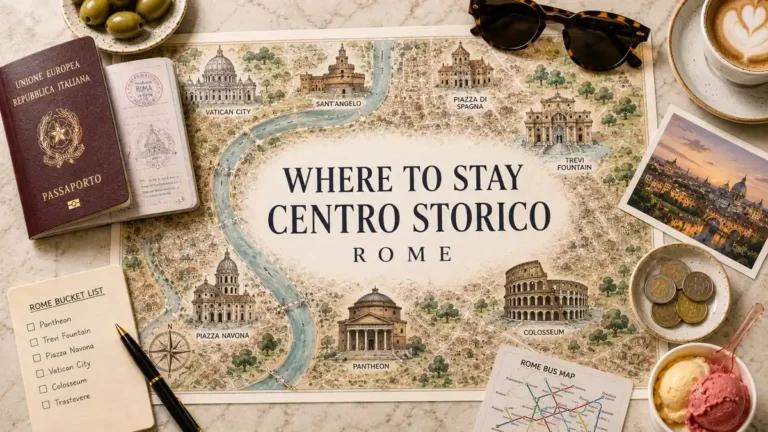
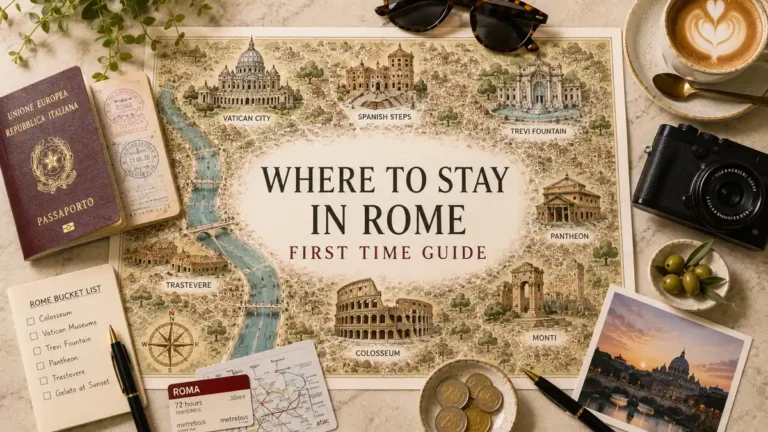
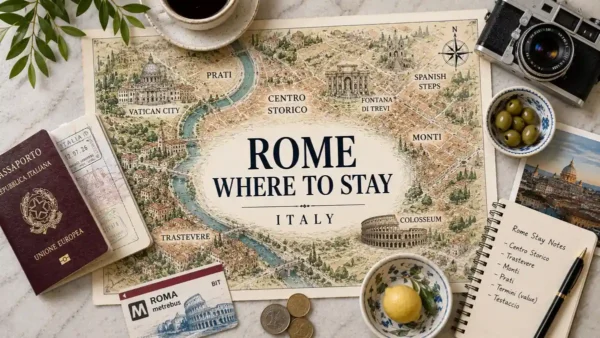
For a two-day trip, staying central pays off more than any other logistics choice — pick a base near the historic center so both arcs begin on foot. See where to stay in Rome for base options, and the broader Rome guide for planning beyond the route itself. Everything here assumes you sleep inside or beside the center; a base out by the airport quietly breaks the walkability the whole plan depends on.
Hotels and places to stay
Compare hotels, apartments and stays for your dates in one search.
Search hotels and stays on hotels.com →
Tripstou may earn a commission if you book through this link, at no extra cost to you.
Day 1: Ancient Rome and the Historic Center
Day 1 runs Ancient Rome in the morning and eases into the historic center by evening. You start at the Colosseum because it demands the freshest energy and the earliest timed entry, then drift north through the Forum into the city’s café-lined heart. The day ends across the river in Trastevere.
Morning — the ancient core. The Colosseum, Roman Forum, and Palatine Hill sit side by side and share one combined ticket, so you clear all three without leaving the archaeological zone. Book the Colosseum timed slot ahead of time; relying on walk-up entry is the itinerary’s biggest risk. Start early to beat both the crowds and the midday heat.
Afternoon — the historic center. A walk north brings you to the Pantheon, then Piazza Navona and the Trevi Fountain, clustered tightly enough to cover entirely on foot. These are the stops most people picture when they picture Rome. For fuller attraction depth beyond these anchors, see our guide to things to do in Rome.
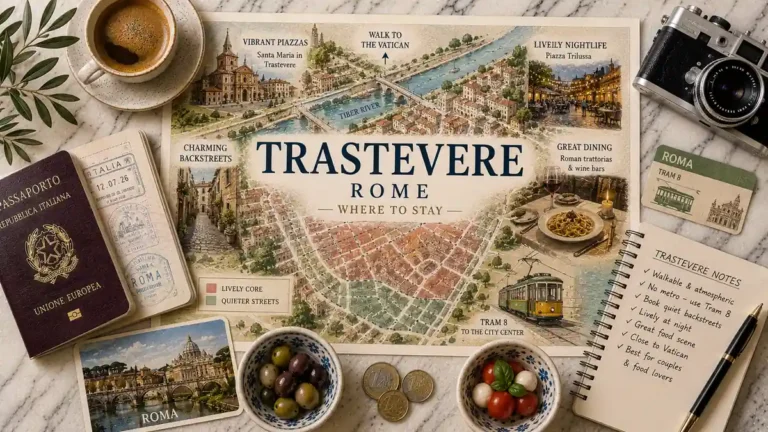
Evening — Trastevere. Cross the river for dinner in Trastevere, Rome’s most atmospheric evening quarter. It sits within walking distance of the center, so the day closes without a transfer.
Slotting the Trevi Fountain into the afternoon rather than a night-time detour is deliberate — it stands minutes from the Pantheon, and doubling back after dark costs you the one thing a two-day trip can’t spare.
Day 2: The Vatican and Northern Rome
Day 2 starts early at the Vatican, then works back east through northern Rome. The Vatican anchors the morning because its museums draw the longest lines and reward the first entry of the day. From St. Peter’s, the route curves through Castel Sant’Angelo toward the Spanish Steps and the northern center.
Morning — the Vatican. Move through the Vatican Museums to the Sistine Chapel, then into St. Peter’s Basilica — the standard one-way flow. Reserve museum entry in advance and arrive at opening. The Vatican Museums close on most Sundays (with the last Sunday of the month a free-entry exception), so confirm the day before you plan around it.
Afternoon — back into the city. A short walk delivers Castel Sant’Angelo on the river, then the Spanish Steps as you re-enter the shopping streets of the north. Neither needs long, and both fit the walk without a detour.
Evening — the northern center. Finish around Piazza del Popolo and the surrounding streets, an easy, flat stretch to close a museum-heavy day at a slower speed.
The Vatican and Colosseum land on opposite mornings for a reason: both open early, both bottleneck at the entrance, and stacking them on one day means queuing twice while the other half of Rome sits waiting.
How the Route Is Ordered to Avoid Backtracking
The order groups nearby sights so each day walks as one loop, not a series of crossings. Rome’s landmarks fall into tight geographic clusters, and the itinerary follows those clusters instead of chasing a ranked list. Every stop sits on the way to the next, so no leg retraces ground you already covered.
Day 1 moves in one direction. The ancient core sits in the southeast, the historic-center cluster lies just northwest of it, and Trastevere waits across the river — a steady westward drift, never a return trip. Day 2 mirrors the logic. The Vatican sits on the western edge, and everything after it — Castel Sant’Angelo, the Spanish Steps, Piazza del Popolo — lines up neatly on the walk back east.
This is why the sequence is fixed and not a menu. Swap the Vatican to the afternoon and you fight its longest lines; move Trevi to Day 2 and you cross the city for a single fountain. The order is the product, and it only holds up walked in one direction.
How to Adapt This Route With More or Fewer Days
Trim the historic-center loop first with less than two full days; add depth or a day trip with a third. The route is built to shrink or stretch from one core. Keep the ancient morning and the Vatican morning fixed — they are the non-negotiable anchors.
Both morning anchors hold at every length; only the middle of the day flexes.
| Time available | Core you keep | What changes |
|---|---|---|
| Under two full days | Both morning anchors only | Historic-center cluster drops to quick photo stops |
| A full two days | The complete route as written | Nothing — this is the target pace |
| Three days or more | Everything, walked slower | Room for depth or one nearby day trip |
With less than two full days:
- Cut the historic-center cluster first — the Pantheon, Piazza Navona, and Trevi survive as quick photo stops instead of lingering visits.
- Keep both morning anchors; a single half-day buys either the ancient core or the Vatican, but not both.
- Drop Trastevere and eat near the center to save the evening crossing.
With a third day:
- Add depth before you add distance — a slower Vatican, the Borghese Gallery, or a neighborhood you rushed past.
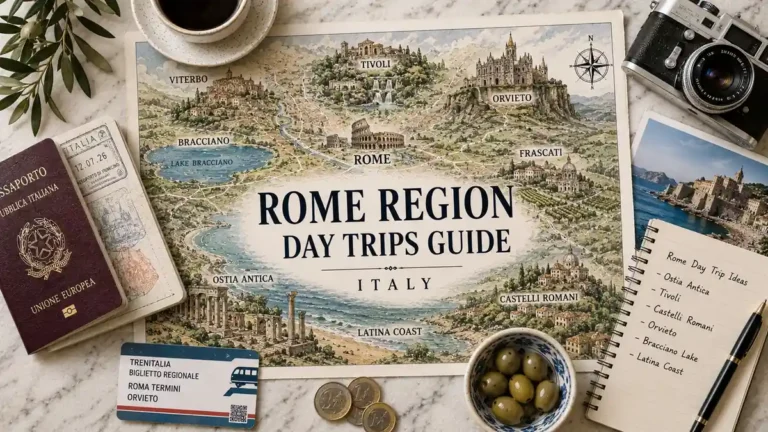
- Consider a day trip such as Tivoli or Ostia Antica only once the core two days are secure.
- For the full extra-day plan, follow the dedicated 3 days in Rome itinerary instead of stretching this one thin.
If Rome is one stop in a longer trip, slot these two days into a wider Italy itinerary and let the surrounding cities absorb the day trips. Budget tracks pace as much as nights — a tighter two days can cost less to run than a slow one; check the Rome trip cost breakdown before you lock plans.
The common third-day mistake is adding a fourth city instead of a slower Rome — the marginal Roman hour usually beats a rushed train to Florence you will barely remember.
Frequently Asked Questions
Do you need to book Colosseum and Vatican tickets in advance for a short trip?
Yes — on a two-day trip, advance booking is close to essential for both. Timed Colosseum entry and Vatican Museums slots sell out and walk-up lines can cost a full morning you cannot spare in 48 hours. Reserve each for its scheduled morning before you arrive to protect the route.
Can you do the Colosseum and the Vatican on the same day?
You can, but this route deliberately keeps them apart. Both open early and bottleneck at the entrance, so pairing them means queuing twice and abandoning half of Rome. Giving each its own morning — Colosseum on Day 1, Vatican on Day 2 — is what makes the walkable arcs hold together.
How much walking is a 2-day Rome itinerary?
Expect a lot — this is a walking itinerary by design, with each day covered largely on foot. The sights sit in tight clusters, so most legs are short strolls, not long hauls, but the days are full. Comfortable shoes matter, and you can shorten stretches with the occasional bus or metro hop.
Is 2 days in Rome too rushed to be worth it?
No — two days is well worth it, provided you accept a fast pace over slow lingering. You see the Colosseum, the Vatican, and the historic center in the right order without sprinting between them. Travelers who want long museum mornings or relaxed cafe afternoons will feel it as rushed and should add a day.
What should you skip with only 2 days in Rome?
Skip the second-tier museums and any out-of-center excursion first. The Borghese Gallery, Capitoline Museums, catacombs, and day trips like Ostia Antica or Tivoli all drop off a 48-hour plan. If time tightens further, treat the Pantheon, Piazza Navona, and Trevi as quick photo stops rather than lingering visits.
Is the Vatican open on Sundays?
The Vatican Museums close on most Sundays, with the last Sunday of the month a free-entry exception. St. Peter’s Basilica generally stays open, but hours shift around papal events. Because the museums anchor Day 2, confirm the exact day before you build your visit around it, and reserve entry ahead.
Related Guides
- Rome guide — the full planning hub for the city, beyond this route.
- 3 days in Rome — the extra-day plan when two days feels too tight.
- Things to do in Rome — deeper attraction and experience detail for each stop.
- Where to stay in Rome — choosing a central base that keeps the route walkable.
- Rome trip cost — what a short Rome trip actually costs to run.
- Italy itinerary — fitting Rome into a longer trip across the country.
Did this guide save you time or money? Tripstou is independent and reader-funded — if you'd like to give something back, you can support the site with a crypto contribution of any size.