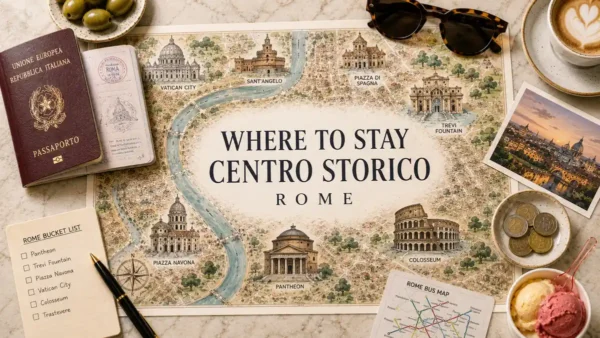
Choosing where to stay in Rome shapes your trip more than choosing a hotel. The city’s areas differ sharply in atmosphere, price, and convenience, so the same three nights feel completely different depending on your base. Stay in the historic core and the major sights are a walk away; pick a quieter district and you trade some convenience for calm and value. This guide resolves the stay decision fast. It gives a clear first-timer default, breaks down the three areas most visitors weigh, and maps each traveler type to the base that fits. It also settles the central-versus-quieter tradeoff and flags a few areas worth knowing and a couple to skip, then routes you to deeper neighborhood, itinerary, and hotel pages when you are ready to book.
Quick Answer
Centro Storico is the best overall base in Rome, especially for first-timers who want to walk to the sights. It is the most central choice but also the priciest and busiest. For more character, better value, and a livelier evening scene, Trastevere is the strongest alternative for a calmer, well-priced base.
Trust Layer
Tripstou stay guide for travelers choosing where to base. Covers area atmosphere, budget, convenience, noise, and traveler fit.
Produced with AI assistance and reviewed by Alex Perrut, working in tourism since 2015, for the Tripstou editorial team. See our editorial process for details.
Last factual review: July 12, 2026.
Official sources consulted: italia.it, enit.it.
Key Takeaways
- Centro Storico is the best all-round base for first-timers, putting the Pantheon, Navona, and Trevi within easy walking distance.
- A central base costs more and stays busier, but on short, sight-focused trips the saved walking time justifies the premium.
- Trastevere and Monti offer mid-range value and stronger local character, making them the best alternatives to the pricier historic core.
- Match your area to your trip type: couples lean Trastevere, families prefer Prati, and budget travelers do best near Monti’s edges.
- Choose your neighborhood before booking a hotel, and avoid basing right around Termini despite its cheaper rooms and transport links.
Table of Contents
Centro Storico: the best base for first-time visitors
Centro Storico is the best base for a first trip to Rome. The historic core around the Pantheon, Piazza Navona, and the Trevi Fountain puts the headline sights within walking distance, so you spend less time on transport and more on the city itself.
Staying here means Renaissance streets, floodlit fountains, and cafe-lined piazzas outside your door. Mornings are for espresso before the crowds arrive; evenings turn the same squares into open-air dining rooms. It is the most sensory, most postcard-Rome place to wake up, and the reason most first-timers never regret paying for the location.
Convenience is the real selling point. You can reach the Pantheon, Navona, Campo de’ Fiori, and the Trevi Fountain on foot, and the Colosseum and Vatican are short, direct trips. The core has fewer metro stops than you would expect, but here that barely matters, because the walkable radius already covers most of what you came to see.
Rooms sit at the high-end of Rome’s range. You pay a clear premium for the address, and mid-range doubles get smaller and dearer the closer you book to a named landmark. Budget beds exist but are scarce and fill early.
Best for: first-time visitors who want to walk to the sights.
Book a room a block or two off the main piazzas: you keep the walkable location but shed most of the late-night noise and the piazza-view markup that inflates the headline nightly rate. For a street-by-street breakdown of where to book, see the full Centro Storico area guide.
Trastevere: the best pick for atmosphere and dining
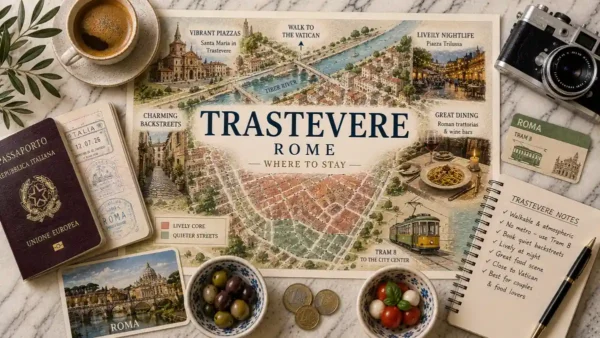
Trastevere is the best base for atmosphere and dining. Its cobbled lanes west of the Tiber stay calm and photogenic by day, then fill with diners and bars after dark, giving you a lively evening base at slightly better value than the historic core.
This is the neighborhood people picture when they picture “living like a Roman.” Ivy-draped facades, artisan workshops, and small piazzas define the day; trattorias and wine bars take over at night. The mood is bohemian and social, less monumental than the core but far more characterful than the areas around the station.
On convenience, Trastevere is a comfortable walk to the historic center across the river and sits close to the Gianicolo hill and Villa Farnesina. It has no metro of its own, so you lean on trams, buses, and your feet, which suits travelers who prefer wandering over point-to-point transit.
Prices land in the mid-range and generally beat the core for equivalent rooms, though weekend and summer demand narrows that gap. It rewards travelers who value character and food over a landmark on every corner.
Best for: travelers who want local character and evening dining.
Ask for a room facing an internal courtyard rather than the lane — the streets that make Trastevere fun past midnight are exactly the ones that keep light sleepers awake. If you are torn between this side of the river and the core, the Centro Storico vs Trastevere comparison settles it, and the full Trastevere area guide covers specific streets and stays.
Monti: the best local, walkable base near the Colosseum
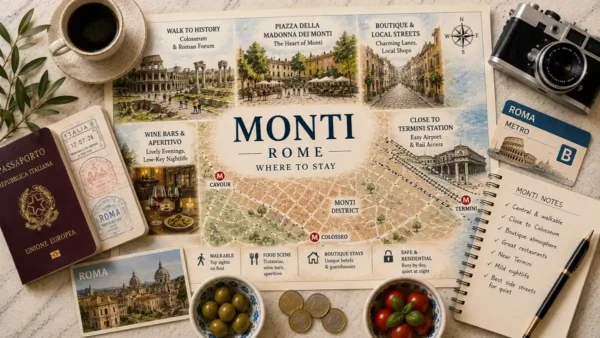
Monti is the best low-key central base in Rome. This stylish, village-like district sits between the Colosseum and Termini, staying walkable and well-connected while dodging the tourist churn of the core — a favorite of returning visitors who want a local feel.
Monti trades grand monuments for neighborhood texture: independent boutiques, vintage shops, natural-wine bars, and a young, design-minded crowd. It feels lived-in, with locals outnumbering visitors on most evenings. You are minutes from the Colosseum and the Forum yet insulated from the coach-tour crush that surrounds them.
Access is a genuine strength. Monti sits beside Termini, Rome’s main rail and metro hub, and close to the Cavour and Colosseo metro stops, making airport transfers and day trips easy. That connectivity, combined with a walk to the ancient sites, is why it wins for second and third visits.
Prices sit in the mid-range, broadly similar to Trastevere and below the deepest core. Value is good for the location, but the district is compact.
Best for: repeat visitors wanting a central but local base.
Monti’s catch is its size: it is small and books out early, so the rooms left near the Colosseum edge can cost more than a comparable stay deeper in the core. Weigh it against the ancient-Rome side in the Centro Storico vs Monti comparison, or read the full Monti area guide for specific blocks.
Best Areas by Traveler Type
The right Rome area depends on your trip type more than any ranking. First-timers, couples, families, night owls, budget travelers, and luxury seekers each have a base that fits best. The table below maps every traveler type to one area and the reason it works.
| Traveler type | Recommended base | Why it fits |
|---|---|---|
| First-time visitors | Centro Storico, the historic core | Walk to the Pantheon, Navona, and Trevi |
| Couples on a break | Trastevere or quiet Centro Storico | Romantic lanes and strong evening dining |
| Families with kids | Prati or residential Centro Storico | Calmer streets, space, and easy Vatican access |
| Night-out travelers | Trastevere or the Monti fringes | Bars and late dining within walking distance |
| Budget travelers | Monti edges or near Termini | Cheaper rooms with solid transport links |
| Luxury travelers | Centro Storico or the Spanish Steps | Grand hotels beside the designer shopping |
Families often do better one stop out than dead-center: the extra space and quiet usually beat the few minutes you lose reaching the Forum. Each base above has a dedicated guide with specific streets and stays, so route to the one that matches your trip:
- First-timers: where first-timers should stay in Rome.
- Couples: best areas for couples.
- Families: best areas for families.
- Nightlife: where to stay for nightlife.
- Budget: where to stay on a budget.
- Luxury: best areas for a luxury stay, with named picks in the luxury hotels roundup.
Hotels and places to stay
Compare hotels, apartments and stays for your dates in one search.
Search hotels and stays on hotels.com →
Tripstou may earn a commission if you book through this link, at no extra cost to you.
Is staying central worth the higher price?
Staying central is worth the higher price for short trips and first visits. A core base turns sightseeing into walking and frees you from timing metros, but you pay a premium and trade quiet for crowds. On longer stays, a quieter area often wins on value and calm.
The math is mostly about trip length and pace. On a two- or three-night trip built around the headline sights, a central room saves hours of transit and lets you drop bags between stops — time that easily justifies the higher nightly rate. Slow travelers and longer stays flip the calculation, because the daily premium compounds while the walking advantage matters less.
| Factor | Central base | Quieter area |
|---|---|---|
| Reaching the sights | Most sights on foot in minutes | Some metro or bus rides needed |
| Nightly price | High-end for the location premium | Mid-range to budget for similar rooms |
| Noise at night | Busier, with piazza and street noise | Calmer, easier for light sleepers |
| Daytime feel | Crowded and heavily touristed by day | More local, residential rhythm |
The break-even tends to land around your third full day: beyond that, the nightly premium of a core base usually outweighs the taxi and transit costs a quieter area adds. Short and sight-focused, stay central. Long and slow, base quieter and commute in.
Other areas worth knowing (and which to skip)
A few more Rome areas are worth a quick look, and a couple are better skipped as a base. Prati near the Vatican suits calm, upscale stays; the streets right around Termini trade convenience for a rougher, less charming setting that most first visitors should avoid.
Prati is orderly, elegant, and residential, with wide boulevards, good restaurants, and direct Vatican and metro access. It suits families and travelers who want quiet at a mid-range price and do not mind being a short ride from the historic center. The Vatican surrounds work the same way: convenient for an early Museums start, quieter after dark.
The blocks immediately around Termini are the main area to be cautious about as a base. Transport access is excellent, but the streets can feel scruffy and impersonal at night, and the atmosphere is a poor first impression of Rome. Choose a room a few streets toward Monti instead. Rome is a broadly safe city for visitors overall — for specifics, see the Rome safety guide — but for a first stay, prioritize a base that feels good to walk home to.
Frequently Asked Questions
How much does a hotel in Rome cost per night?
Rome hotel prices span a wide range by area and season. Central districts like Centro Storico sit at the high-end, Trastevere and Monti land mid-range, and the cheapest rooms cluster near Termini. Rates climb sharply during the spring and autumn peaks. For named high-end picks, see the luxury hotels roundup.
Is it better to stay near Termini or the historic center?
The historic center beats Termini for most first visits. Termini wins only on transport access and cheaper rooms, but its immediate streets feel scruffy after dark and make a weak first impression. Base in or near the historic core for atmosphere and walkability, and treat Termini as a value fallback.
Do you need to stay near a metro station in Rome?
No, you rarely need a metro station in Rome if you base centrally. The historic core, Trastevere, and Monti put most sights within walking distance, and buses or trams fill the gaps. Metro proximity matters more if you stay farther out or rely on it for airport and day-trip connections.
Is Trastevere too noisy to sleep in?
Yes, Trastevere gets lively and loud after dark, but only in the right spots. The nightlife concentrates around the central piazzas and main lanes, where music and diners run late. Book a stay a few streets out, or on an internal courtyard, and the neighborhood sleeps as quietly as anywhere central.
How far in advance should you book a hotel in Rome?
Book your Rome stay early, especially for spring and autumn travel. The best-value central rooms in Centro Storico, Trastevere, and compact Monti sell out first, and Monti’s small size means it fills earliest of all. Aim to reserve several months ahead for peak seasons, and lock a base before choosing a specific hotel.
Should you split your stay across two Rome neighborhoods?
For most trips, no — one central base is enough for Rome. The city’s core is compact and walkable, so a single well-placed neighborhood covers the main sights without the hassle of changing hotels. Splitting your stay only makes sense on longer visits where you want to sample two very different areas.
Related Guides
Once you have chosen a base, plan the rest of the trip around it:
- Rome travel guide — the full city hub for planning, transport, and sights.
- 2-day Rome itinerary — pair your base with a ready-made sightseeing plan.
Did this guide save you time or money? Tripstou is independent and reader-funded — if you'd like to give something back, you can support the site with a crypto contribution of any size.