
Arriving in Rome for the first time, you have no mental map of the city — and Rome does not hand you one easily. Its sights are scattered across an old, irregular center, its metro barely touches the historic core, and every neighborhood claims to be the place to stay. For a first visit, the base you choose shapes the whole trip. Pick well and you step out of your door into the Rome you came for; pick badly and you lose hours commuting past it. This guide skips the full catalogue of districts. It names one decisive base for first-timers, adds two strong alternatives for different priorities, and explains the walkability logic behind the choice — so you can book with confidence and spend your planning energy on the actual trip.
Quick Answer
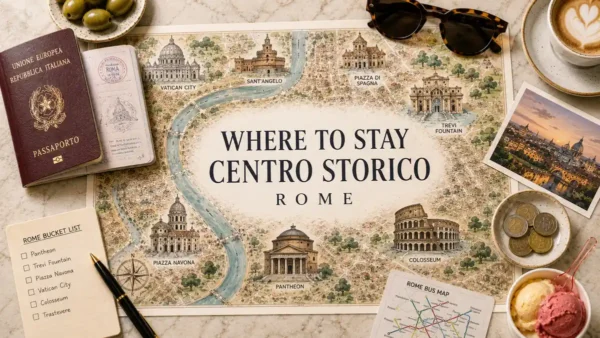
Stay in Centro Storico around the Pantheon and Piazza Navona — first-timers can walk to most major sights from here. The trade-off is price: central charm and walkability cost more per night. For a quieter, still-central base, choose Monti near the Colosseum, or Trastevere for atmosphere across the river.
Trust Layer
Tripstou stay guide for travelers choosing where to base. Covers area atmosphere, budget, convenience, noise, and traveler fit.
Produced with AI assistance and reviewed by Alex Perrut, working in tourism since 2015, for the Tripstou editorial team. See our editorial process for details.
Last factual review: July 12, 2026.
Official sources consulted: Italia.it, ENIT.
Key Takeaways
- Centro Storico around the Pantheon and Piazza Navona is the best first-timer base — you can walk to most major sights.
- Rome’s historic core sits between the metro lines, so a central base beats any transit pass for a short visit.
- Central walkability comes at a price — the Pantheon area runs high-end, and quieter districts often deliver better nightly value.
- Choose Monti for quiet evenings beside the Colosseum, or Trastevere for the richest atmosphere across the river.
- The common first-timer mistake is basing far out or near Termini to save money, then losing hours commuting back in.
Table of Contents
Centro Storico is the best base for a first visit to Rome
Centro Storico is the best base for a first visit to Rome. This historic core around the Pantheon and Piazza Navona puts you within walking distance of the Trevi Fountain, the Spanish Steps, and Campo de’ Fiori. For a first trip, waking up inside the old city beats commuting into it.
The atmosphere is the reason people fall for Rome. Baroque squares, fountains, and honey-colored facades sit at the end of nearly every lane, and the streetscape looks the part at breakfast and at midnight alike. It is busy and touristed, but that energy is exactly what most first-timers travel to feel.
Convenience is the practical case. From a Pantheon-area base you can reach the Vatican, the Colosseum, and the main piazzas on foot or with one short hop, which removes almost all transport planning from your day. The deeper street-by-street picture lives on our Centro Storico neighbourhood guide.
On price, this is the high-end end of the city. Central location and heritage buildings push nightly rates above quieter districts, and value-hunters will find more room elsewhere. You pay for the address — and for a first visit, that address does a lot of work.
The overlooked advantage of a Pantheon-area base is the midday reset. You can drop your bags, escape the afternoon heat or the crowds for an hour, and head straight back out — something no outlying neighborhood makes easy.
Best for: first-timers who want to walk to every major sight and stay inside the postcard.
Monti: quiet, central, and next to the Colosseum
Monti suits first-timers who want a calmer base without leaving the center. This residential quarter sits just north of the Colosseum and Roman Forum, so the ancient core stays within an easy walk. You trade some headline-sight density for quieter evenings and a more local, lived-in feel.
Monti reads as a neighborhood people actually live in. Wine bars, artisan shops, and small trattorias fill its sloping lanes, and evenings stay relaxed instead of tipping into tourist bustle. It is central without feeling like a thoroughfare.
For sightseeing, the location leans toward ancient Rome. The Colosseum, Forum, and Palatine are the closest headline sights, while the Pantheon side of the center is a slightly longer stroll. See the full breakdown on our Monti guide, or weigh the two head-to-head on Centro Storico vs Monti.
On price, Monti usually sits mid-range and often lands better value than the Pantheon core for similar centrality. You are paying for a real neighborhood rather than a monument view.
Best for: first-timers who want quiet evenings beside the ancient core.
Trastevere: charm across the river, but is it too far from the sights?
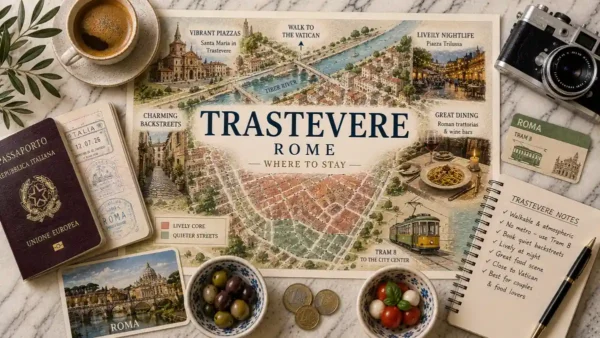
Trastevere delivers Rome’s richest evening atmosphere, but it sits across the river from the ancient sights. Cobbled lanes, trattorias, and nightlife make it the city’s liveliest quarter after dark. The catch is distance: reaching the Colosseum or Forum means a longer walk or a short tram ride.
By day, Trastevere is quiet and photogenic; by night, it fills with diners and locals and becomes the social heart of the city. That rhythm is its whole appeal, and it is a different Rome from the monument-lined center. The full picture is on our Trastevere guide.
The distance question is the real decision here, and it is genuinely two-sided — closer nightlife against a longer daily walk to the classical sights. We keep that verdict light on this page and resolve it in full on Centro Storico vs Trastevere.
Trastevere’s distance only bites in the morning, not at night. You walk out into its best hours, then walk back toward the ruins the next day — so first-timers who front-load sightseeing feel the gap more than late risers do.
On price, expect mid-range to high-end depending on the street, with the liveliest corners commanding more. Best for: first-timers who put evening character above walk-to-everything convenience.
How walkable is central Rome from the historic center?
Central Rome is highly walkable, and for a first visit that matters more than metro access. The historic core packs most headline sights into a compact, pedestrian-friendly zone, so a central base beats relying on trains. From the Pantheon, much of what you came to see is a stroll away.
Rome’s historic center was never rebuilt around cars or a subway. The two main metro lines skirt the old core to protect the ruins beneath it and meet only at Termini, which means the most famous sights often have no station nearby. Walking is not the fallback here — it is the fastest way to move.
Rome punishes the metro-first instinct many first-timers arrive with. Because the lines miss the historic core, a central base does more for your feet than any transit pass, and it removes the daily friction of working out routes. For the wider city picture and transport context, see our Rome travel guide.
The practical takeaway is simple. Base centrally and you convert transport time into sightseeing time, which for a short first trip is the difference that counts.
Which Rome area fits your first visit
Centro Storico fits most first-timers, but the right area depends on your top priority. If you want to walk to everything, base in the historic core; if you want atmosphere, cross to Trastevere; if you want quiet nights near the ruins, choose Monti. Match the area to what you value most.
Use the scan below to map your main priority to a single area. Each row answers one first-visit question, so you can settle the choice at a glance and move on to booking.
| Your top priority | Best area | Why it fits |
|---|---|---|
| Walk to every major sight | Centro Storico (historic core) | Central to the Pantheon, Trevi, and Navona |
| Evening atmosphere and dining | Trastevere (across the river) | Liveliest lanes and trattorias after dark |
| Quiet nights near the ruins | Monti (beside the Colosseum) | Residential streets a walk from the Forum |
| First trip, no strong preference | Centro Storico (historic core) | Safest default for walkable, central convenience |
If you want the exhaustive area landscape beyond these three, our full guide to where to stay in Rome maps every district. For a first visit, though, the shortlist above resolves the decision for nearly everyone.
Hotels and places to stay
Compare hotels, apartments and stays for your dates in one search.
Search hotels and stays on hotels.com →
Tripstou may earn a commission if you book through this link, at no extra cost to you.
Other Rome areas worth knowing
A few other Rome areas can work for specific first-timers, but they sit below the core picks. Prati, the Spanish Steps area, and the streets around Termini each suit a particular need, yet none beats Centro Storico, Monti, or Trastevere as a default first base. Treat them as situational choices.
- Prati: orderly, upscale, and handy for the Vatican, but it trades some of the old-city magic for calmer, more modern streets.
- Spanish Steps area: elegant and central for shopping and the Trevi–Spanish Steps circuit, though it leans expensive and polished rather than characterful.
- Termini vicinity: the cheapest and best-connected option, but busier and less charming — fine for a quick stopover, not the reason you came to Rome.
If your priority is a top-tier hotel over the area itself, the highest-end properties cluster across several central districts. Our guide to luxury hotels in Rome covers those directly.
Frequently Asked Questions
Is it safe to stay near Termini station?
Yes, staying near Termini is generally safe, though it feels busier and less polished than the historic core. The area is well-connected and cheaper, but pickpocketing around the station and transit hubs is more common, so stay alert with valuables. For a first visit, most travelers prefer a more central, characterful base.
How many nights do first-timers need in Rome?
First-timers need three to four nights to see Rome’s headline sights without rushing. Two nights covers the essentials — the Colosseum, Vatican, and the historic center — but feels tight. Three to four nights lets you add slower mornings and a neighborhood or two. Five or more suits day trips beyond the city.
Do I need to use the metro if I stay in the center?
No, if you stay in the historic center you can reach most major sights on foot. Rome’s metro skirts the old core, so walking is usually faster for first-timer landmarks. You may want the metro or a bus for the Vatican or longer hops, but daily sightseeing rarely requires it.
Is Centro Storico too noisy for a first visit?
Centro Storico can be lively at night, but it is rarely too noisy for a first visit. Busy squares and restaurant streets carry sound, so light sleepers should book a room on a quiet lane or courtyard. Most first-timers find the nighttime energy part of the appeal, not a drawback.
Can you walk from the Pantheon to the Colosseum?
Yes, you can walk from the Pantheon to the Colosseum in well under an hour, passing Piazza Venezia and the Forum along the way. It is one of Rome’s most scenic strolls, mostly flat and easy. This walkability is exactly why a central base works so well for first-timers.
Is the Spanish Steps area a good first-timer base?
The Spanish Steps area is a good but pricey first-timer base, strong for central walkability and shopping. It sits within reach of the Trevi Fountain and the historic core, yet feels more elegant and polished than characterful. For most first visits, Centro Storico offers similar centrality with more classic Rome atmosphere.
Related Guides
- Centro Storico neighbourhood guide
- Trastevere neighbourhood guide
- Monti neighbourhood guide
- Where to stay in Rome
- Centro Storico vs Trastevere
- Centro Storico vs Monti
- Luxury hotels in Rome
- Rome travel guide
Did this guide save you time or money? Tripstou is independent and reader-funded — if you'd like to give something back, you can support the site with a crypto contribution of any size.