Planning a Rome trip comes down to one question: what will it actually cost, and how do you size a budget you can trust? This guide answers that in one place — a realistic daily figure, a total for a short city break, a category-by-category split, and the levers that cut the bill. Every number here is given as a credible range, not a false-precise price tag, because what you pay swings with two things above all: how you travel and when you go. A backpacker sharing a hostel dorm and a couple booking a boutique hotel are budgeting for different trips in the same city. Below you will find per-day and per-trip costs, where the money goes, three worked spending tiers, and the mandatory extras — tourist tax and monument booking fees — that many first-time visitors forget until checkout.
Quick Answer
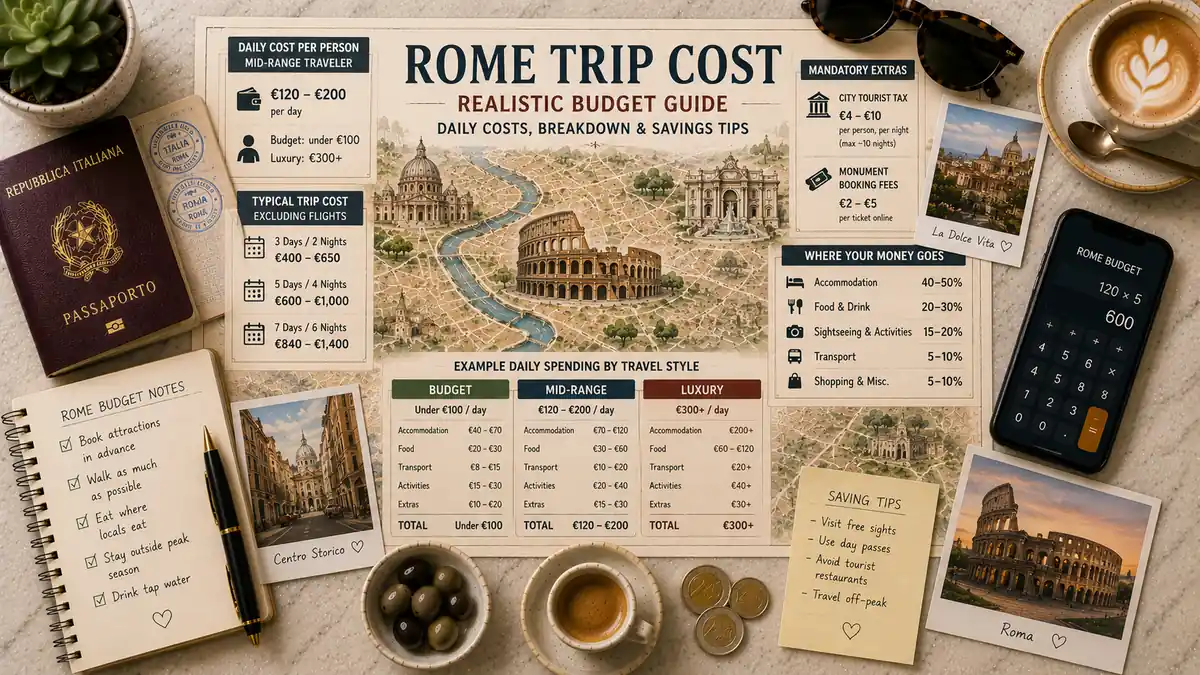
A Rome trip costs most mid-range travelers roughly €120–€200 per person per day. Budget visitors can manage on far less, while luxury stays run well above that range. Travel style and season move the number most, with accommodation the biggest lever. Plan a daily figure, multiply by nights, then add mandatory tourist tax and monument booking fees.
Trust Layer
Tripstou planning guide for travelers resolving one travel decision. Covers the main variable, traveler context, and practical tradeoffs.
Produced with AI assistance and reviewed by Alex Perrut, working in tourism since 2015, for the Tripstou editorial team. See our editorial process for details.
Last factual review: July 15, 2026.
Official sources consulted: Italia.it, ENIT.
Key Takeaways
- Budget on roughly €120–€200 per person per day for a mid-range Rome trip, with budget travelers spending less and luxury far more.
- A typical three-day mid-range visit runs about €400–€650 per person before flights, since costs scale with nights, not days.
- Accommodation is the largest line at 40–50% of a mid-range budget, so your hotel choice sets most of your daily spend.
- Two mandatory extras — a nightly city tourist tax and online monument booking fees — add small but unavoidable costs across your stay.
- Shifting your dates to winter or shoulder season cuts room rates most, the highest-impact lever for lowering a Rome budget.
Table of Contents
How Much Does a Rome Trip Cost per Day?
A Rome trip costs most mid-range travelers about €120–€200 per person per day. That covers a comfortable hotel room share, two or three meals out, public transport, and one or two paid attractions. Budget travelers spend less by trimming accommodation and eating casually; luxury visitors spend well above it on hotels and dining.
Those per-day ranges assume two people splitting a double room. Solo travelers pay more per head. Accommodation is a fixed cost that does not halve when you travel alone, so a couple sharing one room pays once for the priciest line and divides it two ways.
Treat the daily figure as a planning anchor, then stress-test it against your own habits. Two sit-down dinners a day pushes food toward the top of its band; a market picnic or a slice from a pizzeria al taglio keeps it near the floor. Verify current prices before booking. Rome’s ranges shift with season and demand, and a spring weekend prices differently from a quiet winter weekday.
Is Rome Expensive for Tourists?
Rome is moderately expensive — pricier than southern Italian cities, but generally cheaper than Paris, London, or Venice. The main cost drivers are central accommodation and paid attractions, not everyday food. You can eat and get around affordably here; where the budget climbs is the hotel and the queue-skipping monument tickets.
The comparison that matters for budgeting is Rome against the rest of Italy. Rome and Venice sit at the top of the country’s price ladder, while Naples, Bologna, and much of the south cost noticeably less for a similar trip. For the national picture and how other cities compare, see our Italy trip cost guide.
What makes Rome feel expensive is concentration. The sights you came for — the Colosseum, the Vatican, the Roman Forum — pack paid tickets and timed-entry fees into a few dense days, so attraction spending peaks at the same time as central-hotel rates. The trap is timing. Spread the big-ticket monuments across your stay, lean on the city’s many free sights, and Rome settles comfortably into the mid-range.
What Does a Rome Trip Cost by Category?
A Rome trip splits across five main categories: accommodation, food, attractions, local transport, and mandatory fees. Accommodation takes the largest share — typically 40–50% of a mid-range budget — followed by food and paid attractions. Local transport is cheap; tourist tax and monument booking fees are small but unavoidable lines.
Ranges are per person per day; verify current prices before booking.
| Category | Typical range per day | What it covers |
|---|---|---|
| Accommodation | Around €25–€110 per person | Hostel dorm up to a central three-star double, split |
| Food and drink | Around €20–€70 per person | Market breakfasts and casual lunches to restaurant dinners |
| Attractions and tours | Around €0–€50 per person | Free churches and piazzas to major monument tickets |
| Local transport | Around €0–€15 per person | Walking the center or a daily metro-and-bus pass |
| Tourist tax and fees | Around €4–€12 per person | Nightly city tax plus online monument booking surcharges |
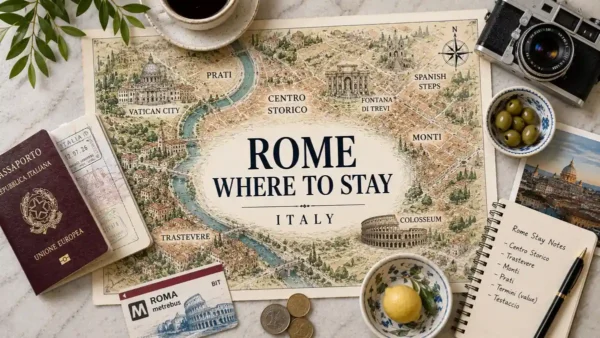
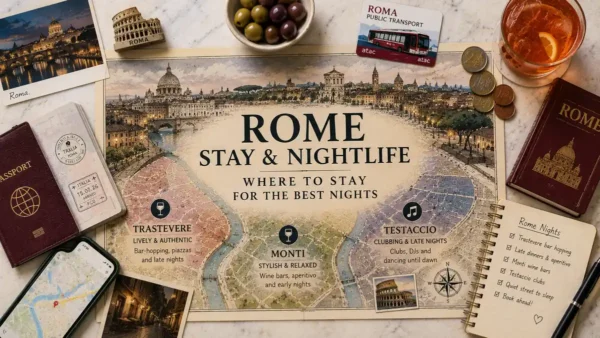
Accommodation and food together account for most of what you will spend, so those two categories deserve the closest look when you set a budget. Where you base yourself shifts the accommodation line the most; for the neighborhood tradeoffs behind those price bands, see where to stay in Rome.
Local transport is one of Rome’s genuine bargains. A single ticket covers most metro and bus rides, and daily or multi-day passes cap the cost if you ride often — though the historic center is compact enough that many visitors never buy a pass at all. For fare mechanics and pass options, see getting around Rome. Getting in from the airport is a separate, larger line: budget for a train, shuttle, or taxi covered in our Rome airport transfer guide.
Two mandatory cost lines are easy to miss. Rome charges a nightly city tourist tax per person, banded by hotel class, and the major monuments add a small fee to book tickets online. Both are small per unit, but they add up across a multi-night stay — exact current amounts are in the FAQ below.
How Much Is Accommodation per Night in Rome?
A hotel night in Rome typically runs €90–€200 for a central mid-range double, or roughly €45–€100 per person sharing. Hostel dorm beds cost far less; four- and five-star hotels cost considerably more. Rates climb in spring and autumn and around holidays, and central locations command a premium over neighborhoods a short metro ride out.
Hotels and places to stay
Compare hotels, apartments and stays for your dates in one search.
Search hotels and stays on hotels.com →
Tripstou may earn a commission if you book through this link, at no extra cost to you.
Budget, Mid-Range and Luxury: Daily Budget by Travel Style
Rome runs on three daily-budget tiers: roughly €60–€90 budget, €120–€200 mid-range, and €300 or more for luxury, per person. Each tier mainly reflects your hotel and how you eat. The gap between tiers is driven far more by accommodation and dining choices than by the sights, which cost everyone about the same.
Per person, per day, excluding flights; treat as ranges and verify before booking.
| Travel style | Daily budget per person | Accommodation | Food and sights |
|---|---|---|---|
| Budget | Around €60–€90 per person | Hostel dorm or shared budget room | Street food, markets, mostly free sights |
| Mid-range | Around €120–€200 per person | Central three-star hotel, double shared | Restaurant meals plus paid monument tickets |
| Luxury | Around €300 or more | Four- or five-star or boutique hotel | Fine dining and private guided tours |
The tiers are not rigid — most travelers mix them, splurging on one restaurant dinner while keeping breakfast to a corner-bar cappuccino and cornetto. The useful move is to pick a tier for your hotel first, since that decision locks in the largest share of your daily spend, then flex food and attractions around it.
Jumping from budget to mid-range in Rome buys comfort and location more than it buys better sightseeing — the Colosseum ticket is identical whichever hotel you sleep in. That is why a more central room is often the upgrade that returns the most experience per euro, turning transport time into walking time. Location beats luxury here.
How Much Does 3 Days in Rome Cost?
Three days in Rome costs a mid-range traveler roughly €400–€650 per person, excluding flights. That figure is your daily budget multiplied by nights, plus the mandatory extras — tourist tax and any monument booking fees. Budget travelers can do the same trip for less; luxury visitors will spend well beyond it.
The math is straightforward: take a mid-range day at €120–€200, count two or three nights, and add the fixed extras. A two-night, three-day weekend lands lower than a three-night stay, since accommodation and tax scale with nights, not days on the ground. Nights drive the total. This is a costing unit, not a schedule — for how to actually sequence those days, see our 2 days in Rome and 3 days in Rome guides.
One quirk of a short Rome trip: your fixed costs land in a tight window, so the first two days carry the heaviest attraction spend as you tick off the Colosseum and Vatican. Add a day and the daily average often falls, because the extra time gets spent on free piazzas, parks, and neighborhoods instead of more paid tickets.
How Can You Visit Rome on a Budget?
The biggest savings come from three levers: shoulder-season timing, a central base you can walk, and free sights. Accommodation timing moves your budget the most, so shifting your dates is the highest-impact change you control. Rome’s free churches, piazzas, and parks then fill an itinerary at little or no cost.
The highest-impact moves, roughly in order:
- Travel in shoulder or low season. Room rates fall noticeably outside the spring and autumn peaks, and winter away from the holidays is cheapest of all.
- Stay central and walk. A room inside the historic center turns most sightseeing into free walking and cuts the transport line to near zero.
- Build around free sights. The Pantheon, most churches, the piazzas, Trastevere, and the parks cost nothing; save paid tickets for the monuments you truly want.
- Eat where Romans eat. A standing espresso, a pizza al taglio slice, or a market lunch costs a fraction of a sit-down tourist-strip meal.
- Book monument tickets direct and early. Official sites carry the smallest booking fee; third-party resellers and last-minute skip-the-line tours cost far more.
One caveat worth pricing in: passes are not automatic savings. A Roma Pass or combined ticket only pays off if you visit enough included sights to clear its cost, so do the arithmetic against your actual shortlist before buying. For more practical savings and etiquette that keep costs down, see our Rome travel tips.
When Is the Cheapest Time to Visit Rome?
Rome is cheapest in winter, roughly November through March, excluding the Christmas and New Year holidays. Accommodation prices drop most in this window — often 20–40% below the spring and autumn peaks — because demand falls with the colder, quieter weather. You trade some daylight and warmth for markedly lower room rates and thinner crowds.
Prices in Rome track demand, and demand tracks weather and school holidays. Cold weeks are cheap. The peaks are spring and early autumn, when mild weather draws the largest crowds and hotels charge accordingly; midsummer stays busy despite the heat. The clearest savings sit in the cold, low-season weeks when rooms compete for fewer visitors.
Shoulder-season edges — late autumn and the first weeks of spring — often hit the sweet spot: rates ease off the peak while the weather stays workable. If your goal is the lowest possible cost, aim for a winter weekday away from any holiday. If you want a balance of price and comfort, target the shoulder weeks instead of the summer and spring peaks.
Frequently Asked Questions
How much is Rome’s city tourist tax?
Rome’s city tourist tax runs roughly €4–€10 per person per night, scaled by your hotel’s star rating, and is typically capped at around ten consecutive nights. Higher-class hotels charge the top of the band. You usually pay it directly at the property, in cash or on your bill, separate from the room rate.
How much money should you bring to Rome for a week?
For a week in Rome, budget roughly €840–€1,400 per person as a mid-range traveler, excluding flights. That is your daily range of €120–€200 multiplied across seven days, plus tourist tax and any monument booking fees. Budget travelers can manage on far less; luxury visitors should plan well above it.
What is the average cost of food and meals in Rome?
Expect roughly €20–€70 per person per day for food in Rome, depending on where you eat. A standing espresso and a pizza al taglio slice cost little, a casual trattoria lunch sits mid-range, and a sit-down restaurant dinner pushes the top of the band. Eating where Romans eat keeps the daily food line low.
Do you have to pay to book the Colosseum online?
Yes, booking major Rome monuments online usually adds a small reservation fee on top of the ticket price. The Colosseum, Roman Forum, and Palatine share a timed-entry ticket that carries this surcharge, and official sites charge the smallest fee. Third-party resellers and skip-the-line tours cost considerably more for the same entry.
What is the biggest expense on a Rome trip?
Accommodation is the biggest expense on a Rome trip, typically 40–50% of a mid-range daily budget. Central hotels command a premium, and rates climb sharply in spring, autumn, and around holidays. Because a room is a fixed cost that solo travelers pay in full, where and when you sleep drives the total more than anything else.
Is Rome expensive for a weekend trip?
A weekend in Rome is moderately expensive: budget roughly €250–€450 per person for two nights as a mid-range traveler, excluding flights. Short trips concentrate the priciest lines — central accommodation and headline monument tickets — into a tight window. Traveling off-peak and walking a central base keeps a weekend affordable without cutting the main sights.
Related Guides
Keep planning your Rome trip with these related guides:
- Rome travel guide — the full city overview and where this cost guide fits.
- Where to stay in Rome — neighborhoods and price bands behind the accommodation line.
- 2 days in Rome — how to sequence a short weekend visit.
- 3 days in Rome — a fuller three-day plan for first-timers.
- Getting around Rome — fares, passes, and how the transport line works.
- Rome airport transfer — routes and costs from Fiumicino and Ciampino.
- Rome travel tips — practical savings and etiquette on the ground.
- Italy trip cost — the national budget picture and how other cities compare.
Did this guide save you time or money? Tripstou is independent and reader-funded — if you'd like to give something back, you can support the site with a crypto contribution of any size.