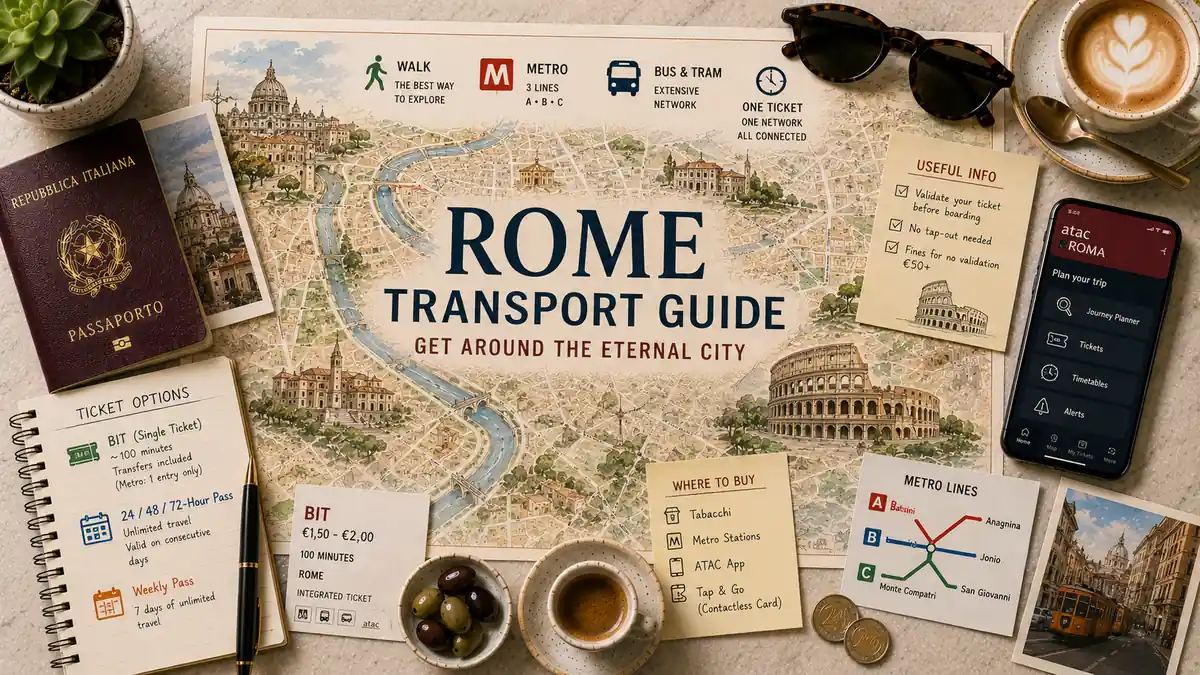
Moving around Rome comes down to two decisions: how you will physically cross the city, and which ticket makes sense for the way you travel. The good news is that Rome keeps both simple. One integrated ATAC network carries the metro, buses, trams, and urban rail on a single ticket, and the historic core is compact enough that walking handles most sightseeing on its own. That leaves a small, clear question — singles or a pass, and where to buy them. This guide gives you the mode-and-ticket answer in one place: how to combine walking with the metro and buses, what each line and ticket actually does, and how to read the fares when different sources quote different numbers. You will also find a single ticket comparison to settle the buy decision. It stays focused on getting around the city itself — not reaching Rome from the airport, and not leaving it by train.
Quick Answer
Rome’s historic core is best on foot; one integrated ATAC ticket covers the metro, buses, and trams. How many rides and days you travel decides between a single BIT, a 24/48/72-hour pass, or weekly. Most short-stay visitors walk and add a day pass on transit-heavy days, buying at tabacchi, machines, the app, or tapping contactless.
Trust Layer
Tripstou planning guide for travelers resolving one travel decision. Covers the main variable, traveler context, and practical tradeoffs.
Produced with AI assistance and reviewed by Alex Perrut, working in tourism since 2015, for the Tripstou editorial team. See our editorial process for details.
Last factual review: July 15, 2026.
Official sources consulted: italia.it, enit.it.
Key Takeaways
- One integrated ATAC ticket covers Rome’s metro, buses, trams, and urban rail, so duration — not mode — is your only real ticket decision.
- Rome’s historic core is walk-first: the metro skips the Pantheon, Trevi, and Piazza Navona, so comfortable shoes matter more than any pass.
- Choose singles when you walk most of the day, and a day pass only once you take three or more rides.
- Buy tickets at tabacchi, station machines, or the ATAC app, or tap a contactless card on much of the network.
- Validate every ticket at the start of each ride, since an unstamped ticket risks an on-the-spot fine well above the fare.
- Rome’s fares shift and sources disagree, so treat every published price as a range and confirm it before you buy.
Table of Contents
How do you get around Rome?
You get around Rome on one integrated ATAC network — metro, bus, tram, and urban rail — plus walking. A single ticket works across all of these public modes, and the compact historic core is genuinely best on foot. This page covers moving within the city, not arriving or leaving.
The network is deliberately integrated: your ticket does not care whether you ride the metro, hop a bus, or take a tram, so you rarely need to plan around modes. In practice most visitors mix two things — walking the centre, and using the metro or a bus for longer hops to the Vatican, Termini, or the Colosseum. If you are planning the wider trip, the Rome travel guide sets the broader context. One boundary worth stating up front: getting from Rome’s airport to the city is a separate journey with its own tickets and is not covered here.
Is Rome walkable?
Yes — Rome’s historic core is compact, flat enough, and best explored on foot. The Pantheon, Trevi Fountain, Piazza Navona, and the Colosseum area sit within a walkable cluster the metro barely touches. For most sightseeing days, walking is faster and more pleasant than descending into the network for a short hop.
Between the Pantheon, Trevi, and Piazza Navona there is no metro station at all — here walking is not the scenic choice, it is the only direct one. How much you walk still depends heavily on where you sleep. A base inside the historic centre or near the Colosseum can turn most days into walking days, while staying out past Termini leans you onto the metro and buses. Choosing where to stay in Rome effectively sets your daily transport mix. Comfortable shoes matter more than any pass on a centre-heavy trip; the cobblestones are the real terrain, not the hills.
What do Rome’s metro lines (A, B, C) actually reach?
Rome’s metro runs three lines — A, B/B1, and C — that connect major hubs but skip much of the historic centre. Line A serves the Vatican and Spanish Steps side, Line B reaches the Colosseum and Termini, and Line C runs across the eastern districts. Termini is the main interchange between A and B.
The practical takeaway is what the metro misses: the Pantheon, Trevi, Piazza Navona, and Campo de’ Fiori have no nearby station, which is exactly why the centre stays walk-first. Line A is the one most visitors actually use, linking the Vatican area to the Spanish Steps and on to Termini. Line C is newer and still being extended, so treat its central reach as evolving — check the current map rather than assume a stop exists. For crossing between the Vatican and the Colosseum, changing lines at Termini is usually the cleanest metro route.
How do Rome’s buses and trams work?
Buses and trams run on the same ATAC ticket as the metro and reach the places the metro cannot. They thread through the historic centre and cross the river where no line goes, making them the practical way to reach spots like Trastevere. You are expected to tap or validate on board as you enter.
Buses cover far more of the map than the metro, which is why a short bus hop often beats a long walk after a full sightseeing day. Trams are fewer but useful on specific corridors, including routes toward Trastevere and the southern districts. Service thins after dark. Daytime frequencies are good on core routes, then a smaller night-bus network takes over in the small hours — treat late-night timings as approximate and check the stop or app. Validate every time; a bus ride on an unstamped ticket counts the same as no ticket at all.
Rome transport tickets: single, day pass, and weekly options
Rome sells one integrated ticket family valid across metro, bus, tram, and urban rail. The ladder runs from a single BIT — one journey within a set time window — up through 24, 48, and 72-hour passes to a weekly CIS. All of them work on every ATAC mode, so the only real question is duration, not which network.
The BIT is the one to understand first. It is time-based, not per-boarding: within its window you can transfer between buses and the metro freely, and it simply expires by the clock. The passes then trade a higher upfront price for unlimited rides across a fixed number of hours or days. The table below sets the ladder side by side, with prices as ranges because published fares disagree.
Fares differ between ATAC and third-party listings and change over time — treat every figure as a range and confirm the current price before you buy.
| Ticket type | Validity | Typical price (verify) | Best suited to |
|---|---|---|---|
| Single BIT | One trip within a short time window | around €1.50–€2 (verify) | occasional single hops on foot-first days |
| 24-hour pass | Unlimited rides for 24 hours | roughly €7–€8.50 (verify) | one transit-heavy sightseeing day |
| 48-hour pass | Unlimited rides for 48 hours | roughly €12.50–€15 (verify) | two active days using the network |
| 72-hour pass | Unlimited rides for 72 hours | roughly €18–€22 (verify) | three days riding several times daily |
| Weekly CIS | Unlimited rides for seven days | roughly €24–€28 (verify) | longer stays or near-daily commuters |
Because the figures move, use the ranges to compare tiers rather than to budget to the cent. What stays stable is the shape of the ladder: each step up buys more time, not more coverage.
Which Rome transport ticket should you buy?
Buy singles if you walk most of the day; switch to a day pass at three or more rides. Most short-stay visitors on a walking-heavy trip come out cheapest on singles, topped up with a 24 or 48-hour pass on museum-hopping days. Longer stays favour a weekly.
A day pass only pays off once you take three or more rides in a single day — and because the centre is so walkable, plenty of visitors never reach that on their sightseeing days. That is the whole break-even calculation. Ticket choice also tracks trip length and pace: across a 2-day Rome itinerary, many people find that one 48-hour pass on the busier day plus a couple of singles beats buying passes for both days.
The Roma Pass includes public transport for its validity, so it can double as a travel pass — but judge it on the whole package, not the rides alone. Its value comes mainly from museum entries and skip-the-line access; the transport is a bonus, not the reason to buy. If you would walk most of the time anyway, the transport portion rarely justifies the price on its own.
Tours and activities
Book skip-the-line tickets, day trips and local tours with free cancellation on most activities.
You can also browse everything on getyourguide.com.
Tripstou may earn a commission if you book through this link, at no extra cost to you.
Where to buy tickets, tap-and-go, and validation
Buy Rome transport tickets at tabacchi, station vending machines, or the official ATAC app, or tap a contactless card. Whichever you choose, you must validate: stamp or tap at the start of every ride. An unvalidated ticket is treated as no ticket if inspectors check.
Tabacchi — the small tobacco shops marked with a blue-and-white “T” — are the everyday option, and they are often faster than queuing at a machine. Station machines and the ATAC app cover you when no shop is open. One boundary: these tickets are for city transport only. Leaving Rome by intercity or high-speed service is a separate system, covered in travelling Italy by train.
Can you tap and pay with contactless in Rome?
Yes — you can tap a contactless bank card or phone to pay on much of Rome’s network, including metro gates and many buses. Coverage has been expanding but is not universal, so carry a backup ticket for routes or vehicles where the reader is not working. Each tap generally charges the single-fare equivalent; verify current terms.
Do you have to validate your ticket (and what’s the fine)?
Yes — you must validate every ticket at the start of each journey, and skipping it risks an on-the-spot fine. Stamp paper tickets in the machine on board buses and trams; metro tickets validate at the gates. Penalties run well above the fare, typically in the tens of euros — verify the current amount before you risk it.
Frequently Asked Questions
How much is a single Rome metro or bus ticket?
A single BIT ticket costs roughly €1.50–€2, though published fares differ between ATAC and third-party listings, so verify the current price. The same flat fare applies whether you ride the metro, a bus, or a tram, and it lets you transfer freely within a set time window.
How long is a Rome BIT ticket valid?
A Rome BIT is valid for roughly 100 minutes from validation, though the exact window can change, so confirm the current figure. Within that time you can transfer between buses and trams as often as you like, but the metro is usually limited to a single entry.
Can you buy Rome transport tickets in advance or online?
Yes — you can buy Rome transport tickets ahead of time through the official ATAC app or at station machines, and paper singles stay unstamped until you validate them. There is no need to pre-buy if you tap a contactless card, since the fare is charged as you ride.
How late does Rome’s public transport run at night?
Rome’s metro generally runs until around 11:30pm, with later closing on Friday and Saturday nights, after which a network of night buses takes over the main routes. Exact last-service times shift and are worth checking on the ATAC app, since night frequencies are sparser than daytime service.
Is the Roma Pass worth buying just for the transport?
Not really — the Roma Pass earns its price through museum entries and skip-the-line access, not the included transport, which works out similar to a multi-day travel pass. If you plan to walk most of the time and visit few paid sites, a standard day or weekly ticket is cheaper.
Do you need to tap out at the end of a Rome metro journey?
No — Rome uses a flat fare, so you validate or tap only once when you enter and never tap out. Whether you use a paper BIT, a pass, or a contactless card, a single validation at the start of the ride is all the system needs.
Related Guides
- Rome travel guide — plan the wider trip around your in-city transport.
- Getting from Rome’s airport to the city — the separate arrival journey and its tickets.
- Where to stay in Rome — how your base shapes walking versus riding.
- 2-day Rome itinerary — fit transport and tickets into a short stay.
- Travelling Italy by train — leaving Rome for the rest of the country.
Did this guide save you time or money? Tripstou is independent and reader-funded — if you'd like to give something back, you can support the site with a crypto contribution of any size.