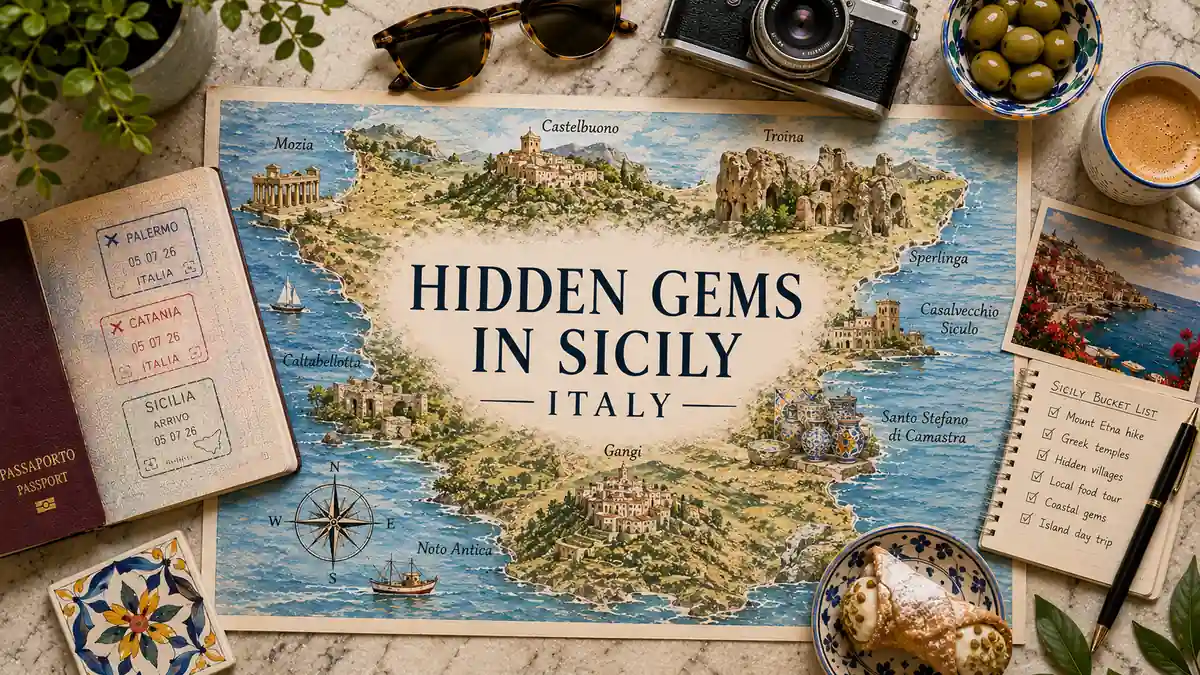
Sicily has a crowding problem that its “hidden gems” lists quietly make worse. Taormina, Palermo, Ortigia, and the Val di Noto are magnificent and completely known, and most articles promising secret Sicily just recycle the same semi-famous runners-up — Erice, Ragusa Ibla, Marzamemi — that stopped being hidden a decade ago. Genuinely underrated Sicily is somewhere else entirely: in the rock-cut interior, the stone villages of the Madonie and Nebrodi mountains, and a handful of western and coastal corners the coaches never reach. This guide is a curated set of those places — each with a specific reason to go and a note on who it suits — organised by discovery lens so you can choose by the kind of trip you want. The axis throughout is simple: famous versus hidden. The famous names get a link out; everything profiled here earns its place by still belonging to the people who live there.
Quick Answer
Sicily’s most genuine hidden gems are its interior and mountain towns: Sperlinga, Troina, and the Madonie villages. This list suits travelers who want lived-in places over headline sights, grouped by lens — interior and mountain versus coastal, east versus west. For a coast-leaning trip, western Mozia is the strongest pick.
Trust Layer
Tripstou selection guide for travelers choosing between multiple places. Covers selection criteria, traveler fit, and trip value.
Produced with AI assistance and reviewed by Alex Perrut, working in tourism since 2015, for the Tripstou editorial team. See our editorial process for details.
Last factual review: July 5, 2026.
Official sources consulted: italia.it, enit.it.
Key Takeaways
- Sperlinga’s rock-cut castle is the most distinctive pick overall — a genuinely strange place almost no travelers have heard of.
- For mountains choose the Madonie borghi like Castelbuono or Gangi; for coast and west, the Phoenician island of Mozia wins.
- Crowding in Sicily tracks distance from a famous anchor far more than the east-versus-west split most lists lean on.
- A car is effectively essential for interior and mountain villages; coastal picks like Santo Stefano di Camastra stay reachable by transport.
- Pair one gem per famous base — detour from Taormina to Casalvecchio Siculo’s abbey, or from Palermo into the Madonie.
Table of Contents
What counts as a genuine hidden gem in Sicily?
A genuine Sicilian hidden gem is a town most itineraries skip entirely and few lists actually name. Three things separate the real thing from the recycled: genuinely lesser-known, a specific reason to go, and off the standard coach circuit. Erice, Ragusa, and Marzamemi fail that test — they are lovely, but no longer hidden.
The famous-versus-hidden axis is what this page is built on. Taormina, Palermo, Ortigia, Agrigento, and Cefalù are extraordinary and deserve their crowds; they simply belong on a different list, alongside Italy’s other headline destinations. You can find them among the famous places to visit in Italy, and this guide is the alternative for the days when you want a town that isn’t performing for visitors.
Most recycled “hidden gems” lists fail on one point: they confuse quiet-in-winter with genuinely undiscovered. A place that fills with day-trippers by mid-morning in July was never hidden — only quiet off-season. The picks below stay lived-in because locals still outnumber visitors on an ordinary day, and that is the real filter Sicily rewards.
The most underrated towns in interior and central Sicily
Sicily’s interior hides its most genuinely underrated towns, and Sperlinga is the standout. The heartland is where real discovery lives because it never built a tourism economy — no cruise port, no famous ruin, no reason for coaches to stop. What remains are working hilltop towns with Norman, Arab, and Byzantine layers still visible in daily life.
Sperlinga
Sperlinga is a village built into the rock, crowned by a castle carved directly out of the sandstone ridge. Its troglodyte dwellings — homes hollowed into the cliff and lived in until recent generations — are unlike anything else on the island. The town also holds a famous line from Sicily’s medieval revolt, when it alone sheltered the French during the Sicilian Vespers.
Its edge over the other interior picks is the sheer strangeness of the setting — a castle and houses that are geology as much as architecture.
- Pick this if: you want a single unforgettable, genuinely strange place few travelers have ever heard of.
Troina
Troina was Sicily’s first Norman capital, one of the earliest towns Count Roger secured in the eleventh-century conquest. At over one thousand metres, it is also among the highest towns in Sicily, with long views across the Nebrodi foothills. The history is genuinely first-tier, yet Troina sees almost no tourism.
The draw is altitude fused with history: a founding chapter of Norman Sicily on a cold, commanding ridge most visitors never climb.
- Pick this if: you care about deep history and want it without a single tour group.
Sambuca di Sicilia
Sambuca di Sicilia is an inland borgo of Arab origin, its oldest quarter still following the street pattern laid down when it was founded as Zabut. Honey-coloured stone, quiet courtyards, and a hilltop belvedere over the countryside give it a calm that coastal towns lost long ago. It sits near the Belice valley wine country.
Its distinction is the intactness of the Arab-founded core — a lived-in medieval plan, not a restored showpiece.
- Pick this if: you want a slow, photogenic borgo with an Arab-Sicilian backbone and nearby wine roads.
Salemi
Salemi is a hilltop town that served briefly as Italy’s first capital, when Garibaldi declared it so in 1860 during the unification campaign. Its tangled Arab-Norman old quarter climbs to a castle with wide views over the Belice valley. An earthquake reshaped parts of the town, leaving an unusual mix of restored lanes and open sky.
The pull is that layered western-interior identity: an Arab street plan, a one-week national capital, and post-earthquake reinvention on a single hill.
- Pick this if: you like history with an odd twist and are already exploring Sicily’s western interior.
Sicily’s overlooked mountain villages: the Madonie and Nebrodi
Sicily’s most underrated cluster is the string of stone villages inside the Madonie and Nebrodi mountains, led by Castelbuono. These parks sit an hour or two inland from the north coast, yet they feel like a different island — cooler, greener, and built around forests, not beaches. The villages here are borghi that never emptied out.
Castelbuono
Castelbuono is the gateway town of the Madonie, wrapped around the fourteenth-century Ventimiglia castle at its centre. It is the liveliest of the mountain villages — a real market town with cafés, an artisan food scene, and the local speciality of manna, the sweet sap still tapped from ash trees in these hills. It works well as a mountain base.
Because it functions year-round as a working town, it never feels like an open-air museum.
- Pick this if: you want a lived-in mountain base with services and food culture, beyond scenery alone.
Gangi
Gangi spills down a conical hill in tiers of grey stone, one of the most complete medieval borghi in Sicily. It won national recognition as Italy’s most beautiful village and briefly offered near-free houses to newcomers, yet it never turned into a tourist town. Narrow stepped lanes open suddenly onto Madonie panoramas.
The pure visual drama of the townscape carries it — a hill that reads as one cascading monument.
- Pick this if: you want the most photogenic mountain borgo and enjoy steep, maze-like old towns.
Petralia Soprana
Petralia Soprana is the highest town in the Madonie, a serene borgo of pale stone perched above the surrounding peaks. Its quiet piazzas, belvederes, and near-total absence of crowds make it the most contemplative pick in the cluster. On clear days the views reach all the way to Etna.
Altitude and stillness define it: the calmest, highest-feeling place on this list.
- Pick this if: you want silence, big views, and the most peaceful borgo in the mountains.
Polizzi Generosa
Polizzi Generosa sits on a ridge deep in the Madonie, a compact village with a surprising density of churches and a strong mountain-food identity. It is the gateway to some of the park’s best hiking and a centre for local produce like the rare Madonie beans and hazelnuts. Few foreign visitors reach it.
It earns its place as a genuine trailhead village, closest of the four to the wild heart of the park.
- Pick this if: you want to actually walk in the Madonie and use a village as your hiking base.
Lesser-known coastal and western corners worth the detour
For coast and crowd-free western Sicily, Mozia is the most rewarding detour. The famous shorelines around Taormina and San Vito draw the crowds, but the island keeps quieter corners for travelers willing to drive a little further. These picks trade postcard fame for space, texture, and a stronger sense of place.
Mozia / Motya
Mozia is a tiny island in the Stagnone lagoon near Marsala that was one of the western Mediterranean’s most important Phoenician settlements. You reach it across shallow water threaded through salt pans and windmills, arriving at ancient walls, a sacred pool, and the famous marble Motya Charioteer. Almost nothing here is monetised into a mass attraction.
The reward is the layered payoff — a Phoenician city, a working salt landscape, and a lagoon crossing in one compact visit.
- Pick this if: you want deep ancient history and unusual scenery on the far western coast.
Santo Stefano di Camastra
Santo Stefano di Camastra is a north-coast ceramics town where nearly every shopfront and staircase is tiled in hand-painted majolica. Sicily’s ceramic tradition is usually pinned to Caltagirone, yet this smaller coastal town lives and breathes it with far fewer visitors. It makes an easy, colourful stop between the Madonie and the Nebrodi coast.
Total immersion in one craft is the appeal — a whole town styled as a ceramics workshop.
- Pick this if: you love craft and design and want a coastal stop with a distinct handmade identity.
Sampieri
Sampieri is a low-key fishing village on Sicily’s southeast coast, with a long sandy beach and a slow, local rhythm. It sits just beyond the baroque towns of the Val di Noto, yet sees a fraction of their visitors. The haunting ruined brick kiln on the shore, familiar from Italian television, gives the beach an unforgettable silhouette.
It comes down to the empty-beach-plus-baroque-hinterland combination — sea and stone within a short drive.
- Pick this if: you want a quiet southeast beach with baroque towns close by, minus the tour buses.
Casalvecchio Siculo
Casalvecchio Siculo is an inland village in Sicily’s northeast, close enough to Taormina for a half-day escape but a world away in feel. Its landmark is the isolated Norman-Byzantine abbey of Santi Pietro e Paolo d’Agrò, one of the island’s most striking medieval churches, set in a green river valley. The village itself stays firmly untouristed.
Proximity to a famous base is the point — you can trade Taormina’s crowds for total quiet in under an hour.
- Pick this if: you are based near Taormina and want a fast, easy escape into the untouristed interior.
Is eastern or western Sicily less touristy?
Western Sicily is generally less touristy than the east, especially away from Palermo and the coast. The east concentrates the headline sights — Taormina, Etna, Syracuse, and the baroque Val di Noto — so it draws the heaviest traffic. The west and the interior stay quieter simply because fewer marquee names pull visitors there.
Treat the split as a discovery lens rather than a verdict on which half is better. Both halves hold genuine gems; the choice is about which texture you want. The east pairs big-name sights with easy detours into the Nebrodi and the untouristed northeast. The west rewards travelers who prefer Arab-Sicilian towns, salt-pan coastline, and long empty interiors — though its distances are wider and its public transport thinner.
There is a quieter truth underneath the map: crowding in Sicily tracks proximity to a famous anchor far more than compass direction. A village twenty minutes from Taormina can feel busier than a western town three hours from anywhere. Distance from the nearest headline sight predicts the quiet better than east-versus-west ever will.
Do you need a car to reach Sicily’s hidden gems?
For most of these interior and mountain gems, a car is effectively essential. Public transport in Sicily concentrates on the big coastal cities and the main rail line, while small hill towns sit off those routes with sparse, infrequent service. The freedom to reach a village and move on the same day is what a car buys here.
The decision splits cleanly by which gems you are after. Coastal and larger towns — Santo Stefano di Camastra, Marsala for Mozia, Castelbuono — are broadly reachable without a car, since they sit on or near coastal transport. The deep interior and the mountain borghi are a different matter: without your own wheels, you are tied to thin schedules that can strand you for a night you did not plan.
If you prefer not to drive, build the trip around the reachable gems and accept a shorter list — that is the honest tradeoff, and it is a real, workable option in eastern and coastal Sicily. For the timetables, base choices, and route planning behind all of this, the Sicily travel guide is the place to resolve the logistics; this page stays on where to go and why.
One planning lever matters more than the car question itself: cluster your gems by zone. Basing yourself for two nights in one area and radiating out beats long point-to-point hops between distant towns, whether or not you are driving.
Train and bus tickets
Compare routes, schedules and prices across rail and bus operators in one search, with mobile tickets on your phone.
New to Omio? Code NEW10 takes 10% off your first booking — or APPNEW10 if you book inside the Omio app. Both apply to bookings up to €80.
Search routes and compare prices on Omio →
Tripstou may earn a commission if you book through this link, at no extra cost to you.
How to pair a hidden gem with a famous Sicily base
Pair each famous base with one nearby gem, and let the gem be your morning or your slow day. The most rewarding Sicily trips alternate headline sights with quiet detours, so the crowds never define the whole journey. Anchor on a well-connected base, then reach out to a lesser-known town within easy range.
A few pairings do most of the work:
- From Taormina, skip a crowded afternoon and detour inland to Casalvecchio Siculo and its Norman-Byzantine abbey.
- From Palermo or Cefalù, climb into the Madonie for Castelbuono, Gangi, or Petralia Soprana as a full day in the mountains.
- From Marsala or Trapani in the west, cross to Mozia and the salt pans, then explore the Arab-Sicilian interior around Salemi and Sambuca.
- From the baroque southeast around Noto or Ragusa, drop down to Sampieri for an empty-beach afternoon.
The rule that keeps this from turning into a checklist is one gem per base, not three. Give the lesser-known town enough time to actually slow you down, and use the famous base for the sights, food, and evenings. Once you are on the ground, the things to do in Sicily guide covers what to fill those days with; this page stays focused on which underrated town to reach for.
Hotels and places to stay
Compare hotels, apartments and stays for your dates in one search.
Search hotels and stays on hotels.com →
Tripstou may earn a commission if you book through this link, at no extra cost to you.
Frequently Asked Questions
What is the least touristy town in Sicily?
Among the picks here, the interior towns of Troina and Sperlinga are the least touristy, seeing almost no visitors even in summer. Troina’s high Nebrodi ridge and Sperlinga’s rock-cut village sit far from any coach route, so locals still outnumber travelers on an ordinary day.
Is off-the-beaten-path Sicily worth it?
Yes, if you value lived-in places over headline sights and don’t mind driving. Sicily’s underrated interior and mountain towns reward travelers with real local life, unusual history, and space the famous spots lost long ago. The tradeoff is thinner transport and fewer services, so plan around a car.
Are Sicily’s hidden gems actually crowded now?
The famous “hidden gems” are, but the genuinely underrated ones are not. Semi-famous names like Erice, Ragusa Ibla, and Marzamemi fill with day-trippers by mid-morning in summer. The interior and mountain towns profiled here stay quiet because no marquee sight pulls coaches to them, even in peak season.
Which Sicilian hidden gem is best for a first visit?
For a first taste of hidden Sicily, Castelbuono is the easiest gem to start with. As a lively Madonie market town with services, food culture, and reasonable access from Palermo or Cefalù, it delivers the off-the-beaten-path feel without the isolation of the deep interior villages.
Are the Aeolian Islands a hidden gem in Sicily?
Not really — the Aeolian Islands are well-known and busy in summer, closer to a headline destination than a hidden gem. For genuinely quiet island scenery, Mozia in the western Stagnone lagoon is the stronger pick: a tiny Phoenician site among salt pans that sees a fraction of the crowds.
Are Sicily’s mountain villages worth visiting in winter?
They are, though winter changes the experience entirely. The Madonie and Nebrodi villages turn cold and can see snow, trading summer heat for crisp air and empty streets. Services thin out and a few sit near mountain ski areas, so check access ahead, but the stillness runs deepest then.
Related Guides
- Hidden gems in Italy — underrated towns and regions beyond Sicily, across the whole country.
- Best places to visit in Italy — the famous headline destinations, including Sicily’s icons.
- Things to do in Sicily — what to actually see and do once you arrive.
- Sicily travel guide — when to go, where to base, and how to plan the trip.
- Palermo travel guide — the island capital, and the base many of these trips start from.
- Best time to visit Italy — national seasonality, and where the south sits inside it.
- Italy itinerary — how to fit a Sicily leg into a longer route.
Did this guide save you time or money? Tripstou is independent and reader-funded — if you'd like to give something back, you can support the site with a crypto contribution of any size.