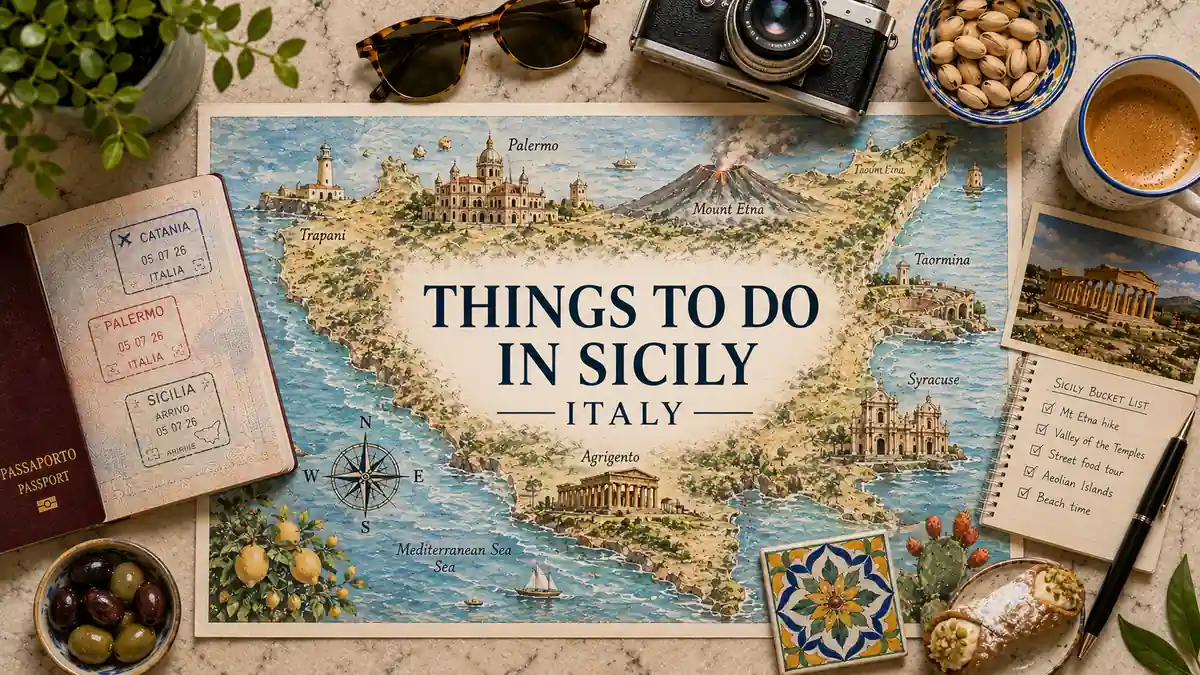
Sicily packs more marquee experiences than any single trip can hold. You can hike an active volcano, walk through Greek temples older than the Colosseum, swim off white-sand beaches, sail to volcanic islands, and eat some of Italy’s best street food — all on one island, but rarely in one week. That makes choosing, not finding, the real task. This guide curates Sicily’s best things to do, grouped by experience type — volcano and nature, ancient sites, coast and islands, and food — so you can pick what fills your trip. It stays deliberately on experiences: which towns to base in, how many days you need, and how to get around are decisions we hand to dedicated guides. Read it as a shortlist of what’s worth your time, sorted so a first-timer and a return visitor can both find their trip fast.
Quick Answer
Sicily’s best experiences center on Mount Etna, the Valley of the Temples, Taormina, the coast and islands, and street food. They group into four types — volcano and nature, ancient sites, coast and islands, and food. First-timers pair Etna with one ancient site and a food tour to cover the island’s range.
Trust Layer
Tripstou selection guide for travelers choosing between multiple places. Covers selection criteria, traveler fit, and trip value.
Produced with AI assistance and reviewed by Alex Perrut, working in tourism since 2015, for the Tripstou editorial team. See our editorial process for details.
Last factual review: July 5, 2026.
Official sources consulted: italia.it, enit.it.
Key Takeaways
- Mount Etna is Sicily’s signature experience — hike Europe’s highest active volcano in the morning, then taste volcanic wine on its slopes.
- For ancient sites, prioritize the Valley of the Temples at Agrigento or Taormina’s theatre, which frames Etna and the sea.
- The best coast experiences cluster west near San Vito lo Capo and Zingaro, while Aeolian boat trips reward an overnight stay.
- A Palermo or Catania street-food market tour delivers Sicily’s cheapest great meals and its most distinctive Arab-Greek-Norman cuisine.
- The island is too large to cover in one trip, so choose two adjacent experience types and go deep.
- Where to base, the best time to visit, and how many days you need are planned on dedicated Sicily guides.
Table of Contents
What are the best things to do in Sicily?
Sicily’s best things to do fall into four experience types: nature, ancient sites, coast, and food. That means hiking Mount Etna, touring Greek temples and theatres, swimming off the coast and islands, and eating through Palermo’s markets. No single trip covers the whole island, so the four categories help you prioritize by interest.
The four types also map loosely onto regions, which makes planning easier. Etna, Taormina and Syracuse anchor the east coast; the Valley of the Temples sits on the south coast at Agrigento; the best beaches and the Zingaro reserve run along the west near San Vito lo Capo; and street food peaks in Palermo and Catania. Group your experiences by the coast you base on and you cut a lot of backtracking across a large island.
Match the type to the traveler:
- Nature and adventure travelers gravitate to Etna and the Zingaro coast.
- History-focused travelers prioritize the Valley of the Temples and Taormina.
- Beach and island seekers head west and out to the Aeolians.
- Food-first travelers build the trip around a Palermo market tour.
Pairing one east-coast experience with one west-coast experience sounds balanced, but each crossing eats most of a driving day — most first trips are stronger built around a single coast. Sicily is one region of a much larger country, and its experience mix differs sharply from the mainland; see our wider roundup of things to do in Italy for how it fits the national picture.
Mount Etna: Volcano Hikes and Vineyard Tastings
Mount Etna is Sicily’s standout experience: hiking Europe’s highest active volcano, then tasting wine on its slopes. The volcano dominates the eastern skyline near Catania and Taormina, and its mineral-rich soil feeds a celebrated wine region. Doing both in one day is the classic Etna outing — a morning on the mountain paired with an afternoon cellar visit.
Climbing Mount Etna
Climbing Mount Etna comes down to how high you go and how you get there. The lower slopes are freely walkable, but the summit-crater zone is regulated and normally reached with a licensed guide, because access shifts with volcanic activity rather than with the season. The main routes:
- Cable car plus 4×4 and guide — the fastest way toward the summit craters; suits travelers short on time or stamina, at the highest cost. Expect a premium, and confirm live rates before booking.
- Guided hike from Rifugio Sapienza (south side) or Piano Provenzana (north side) — the full mountain experience for reasonably fit walkers; the upper-zone approach typically requires an authorised guide.
- Self-guided walk on the lower marked trails — free and flexible for casual visitors, but the upper craters stay off-limits and rules tighten when the volcano is active.
Etna’s access ceiling moves with the volcano, not the calendar. An eruption or a wind shift can close the summit craters on a cloudless day, so treat any tour that guarantees the very top with caution — and keep the vineyard afternoon as a weatherproof backup.
Pick this if: you want the island’s most dramatic scenery underfoot and don’t mind an early, cold start.
Etna Wine and Vineyard Experiences
Etna’s vineyards turn the volcano into a tasting experience, not just a climb. Vines grow in black volcanic soil at altitude, producing structured reds from Nerello Mascalese and mineral whites from Carricante that taste like nowhere else in Italy. Most estates on the northern and eastern flanks run cellar tours with a guided tasting, usually as a relaxed half-day.
The wine day pairs naturally with a morning hike, since the vineyards sit on the same slopes you descend from. Book estate visits ahead in the busy months, and treat any tasting fees as ranges that shift by producer.
Pick this if: tasting the volcano appeals more than climbing it, or you want a gentle half-day after the summit.
Tours and activities
Book skip-the-line tickets, day trips and local tours with free cancellation on most activities.
You can also browse everything on getyourguide.com.
Tripstou may earn a commission if you book through this link, at no extra cost to you.
Sicily’s Ancient Greek and Roman Sites
Sicily holds some of the best-preserved Greek temples and theatres outside Greece. The island was a heartland of Magna Graecia, and its ruins rival — often surpass — what survives on the mainland. Three sites carry the category: the Valley of the Temples, Taormina’s theatre, and the Greek quarter of Syracuse. They split by mood more than by ranking.
Valley of the Temples, Agrigento
The Valley of the Temples at Agrigento is Sicily’s greatest concentration of Doric temples, strung along a ridge above the sea. The Temple of Concordia ranks among the best-preserved Greek temples anywhere, and the park lines up several more along a walkable path. Plan roughly half a day; it is hot and shadeless in summer, so go early or late, and check current hours and ticket prices before you set out.
Pick this if: you want the fullest hit of classical antiquity and will trade a beach morning for it.
Ancient Theatre of Taormina
The Ancient Theatre of Taormina frames Mount Etna and the sea through its ruined stage — the most scenic classical site in Sicily. Greek-built and later Roman-remodelled, it still hosts summer performances, and the cliffside town around it is a polished resort in its own right. Because Taormina and Etna share the east coast, most travelers pair the two into one leg.
Pick this if: you want ruins with a spectacular view and a polished resort town attached.
Other Greek and Roman Ruins (Syracuse, Segesta, Villa Romana)
Beyond the two headliners, three more sites reward anyone chasing ancient Sicily:
- Syracuse — the Neapolis park holds a huge Greek theatre and the Ear of Dionysius, while the island of Ortigia is a living old town; ideal for combining ruins with a beautiful base city.
- Segesta — a lone, near-complete Doric temple on a windswept hill in the west, with a hilltop theatre above; ideal for atmosphere and thin crowds.
- Villa Romana del Casale — at Piazza Armerina inland, its Roman floor mosaics are among the finest anywhere; ideal for a detour and for mosaic lovers.
Pick this if: you’ve done the headline sites and want ancient Sicily with fewer crowds.
Coast, Beaches, and Island Escapes
Sicily’s beaches and Aeolian boat trips are its top water-based experiences. The coast delivers easy swimming and dramatic scenery; the offshore islands add volcanoes, boat days, and a slower rhythm. Both peak in the warm months, so this category is the most season-dependent thing to do on the island — plan it for late spring through early autumn.
Best Beaches (San Vito lo Capo, Cefalù, Zingaro)
Sicily’s best beaches cluster on the west and north coasts, each with its own character:
- San Vito lo Capo — a wide crescent of white sand and turquoise water near Trapani; ideal for a classic beach day, and famous for its couscous festival.
- Cefalù — a sandy town beach beneath a medieval old town and rocky headland on the north coast; ideal for pairing swimming with a walkable historic centre.
- Zingaro Nature Reserve — a car-free coastal trail linking small pebble coves between Scopello and San Vito; ideal for walkers who want to earn their swim.
Swimming season runs roughly from late spring to early autumn; outside those months the water cools and beach services thin out, so treat the season as a range and check locally.
Pick this if: you want warm-water swimming and downtime built into the trip, not just sightseeing.
Aeolian Islands Boat Trips
The Aeolian Islands are a volcanic archipelago north of Sicily, reached by ferry or hydrofoil and best seen from the water. Lipari, Salina, Vulcano, Panarea and Stromboli each have a distinct pull, and Stromboli is famous for the glow of its regular night eruptions. Day trips run in season from Milazzo and, less often, Palermo; schedules and prices vary and shrink in winter, so confirm them live before you commit.
The Aeolians reward an overnight far more than a day trip. Stromboli’s eruptions only perform after dark, and the last hydrofoil back to Sicily leaves well before the show — day-trippers see the island but miss the fireworks.
Pick this if: you’ll trade a sightseeing day for open water and an active volcano seen from the sea.
Sicilian Street Food and Market Experiences
A Palermo or Catania street-food tour ranks among Sicily’s best experiences. Sicilian food is its own cuisine — Arab, Greek and Norman layers — and the markets are where you taste it cheapest and best. Arancini, panelle, sfincione and cannoli are the anchors, eaten standing up in centuries-old market lanes.
The two food capitals specialise differently. Palermo is the bolder, fritters-and-offal city: its Ballarò, Vucciria and Capo markets are the heartland of street snacks like pane con la milza. Catania leans toward seafood at La Pescheria fish market and a sweet granita-and-brioche breakfast. A guided market tour usually runs a couple of hours and a modest per-person fee — treat the price as a range and confirm on booking — and earns its keep by getting you into the right stalls and explaining what you’re eating.
Pick this if: you judge a city by its markets and want the trip’s cheapest great meals.
Which Sicily Experiences Fit Your Trip?
Match Sicily’s experiences to your travel style: nature lovers climb Etna, history travelers chase temples, beach-seekers head west. Most first trips work best as a mix — one volcano day, one ancient site, one coast day, and one food tour. Trip length and where to base then decide how many of these you can realistically fit.
| Traveler type | Lead experience | Pair it with | Base near |
|---|---|---|---|
| First-time visitor | Mount Etna hike or cable car | one ancient site plus a food tour | Catania or Taormina, east coast |
| Families with kids | Beaches and gentle coast days | Etna cable car and easy ruins | Cefalù on the north coast |
| History-focused travelers | Valley of the Temples, Agrigento | Syracuse, Segesta and Taormina | Syracuse or the south coast |
| Food-first travelers | Palermo street-food market tour | Catania seafood and Etna wine | Palermo in the west |
| Active and nature lovers | Etna summit hike | Zingaro reserve and Aeolian boats | split between east and west |
The real limit on a Sicily trip isn’t your interests — it’s the island’s size. Each experience type clusters on a different coast, and Sicily is closer to a small country than a weekend city. Choose two adjacent types and go deep instead of chasing all four across the map.
Which town to actually sleep in — plus the best time to visit and how to get around — sits outside this experience roundup; our Sicily guide covers basing, timing and transport. If you’re weighing Sicily against other regions before you commit, see the best places to visit in Italy. And to turn a shortlist of experiences into a day-by-day route, build it with our Italy itinerary.
Frequently Asked Questions
What are the best tours and tickets in Sicily?
The most-booked Sicily tours are Mount Etna summit trips, Valley of the Temples entry tickets, Palermo street-food walks, and Aeolian Islands boat days. Book Etna guides and popular site tickets ahead in peak season, and treat listed prices as ranges that shift by operator and demand — confirm live rates before you commit.
Can you climb to the top of Mount Etna?
Yes, but reaching the summit-crater zone normally requires a licensed guide, and access shifts with volcanic activity, not the season. The lower slopes are freely walkable year-round. The upper craters can close on a clear day when the volcano is active, so confirm current access before booking any summit tour.
Is Sicily worth visiting?
Yes, Sicily is one of Italy’s most rewarding regions to visit. Few places pack an active volcano, Greek temples, white-sand beaches, volcanic islands, and a distinct food culture onto one island. It suits travelers who want variety over a single theme, though its size rewards focus over a rushed, cover-everything trip.
What is Sicily famous for?
Sicily is famous for Mount Etna, its Greek temples, and its street food. Europe’s highest active volcano, the Valley of the Temples, and Palermo’s market snacks are the island’s signatures. It’s also known for the Aeolian Islands, cannoli and granita, and a cuisine shaped by Arab, Greek, and Norman rule.
Do you need a car to do things in Sicily?
A car helps for most of Sicily’s experiences but isn’t essential for all of them. Etna, the Valley of the Temples, and west-coast beaches are far easier with your own wheels, while Palermo, Catania, Taormina, and Aeolian ferries work well without one. Our Sicily guide covers getting around in detail.
Related Guides
- Sicily guide — where to base, the best time to visit, and how to get around the island.
- Best places to visit in Italy — how Sicily compares with other regions when you’re planning a wider trip.
- Italy itinerary — how to sequence Sicily’s experiences into a day-by-day route.
- Things to do in Italy — the national experience set that Sicily sits within.
- Hidden gems in Sicily — the underrated towns and corners beyond the famous icons.
- Palermo travel guide — the island capital in full, from sights to where to stay.
- Best time to visit Italy — national seasonality, and where a Sicilian trip sits inside it.
Did this guide save you time or money? Tripstou is independent and reader-funded — if you'd like to give something back, you can support the site with a crypto contribution of any size.