
Choose one region of Europe, not the continent. Let the length of your trip decide how much of that region you see, and let the season decide which region you pick. A week fits one or two bases; two weeks fits one region well, moving in one direction through a few bases.
That is the strongest first-trip shape: one region, a handful of bases across about two weeks, no backtracking. Europe rewards it because very different countries sit a short train ride apart, so a narrow choice still gives you range.
The sections below walk the decisions in the order a planner makes them: which region, how much of it, when, how to move, what it costs you in comfort, and which boundaries change the plan.
In This Guide
The Short Version
- A first trip to Europe works best inside one region, picked by trip length first and season second, not as a sweep of famous capitals.
- Size the trip by bases rather than countries: roughly one or two in a week, two or three in about ten days, three or four in two weeks.
- The Mediterranean regions are at their best in spring and autumn, the Alps split into a summer trip and a winter trip, and the Baltics belong to their short summer.
- Trains handle neighbouring countries, short flights handle long jumps and islands, and a car earns its place only on rural or mountain stretches.
- Europe is not one currency or one entry regime: Switzerland sits inside Schengen but outside the EU, and pays in Swiss francs.
- Italy on its own, or Spain with Portugal, over about two weeks and travelled in one direction, makes the strongest first trip.
How to Decide Where to Go in Europe
Deciding where to go in Europe comes down to three filters applied in order: trip length tells you how much ground you can cover, season tells you which region is at its best, and travel style tells you what you want the days to feel like. The output is one region. A list of famous capitals is not a plan.
The continental sweep fails for a simple reason. Every change of country costs most of a day in packing, transfers and check-ins, and the big-city days start to repeat: another old town, another cathedral square, another evening spent finding dinner near a station. Five capitals in two weeks leaves little more than the journeys between them.
Europe makes the narrow choice easy to live with. Within a few hours of rail you can cross a language border, change cuisine and swap a coast for mountains, so one region already holds the contrast most first-timers are chasing. That density is why Europe works as a first long-haul trip: variety without long transfers.
Before reading the region blocks, settle two things. Know roughly how many nights you have, and know which part of the year you are travelling in. Style comes third: cities and food, beaches and islands, mountains and walking, or a slower, cheaper pace.
Which Part of Europe Fits Your Trip?
This guide covers six regions of Europe: Iberia, Italy, France with Belgium and Monaco, the Alps in Switzerland, Greece and its islands, and the Baltics. What separates them is landscape and pace. Four are coast-and-city trips with a Mediterranean pull, one is a mountain trip, and the Baltics are a compact northern trip of three small capitals. Pick the block that matches your season and style, then skip the rest.
| Region | Countries | Strongest for | Season fit | Spend style |
|---|---|---|---|---|
| Iberia | Spain, Portugal, Andorra | Cities, food, long coastlines | Spring and autumn | Kind (Portugal), mid (Spain) |
| Italy | Italy | Art cities, food, one-country depth | Spring and autumn | Mid |
| France and neighbours | France, Belgium, Monaco | Capitals, regional food, the Riviera | Spring to autumn; winter markets | Mid; punishing in Monaco |
| The Alps | Switzerland | Mountain scenery, scenic rail | Summer or winter | Punishing |
| Greece | Greece | Islands, beaches, ancient sites | Late spring to early autumn | Kind (mainland), mid (islands) |
| The Baltics | Estonia, Latvia, Lithuania | Compact old towns, an easy line of capitals | Summer | Kind |
Iberia: Spain and Portugal, with Andorra in the Pyrenees
Iberia is the region for travelers who want big cities, late dinners and coastline in one trip. Spain carries the weight: distinct regions with their own food and architecture, linked by a fast rail network. The Spain travel guide sorts those regions by trip length.
Portugal adds a slower, smaller-scale country next door, with an Atlantic coast and two very different cities at either end of it; start with the Portugal travel guide if you want a gentler pace or a tighter budget. Andorra is the mountain add-on, a small valley country high in the Pyrenees reached by road from Spain or France. The Andorra travel guide covers when it is worth the detour.
Italy on Its Own
Italy fills two weeks without help from any neighbour. Art cities in the north and centre, food that changes every few hours of travel, and a south that feels like another country give one border more range than most multi-country routes. Adding a second country usually means cutting an Italian region that would have been the better trip. The Italy travel guide shows how to split the country by length of stay. Italy suits a first-timer who wants density over border count.
France, Belgium and Monaco
France works three ways, and the choice shapes the whole trip:
- The capital plus one region — the classic first trip, pairing a big city with a contrasting countryside or coast; the France travel guide helps choose the region.
- The capital with Belgium — a northern city trip of canals, beer halls and medieval centres within easy rail reach; see the Belgium travel guide.
- The south with the Riviera — lavender country and the coast, with Monaco as a short stop on the French Riviera; the Monaco travel guide covers what fits in a visit.
The Alps: Switzerland
Skip Switzerland on a first trip if your budget is tight or you are coming for cities. It earns its place for mountain scenery, lake towns and some of the most scenic rail travel in Europe, and every day there costs more than the same day almost anywhere else on this page. Travelers who come for the landscape rarely regret it; those who treat it as a transit stop between France and Italy often do. The Switzerland travel guide covers where to base yourself, and the currency and entry boundary is set out further down this page.
Greece and the Islands
The shape decision in Greece is mainland versus islands. The capital and the mainland deliver ancient sites and a lower-cost, road-based trip. The islands deliver beaches and village life, but every island hop eats part of a day, so a first trip works best with few islands and longer stays on each. The Greece travel guide helps pick the mix. Greece fits the traveler whose trip is built around the sea.
The Baltics: Estonia, Latvia and Lithuania
The Baltics are the easiest multi-country trip in Europe to route: three compact capitals in a line, linked by bus and rail, each with a walkable old town. Start from either end and move in one direction. The Estonia travel guide, the Latvia travel guide and the Lithuania travel guide cover each country, and together they make a calm, affordable alternative to the busy south. The catch is the season: the region is at its best in a short summer window.
How Much of Europe Fits in a Week, Ten Days or Two Weeks
A week fits roughly one or two bases, about ten days fits two or three, and two weeks fits three or four. Only from about three weeks does a second region become worth the travel days. The reason is the same at every length: each move between bases costs most of a day, so more stops mean fewer days actually spent somewhere.
| Trip length | Bases that work | Pairing that fits | What to drop |
|---|---|---|---|
| A week | One or two | One city plus day trips, or two Iberian or two Baltic bases | Any second country that needs a long transfer |
| About ten days | Two or three | Italy north to centre; the French capital plus one region | A third country |
| Two weeks | Three or four | Italy north to south; Spain with Portugal; all three Baltic capitals | A second region |
| Three weeks or more | Four or more, split across two regions | One region in depth plus a neighbouring one, such as France then Switzerland | Backtracking between the two |
“How many countries can I visit?” is the wrong question for planning. “How many bases?” is the right one, because the base count sets how many travel days you lose. Two neighbouring countries with one base each can cost less travel than three bases inside Spain. Count the moves, not the flags.
Any trip that needs a flight between every base is a trip with too many bases for its length.
Fewer Bases, One Direction: How to Route a Multi-Country Trip
Route a multi-country Europe trip in one direction, with no backtracking, using as few bases as your length allows and day trips from each base instead of changing hotels. That is also the answer to where to stay at continent scale: one base per city or region, chosen for its rail links.
One direction means a line across adjacent countries: west to east from Portugal into Spain, north to south down Italy, or down the line of Baltic capitals from one end to the other. A loop that returns to its starting city spends a day or more retracing ground you have already seen.
The base-and-day-trip logic turns several stops into one. A well-connected city puts smaller towns within a return day trip, so you unpack once and still see the region around it. Travel days cost more than they look. The ride may be short, but checkout, the walk to the station, the wait and the new check-in take the best part of a day.
Should you fly into one city and out of another?
Yes, when the route is linear. Flying into one city and out of another (an open-jaw ticket) removes the return leg to your starting point, which on a one-direction route saves a full travel day. The catch is the fare shape: an open-jaw ticket can price differently from a simple return, and a rental car dropped in another country usually carries a one-way fee. Compare the open-jaw fare with the cost of the day you would lose going back.
Tours and activities
Book skip-the-line tickets, day trips and local tours with free cancellation on most activities.
You can also browse everything on getyourguide.com.
Tripstou may earn a commission if you book through this link, at no extra cost to you.
When to Go Depends on the Region You Picked
The Mediterranean regions — Iberia, Italy, Greece and the Riviera — are at their best in the shoulder seasons of spring and autumn. The Alps split into a summer trip and a winter trip. The Baltics are a short-summer destination. Winter in the north and centre of the continent belongs to the Christmas markets.
In the south, the shoulder seasons give long, mild days without the peak-summer heat and crowds. Summer still works for the Greek islands and the coast, as long as you accept the busiest weeks.
Switzerland is two different trips: hiking, lakes and open high passes in summer, ski resorts and snow in winter. The months in between are the quiet ones. The Baltics reverse the southern logic: summer is the season, and the rest of the year is short-daylight city travel.
Winter suits travelers who want city breaks and festive lights, especially across France, Belgium and the Alpine towns; the guide to Christmas markets in Europe covers where to go. For the month-by-month detail by region, see the best time to visit Europe, month by month.
How to Move Between Countries
Take the train between neighbouring countries, fly for long jumps and islands, and rent a car only for rural or mountain stretches. The mode follows the route shape you chose: a one-direction line across adjacent countries is a rail trip almost by definition.
Rail suits most first trips. City centre to city centre, no airport transfers, and the journey itself is part of the scenery in the Alps and much of France and Italy. Rail-only travelers do best in Italy, France, Belgium, Switzerland and the Spanish high-speed corridors.
Short flights earn their place for the long jumps: crossing from Iberia to Italy, reaching Greece from the west, or hopping between distant islands. The Greek islands are a sea-and-air trip, not a rail trip.
A car is the tool for rural Iberia, the Alpine valleys and the Greek mainland, where the best stops sit between stations. In big cities it is a burden. For trains against flights against buses, rail passes and booking, read the guide to getting around Europe by train, plane and bus.
Where Europe Is Kind or Punishing for Your Budget
Cost in Europe is a regional choice before it is a style choice. The Baltics, Portugal and mainland Greece stretch any budget; Switzerland and Monaco punish every spending style; the big Western capitals sit in between. The Baltics are the cheapest region on this page for a full trip, because everyday costs are low and the short hops between capitals keep transport light.
A tight budget buys hostels or simple guesthouses, market and bakery meals, and buses or slower trains. In the Baltics, Portugal and mainland Greece that style still leaves room for sit-down dinners and paid sights. In Switzerland the same style means self-catering most days and choosing excursions one at a time.
A comfortable mid-range trip buys central hotels, one restaurant meal a day and trains booked in advance. That is the natural level for Spain, Italy, France and Belgium, where it covers a good trip without constant trade-offs. Paris and the busiest Italian cities are where mid-range feels tightest.
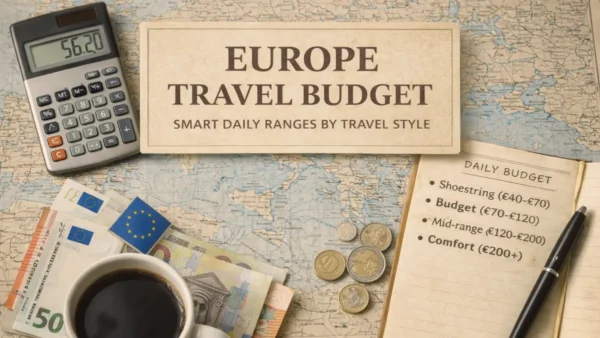
A high-end trip buys boutique hotels, long lunches and private transfers anywhere on the continent. It goes furthest in Portugal and Greece, where comfort comes cheaper, and least far in Switzerland and Monaco. For the numbers by style and country, see what a trip to Europe costs.
Euro, Swiss Franc, Schengen: The Boundaries That Change Your Plan
Not every country on this page uses the euro, and Europe is not one entry regime. Switzerland is inside the Schengen area but outside the European Union and uses the Swiss franc. The nine EU countries covered here share both the euro and the Schengen area.
The Schengen area has 29 countries: 25 EU member states plus four countries outside the EU — Iceland, Norway, Switzerland and Liechtenstein.
Because Switzerland pays in francs, any route that crosses the Alps needs a second currency in your wallet or on your card.
Spain, Portugal, Italy, France, Belgium, Greece, Estonia, Latvia and Lithuania are all EU members inside Schengen that use the euro.
Short stays are capped at 90 days in any rolling 180-day period across the Schengen area as a whole, not per country.
Check the entry rules that apply to your passport before booking.
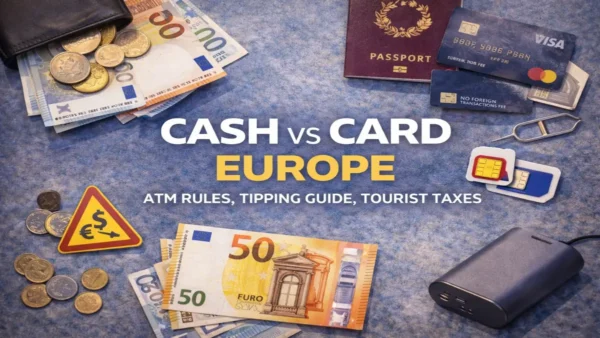
Readers heading to Andorra or Monaco should check the rules for those destinations in the Andorra travel guide and the Monaco travel guide. For paying on the ground — cards, cash withdrawals, tipping and tourist taxes — read the guide to cash vs card in Europe.
Which Region for Which Traveler
The first-timer, the budget traveler, the rail-only traveler, the beach traveler and the winter traveler each have a different best region in Europe. Matching the region to the traveler matters more than any single sight on the map.
- The first-timer — Italy or Spain with Portugal: dense highlights, easy trains and a long shoulder season, at the cost of the busiest sights in Europe.
- The budget traveler — the Baltics, Portugal or mainland Greece, where a modest budget still buys comfort; the price is fewer headline names.
- The rail-only traveler — France with Belgium, Italy, or a Swiss summer, all built around centre-to-centre trains; Switzerland adds scenery and a much higher bill.
- The beach traveler — Greece and its islands, or the Iberian coast; the sea comes with crossings and transfers that cost time.
- The winter traveler — the Alps for snow, or France and Belgium for markets and city breaks; short days and cold evenings come with it.
The traveler who wants everything has an answer too: a second trip. Europe repays return visits, and a first trip that goes deep in one region leaves a clear map for the next one.
The Strongest First Trip to Europe Stays in One Region
The strongest first trip to Europe is Italy on its own, or Spain with Portugal, over about two weeks, with a few bases and one direction of travel. Both pack the most distinct highlights per travel hour on the continent, both run on easy rail, and both have a long shoulder season that gives good weather without peak crowds.
Italy wins for art, food and density inside one border. Iberia wins for travelers who want a second country without a long transfer, a coastline and a gentler budget in Portugal. Save the Alps, the Greek islands and the Baltics for the second trip, when you know how you like to travel and can give each its own season.
Plan in this order: fix your dates and region first, then the route shape, then the bases, then the transport between them. Booking a train before the bases are settled is how routes end up backtracking. For the practical side of a first trip — money habits, etiquette and what to pack — read the Europe travel tips for a first trip.
Scope and Sources
This page helps you choose a region of Europe and a trip shape among the countries Tripstou covers; it is a continent-level planner, not a country guide, an itinerary, a visa page or a price page.
Written with AI assistance, this planner was then gone over by Alex Perrut, working in tourism since 2015, for the Tripstou editorial team. How that works is set out in our editorial process.
Official sources consulted: European Commission, Migration and Home Affairs, Your Europe (European Commission).
Did this guide save you time or money? Tripstou is independent and reader-funded — if you'd like to give something back, you can support the site with a crypto contribution of any size.