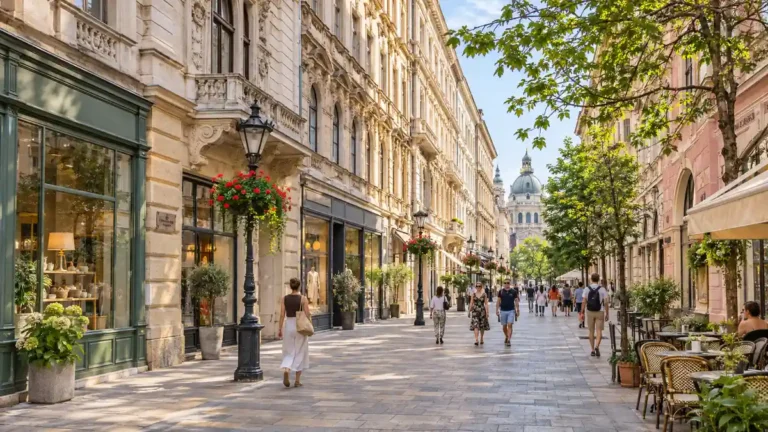
A first trip to Budapest is a trip to one city split by the Danube: hilly, quiet Buda on the west bank and flat, busy Pest on the east, with thermal baths, the Parliament and the ruin bars of District VII as the reasons people come. For a traveler arriving from far away, the planning comes down to how long to stay, where to base, when to go, how to get in from the airport, which bath to choose and which day trips are worth the time.
Hungary is in the EU and the Schengen area, but it pays in forint, not the euro. Plan your cash and cards around that from the first hour.
Quick Answer
Budapest is worth it for a river-and-architecture city break with thermal baths and a night out that costs less than in most Western European capitals. Plan three days (two is the minimum, a fourth adds the Danube Bend), in spring or early autumn. It suits first-time Europe visitors who want a walkable capital, based in central Pest.
Is Budapest Worth Visiting, and What Is It Known For?
Budapest is worth visiting for its Danube setting, where two very different banks face each other across the river. The thermal baths, the Parliament and Castle Hill skyline, and a ruin-bar nightlife found nowhere else make it a complete first trip. It is also cheaper and less crowded than Vienna or Prague for a comparable city break.
Buda, on the west bank, is hilly and quiet. Castle Hill and Gellért Hill rise above the river there, and evenings are calm. Pest, on the east bank, is flat and busy: the Parliament, St Stephen’s Basilica and the Jewish Quarter are all on this side, and so are most of the sights, restaurants and bars a first-timer will use.
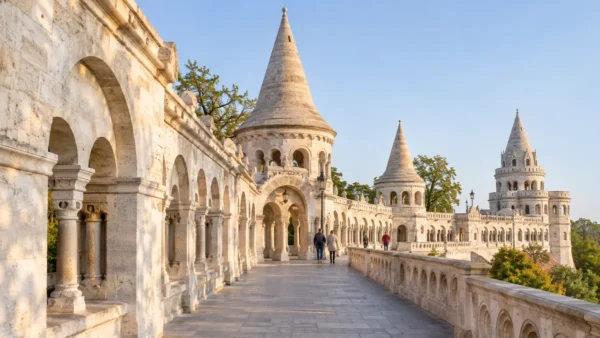
The city’s defining sights are easy to name. On the Buda side stand Buda Castle and the Castle District, Fisherman’s Bastion and Matthias Church, with the Buda Castle labyrinth running underneath. The Széchenyi Chain Bridge links the two banks. In Pest, the Parliament fills the riverfront, St Stephen’s Basilica has a dome terrace over the rooftops, Andrássy Avenue runs out to Heroes’ Square and City Park, and the Great Synagogue on Dohány Street anchors the Jewish Quarter. The Shoes on the Danube Bank memorial sits on the Pest embankment, and Margaret Island is the green space in the middle of the river. Our guide to things to do in Budapest ranks these sights and resolves tickets and timing for each.
The floodlit Parliament and Buda Castle seen from the water are the image most people take home. An evening Danube cruise puts both banks and the lit bridges in one view, and it works best early in the trip, while the layout of the city is still new.
Do you need to book the Parliament tour in advance?
Yes: book the Parliament tour online before you travel. The visit is a guided tour of the building, and you can reserve a tour slot once your dates are fixed.
Tours and activities
Book skip-the-line tickets, day trips and local tours with free cancellation on most activities.
You can also browse everything on getyourguide.com.
Tripstou may earn a commission if you book through this link, at no extra cost to you.
Three Days Is the Sweet Spot for a First Trip
Three days covers both banks, one bath and one evening in District VII without rushing. Two days is the minimum for the main sights. Four or five days add the Danube Bend and a slower pace.
| Trip length | What it buys | Who it suits |
|---|---|---|
| 2 days | Castle Hill and the Pest riverfront, the Parliament, one evening out; a bath only if you give up a sight | A stop on a multi-city trip |
| 3 days | Both banks at walking pace, one bath morning, a District VII night, Andrássy Avenue and City Park | Most first-timers |
| 4–5 days | Everything above plus a Danube Bend day and a second bath | Slow travelers and those flying in long-haul |
The third day is what turns a bath from a trade-off into a given. With two days, a morning at Széchenyi costs you the Castle District or the Basilica; with three, it fits beside both. Our 3-day Budapest itinerary lays the plan out day by day.
When to Visit Budapest: Shoulder Seasons First, Winter for the Baths
Spring (April–May) and early autumn (September–October) give Budapest its best balance of weather and crowds. Summer is hot and the busiest season. December is for the Christmas markets, and deep winter is cold but puts the outdoor baths at their best.
Spring suits walkers. The riverside and Margaret Island are green, the days are long enough for both banks, and the outdoor bath pools are pleasant without summer queues.
Summer brings heat and the city’s largest crowds. Sziget season and the Formula 1 weekend fill hotels, so book early if your dates overlap. Palatinus on Margaret Island opens its outdoor pools in this season.
Early autumn is the strongest all-round pick. The heat breaks, the crowds thin, and evenings are still mild enough for a river cruise or a ruin-bar courtyard.
December belongs to the Christmas markets on Vörösmarty tér and in front of the Basilica. January and February are cold and grey, yet a steaming outdoor pool at Széchenyi under freezing air is the most memorable bath visit of the year. Winter is the season to choose if the baths are the point of the trip.
Buda or Pest: Where Should You Stay on a First Visit?
Stay in Pest on a first visit. Choose District V if you want to walk to the Parliament, the Basilica and the river; District VI or VII if your evenings matter most; Castle Hill in District I if you want quiet and views and accept a tram or a walk to dinner.
District V (Belváros) is the most central base, with the riverfront on the doorstep. District VI (Terézváros) follows Andrássy Avenue and suits travelers who want restaurants and the Opera nearby with less noise. District VII (Erzsébetváros, the Jewish Quarter) is just as central and the liveliest, which makes it the loudest at night, so light sleepers should ask for a room off the street. District VIII (Józsefváros) is the cheaper edge of the centre and works for budget travelers who do not mind a short tram ride. District I on Castle Hill is quiet and scenic, but it empties at night and every dinner means crossing back to Pest.
A first trip is decided by evenings, not views: Castle Hill wins every photo, and Pest wins every night out.
Hotels and places to stay
Compare hotels, apartments and stays for your dates in one search.
Search hotels and stays on hotels.com →
Tripstou may earn a commission if you book through this link, at no extra cost to you.
Budapest Airport to the City: 100E Express or the 24-Hour 200E
Take the 100E Airport Express from Budapest Airport (Liszt Ferenc International) to Deák Ferenc tér via Kálvin tér, about 40 minutes, on its own airport ticket paid by bank card on board. Late at night, or if you hold a regular ticket or pass, bus 200E runs 24 hours to the nearest metro connection.
- 100E Airport Express: the direct route to the centre, ending at Deák Ferenc tér, where three metro lines meet. It uses a dedicated airport shuttle single ticket, bought and validated on board by bank card at the Pay&GO device. Pass holders need the airport add-on in the BudapestGO app before boarding.
- 200E: the round-the-clock option on regular BKK tickets and passes, with a change to the metro or another line to reach the centre. Airport shuttle tickets are not valid on it.
- Taxi: door to door with luggage, the choice for groups or a very late arrival; use the official taxi rank outside the terminal.
A pass does not cover the 100E on its own. A traveler who has already loaded a pass and lands without the add-on saves the hassle by taking the 200E, where the pass works as it is.
Travelers arriving by train from Vienna or elsewhere come into one of the three main railway stations: Keleti, Nyugati or Déli. All three sit on the metro network.
Entry rules before you fly
Short stays are capped at 90 days in any rolling 180-day period across the Schengen area as a whole, not per country. Non-EU arrivals are registered biometrically at the border instead of having passports stamped, under the EU Entry/Exit System. Visa-exempt visitors should confirm whether the ETIAS travel authorisation applies to their trip before booking. Our guide to Hungary visa requirements sets out what applies to your passport.
Getting Around on the Metro, Trams and Your Feet
Central Budapest is walkable, and BKK’s four metro lines, trams and buses cover the rest of the city. Buy tickets in the BudapestGO app or by card and validate every one, because inspectors are common and check often.
The M1 is the historic line, running under Andrássy Avenue to Heroes’ Square and City Park, and it is a sight in itself. Trams run along the Danube embankment on the Pest side and around the Grand Boulevard, and they are the most scenic way to move between Pest neighbourhoods. Most Pest sights sit within walking distance of each other, from the Parliament to the Basilica to the Jewish Quarter.
Crossing to Buda takes a walk over the Chain Bridge or a tram over one of the other bridges. Castle Hill is a real climb on foot; save your legs for the Castle District itself and take a bus up if the day is long.
Széchenyi, Rudas or Lukács: Which Bath, Now That Gellért Is Closed
Choose Széchenyi for a first visit and its outdoor pools, Rudas for an Ottoman-era bath on the Buda riverside, or Lukács for a quieter local bath. Gellért, the Art Nouveau bath, is closed for renovation and is not an option on this trip.
- Széchenyi (City Park): the outdoor icon, with the yellow neo-baroque building and the steaming pools in every photo. The first-timer’s pick; it is also the busiest, so a morning visit is calmer.
- Rudas (Buda riverside): an Ottoman-era domed pool under a Buda hillside, for travelers who want history and atmosphere over size. Smaller and darker than Széchenyi, which is its appeal.
- Lukács (Buda): a bath used by locals more than visitors. The quiet choice for a slow morning, with less spectacle.
- Palatinus (Margaret Island): a summer-only outdoor complex of pools and lawns, closer to a lido than a spa. Good for families on a hot day, irrelevant out of season.
A bath visit takes about half a day once you count changing, soaking and resting. Book a ticket or slot ahead for the big names; at Széchenyi you can book an entry pass before you arrive. Bring flip-flops and a towel, and expect late-night “sparty” events at the larger baths in season, which change the mood entirely.
Eating and Drinking in Budapest: Lángos, the Great Market Hall and Szimpla Kert
Eat gulyás, lángos, chicken paprikash and kürtőskalács where the city eats them: the Great Market Hall, the Karavan street-food court, Bors GasztroBar and Molnár’s Kürtőskalács. Spend one evening in a District VII ruin bar, starting with Szimpla Kert.
What to eat and where
Gulyás, chicken paprikash and lángos are the dishes to try first, with Dobos torte, pogácsa and chimney-shaped kürtőskalács for something sweet or salty on the move. For drinks, order pálinka (fruit brandy), Tokaji (the sweet wine) and Egri Bikavér, the red blend from Eger.
The Great Market Hall is the place for lángos at the upstairs counters and a look at the paprika and produce stalls below. Karavan and Bors GasztroBar handle quick, cheap meals in District VII, and Molnár’s Kürtőskalács bakes the pastry fresh. The New York Café is the famous grand café, worth a coffee if you want the gilded interior.
Ruin bars and the Jewish Quarter after dark
Szimpla Kert in District VII is the original ruin bar and the one to see, even with only one night. Its maze of courtyards and mismatched rooms set the template for every bar that followed, and its Sunday farmers’ market is the daytime version of the same building.
District VII has local rules on night-time noise and drinking in the street. Follow the posted signs and keep drinks inside the bars.
Which Day Trips From Budapest Are Real Day Trips?
Szentendre is the one genuine short hop, on the H5 HÉV suburban line from Batthyány tér. Visegrád and Esztergom make the Danube Bend a full day. Eger and Lake Balaton are better as an overnight on a wider Hungary trip.
| Destination | How you get there | Day-trip verdict |
|---|---|---|
| Szentendre | H5 HÉV suburban line from Batthyány tér (M2) | Closest and easiest; a half day works |
| Visegrád | Bus 880 or a seasonal boat | Full day, often paired with Szentendre |
| Esztergom | Train from Nyugati | Full day |
| Eger | Train from Keleti | Better as an overnight |
Szentendre, Visegrád and Esztergom sit along the same bend of the river, so one long day can string the three together if you are willing to start early. Travelers who prefer not to juggle buses, boats and trains can book this day trip as a single organised tour. Lake Balaton is a summer trip for a longer Hungary itinerary. Our Hungary travel guide covers Balaton, Eger, Tokaj and Pécs as destinations in their own right.
Budget, Mid-Range or High-End: What Each Buys in Budapest
Budapest rewards a mid-range budget more than most European capitals: a central Pest apartment or three-star hotel, a bath morning, a sit-down dinner and tram travel sit comfortably inside it. Budget travelers still eat and drink well, and high-end buys river-view hotels and the grand cafés.
On a tight budget, the city is kind. A hostel or a room in District VIII, lunches at the Great Market Hall and Karavan, BKK instead of taxis and one bath visit make a full trip. Ruin bars are cheap enough that nights out do not decide the budget.
In the comfortable middle, Budapest is at its best. A central apartment in District V, VI or VII, two bath visits, a restaurant dinner each night and a river cruise fit without trade-offs.
At the high end, money buys a Danube-view room, dinners in the grand cafés and fine-dining rooms, and private transfers. Where the city punishes every style is the same: airport taxis hailed outside the official rank, street exchange kiosks, and restaurants angled at visitors right beside the big sights.
Forint, cards and ATMs
Hungary pays in forint, not the euro. Cards work almost everywhere, but carry a little cash for markets and small bars. Withdraw from bank ATMs such as OTP or Erste and avoid Euronet machines and street exchange kiosks. When a card terminal or ATM offers to charge you in your home currency, decline the dynamic currency conversion and pay in forint. Some shops accept euros, but only at a poor exchange rate.
Who Budapest Suits, and When Vienna or Prague Fits Better
Budapest suits first-time Europe visitors who want a walkable capital with baths and nightlife at a lower cost than its neighbours. Couples and groups of friends get the most from it, and families do well with Margaret Island, City Park and Széchenyi. A traveler who wants imperial palaces and classical music first should look at Vienna, and one who wants a compact fairy-tale old town should look at Prague.
First-timers get an easy city: a clear river divide, a metro that starts at the centre and English widely spoken in hospitality. Couples have the river at night and the bath mornings. Groups of friends come for District VII and the ruin bars. Families find space on Margaret Island and in City Park, and Széchenyi’s outdoor pools work for children. Older travelers should base in Pest, where the streets are flat, and treat the Castle Hill climb as a bus ride.
Vienna, Bratislava and Prague are linked to Budapest by train and form the usual multi-city route through central Europe. For more of Hungary beyond the capital, the guide to travel in Hungary is the next step.
The Short Version
- Give Budapest three days: two covers only the main sights, and a fourth or fifth adds a Danube Bend day and a second bath.
- Base in central Pest, where the sights and the evenings are, and pick Castle Hill only if quiet and views matter more than dinner on the doorstep.
- Go in spring or early autumn for the best balance of weather and crowds, in December for the Christmas markets, or in deep winter if the baths are the point of the trip.
- From the airport, the 100E Airport Express runs to Deák Ferenc tér on its own ticket paid by card on board, while the 24-hour 200E takes regular tickets and passes.
- Gellért is closed for renovation, so choose Széchenyi for the outdoor pools, Rudas for an Ottoman-era bath or Lukács for a quiet local morning.
- Book the Parliament tour online before you travel, because it is the one sight a first-timer should not leave to the day.
- Szentendre is the only genuine short day trip from Budapest; Visegrád and Esztergom take a full day, and Eger is better as an overnight.
How We Checked This Guide
This is the broad first-trip planner for Budapest, settling trip length, base, season, airport arrival, baths, day trips and spend style; it is not a ranked sights list, a day-by-day itinerary, a district-by-district stay guide or a BKK fare page.
Alex Perrut, working in tourism since 2015, went over the arrival, bath and day-trip details for the Tripstou editorial team. Produced with AI assistance; our editorial process describes the steps.
Official sources consulted: Visit Hungary, BKK Budapest transport.
Budapest Questions First-Timers Still Ask
Should you tip in Budapest?
Yes, a tip is usual in restaurants, but check the bill first for a service-charge line. If the charge is already there, the tip is paid; if it is not, leave a modest tip in cash or add it on the card terminal when you pay.
Is Budapest safe for tourists?
Yes, Budapest is safe by European-capital standards, and the risks a visitor meets are about money more than danger. Watch your bag on crowded trams and at the busy markets, use bank ATMs over Euronet machines and street exchange kiosks, and check menu prices before ordering in bars and restaurants that court visitors near the big sights.
Is the Budapest Card worth it?
It is worth it only if your days are full of the paid sights and bath entries it covers. The card bundles BKK public transport with entries and discounts, so a traveler who walks most of the centre and visits one or two paid sights gains little from it. Compare its current inclusions against your own plan before buying.
Next Steps for the Budapest Trip
- 3-day Budapest itinerary: the day-by-day version of the three-day plan.
- Things to do in Budapest: the sights ranked and resolved, with tickets.
- Hungary visa requirements: what your passport needs before you fly.
- Hungary travel guide: Hungary beyond the capital, from Balaton and Eger to Tokaj and Pécs.
Did this guide save you time or money? Tripstou is independent and reader-funded — if you'd like to give something back, you can support the site with a crypto contribution of any size.