A first trip to Lisbon is decided by hills and by where you sleep, not by the length of your sight list. The flat grid of Baixa sits at the bottom; Alfama’s stairs climb above it; Belém spreads west along the Tejo; Tram 28 rattles through the postcard districts, packed. Get those relationships right and the city is small, cheap to cross and easy to love. Get them wrong and you spend the week hauling luggage uphill. This guide states what is actually running and what a ride actually costs, because much of what you will read elsewhere is out of date. It settles the five decisions a first trip turns on — how many days, which season, which base, how you move, what it costs — then hands you to the deeper pages.
Quick Answer
A first trip to Lisbon works best over three days from a flat central base in Baixa or Chiado. Three days cover Alfama, Belém and the miradouros on foot; a fourth buys Sintra or Cascais. Metro, bus and tram share one flat €1.90 fare, with no airport supplement, so the hills decide your base.
Trust Layer
Tripstou city guide for travelers planning a city trip. Covers trip length, stay style, season, cost, and mobility tradeoffs.
Produced with AI assistance and reviewed by Alex Perrut, working in tourism since 2015, for the Tripstou editorial team. See our editorial process for details.
Last factual review: September 17, 2026.
Official sources consulted: Visit Portugal, Turismo de Portugal, Carris, Metro de Lisboa.
Key Takeaways
- Three days covers Lisbon itself — Baixa, Alfama, Belém and the miradouros; a fourth day buys Sintra or Cascais.
- Base yourself flat in Baixa or Chiado; Alfama and Graça trade metro access and easy luggage days for stairs.
- Metro, bus and tram cost €1.90 a ride on a €0.50 Navegante card, and the airport adds no supplement.
- Do not plan on a funicular to Bairro Alto: Ascensor da Glória is out of service, so walk up from Rossio or Baixa-Chiado.
- Budget trips run €60–85 a day, mid-range €110–165 and high-end €250–350 per person, flights excluded.
Table of Contents
Is a Trip to Lisbon Worth It?
Yes — a trip to Lisbon is worth it, and it ranks among Europe’s strongest first city trips. The draw is a walkable core of historic districts, river-facing viewpoints and food you can eat cheaply and well. The honest caveat is gradient: the districts worth seeing sit above the flat centre, and the core gets crowded.
The verdict rests on a handful of places you will actually use. Alfama is the medieval tangle below the castle where fado is still sung in small rooms. Belém, west along the Tejo, holds the monument cluster you have already seen in photographs. Miradouros such as Santa Luzia and Senhora do Monte turn an ordinary walk into a view over terracotta roofs and open water.
Lisbon suits first-timers, couples and food-led trips above all. Travelers who want beaches at the door or a cooler, greener city may prefer Porto or the Algarve, both weighed up in our guide to the best places to visit in Portugal.
Here is the tension the rest of this page resolves: Lisbon is cheap to move across and costly in effort to move up. One flat fare reaches the whole network. Nothing carries your suitcase up to Alfama except your legs. Choose the base accordingly.
What Lisbon Is Known For
Lisbon is known for fado, miradouros, azulejo facades, Tram 28, pastéis de nata and the Belém monuments. Alfama supplies the fado houses and the tiled lanes; Baixa supplies the flat grid rebuilt after the great earthquake. Together they form the identity a first trip is built around.
The Belém cluster is the one concentration worth a dedicated half-day: Mosteiro dos Jerónimos, the Padrão dos Descobrimentos, Torre de Belém — where entry runs on timed slots, so book yours before turning up — and Pastéis de Belém a short walk from all three.
In the centre, Praça do Comércio opens onto the river and Rossio anchors the Baixa grid, with Castelo de São Jorge crowning the hill above Alfama. Cais do Sodré holds the Time Out Market, Alcântara holds LX Factory, and Feira da Ladra spreads across Graça on market days. Our guide to things to do in Lisbon takes each of them further.
Food ranks with the monuments here. Pastéis de nata are what everyone remembers, though the everyday pleasure is grilled fish, a bifana and house wine in a tasca. The city eats late and cheaply by Western European standards, and the standing counter is usually better value than the terrace — the eating pattern our Portugal food guide sets out.
Tram 28 earns its fame as a route through Graça and Alfama — an attraction in its own right, and never a transport plan.
Tours and activities
Book skip-the-line tickets, day trips and local tours with free cancellation on most activities.
You can also browse everything on getyourguide.com.
Tripstou may earn a commission if you book through this link, at no extra cost to you.
How Many Days You Need in Lisbon
Three days is the right length for a first trip to Lisbon. That covers Baixa and Chiado, a full Alfama morning, a Belém half-day and time to sit at a miradouro. Two days works if you drop Belém or the viewpoints; four or more adds Sintra or Cascais without rushing the city.
The variable that decides two days against three is Belém. It sits far enough west that it eats a half-day whole, and squeezing it into a short trip leaves the historic centre with one rushed afternoon. Travelers landing in the evening should count that arrival as half a day and plan backwards from there.
| Trip length | What it realistically buys | Who it fits | What you give up |
|---|---|---|---|
| Two days | Baixa, Chiado and one unhurried Alfama morning | Weekend city-breakers on fixed flights | Belém, or the viewpoint time that defines Lisbon |
| Three days | Adds the Belém half-day and two or three miradouros | Most first-timers wanting the city complete | Any day trip beyond the city limits |
| Four days or more | Adds Sintra or Cascais by urban train | Travelers who dislike compressed sightseeing days | Little, beyond the cost of the extra nights |
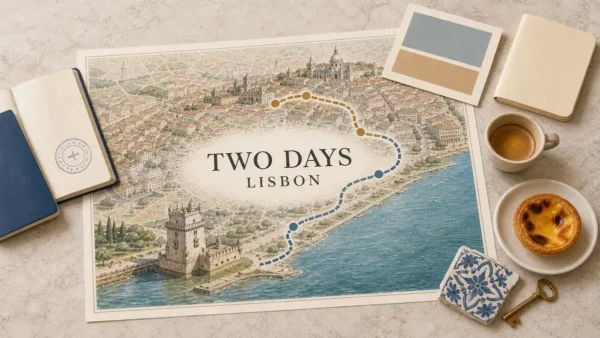
The tiers above set pacing; the routing lives elsewhere. Our 2-day Lisbon itinerary and 3-day Lisbon itinerary lay both out day by day.
Is 3 Days Enough in Lisbon?
Three days is enough for Lisbon itself. It covers the Baixa–Chiado core, an Alfama morning, the Belém monuments and two or three miradouros at a walking pace. The trade is the day trip: at three days, Sintra or Cascais fits only if you surrender part of the city.
When to Visit Lisbon
Spring and early autumn are the best times to visit Lisbon. March to May and September to October deliver warm, walkable days without midsummer heat, peak crowds or peak prices. High summer is hottest and busiest; winter is mild, quiet and cheapest. Lisbon has no unusable season.
- Shoulder season — best for first-timers and anyone who intends to walk the hills. Long daylight, comfortable climbing weather, and room to sit at the miradouros. The tradeoff: everyone else has worked this out too, so central stays book up early.
- High summer — best for travelers tied to school holidays or continuing to the coast. The tradeoff is real: the climbs punish you in the afternoon heat, queues run longest, and Lisbon empties of its own residents in August, so some neighbourhood kitchens close.
- Winter — best for budget trips, museum days and anyone who dislikes crowds. Days stay mild by northern European standards and the viewpoints are yours. The tradeoff is shorter daylight, spells of rain and a quieter evening scene.
If Lisbon is one stop in a longer trip, the season maths changes with the region — our guide to the best time to visit Portugal weighs the north against the Algarve.
Where to Stay in Lisbon for a First Trip
Where you stay in Lisbon is a choice between flat and steep. Baixa and Chiado sit on the level, minutes from the metro, and are the safe first-trip pick with luggage. Alfama and Graça trade that ease for atmosphere and stairs; Bairro Alto and Cais do Sodré put nightlife at the door; Príncipe Real stays quieter.
- Flat and central — Baixa and Chiado. Level streets, the Baixa-Chiado metro station, walking distance to most of what you came for. Our where to stay in Lisbon guide compares the areas side by side, and the best areas for first-time visitors narrow it further.
- Steep and atmospheric — Alfama, Graça and the castle hill. Tiled lanes, fado at night, views from the doorstep, all paid for in stairs. Couples who want that trade can start from our romantic places to stay in Lisbon.
- Nightlife-adjacent — Bairro Alto and Cais do Sodré. Bars at street level and noise carrying late; our nightlife stay guide flags which streets still sleep.
- Value and family bases — the cheaper edges of the centre hold up well on foot. See our budget stays in Lisbon and, for cots, lifts and flat approaches, our family stays in Lisbon.
- Top end — river views, pools and design hotels cluster in a handful of streets. Our luxury areas guide and our pick of luxury hotels in Lisbon cover them.
Book the hill only if you can picture the last hundred metres of it with your suitcase in your hand.
Hotels and places to stay
Compare hotels, apartments and stays for your dates in one search.
Search hotels and stays on hotels.com →
Tripstou may earn a commission if you book through this link, at no extra cost to you.
How to Get Around Lisbon
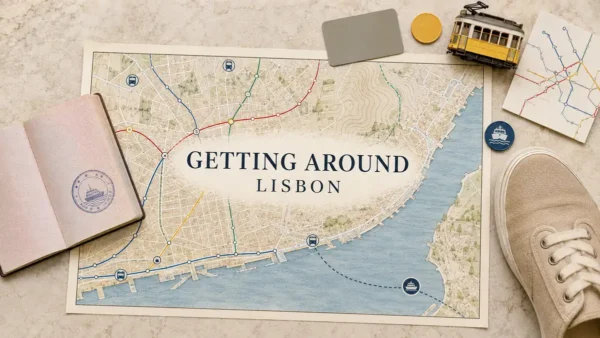
Lisbon runs on one flat fare: €1.90 a ride on metro, bus and tram. The catch is coverage — the metro skips most of the postcard districts, so trams, urban trains and your own legs fill the gaps to Alfama, Graça and Belém. Buy the reusable Navegante ocasional card for €0.50 and load it.
The fares, verified on the operators’ own sources: a single ride is €1.90; loading value as zapping brings it to €1.72; a contactless bank card tapped at the gate charges €1.92; a 24-hour Carris and Metro ticket is €7.25. Paying on board costs more — €2.30 on a bus, €3.30 on a tram — which is why the €0.50 card repays itself within three rides.
Use the metro for distance and the trams for the hill districts. Bus coverage is better than most visitors expect and reaches routes the metro never touches. Urban trains leave Rossio for Sintra and Cais do Sodré for Cascais, and ferries cross the Tejo from Cais do Sodré for the cheapest view of the city there is. The Lisboa Card exists and bundles travel with monument entries; whether it beats single fares depends on how many paid sights you genuinely want, and our Lisbon transport guide runs that comparison.
Do not plan on a funicular up to Bairro Alto: Ascensor da Glória is out of service. Walk up from Rossio, or ride the metro to Baixa-Chiado and climb through Chiado.
How do you get from Lisbon Airport to the city centre?
Take the metro from Aeroporto station at Humberto Delgado Airport. It runs on the same €1.90 network fare: there is no airport supplement and no airport-specific ticket. AeroBus no longer runs, so ignore resellers still listing it. Taxis, transfers and shuttles are compared in our Lisbon airport to city centre guide.
Is Lisbon Walkable?
Lisbon is walkable in distance and punishing in gradient. The historic core is small enough to cross on foot without thinking about it, but Baixa is the only genuinely flat part of it. Everything worth climbing to — Alfama, Graça, the castle — arrives by stairs and steep calçada.
Gradient matters most on three days of any trip. Arrival day, when your suitcase meets the hill your apartment sits on. Any day holding two viewpoints, because the climbs to Castelo de São Jorge, Graça and Senhora do Monte stack up fast. And the day it rains, when polished calçada turns slick underfoot.
There is a cheap fix almost nobody mentions: plan the hills downhill. Climb or ride up once early, then let the rest of the route fall back towards the river all afternoon.
Travelers with limited mobility, knee trouble or a pushchair should base on the flat and treat the hills as day visits, reached from below. Grip beats style on the cobbles; our Portugal packing list makes the footwear case in detail.
How Much Does a Trip to Lisbon Cost?
A trip to Lisbon costs roughly €60–85 a day on a budget. Mid-range runs €110–165 and a comfortable trip €250–350, per person per day, flights excluded. Lisbon is cheap to move around and eat in; central beds are where the money goes.
- Budget, €60–85 — a dorm or simple guesthouse, market breakfasts and tascas for dinner, and the €1.90 fare doing all your transport. Lisbon is unusually kind at this level: the river, the miradouros and most of the walking cost nothing.
- Mid-range, €110–165 — a central double in Baixa, Chiado or Príncipe Real, a sit-down dinner most nights, a few paid monuments. The premium sits on the address: a flat, walkable one costs more than an atmospheric one up the hill.
- Comfortable, €250–350 — design hotels or river-view apartments, tasting menus, taxis instead of the climb. Lisbon absorbs this level easily, and it still caps out below Paris or Rome for the same standard.
The category-by-category breakdown sits in our Lisbon trip cost guide, and the national picture in our Portugal trip cost guide.
Who a Trip to Lisbon Suits — and Who Should Think Twice
Lisbon suits first-timers, couples and food-led travelers best. It works well for families and for nightlife trips when the base is chosen for them. It is hardest on anyone who cannot manage stairs and steep cobbles outside the flat grid of Baixa. Knees matter more than age here.
Every fit comes with a condition attached. Couples get the fado houses and the miradouro evenings, provided they take a hill base knowing what it costs in stairs. Families get trams, ferries and a riverfront to run along, provided the base is flat. Solo travelers get a sociable, English-friendly city with one of Europe’s simplest fare systems.
On safety, the realistic risk is pickpocketing where crowds concentrate — Tram 28 carriages, Baixa’s main streets, the busiest viewpoint platforms — and the specifics live in our Lisbon safety guide, our Portugal scams roundup and our solo female travel guide to Portugal. Street-level know-how, from tipping to calçada etiquette, is collected in our Lisbon travel tips.
Think twice if stairs and steep cobbles are a genuine barrier, or if you want a beach holiday with a city attached: the sand is a train ride away, and the city itself points uphill.
Day Trips From Lisbon and the Wider Portugal Route
Sintra and Cascais are Lisbon’s two genuine day trips. Both run on urban trains — Sintra from Rossio, Cascais from Cais do Sodré — so neither needs a car or a tour. Lisbon also works as the opening base for a wider Portugal route, north by rail or south by road.
- Day trips — Sintra and Cascais first, then Setúbal, Óbidos and the Arrábida coast as the second tier; all classified in our day trips from Lisbon guide.
- Route length — the ladder runs from our 7-day Portugal itinerary through the 10-day Portugal itinerary to the 14-day Portugal itinerary, with the shapes compared in our main Portugal itinerary planner.
- Rail or road — trains link the big cities cleanly, as our Portugal train itinerary shows, while a car earns its keep inland and in the Alentejo, covered in our Portugal road trip guide.
- Coast and islands — our best beaches in Portugal guide covers the mainland, and our Portugal islands guide handles Madeira and the Azores.
- The country above this page — our Portugal travel guide is the hub that frames every regional decision.
Starting in Lisbon and working north keeps the rail legs simple and the luggage moves few.
Frequently Asked Questions
Do people speak English in Lisbon?
Yes. English is widely spoken in Lisbon’s hotels, restaurants, shops and transport offices, and younger Portuguese speak it confidently. Learning bom dia, obrigado and a conta, por favor is still appreciated, especially in neighbourhood tascas away from the centre, where staff may prefer Portuguese.
What currency does Lisbon use?
Lisbon uses the euro, like the rest of Portugal. Cards are accepted almost everywhere a visitor spends — hotels, restaurants, supermarkets, museums and transport machines — and contactless is standard. Check with your bank about foreign-transaction charges before you travel, since those come from your card issuer, not from Portuguese prices.
Do you need cash in Lisbon?
Not for most of a trip, but carry a small amount. Cards cover hotels, restaurants and ticket machines, while kiosks, market stalls, some small tascas and a few fado rooms still prefer notes and coins. Tipping in cash is easier, too. Prefer a bank ATM to a standalone machine.
Do you need a car in Lisbon?
No. A car is a liability in Lisbon: the historic streets are narrow and steep, parking is scarce and expensive, and the metro, buses, trams, urban trains and ferries reach everything a first trip needs. Rent only when you leave the city for an onward Portuguese road trip.
What shoes should you wear in Lisbon?
Wear flat shoes with real grip. Lisbon’s pavements are polished calçada — small limestone blocks that turn slick in rain — and the routes to Alfama, Graça and the castle climb steps and steep lanes. Trainers or rubber-soled walking shoes beat smooth leather soles and anything with a heel.
Is Tram 28 worth riding?
Yes, once, and early. The ride is the attraction: steep lanes, tight corners and views no metro line reaches. The trade is a packed carriage and pickpockets working it, so keep bags in front of you. Tap a travel card at the door — paying the driver costs €3.30 against €1.90.
Is Lisbon good for families with young children?
Yes, with a flat base — and easier than the hills suggest. Trams and the Tejo ferries work as cheap entertainment, the riverfront at Belém is open and flat, and restaurants seat children late without fuss. Pushchairs are the real constraint on stairs and calçada, so keep the hills as visits.
Is Lisbon a good first trip to Europe?
Yes — it is one of the easiest European cities to start with. The centre is compact enough to learn in a day, one flat fare covers every mode including the airport, and prices sit below Paris or Rome for the same standard. The one thing to prepare for is the gradient.
Related Guides
- Where to Stay in Lisbon — the areas compared, flat against steep.
- 3-Day Lisbon Itinerary — the three days above, routed day by day.
- Lisbon Transport Guide — fares, cards and passes in full.
- Lisbon Trip Cost — the bands broken down by category.
- Things to Do in Lisbon — the sights this page only names.
- Day Trips From Lisbon — which escapes are worth a whole day.
Did this guide save you time or money? Tripstou is independent and reader-funded — if you'd like to give something back, you can support the site with a crypto contribution of any size.