Berlin is a first trip built around history you can walk through, museums on a large scale and long evenings out, and it rewards the planner who settles one thing before anything else: how many days to give it. The city is big and spread out, so the length of the stay decides how much of it you actually see.
Once the days are fixed, the rest follows in order: the season, the district you sleep in, the train from BER, and the one visit that has to be registered before you fly.
Quick Answer
Berlin is worth a first trip if you want twentieth-century history, big museums, nightlife and green space more than a pretty old town. Three days is the sweet spot; two covers only the headline landmarks, and four to five adds a slower pace and a day trip. First-timers base in Mitte; nightlife-led travelers pick Kreuzberg or Friedrichshain.
About This Berlin Guide
This page plans a first trip to Berlin — whether to go, how long to stay, when, where to base, how to get in from BER and what to register ahead — and leaves the sights list, hotel choice, day-by-day plan, fare tables, budget figures and entry status to the linked Berlin and Germany guides.
Written with AI assistance, this Berlin planner had its arrival, ticket and Reichstag details checked by Alex Perrut, working in tourism since 2015, for the Tripstou editorial team under our editorial process.
Official sources consulted: DB Regio Berlin-Brandenburg, Sachsenhausen Memorial, German Bundestag, Berlin city portal, Potsdam Tourism.
Berlin is worth it for history, museums and nightlife, not for prettiness
Berlin rewards a first trip because its recent past is out in the open: the line of the Wall, the Cold War checkpoints and the memorials to the Nazi era sit in the streets you walk, not behind glass. Its museums, parks and night scene are all large. What it does not have is a compact, pretty old town, and a visitor who travels for cobbled squares will love Berlin for other reasons or not at all.
The city suits four kinds of first-timer, each in a different way:
- The history-first traveler gets the most from Berlin of anyone, because the Wall sites, the Topography of Terror and Sachsenhausen tell one continuous story within a short train ride of each other.
- The museum-first traveler can fill whole days on Museum Island alone and still leave the west side untouched.
- The nightlife-first traveler finds the late, loose Berlin of Kreuzberg and Friedrichshain, where an evening starts when other capitals are closing.
- The park-and-café traveler spends long afternoons in the Tiergarten and in beer gardens and comes home rested.
Berlin does less well for shoppers on a Sunday, for anyone who wants every sight within a short stroll, and for a trip that is mainly about architecture older than the twentieth century. If you are still weighing Berlin against Munich or a longer route through the country, the Germany travel guide sets out that choice; this page assumes Berlin is on the list.
What Berlin is known for: the landmarks that anchor a first trip
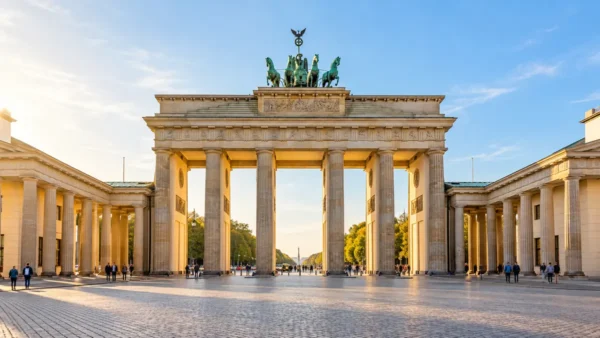
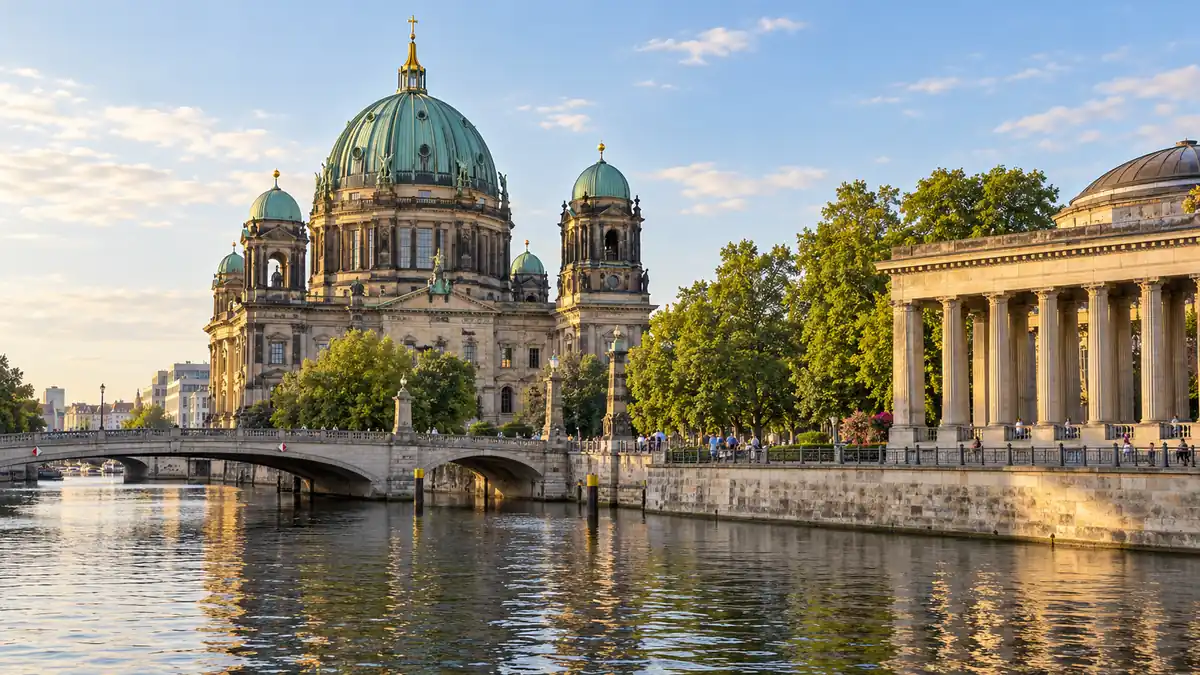
Berlin’s first-trip anchors sit in three groups: the Brandenburg Gate and the Reichstag dome at the eastern edge of the Tiergarten; Museum Island and the TV Tower at Alexanderplatz in the east of Mitte; and the Wall sites (the Berlin Wall Memorial at Bernauer Strasse and the East Side Gallery). The Memorial to the Murdered Jews of Europe and the Topography of Terror are where the twentieth century is confronted most directly.
The walk from the Brandenburg Gate east to Museum Island links the first group to the second and makes a natural first afternoon in Mitte; if you want the story told as you go, book a guided walk. Gendarmenmarkt sits just off that line. Checkpoint Charlie is busy and staged, yet worth a few minutes as context for the Wall sites.
The Memorial to the Murdered Jews of Europe and the Topography of Terror are a short walk apart, and many first-timers visit them in one sitting with someone who can connect the Nazi and Cold War layers of the same ground; for that, book a history walk.
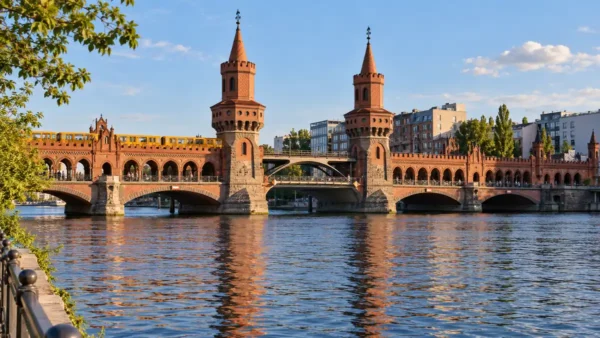
A boat trip on the Spree is the easiest orientation on an arrival day. From the water the government district, the Reichstag and Museum Island pass in the same order you will later walk them, and it asks nothing of tired legs. Further west, Charlottenburg Palace is the one big sight outside the centre that justifies its own half day.
Berlin’s landmarks are spread across districts, not lined up on one street, so the group you start in shapes the whole first day. The full selection, with what each sight is like to visit, is in the guide to things to do in Berlin.
Do you need to book the Reichstag dome?
Yes, in practice: the Reichstag dome is free, but you register online in advance, and there is no phone booking. Register online before you travel; same-day places are not guaranteed.
Walk-in places exist only at the service centre on Platz der Republik, only if slots remain, and only at least two hours before the visit. Every visitor needs original photo ID. Of all the Berlin landmarks, this is the only one whose visit has to be fixed before the flight, so do it the day you book your tickets.
What to eat in Berlin: currywurst, döner and the market halls
Berlin’s food identity is street-level. Currywurst is the dish to try first, at Curry 36 or Konnopke’s Imbiss, followed by a döner kebab, a Berliner Pfannkuchen and a glass of Berliner Weisse. For an evening that sits still, go to the street-food market at Markthalle Neun, the KaDeWe food hall in the west, or a beer garden such as Prater Garten.
Tours and activities
Book skip-the-line tickets, day trips and local tours with free cancellation on most activities.
You can also browse everything on getyourguide.com.
Tripstou may earn a commission if you book through this link, at no extra cost to you.
How many days do you need in Berlin?
Three days is the first-trip sweet spot in Berlin: it covers the Mitte landmarks, one day on the Wall sites and one day for museums or a neighbourhood, without rushing. Two days buys the headline landmarks only. Four to five days lets the pace drop and adds a day trip.
| Trip length | What fits | Who it suits |
|---|---|---|
| Two days | Brandenburg Gate, Reichstag dome, Museum Island from outside, one Wall site | A Berlin stop inside a longer Europe trip |
| Three days | Mitte landmarks, a Wall day, a museum or neighbourhood day | Most first-timers |
| Four to five days | All of the above at an easier pace, plus Potsdam or Sachsenhausen | History-first and museum-first travelers |
Two days feels shorter in Berlin than in most capitals. The sights are grouped by district, not walkable end to end, so every switch between groups costs a train ride. A two-day visitor has to choose between the Wall and the museums.
The third day is the one that changes the trip. It turns a checklist into a city you understand, with room for Kreuzberg or Prenzlauer Berg at street level. For the day-by-day version, follow the 3 days in Berlin itinerary.
Late spring and September are the best time to visit Berlin
May, June and September are the best months for a first trip to Berlin: the days are long, café terraces and beer gardens are open, and bed prices spike less than in high summer. Summer is the busiest and priciest season for beds. Winter is cold with short days, and its draw is the Christmas markets.
Late spring suits the park-and-café traveler best, since the Tiergarten and the beer gardens are the point of the season. September gives much the same outdoor life with the summer crowds thinned, which makes it the easier month for a first trip built around walking between districts.
High summer works for travelers who want the longest evenings outdoors and accept fuller, dearer hotels for it. Book beds early if July or August is the only window.
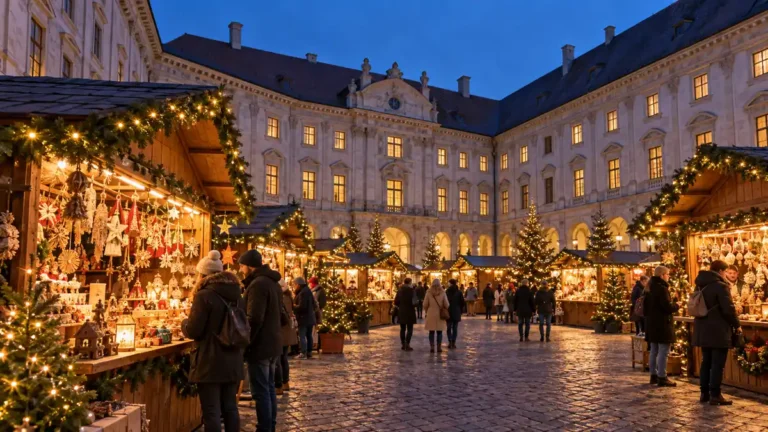
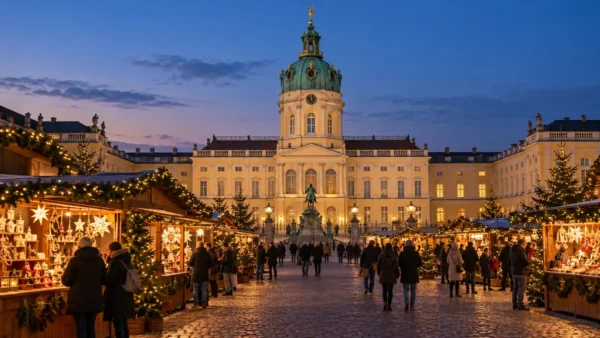
Winter is a season for a different trip: shorter days indoors at the museums, and evenings at Berlin’s Christmas markets. It suits travelers who come for the markets themselves, not for long outdoor sightseeing.
A museum-heavy or nightlife-led trip barely depends on the season at all. If those are your reasons for going, pick the dates on price and leave the weather out of it.
Where to stay in Berlin on a first trip, district by district
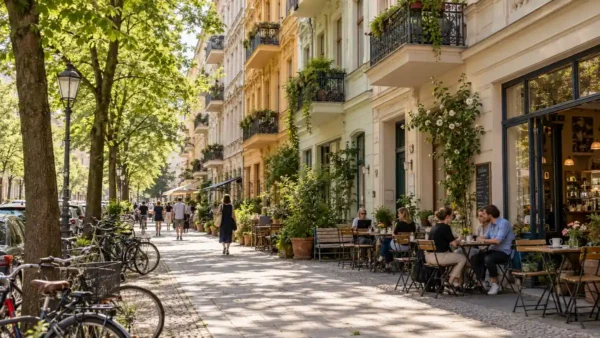
First-timers should base in Mitte, within walking range of the Brandenburg Gate, Museum Island and the main stations. Everyone else chooses by what their evenings look like, because the districts differ more after dark than by day.
- Mitte puts a first trip’s landmarks on the doorstep and keeps transfers short on every sightseeing day.
- Kreuzberg and Friedrichshain are the alternative, late-night Berlin, with the East Side Gallery on the Friedrichshain bank of the Spree.
- Prenzlauer Berg is quieter and café-lined, the easiest fit for families and early sleepers.
- Charlottenburg is the calm west side, close to the palace and KaDeWe, for travelers who like a slower, more residential base.
Neukölln suits a bar-led trip, and Schöneberg is the centre of Berlin’s LGBTQ+ scene. For the area-by-area decision and the hotels in each, see where to stay in Berlin.
Hotels and places to stay
Compare hotels, apartments and stays for your dates in one search.
Search hotels and stays on hotels.com →
Tripstou may earn a commission if you book through this link, at no extra cost to you.
Getting from BER into the city, and around a spread-out Berlin
From BER, take the FEX (Airport Express) to Berlin Hauptbahnhof in about 23 minutes on a Berlin ABC ticket, because BER sits in fare zone C, and validate the ticket before boarding. Inside the city the U-Bahn, S-Bahn and trams do the work, and the trick is to group each day’s sights by district, since Berlin is spread out.
The FEX runs about every 15 minutes in the main part of the day, stops at Südkreuz and Potsdamer Platz on the way in, and charges the standard fare with no airport premium. An ABC single costs €5. The S-Bahn lines S9 and S85 also serve BER if your base is closer to one of their stops.
One ticket system covers every train, tram and bus. The AB zone covers the city itself; zone C matters only for BER, Potsdam and Oranienburg. Because the FEX carries no supplement, the fastest train in from the airport is also the obvious one. Day tickets and the full fare picture are on the Germany trip cost page.
Do you need to validate tickets in Berlin?
Yes: a paper ticket must be stamped in a validator on the platform or on board before you travel, and an unvalidated ticket counts as no ticket. It is the rule first-timers most often learn from an inspector. Stamp it once, at the start of the journey.
Is Berlin expensive for a first trip?
Berlin is the cheaper of Germany’s two anchor cities: beds cost less than in Munich, the headline sights (the Reichstag dome, the memorials, the Wall sites, the parks) are free or low-cost, and street food keeps eating cheap. The money goes on summer beds and on paid museums.
On a tight budget, Berlin is unusually kind. A hostel or simple room outside Mitte, currywurst and döner for lunch, the free memorials and Wall sites by day and public transport instead of taxis add up to a full trip. The catch is summer, when the cheapest beds go first.
A comfortable middle buys a hotel in Mitte or Prenzlauer Berg, sit-down dinners, a few museum tickets and a day trip. This is where most first-timers land, and where the choice of month moves the bill more than anything you do once there.
A high-end trip buys a quiet room in Charlottenburg or central Mitte, long lunches, every museum you want and the odd taxi across a city that is wider than it looks. With beds below Munich’s, the same spend reaches further here. For daily budget bands and fares, see the cost of a trip to Germany.
Which day trips from Berlin are real day trips?
Two day trips from Berlin are easy on a Berlin ABC ticket: the Sachsenhausen Memorial, via Oranienburg, and Potsdam. Leipzig and Dresden are genuine long days by fast train that only fit a trip of four days or more. The Spreewald is a slower, optional green day.
| Day trip | From | About how long | Ticket and note |
|---|---|---|---|
| Sachsenhausen (RE5) | Hauptbahnhof | About 25 min to Oranienburg, hourly, plus about 20 min on foot | Berlin ABC ticket |
| Sachsenhausen (S1) | Friedrichstraße | About 45 min to Oranienburg, plus about 20 min on foot | Berlin ABC ticket |
| Potsdam (RE1 or S7) | Hauptbahnhof | About 30 min | Berlin ABC ticket |
Potsdam is the half-to-full day that pairs best with a three- or four-day stay, since it needs no ticket beyond the ABC one you already use for the airport run. Leipzig and Dresden are a different commitment: a long rail day there and back that crowds out Berlin itself on a short trip. The Spreewald, with its waterways south-east of the city, suits a fifth day and an unhurried pace.
How do you get to Sachsenhausen from Berlin, and is it worth the day?
Yes for a history-first traveler, and it takes about half a day: take the RE5 from Hauptbahnhof to Oranienburg, about 25 minutes and hourly, or the S1 from Friedrichstraße, about 45 minutes, then walk about 20 minutes to the memorial. Get off at Oranienburg; there is no station called Sachsenhausen. Admission to the memorial is free.
The site is large and sobering, and most visitors leave with more questions than an information panel can answer. Going with a guide helps for that reason; you can book a guided visit from Berlin. Plan a quiet evening after it.
Before you fly: the Berlin realities that catch first-timers
The things that change a first day in Berlin are small and avoidable: the city is spread out, so plan by district; validate every ticket; most shops shut on Sundays; carry some cash; and the red strips on the pavement are bike lanes. None of them costs much to get right, and each can cost a morning to get wrong.
- Plan each day around one district. Crossing Berlin twice in a day eats the hours you came for.
- Stamp the ticket before you ride. An unvalidated ticket counts as none, as the validation answer above explains.
- Treat Sunday as a museum or park day. Supermarkets and most shops are closed; the details are below.
- Keep some cash on you. Smaller Imbiss stands and market stalls do not always take cards.
- Stay off the red strips. They are bike lanes, and cyclists use them fast.
- Cross on the green light. Wait for the pedestrian signal, even when the street looks empty.
- Register for the Reichstag dome before the flight, as set out in the dome answer above.
Check the entry rules that apply to your passport before booking.
Are shops open on Sunday in Berlin?
Mostly no: supermarkets and most shops close on Sundays in Berlin. Museums, cafés, restaurants, bakeries in the morning and station shops stay open, so Sunday is a day for a museum or a park, not for shopping. Buy breakfast supplies on Saturday.
Decide These Before You Book
- Give Berlin three days on a first trip, since two days covers only the headline landmarks and four to five days adds a slower pace and a day trip.
- Go in May, June or September for long days and open beer gardens without high-summer bed prices, and keep winter for a trip built around the Christmas markets.
- Sleep in Mitte if the landmarks lead the trip, in Kreuzberg or Friedrichshain if the nights do, and in Prenzlauer Berg if you want quiet streets and cafés.
- From BER, ride the FEX to Hauptbahnhof on a Berlin ABC ticket, and stamp every paper ticket before boarding, because an unvalidated ticket counts as no ticket.
- Register online for the free Reichstag dome visit before you fly, because walk-in places are not guaranteed and every visitor needs original photo ID.
- Plan each day around one district, carry some cash for Imbiss stands and market stalls, and treat Sunday as a museum or park day because most shops close.
Did this guide save you time or money? Tripstou is independent and reader-funded — if you'd like to give something back, you can support the site with a crypto contribution of any size.