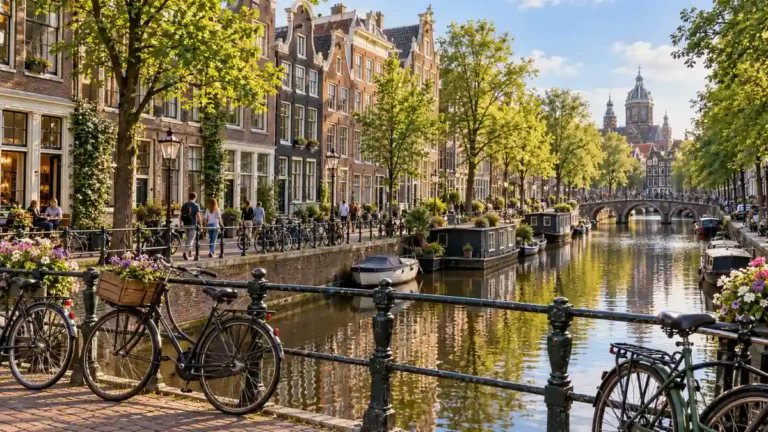
Travel to Amsterdam works best as a three- to four-day first trip built around the canal ring, the Museumplein museums and one day trip by train. Planning a trip to Amsterdam comes down to choices made before you book: how long to stay, which season, the neighbourhood you sleep in, the train from Schiphol, the two museums that need timed tickets, and which nearby towns really fit into a day.
Quick Answer
Amsterdam is worth a first trip for its canal ring, two world-class museums and a compact centre you cover on foot and by tram. Three to four days is the sweet spot: both museums, the canals, the Jordaan and one day trip. Two days covers the highlights only. It suits first-time Europe travelers, art lovers and couples.
Amsterdam Is Worth It for the Canal Ring, the Museums and the Jordaan
Amsterdam is worth a first trip, and the reasons sit well above its nightlife reputation. The seventeenth-century canal ring along the Prinsengracht and the Herengracht is the city’s real landmark. Museumplein holds the Rijksmuseum, home of Rembrandt’s Night Watch, and the Van Gogh Museum side by side. And village-scale neighbourhoods like the Jordaan and the Nine Streets reward slow walking. The honest trade-off: the centre is crowded and hotel beds are expensive in season.
The rest of the first-timer’s map is compact. Dam Square and the Royal Palace mark the old centre. The Anne Frank House stands beside the Westerkerk on the Prinsengracht. The Begijnhof hides a quiet courtyard a few steps from the shopping streets, the Bloemenmarkt floats along the Singel, and Vondelpark is where the city goes on a dry afternoon. De Wallen, the Red Light District, is part of the oldest quarter whether you seek it out or not.
Across the IJ, the A’DAM Lookout and the NDSM wharf in Noord show the industrial, creative side of the city. A canal cruise on the first evening is the classic way to see how all of it fits together from the water. The sights, how to group them and how long each takes are on the page of things to do in Amsterdam.
Who Amsterdam Suits, and Who Will Find It Too Crowded
Amsterdam suits first-time Europe travelers looking for a walkable city without a car, art lovers, couples and anyone pairing a city break with small Dutch towns. It suits less well anyone after quiet streets in summer, cheap beds in peak season or a sun-and-beach holiday, and visitors who expect the nightlife reputation to be the whole city.
For a first trip to Europe, Amsterdam is an easy start. English works everywhere, the centre is small, and a train from the airport lands you in the middle of it. Art lovers get Rembrandt, Vermeer and Van Gogh on a single square. Couples get the canal evenings and the brown cafés, which are at their best out of season.
Crowds are the real filter. Centrum and the Red Light District on weekend evenings feel like a festival you did not sign up for. If that puts you off, sleep outside the old centre and walk it in the morning.
Is Amsterdam good for families?
Yes, Amsterdam is good for families once you pick a calm base. Vondelpark, the free ferry across the IJ and the trams themselves keep children entertained, and ARTIS Royal Zoo is the family anchor of any visit; you can reserve zoo entry before the day. Oud-Zuid and Oud-West are the quieter bases. Two caveats: bike traffic on narrow streets is hard work with small children, and the Red Light District is part of the old centre, not a separate zone.
How Many Days Do You Need in Amsterdam?
Three to four days is right for a first visit: enough for the Rijksmuseum and the Van Gogh Museum, the canal ring on foot and by boat, the Jordaan, and one day trip by train. Two days covers the highlights but feels rushed. Five days or more buys a relaxed pace or two day trips. The centre is compact, the towns around it sit under an hour away, and the timed museum tickets fix your days for you.
| Trip length | What fits | Pace | Who it suits |
|---|---|---|---|
| 2 days | One big museum, a canal cruise, the Jordaan, Dam Square | Rushed, no day trip | Weekend breaks, stopovers |
| 3–4 days | Both big museums, the canal ring, the Jordaan and De Pijp, one day trip | Comfortable | Most first-time visitors |
| 5+ days | Smaller museums, Noord, two day trips | Relaxed | Slow travelers, longer Netherlands trips |
Two days is enough only for the highlights. Pick one museum, take a canal cruise, walk the Jordaan and Dam Square, and skip the day trips; the Anne Frank House and the Van Gogh Museum have to be booked before you arrive or they will not fit at all. The hour-by-hour version is the 2-day Amsterdam itinerary.
The third day matters more here than in most capitals. With two museum slots on fixed times, a two-day visit spends half its daylight working around entry windows; a third day frees the canals and neighbourhoods from the clock.
When to Go: Spring for the Tulips, Autumn for the Space
Autumn is the easiest first-trip season: mild weather, thinner crowds and museums without queues outside. Spring is Amsterdam at its most photographed and most expensive, with tulip season, Keukenhof open and King’s Day. Summer brings long evenings and peak crowds on the canals. Winter is the cheapest and darkest, with the Amsterdam Light Festival as its own reason to come. Go in autumn unless flowers are the point of the trip.
Spring suits anyone who has come for the bulb fields. Expect the highest hotel prices of the year and the fullest museum slots.
Summer suits long canal-side evenings, Pride and day trips with daylight to spare. It also brings the densest crowds in Centrum.
Winter suits budget and culture trips. Days are short, but the museums, the brown cafés and Sinterklaas season give the city a warmer feel than the weather suggests. Rain is possible in any season, so pack a hooded jacket; an umbrella loses to the wind on a bridge. The month-by-month view is in the guide to the best time to visit Amsterdam.
Where to Base Yourself: Centrum, Jordaan, De Pijp, Oud-Zuid or Noord
For a first trip, the Jordaan or the canal-ring edge of Centrum puts the sights on foot, at the cost of the highest prices and the busiest streets. Oud-Zuid and Oud-West, near Museumplein and Vondelpark, are the calmer first-timer alternative.
Centrum suits short trips where every hour on foot counts and the crowds are accepted. The Jordaan has the canal-house atmosphere with less of the late-night noise. Oud-Zuid and Oud-West trade a tram ride for quiet streets and the museums on the doorstep, which makes them the family pick. De Pijp, around the Albert Cuyp Market, is for food and evenings out. Noord, a free ferry ride across the IJ, is the creative, industrial option for anyone who wants space. The area-by-area comparison and the stay types are on the page about where to stay in Amsterdam.
Hotels and places to stay
Compare hotels, apartments and stays for your dates in one search.
Search hotels and stays on hotels.com →
Tripstou may earn a commission if you book through this link, at no extra cost to you.
From Schiphol to the Canals, and How to Get Around Once You Arrive
Schiphol has its own railway station under the terminal, and a direct NS train takes you to Amsterdam Centraal in a short ride. From there the centre is a walking city: GVB trams cover the Museum Quarter and De Pijp, a free ferry crosses to Noord, and a bike is for confident riders only.
The train from Schiphol to Amsterdam Centraal
The direct train is the default for nearly every visitor. The platforms sit under the terminal, so you walk from arrivals to the train without leaving the building, and a short direct train ride later you step out at Amsterdam Centraal. Pay by tapping a contactless bank card or phone at the reader as you enter at Schiphol and again as you leave Centraal, or buy a ticket at the NS machines. Taxis and hotel shuttles exist, but for a first trip the train is simpler to organise and lands you closer to the canals.
Can you pay with a contactless card on Amsterdam trams and trains?
Yes. The same contactless card or phone, tapped in and out, works on NS trains and on GVB trams, buses and metro. Forget to tap out and the trip is charged at a higher default fare, which is the one mistake worth avoiding.
Walking, trams, the free ferry to Noord, and whether to rent a bike
Walking covers most of a first visit; the other three modes fill the gaps.
- On foot: Centraal to Dam Square, the canal ring and the Jordaan, which is where most of a first trip happens.
- Tram: GVB trams for Museumplein, Vondelpark and De Pijp, the stretches that are long on foot.
- Free ferry: worth it, from behind Centraal across the IJ to Noord, the quickest way to see the river and reach A’DAM Lookout and NDSM, and it costs nothing.
- Bike: only if you ride confidently in traffic, know that bike lanes are not pavements and give trams the right of way; if unsure, walk and ride the tram.
What Do You Need to Book Ahead in Amsterdam?
Book two things before you fix anything else: the Anne Frank House and the Van Gogh Museum. The Anne Frank House sells timed tickets online only, not at the door, and they go fast, so book it as soon as your dates are fixed.
The Van Gogh Museum is the second timed-entry booking and the one to build your museum day around. Its timed slots fill, so secure the time first and plan the rest of Museumplein around it. The Rijksmuseum next door also runs on timed entry but needs less lead time, so you can book a timed ticket once the Van Gogh slot is set.
Everything else can wait. A canal cruise is easy to reserve a day ahead, and the Heineken Experience works the same way. The hotel is the third early booking in spring and summer, when the good-value rooms near the canals go first. How the museum tickets work, what they cost and whether the city card pays are in the Amsterdam museums guide.
Tours and activities
Book skip-the-line tickets, day trips and local tours with free cancellation on most activities.
You can also browse everything on getyourguide.com.
Tripstou may earn a commission if you book through this link, at no extra cost to you.
What Amsterdam Costs, by How You Like to Spend
Amsterdam is among the pricier European cities, and the hotel bed decides the bill, especially in spring and summer. Getting around is cheap thanks to walking, trams and a free ferry. Museums are the main paid activity, and eating ranges from a herring stall to a canal-house restaurant.
On a tight budget, the trip runs on a hostel or a room outside the canal ring or in Noord, market and street food, one timed museum a day, walking, and day trips by train. The city is kind to this style: the distances are short, the ferry is free and the parks cost nothing. It is punishing only on beds in peak season.
A comfortable middle buys a small hotel or B&B in the Jordaan or Oud-Zuid, one sit-down dinner a day, both big museums, a canal cruise and one or two day trips. Amsterdam rewards this style most. The extra spend goes into location, and location is what saves time here.
A high-end trip means a canal-house hotel, restaurant dinners, private or small-group tours and taxis where trams do not go. A city tourist tax is added to hotel bills at every level, and the I amsterdam City Card exists for heavy museum days; the museums guide says whether it pays off.
Moving your bed one neighbourhood out of the canal ring changes the cost of an Amsterdam trip more than any saving on food or transport: the tram ride back costs minutes, the room costs every night.
Eating well on any budget: herring stalls, brown cafés and the markets
Amsterdam’s cheapest food is also its most local. Raw herring (haring) from a stall such as Stubbe’s Haring, kibbeling, poffertjes and a warm stroopwafel cost little and taste like the city. Bitterballen and kroket come from a wall dispenser or, better, with a beer in a brown café (bruin café). Dutch apple pie at Winkel 43 and Gouda or Edam from a market stall fill the middle ground. For browsing and grazing, the Albert Cuyp Market, Foodhallen in De Hallen and the Noordermarkt are the places to know. What to order and where is in the Amsterdam food guide.
Which Day Trips from Amsterdam Are Real Day Trips?
The real day trips are the towns under half an hour or within about an hour by direct train from Amsterdam Centraal: Haarlem and Zaanse Schans first, then Utrecht, then Leiden, the Hague with Delft, and Rotterdam. Giethoorn, the Volendam, Edam and Marken loop and Keukenhof are coach or tour days, and Bruges is a long cross-border day that eats into the whole trip.
Under half an hour by train
- Haarlem: a smaller canal city with the Grote Markt and the Frans Hals Museum, the easiest half day out.
- Zaanse Schans: windmills and green wooden houses, from Zaandijk Zaanse Schans station plus a short walk.
- Utrecht: an old canal core with wharf cellars at water level and the Dom tower.
Within about an hour by train
- Leiden: a university canal town, quieter than Amsterdam.
- The Hague and Delft: Vermeer at the Mauritshuis, the sea at Scheveningen, and Delft’s old centre close by.
- Rotterdam: modern architecture and the harbour, the counterpoint to Amsterdam’s gables.
A full day by coach or tour, not a quick hop
- Giethoorn: the canal village, far enough to take the whole day.
- Volendam, Edam and Marken: fishing harbours and a cheese town, usually combined in one loop.
- Keukenhof and the bulb fields: spring only.
- The windmill-and-cheese countryside: farms and polders, best on a guided outing.
- Bruges: across the border in Belgium, a long day for a short visit.
Choose a coach day only when the place cannot be reached any other way: it costs a full day that a train trip to Haarlem or Utrecht would leave half free. On a trip of a week or more, a second base in Rotterdam or Utrecht beats long return journeys from one Amsterdam hotel; the Netherlands travel guide covers planning the wider trip. How to reach each town, and what to see once there, is on the page of day trips from Amsterdam.
Entry Rules, English and Etiquette Before You Fly to Amsterdam
The Netherlands is in the EU and the Schengen area and uses the euro. Check the entry rules that apply to your passport before booking. English is spoken everywhere you will go as a visitor, so you need no Dutch, though a “dank je wel” is always appreciated.
- Bike lanes are not pavements: look both ways before you step off the kerb.
- Coffeeshops and the Red Light District call for discretion, and the windows are never photographed.
- Cards are the norm, but a little cash helps at markets and some toilets.
- Common scams and the tourist tax are covered with the local rules.
Each of these has its own short entry in the guide to Amsterdam etiquette and local rules.
Decide These First
- Plan three to four days for a first visit, because two days covers the highlights but leaves no room for a day trip.
- Book the Anne Frank House and a Van Gogh Museum time slot before anything else, since the Anne Frank House sells no tickets at the door.
- Base yourself in the Jordaan or Oud-Zuid for a first trip, and choose Centrum only if you accept its crowds and prices.
- Go in autumn for the easiest balance of weather and crowds, and in spring only if the tulips are the reason for the trip.
- Take the direct train from Schiphol and tap the same contactless card in and out on trains and trams alike.
- Put your money into the hotel’s location, because the bed decides what Amsterdam costs while walking, trams and the free ferry keep the rest cheap.
- Pick Haarlem, Zaanse Schans or Utrecht for a day out that leaves half the day free, and treat Giethoorn or Keukenhof as a full day by tour.
Scope and Sources
This page plans a first trip to Amsterdam (trip length, season, base, the Schiphol train and getting around, what to book, what each spend style buys and which day trips work) and leaves the sights list, museum tickets, area-by-area stays, the 2-day plan, eating, day-trip logistics and local rules to their own guides.
Written with AI assistance, this planner was then read through by Alex Perrut, working in tourism since 2015, for the Tripstou editorial team; our editorial process sets out the method.
Official sources consulted: Holland.com, NBTC Holland Marketing, Anne Frank House.
Keep Planning Amsterdam
- 2-day Amsterdam itinerary: the hour-by-hour plan for a short visit.
- Things to do in Amsterdam: the sights and how to combine them.
- Amsterdam museums guide: how the timed tickets work and which museums to pick.
- Where to stay in Amsterdam: area by area, with stay types.
- Amsterdam food guide: what to eat and where.
- Day trips from Amsterdam: each town and how to reach it.
- Best time to visit Amsterdam: season by season.
- Amsterdam etiquette and local rules: cash, coffeeshops and the Red Light District.
- Netherlands travel guide: the rest of the country.
Did this guide save you time or money? Tripstou is independent and reader-funded — if you'd like to give something back, you can support the site with a crypto contribution of any size.