
Three days in Paris is a sequencing problem, not a shortlist problem. The city is large, split down the middle by a river, and its headline sights sit on opposite banks — so the difference between a good three days and an exhausting three days is the order you put them in, not the number of things you tick off.
Two kinds of reader land here. One has the dates fixed and wants the route. The other is still deciding whether three days is the right length at all. This guide answers both: the day-by-day route in the order that works, the reasoning behind the split, and a straight verdict on what three days genuinely buys you. It also resolves the one real fork in the plan — whether day three belongs at Versailles or deeper inside the city — instead of leaving you with two half-answers and a map.
Quick Answer
Split three days in Paris by geography: the Left Bank core, the Right Bank icons, then a third day. Day three is the fork: a Versailles excursion out and back, or more of the city. The route suits first-time visitors; set your day order around closing days before booking anything.
Trust Layer
Tripstou itinerary guide for travelers planning a route. Covers pacing, stop count, stop order, base logic, and trip length.
Produced with AI assistance and reviewed by Alex Perrut, working in tourism since 2015, for the Tripstou editorial team. See our editorial process for details.
Last factual review: August 7, 2026.
Official sources consulted: France.fr, Atout France.
Key Takeaways
- Split the three days by geography — Left Bank core, Right Bank icons, then a flexible third day — to avoid backtracking.
- Three days is the confident first-visit minimum: it covers the core highlights but not deep museum time or a second excursion.
- Book four nights for three full days — evening arrivals and morning departures produce fragments, not usable days.
- Choose Versailles on day three for palace-scale contrast, or a deeper city day if finishing Paris matters more.
- Sequence around two closures: the Louvre shuts on Tuesdays and the Versailles palace shuts on Mondays.
- Keep one central base for all three nights and reserve the Louvre slot before you leave home.
Table of Contents
Is 3 Days in Paris Enough?
Three days is the confident first-visit minimum in Paris — enough for the core highlights without rushing. It covers the historic centre, the major Right Bank icons, and one flexible day, at a pace that still leaves room to sit down. What it does not buy is deep museum time or a second day trip.
Two days forces the first real cut. You keep the historic core and one big museum, and you lose the flexible day that absorbs bad weather, a late start, or a closure. Three days is where the trip stops behaving like a checklist and starts behaving like a visit, because the third day is the one you can spend on a single idea instead of on transit between icons.
Four or five days do not add more icons — they add depth. The extra time goes into neighbourhoods, a second museum at a slower pace, and the fork option you did not take on day three. That is a different kind of trip, and a genuinely better one, but it is not what most first visits have available. If you are still shaping the whole trip and not only its route, the full Paris planning guide covers the wider decisions this page deliberately leaves alone.
| Trip length | What the route covers | Pace | Who it suits |
|---|---|---|---|
| Two days | Historic core and one major museum | Tight, with almost no slack built in | Stopover visitors and weekend add-ons |
| Three days | Both banks plus one flexible third day | Full but humane, with real breaks | First-time visitors on a city break |
| Four to five days | Both banks, Versailles and a neighbourhood day | Relaxed, with time to revisit favourites | Return visitors and slower travelers |
The day you lose in Paris is almost never day two — it is the half-day swallowed by arrival and the one clipped by departure. That is why this route front-loads streets and bridges on day one and puts the ticketed heavyweight in the middle, where a delayed flight cannot take it down as well.
How Many Nights Do You Need for 3 Full Days?
Three full days in Paris means four nights. An evening arrival and a morning departure do not produce two usable days between them; they produce two fragments and a lot of luggage handling. Book four nights and the three days in this route are actually yours.
Transfer time is the reason the maths is unforgiving. Getting in from the airport and back out again eats into day one and day three at both ends, and the further your base sits from the centre, the more it eats — see getting from the airport into central Paris for how that transfer works in practice. If your flights genuinely force a three-night trip, treat arrival day as a half-day and plan from the shorter version in the adaptation section below.
The Route at a Glance: How to Split 3 Days in Paris
The strongest split groups each day by geography — one bank or zone per day, with minimal backtracking. The Seine divides Paris into the Left Bank in the south and the Right Bank in the north, and most headline sights cluster on one side or the other. Grouping by side turns transit time into walking time.
Here is the three-day Paris itinerary in one block. The day sections below expand it in the same order:
- Day 1 — Île de la Cité and the Left Bank: the city’s oldest ground, on foot.
- Day 2 — the Right Bank, Louvre to the boulevards: the icons day.
- Day 3 — Versailles out and back, or a deeper city day: the flexible day.
The order is not arbitrary. Day one is the walking day, so it survives jet lag, a late start, and a delayed bag; nothing on it depends on a reserved slot. Day two carries the ticketed heavyweight in the middle of the trip, when you are rested and already know how the city fits together. Day three sits last because it is the one that can absorb everything the first two days pushed forward — a closure, rain, or simply the museum you did not finish.
Most disappointing Paris itineraries are not overfull. They zigzag. Crossing the Seine twice in the same day is the tell, and it usually costs an hour that would have bought a slower lunch or an unhurried gallery.
Day 1: The Historic Core — Île de la Cité and the Left Bank
Start where Paris started — the islands and the Left Bank, walked as one connected arc. Day one leans on streets and bridges instead of ticket queues, which suits a first morning after travel. It also sets your mental map: once you have crossed the Seine on foot, the rest of the route makes sense.
Morning — Île de la Cité. Give the island a slow couple of hours. Notre-Dame anchors it, and the quays around it are the orientation point for everything that follows; from the middle of Pont Neuf you can see both banks at once, which is the fastest way to understand the split this route is built on. Leave on foot across one of the small southern bridges — the island connects straight into the Latin Quarter, and no transport is involved.
Midday to mid-afternoon — the Latin Quarter and Luxembourg. This block takes the middle of the day, including lunch. It exists to slow the pace between two heavier bookends: the streets behind the Panthéon are for wandering, and the Jardin du Luxembourg is where most people’s first Paris afternoon quietly turns into a sit-down. Move west when you are ready, either on a riverside walk or a short metro hop if legs are complaining.
Late afternoon into evening — the western Left Bank. The last block closes the day at the Musée d’Orsay or, better for a first evening, the Champ de Mars beneath the Eiffel Tower at dusk. Both stay on the same bank, so the day never crosses the river. Check opening times for anything ticketed before you commit the afternoon to it. If this is your first trip to the city, a quick read of our first-timer Paris tips covers the small practicalities this route does not stop for.
Day 2: The Right Bank — the Louvre to the Grand Boulevards
Day two crosses the river for the Right Bank icons, anchored by the Louvre. Putting the heaviest museum in the middle of the route works: you arrive rested, you already know the city’s geography, and you still have a day in hand if something has to move. Reserve a Louvre slot before you travel.
Morning — the Louvre. Book a time slot ahead; it is recommended, not mandatory, but an unbooked arrival is how a morning becomes a queue. Take the museum in one focused block and leave before it flattens you — this route treats it as one leg of a day, never the whole day. You walk out directly into the next block, which is the point of putting it first. One date rule matters here: the Louvre is closed on Tuesdays, so if day two lands on a Tuesday, swap it with day three.
Afternoon — the ceremonial axis. This block is a straight walk and it takes as long as you let it. Cross the Tuileries, keep going up the Champs-Élysées, and finish at the Arc de Triomphe; it is one continuous line, so there is no navigation to think about and no reason to descend into the metro unless the weather turns. The scale of the axis is the actual attraction, and walking it is how you feel it.
Evening — the grand boulevards. Come back east for the Opéra district and the boulevards around it, which are at their best after dark and cost nothing to see. This block is deliberately unticketed, so it flexes: stretch it if the Louvre ran short, cut it to a dinner if the axis ran long. A short metro ride returns you to your base.
Day 3: Versailles or Deeper Into Paris?
Day three is a genuine fork: a Versailles excursion, or a deeper city day. Versailles wins if palace-scale grandeur is a headline reason for the trip; the city day wins if you would sooner finish Paris than leave it. Both work — they simply spend the same day on very different things.
The Versailles version is an out-and-back excursion, and it consumes most of the day. You leave central Paris early by train, spend the bulk of the day on the estate, and return the same way; there is no version of this that is a half-day. Book your entry ahead, and note the one hard constraint: the palace and the Trianon estate are closed on Mondays, though the park and gardens open daily. If Monday is your only free day, the fork resolves itself and you take the city option.
The deeper-city version runs at the same rhythm without the train. A morning in the Marais, an afternoon for the museum or island you did not reach on days one and two, and an evening up in Montmartre gives the day the same three-block shape as the rest of the route, with the advantage that every block sits close to your base and nothing depends on a departure time.
| Day three option | What the day delivers | What it costs the route | Best for |
|---|---|---|---|
| Versailles out and back | Palace-scale grandeur outside the city | The whole day, plus a quiet evening | First-timers who want the contrast |
| A deeper city day | Neighbourhood time and the museum you missed | The excursion, saved for a future trip | Travelers who prefer depth over distance |
| Trying to fit both | A rushed morning and a rushed evening | The pace that made the route work | Nobody on a three-day first visit |
Versailles costs more than a day; it costs the evening too. The return train lands you back in the city with tired legs and no appetite for a last Paris walk, so either plan a short evening close to your base or accept that your final night starts early. Crowds gather at the estate and on the train that serves it, and busy platforms are where bags get opened — our guide to staying safe and pickpocket-aware in Paris covers the habits worth having at both.
Museum Closing Days and Bookings Decide Your Day Order
Two closing days shape this route: the Louvre closes on Tuesdays and the Versailles palace closes on Mondays. Fix those two constraints before you assign anything else, because both sit on days that carry a headline sight. Everything else in the plan can move around them without changing the route’s shape.
The Two Closing Days That Lock the Sequence
Only two closures are firm enough to build a route on, and both are easy to design around once you know them.
- The Louvre is closed on Tuesdays. If your day two falls on a Tuesday, swap days two and three.
- The Versailles palace and Trianon estate are closed on Mondays. The park and gardens stay open daily, but a Monday excursion is not the visit most people are picturing.
- Every other closing day: check the official site before you lock your days. Museum closing days do change, and a plan built on a half-remembered rule fails on the morning it matters.
A Monday-to-Wednesday trip is the one common window where both closures bite at once, and it still resolves by reordering instead of by dropping anything: Louvre on Monday, the city day on Tuesday, Versailles on Wednesday.
What to Book Before You Arrive
Book timed slots for the big-ticket sites before you leave home, and leave the rest open. Two entries on this route deserve it: the Louvre and, if you take the fork, Versailles. The Louvre’s time-slot reservation is recommended rather than required — including for visitors entitled to free admission — and it is the one booking that most changes how day two feels. For Versailles, book ahead.
Everything else on this route is either free, outdoors, or small enough to absorb a wait. Tickets and pass choices are also where a short Paris trip quietly gains or loses money, and what a Paris trip costs handles that side of the decision in full.
Tours and activities
Book skip-the-line tickets, day trips and local tours with free cancellation on most activities.
You can also browse everything on getyourguide.com.
Tripstou may earn a commission if you book through this link, at no extra cost to you.
One Base and Mostly Walking: the Logistics That Make It Work
One central base serves all three nights, and most of each day works on foot. Moving hotels inside a three-day city trip costs you a morning and buys nothing, since no part of this route is far enough to justify a second check-in. Walk within each day’s zone; take the metro between zones.
Is One Hotel Enough for Three Days?
Yes — one central base covers all three days of this route without compromise. Both in-city days start and end within walking distance of the centre, and the Versailles departure is a train ride from that same base, so there is nothing a second hotel would solve. Packing twice inside a three-day trip is pure loss.
What matters is central, not fashionable: a base close to the core keeps the walking-first design intact, and that is a different question from which neighbourhood you would most enjoy living in. Our guide to where to stay in Paris resolves the area choice properly.
Walking vs the Metro Between Blocks
Walk inside each day’s zone and use the metro only for the long jumps between them. Every day in this route is built as a chain of adjacent blocks, so the walking is the connective tissue and not an endurance test — the streets between the stops are a large part of what you came for.
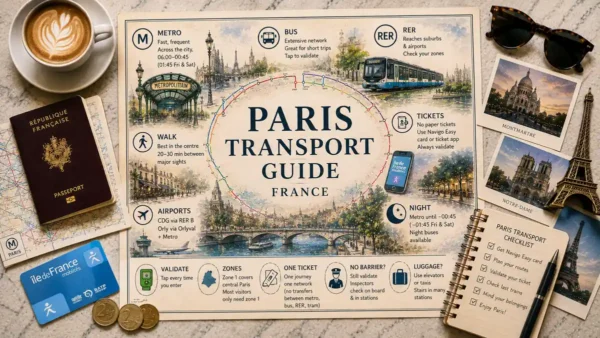
On this route the metro genuinely earns its place about twice a day: the hop between distant blocks, and the ride home at night. Everything else is walkable. For how the network actually works, see getting around Paris.
Hotels and places to stay
Compare hotels, apartments and stays for your dates in one search.
Search hotels and stays on hotels.com →
Tripstou may earn a commission if you book through this link, at no extra cost to you.
How to Adapt This Itinerary With More or Fewer Days
Shrink or grow this route by one rule — cut the fork day first, add depth before new zones. The three-day shape survives at two days and at five because it is built on geography instead of a fixed list of sights. Adapt the edges and keep the spine intact.
Cutting to two days. Day three goes first, whole. You keep the Left Bank arc and the Right Bank icons, and you lose the excursion along with the flexible day that absorbs closures — our 2 days in Paris itinerary takes it from there.
Growing to four or five days. Add depth before you add new territory:
- Take both sides of the day-three fork: the Versailles excursion and the deeper city day.
- Give one neighbourhood a full morning instead of an evening pass.
- Return to the museum you rationed on day two, at a slower pace.
- Only then look outside the route’s existing zones.
Travelling with kids changes the pace, not the route: keep the same three-block days and drop the third block on at least one of them, so the day ends before everyone has stopped enjoying it.
If it rains, swap within the day instead of rebuilding it:
- Move the day-one Left Bank evening indoors and push the outdoor block to a clearer day.
- Pull the ticketed museum forward from day two to whichever day the weather is worst.
- Trade a Versailles day for the city day — a wet estate is mostly a wet garden.
Frequently Asked Questions
Is the Paris Museum Pass worth it for 3 days?
It is worth it only if your three days include several paid museum entries. This route does not: day one is mostly streets, day two centres on one museum, and day three is either Versailles or neighbourhoods. Count your actual ticketed stops first, then decide — a pass you underuse costs more than it saves.
Can you do the Louvre and the Eiffel Tower on the same day?
Yes, but this route deliberately separates them. They sit on opposite banks, so pairing them costs a river crossing and most of an afternoon in transit. The Louvre anchors day two on the Right Bank; the Eiffel Tower closes day one on the Left Bank. Keep them apart and each gets a proper block instead of a rushed one.
Is a Seine river cruise worth it on a short Paris trip?
Yes, if it replaces a block instead of squeezing into one. A cruise sits naturally at the end of day one or day two, when the light is good and your legs are done. It works badly as a rushed extra between two ticketed stops, which is how most three-day trips try to fit it.
What is the best time of year to visit Paris for a 3-day trip?
Spring and early autumn suit this route best, because it leans on walking and daylight. Long evenings let the outdoor blocks run late, and that is where the route’s slack lives. Deep winter shortens every day and pushes more of the plan indoors, which makes the advance bookings matter more than usual.
Is 3 days in Paris too much for young children?
No, but the day-three fork resolves itself: choose the city day. An out-and-back excursion adds a train at both ends of an already long day, and that is where family plans usually break. Keep the same geographic split, start later, and let the base you chose absorb an afternoon rest.
What happens to this itinerary if it rains for all three days?
Swapping between days stops working, so change the block mix instead. With no dry day to trade into, keep the geographic split but shorten each day’s outdoor block and lengthen the indoor one. Every zone on this route has indoor stops within walking distance, so no day needs rebuilding from scratch.
Related Guides
- Paris travel guide — the full planning picture behind this route.
- 2 days in Paris itinerary — the shorter route, sequenced properly.
- Where to stay in Paris — choosing the central base this itinerary assumes.
- Getting around Paris — how the metro and walking fit together.
- Paris trip cost — what three days actually adds up to.
- Paris airport transport — the transfer that shapes days one and three.
Did this guide save you time or money? Tripstou is independent and reader-funded — if you'd like to give something back, you can support the site with a crypto contribution of any size.