Most people asking whether Paris is safe have already booked the trip. The question is not really whether to go; it is how worried to be, and what precautions actually earn their inconvenience. Paris carries a loud reputation for pickpockets and street scams, and that reputation does something unhelpful: it spreads a vague, general anxiety across an entire city when the real risk is narrow, specific and largely predictable.
This page gives a calibrated answer instead of a rating. It sets out what the realistic risk to a visitor is, where in Paris that risk concentrates and why, how night-time and the Métro change the picture, which scams you will actually meet and how to recognise them mid-approach, whether travel insurance is worth buying, and which numbers to call if something goes wrong. No safety scores. No list of neighbourhoods to avoid — no official body publishes one, and neither will we.
Quick Answer
Paris is safe for travelers, and violent crime against visitors is rare. The realistic risk is pickpocketing and scams, concentrated in crowded monument areas and on the Métro and RER. Treat packed transport and tourist choke points as the moment to secure your bag and ignore street approaches.
Trust Layer
Tripstou safety guide for travelers deciding how safe a destination is and what precautions actually matter. Covers real risk levels, common scams, situational awareness, and protection choices.
Produced with AI assistance and reviewed by Alex Perrut, working in tourism since 2015, for the Tripstou editorial team. See our editorial process for details.
Last factual review: August 7, 2026.
Official sources consulted: France.fr, Atout France.
Key Takeaways
- Paris is safe for visitors; the realistic threat is theft from your bag, not violence directed at you.
- Risk in Paris tracks crowd density and predictable tourist flow, not the reputation of any particular neighbourhood.
- Arrival day on the RER B, jet-lagged and holding luggage, is the highest-exposure hour of a Paris trip.
- Every Paris street scam opens with a stranger occupying your hands or your conscience; declining without stopping ends it.
- After dark the variable is setting, not postcode — empty parks and quiet station side streets, not whole districts.
- Travel insurance is worth buying for most Paris trips, and a theft claim needs a police report filed locally.
Table of Contents
Is Paris Safe for Tourists?
Paris is safe for tourists. Violent crime against visitors is rare, and the realistic threat to your trip is theft: pickpocketing and street scams worked on people who are distracted, loaded with bags and standing still in a crowd. The risk is to your bag, not to you.
Risk in Paris tracks crowd density and predictable movement. Neighbourhood character has much less to do with it than travel forums suggest. Thieves work where visitors are guaranteed to be, where hands are full and where attention is elsewhere: the queue outside a major monument, the steps of a landmark, a packed carriage, the ticket hall of a mainline station. That is why two people can spend the same week in the same city and come home with completely different stories — one moved through the choke points on autopilot, the other did not.
Paris is a capital, and it carries a capital’s standing security posture. Armed patrols under the national Vigipirate plan are a normal sight at stations, monuments and transport hubs, and bag checks at museums and department stores are routine. Both are background conditions, not signals that something is happening. Read them the way Parisians do — as furniture.
Strikes and demonstrations are a recurring feature of French public life and can appear with little warning, occasionally disrupting transport or closing a street; walking around a demonstration rather than through it is the whole of the advice.
The trap in Paris safety research is treating it as a map problem when it is a setting-and-behaviour problem. The same street is a different proposition at 8pm and at 2am, and the busiest tourist approaches carry more theft exposure than the residential blocks travelers spend their pre-trip worry on. If you want the country-level posture — French law, driving, regional differences — that sits in our guide to safety in France. If the trip itself is still taking shape, start from the full Paris travel guide.
Is Paris Safe at Night?
Paris is safe at night in its central, busy areas, where streets stay populated late. After dark the variable is setting. Quiet blocks around the big mainline interchange stations, large parks once they empty, and the thinning crowd on a last train all deserve more attention than a lit, busy boulevard.
Three settings account for most night-time unease in Paris, and each is a time-and-place condition you can route around. The streets immediately around the northern mainline stations are busy and unremarkable by day; late at night, once the commuter flow stops, the side streets go quiet while the station itself stays awake, and that combination is worth walking briskly through instead of lingering in. Paris’s two big woods, the Bois de Boulogne and the Bois de Vincennes, are daytime spaces that change character entirely once they empty — neither is somewhere to cross on foot after dark. And the last hour of Métro service concentrates a particular crowd: tired, drunk in places, moving fast.
Official guidance also flags drink spiking in bars and clubs, so keep your own drink in sight and treat an unattended glass as finished. It is a small habit and it costs nothing.
None of this makes a district unsafe. A street that feels wrong at 2am is usually the same street you walked at 8pm without a thought, and the honest advice is about the hour and the emptiness. The arrondissement number tells you very little. The night-time question worth asking in Paris is how long the walk lasts between the Métro exit and your door — that walk is the part you control, and it is decided when you book. If area choice is your real safety lever, that decision belongs in where to stay in Paris.
Is the Paris Metro Safe?
The Paris Métro is safe to use, including in the evening on busy lines. The documented risk is theft. Official guidance describes pickpocketing operating across the Métro, on RER lines and at the mainline stations, and it singles out two RER lines where more serious incidents have been recorded.
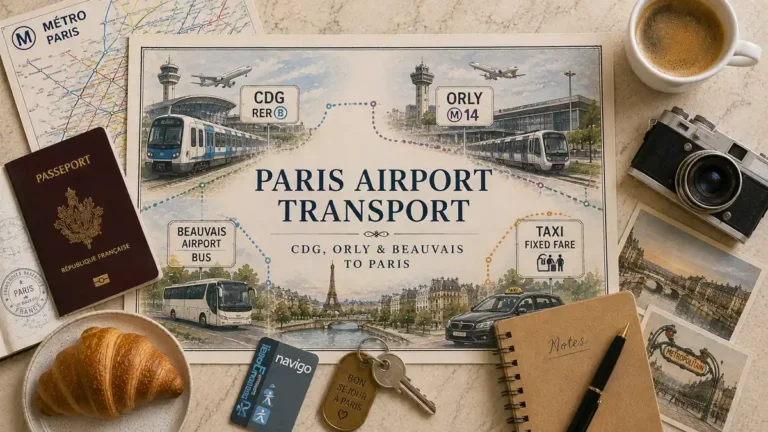
RER line B is the corridor official guidance names most often, and it is also the one most travelers use without thinking: it links Charles de Gaulle and Orly to the centre and serves Gare du Nord, where Eurostar arrives. RER line D, which serves the Stade de France, is flagged alongside it. UK government guidance records documented cases of serious assault on both lines, which is why those two get named while the rest of the network does not.
Arrival day is the highest-exposure hour of a Paris trip, and the reason is mechanical. You are jet-lagged, holding a phone with directions on it, wearing a rucksack you cannot see and standing beside a suitcase that anchors you in place — on the exact train that carries people in that state every day. Arrival day is the one journey where paying to skip the RER counts as a safety decision as much as a comfort upgrade; on any other day of the trip the same fare buys much less.
An official transport safety line exists for reporting incidents on the Métro and the trains, staffed and reachable by SMS. The numbers are consolidated in the emergency section below, so you are not hunting for them mid-journey.
Late at night the practical judgement is about the carriage. Choose a busy one. An empty end car and a deserted stretch of platform are the two things worth walking past, and a crowded middle carriage is the safest seat on any line. Which line, which ticket and which pass make sense is a separate question — that one is answered in getting around Paris.
Common Scams in Paris and How to Recognise Them
The scams a visitor meets in Paris are scripted, and naming the script is the defence. Three of them run reliably at the city’s busiest sights: the friendship bracelet, the petition clipboard and the gold ring. All three open the same way, with a stranger creating an obligation before you have decided to take part.
- The friendship bracelet — classically worked on the approach and the steps below Sacré-Cœur in Montmartre. Someone friendly takes your wrist or offers a “gift”, knots a thread around it while chatting, then asks for payment for a bracelet you cannot remove. The tell is the hand: a stranger who touches you first is running a script. Keep your hands down as you climb, do not break stride, and keep walking even if the thread is already tied.
- The petition or clipboard — common on the forecourts around the Louvre and Notre-Dame. A young person asks whether you speak English, presents a petition for a charity or a deaf association, then pressures a “donation” once you have signed. The board and pen occupy your hands and your eyes while an accomplice works your pockets or your open bag. Never take the clipboard, answer while still moving, and check your bag afterwards.
- The gold ring — worked along the Seine, on the bridges and the riverside walkways. Someone bends down just ahead of you, picks up a gold-coloured ring and asks whether you dropped it; when you say no, they insist you keep it, then ask for money for a drink or for the ring’s “value”. The sequence gives it away: nobody finds treasure at your feet by accident. Say it is not yours, refuse the ring, keep walking.
Every version follows the same four beats: an approach that seems harmless, a hook that occupies your hands or your conscience, pressure once you are committed, and often an accomplice working while your focus is elsewhere. Interrupting the approach costs nothing. The scam and the pickpocket are usually the same operation — the script exists to buy three seconds of your attention, and three seconds is the entire job. Declining without stopping is normal behaviour in Paris and nobody reads it as rude.
The tactics that make you a poor target in the first place — how you carry a bag, what goes in which pocket, how you stand in a packed carriage — are covered in our guide to avoiding pickpockets in Paris.
Paris Is Broadly Safe for Solo Female Travelers, With Caveats
Paris is a comfortable solo-travel city for women, including in the evening in central areas. The honest caveat is street harassment: catcalling and persistent approaches happen, and solo women report that annoyance far more often than they report feeling genuinely unsafe. Dining alone and evening walks in busy central areas are entirely normal here.
Paris makes solo travel easy in ways that matter for safety without being about safety. Café culture means a table for one draws no attention, museums are solo-normal, and the centre is dense enough that you are rarely more than a few minutes from a busy street. Solo men and solo women face the same theft risk, which is the dominant one for both; harassment is where the two experiences diverge.
The judgement calls that actually come up are small and repetitive: whether to take the last Métro or a taxi after a late dinner, how to end a conversation that will not end, whether to walk the final ten minutes or ride them. A firm, unsmiling no is a complete sentence in Paris. Politeness reads as an opening. The drink-awareness habit from the night-time section applies just as much on a solo trip, since a drink you left behind is a drink you replace.
A confident first day does more for solo safety than any precaution list, because knowing where you are going removes the hesitant, phone-in-hand pause that scammers and pickpockets are scanning the crowd for. On a first visit, a planned route is worth more than it sounds — see the 2-day Paris itinerary or the 3-day Paris itinerary for a structure that keeps you moving with intent.
Do You Need Travel Insurance for Paris?
Travel insurance is worth buying for a Paris trip for most visitors. The decision turns on what you would personally be liable for if something went wrong: medical treatment if you are not covered by European reciprocal arrangements, a stolen phone or camera, and non-refundable bookings you would otherwise eat.
Medical cover is the part that decides it. Visitors whose home country has a reciprocal health arrangement with France — EU nationals, and holders of the equivalent UK card — can access state treatment on broadly the same terms as residents, which takes the frightening scenario off the table. Travelers from outside those arrangements pay for their care, and an ordinary accident involving an ambulance, a scan and a night in hospital is not a small bill in any European capital.
Theft cover is the second reason, and it is the Paris-specific one. The city’s realistic risk is precisely what a personal-effects policy exists for: a phone taken on a platform, a camera lifted from a café table, a bag opened on a crowded escalator. Check what you already hold before buying twice — some home contents policies and several credit cards include travel medical or personal-effects cover.
The claim you are most likely to make on a Paris trip is a theft claim, and it stands or falls on a police report you can only obtain while you are still in the city. That single piece of paperwork is why the emergency section below puts reporting ahead of everything except blocking your cards.
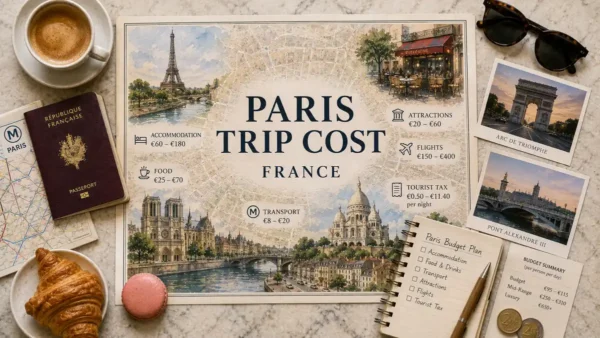
Insurance matters least on a short city break by an EU national with refundable accommodation, no expensive gadgets and existing card cover. Everything else tilts the other way: a long-haul arrival, non-refundable bookings, a trip built around one fixed set of dates. Against the total cost of the trip the premium is a small line — see how it sits alongside the rest in the cost of a trip to Paris.
Travel medical insurance
SafetyWing Nomad Insurance provides travel medical coverage designed for travelers and digital nomads, with flexible Monthly and Annual plans.
Check Nomad Insurance coverage and current pricing →
New Nomad Insurance Essential members can get 8 weeks of electronic theft coverage free with reward code TRIPSTOU8.
Apply the reward before creating your SafetyWing account by looking for the pink camera icon on the Nomad Insurance page.
Tripstou may earn a commission if you purchase through this link, at no extra cost to you.
Paris Emergency Numbers and What to Do If Something Is Stolen
Every act-now number for Paris is in one place below. The sequence after a theft is short: block, report, replace. Emergency services in France answer on a small set of numbers that work from any phone, and the transport network runs its own dedicated safety line on top of them.
- 112 — the European emergency number. Works from any phone across the EU and routes you to whichever service you need.
- 17 — police. The number for a theft in progress, an aggressive approach, or anything needing officers now.
- 15 — SAMU, the medical emergency service, for ambulances and urgent medical advice.
- 18 — the fire brigade, the sapeurs-pompiers, who also respond to medical emergencies.
- 114 — the emergency line for deaf and hard-of-hearing callers, reachable by SMS or video.
- 3117, or SMS to 31177 — the transport safety line for incidents on the Métro, the RER and the trains.
3117 is the number most visitors have never heard of, and it is the one built for the setting where Paris theft actually happens. Its SMS line, 31177, works when speaking up inside a crowded carriage is not an option.
After a theft, order matters more than speed. Block your cards and your phone first, from another device or a borrowed one — a stolen phone with payment apps on it is the expensive part. Then file a police report at any commissariat, because your insurer will ask for it and no claim moves without one. Finally, if a passport has gone, your embassy or consulate in Paris issues emergency travel documents; contact them the same day, since the morning of your flight is too late.
Frequently Asked Questions
Is Paris safe for families with kids?
Paris works well for families, and the risks are the same ones adults face: crowds, theft and tired legs. Pushchairs are the real friction: Métro stairs and packed carriages make buses and walking the easier way to move a family around, and keeping children close in monument queues matters more than any area choice.
Is Paris safe for American tourists right now?
Yes — Americans face the same risk profile as everyone else in Paris: theft in crowds, not violence. Government advisory wording for France is set nationally and revised periodically, so check your own government’s current travel advice before you fly; second-hand summaries go stale quickly.
What should I do if I get pickpocketed in Paris?
Assume the item is gone and act to limit the damage. Block your cards and phone immediately, then file a report at any Paris commissariat before you fly home — insurers ask for that French document, and it is much harder to obtain once you have left.
What is the friendship bracelet scam at Sacré-Cœur?
It is a payment-by-ambush hustle worked on the steps up to Sacré-Cœur. Someone greets you, takes your wrist, knots a thread onto it, then names a price for the bracelet. You are under no obligation to pay whatever has already been tied on — say no and keep moving.
Is a taxi or Uber safer than the metro late at night in Paris?
Both are safe; the difference is exposure, not danger. A licensed taxi or a booked ride removes the walk between the Métro exit and your door, which is the part of a late journey most worth removing. On busy lines in the evening the Métro is fine either way.
Is Paris more dangerous than other European capitals?
Paris sits in the same band as other big Western European capitals for traveler risk. Its theft problem is comparable to Barcelona’s or Rome’s and reflects the same cause: enormous visitor volume funnelled through a handful of monuments and transit hubs. The type of risk matters more than the city.
Related Guides
Paris safety resolves into four follow-on decisions: where you base yourself, how you move, what the trip costs, and how the country reads more broadly. These guides pick up each one.
- Paris travel guide — the broad orientation to the city, and the parent of everything in this cluster.
- Avoiding pickpockets in Paris — the practical tactics this page deliberately leaves out, from bag position to crowd behaviour.
- Where to stay in Paris — area selection, including how your base shapes how much late-night movement the trip needs.
- Getting around Paris — lines, tickets and passes, and how the airport connects to the centre.
- Safety in France — the country-level posture, driving, and the risks that are not Paris-specific.
- Cost of a trip to Paris — where insurance, transport and everything else land in the overall budget.
Did this guide save you time or money? Tripstou is independent and reader-funded — if you'd like to give something back, you can support the site with a crypto contribution of any size.