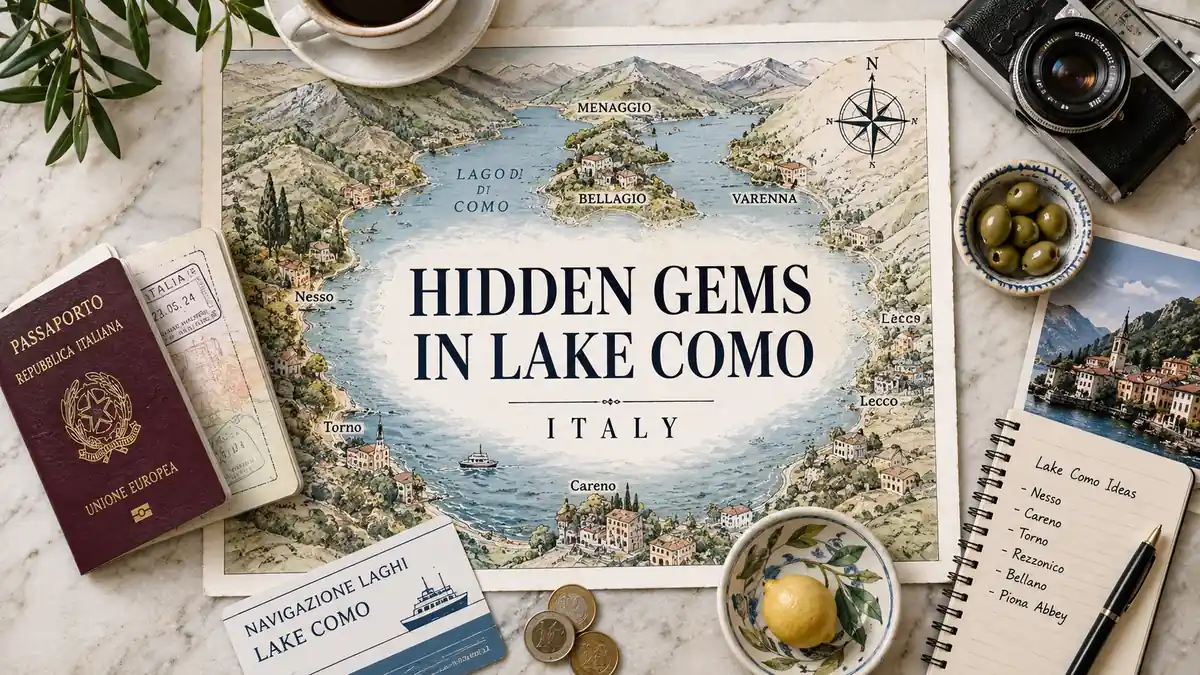
Lake Como’s fame concentrates in three towns. Bellagio, Varenna, and Menaggio anchor nearly every itinerary, and in summer their waterfronts and ferries run shoulder to shoulder. The scenery earns the reputation, but the crowds come with it. The lake’s real reward sits a few kilometers away, in the villages most visitors never step off the boat to see. These are the hidden gems: stone hamlets stacked above gorges, foot-only shores with frescoed churches, monasteries on quiet headlands, and beach coves that stay calm while the famous towns fill. This guide is a curated shortlist of those lesser-known places, organized by shore so you can pick by feel — the western Como–Menaggio side for scenery-dense villages close together, the eastern Lecco branch for the lake’s quietest corners. Every pick is chosen for one thing: a genuine Lake Como experience without the queues.
Quick Answer
Lake Como’s best hidden gems are Nesso, Careno, and Rezzonico — quiet villages well outside the famous triangle. The main decision is which shore: the eastern Lecco branch stays quieter than the western Como–Menaggio side. These picks suit slow travelers who want waterfront hamlets and empty church squares, reachable by boat or car.
Trust Layer
Tripstou selection guide for travelers choosing between multiple places. Covers selection criteria, traveler fit, and trip value.
Produced with AI assistance and reviewed by Alex Perrut, working in tourism since 2015, for the Tripstou editorial team. See our editorial process for details.
Last factual review: July 10, 2026.
Official sources consulted: italia.it, enit.it.
Key Takeaways
- Nesso, Careno, and Rezzonico are the strongest hidden-gem picks — quiet villages that stay calm while the famous triangle fills.
- The eastern Lecco branch is Lake Como’s quieter shore, with fewer big-name towns and less international ferry traffic than the west.
- For one dramatic sight, choose Nesso and its Orrido di Nesso gorge, where a waterfall meets the arched Ponte della Civera.
- Quiet comes at a cost: the eastern villages sit further apart with sparser ferries, so reaching them usually means a car or train.
- The famous towns still win a first visit for the headline view, so pair one with a hidden gem instead of skipping them entirely.
Table of Contents
Why Skip the Bellagio Triangle for Lake Como’s Hidden Gems
Lake Como’s crowd-free reward lies beyond Bellagio, Varenna, and Menaggio. A genuine hidden gem here sits outside the central triangle: a small village, quiet even in peak months, that most day-trippers never reach. These are working lakefront hamlets and foot-only shores that keep their own rhythm.
The famous three deserve their reputation for a view and a photograph, and they still belong on a first visit — you can see how they rank among Italy’s famous highlights. The problem is concentration. By late morning in summer the ferries between them run full, the lakefront cafes queue, and the alleys move at the pace of a coach tour.
The crowd doesn’t spread evenly around Lake Como. It clusters in the three central towns where the ferries cross, which means you only need to travel fifteen or twenty minutes up either shore to leave most of it behind. That short gap is the whole opportunity.
A Lake Como hidden gem qualifies on three counts: it sits away from the central ferry hubs, it stays genuinely quiet even in high season, and it holds a distinct reason to visit — a gorge, a castle, a frescoed church, an island. The picks below all clear that bar. For the wider picture, the same logic drives our roundup of hidden gems in Italy, where quiet corners sit next to famous ones across the country.
Western Shore Hidden Gems: Como to Menaggio
Nesso is the western shore’s standout hidden gem, built around a dramatic gorge and waterfall. The Como–Menaggio side packs its quiet villages between the busy hubs, so you can reach them quickly yet still find empty waterfronts. Choose this shore for scenery-dense hamlets within easy range of Como city.
Because these villages line up along one shore, they suit a slow day of short hops. Pick two or three, not all five. Each holds a single strong reason to stop, and the pleasure is in lingering — a waterfront lunch, a church square, a swim — not ticking them off.
Nesso & the Orrido di Nesso
Nesso is a stone village stacked above the Orrido di Nesso, a deep gorge where two streams meet in a waterfall. The old Ponte della Civera arches over the ravine, framing the lake behind it — the image that draws photographers off the main road. A steep stairway of stone steps drops from the upper village to a tiny harbor below. The gorge and its bridge are the reason to detour; for how a stop like this fits alongside boat trips and lakefront walks, see our guide to things to do in Lake Como.
Pick this if: you want the most dramatic single sight on the western shore and don’t mind steep steps.
Careno
Careno is a foot-only hamlet with no road access, reached on stairways that keep it almost empty. Its church of San Martino holds medieval frescoes and sits just above the water. The lack of car access is the whole point: no coach parties, no through-traffic, just steps down to a small landing.
Pick this if: you want the quietest western village and are happy to arrive on foot or by boat.
Sala Comacina & Isola Comacina
Sala Comacina faces Isola Comacina, the only island on Lake Como. A short boat hop crosses to the island’s ruins, chapels, and open-air remains of an early medieval settlement abandoned centuries ago. Back on shore, Sala keeps a low-key waterfront while its famous neighbors draw the crowds.
Pick this if: you want a village plus the lake’s single island in one easy stop.
Rezzonico
Rezzonico is a medieval hamlet gathered below the Castello di Rezzonico, a well-preserved lakeside castle with square towers. Cobbled lanes drop from the fortress to a small harbor, and the whole cluster stays compact enough to walk in minutes. It rewards a stop for the castle silhouette alone.
Pick this if: you want a castle village most Lake Como visitors skip entirely.
Torno
Torno is a quiet waterfront village just north of Como city, easy to reach yet largely overlooked. Its small piazza opens onto a harbor with a couple of cafes and a church doorway worth the pause. Proximity to Como keeps it convenient without the ferry-hub bustle.
Pick this if: you want the closest hidden gem to Como city for a short escape.
The Eastern Lecco Shore: The Lake’s Quiet Side
Abbazia di Piona is the eastern shore’s standout, a Cistercian monastery on a quiet headland near Colico. The Lecco branch draws fewer international visitors, so its villages feel calmer and more local. Choose this side for contemplative stops, swimmable shores, and gorges within a short drive of each other.
The Lecco branch trades convenience for calm. Its villages sit further apart and see fewer ferries, so a day here feels slower and more deliberate. That is exactly why it stays quiet when the western shore fills.
Abbazia di Piona
Abbazia di Piona is a Cistercian monastery sitting on a small peninsula near Colico, at the lake’s northern end. Its Romanesque cloister and lakeside setting make it one of the calmest stops on the whole lake. Monks have kept the site for centuries, and it still runs at monastery pace.
Pick this if: you want a spiritual, low-key stop far from the ferry crowds.
Lierna
Lierna is a quiet village known for Riva Bianca, a small beach where pastel houses meet the water. It’s one of the eastern shore’s most swimmable spots, with a sheltered cove and clear shallows. The old fishing quarter behind the beach stays calm even when the western towns fill up.
Pick this if: you want a beach village for a slow, low-crowd swim day.
Bellano
Bellano wraps around the Orrido di Bellano, a gorge where the Pioverna river cuts through rock beneath walkways. The village itself keeps a lived-in, workaday feel, with a lakefront that never turns into a tourist strip. The gorge is the draw; the quiet is the bonus.
Pick this if: you want a gorge and a genuine village on the quieter shore.
Which Shore Is Quieter, West or the Lecco Branch?
The eastern Lecco branch is the quieter shore overall. It carries fewer big-name towns and less international ferry traffic, so its villages stay calmer through peak season. The western shore is livelier and easier to reach, with more hidden gems packed close together but bigger crowds passing between them.
The choice comes down to how you like to travel. Slow travelers and those chasing genuine quiet lean east, toward Piona, Lierna, and Bellano. Travelers who want more variety in a single day, and don’t mind a busier boat, stay west with Nesso, Careno, and Rezzonico.
The quiet on the Lecco branch comes at a price: it has fewer ferry connections, so reaching its villages usually means driving or taking the train line along the eastern shore, while the western gems chain together by boat in one day. Quiet costs a little convenience. Decide which you value more before you fix a base.
How to Reach the Hidden Villages Without the Crowds
You reach most hidden villages by boat, by car, or on foot for the smallest hamlets. Navigazione Laghi ferries link many lakeside stops, while a car opens the quieter shores the boats skip. Foot-only spots like Careno need the last stretch on stairways. Match the method to the village.
A few simple matches cover most trips without needing a timetable:
- Boat: best for chaining western-shore villages like Nesso, Sala Comacina, and Torno in one trip.
- Car: best for the eastern Lecco shore, where villages sit further apart and ferries are sparser.
- On foot: the final approach to Careno and other stair-access hamlets.
The trick to a crowd-free visit isn’t only where you go but when you move. The ferries fill mid-morning as day-trippers arrive from Como, so an early first crossing lands you in the quiet villages before the boats do. Go early. Exact ferry routes, timings, and parking shift with the season, so confirm them when you plan your Lake Como trip.
Frequently Asked Questions
Is Lake Como too touristy or overrated?
No, Lake Como is not overrated, but its fame concentrates in three towns. Bellagio, Varenna, and Menaggio draw the summer crowds, while the villages a few kilometers up either shore stay quiet. Step off the main ferry route and the lake still feels calm, scenic, and genuinely local.
Which Lake Como town is the least touristy?
Careno is among Lake Como’s least touristy spots — a foot-only hamlet with no road access, reached on stairways that keep coach parties out. On the eastern shore, Abbazia di Piona and Bellano also stay quiet. As a rule, the further you get from the central ferry triangle, the fewer crowds you meet.
Are the hidden gems worth it versus Bellagio and Varenna?
Yes, if you value quiet over headline sights. Bellagio and Varenna deliver the postcard views but share them with the crowds, while villages like Nesso and Rezzonico trade a little polish for empty squares and slower days. On a first trip, pair one famous town with two or three hidden gems.
Can you visit the hidden villages without a car?
Yes, many hidden villages are reachable without a car. Navigazione Laghi ferries serve much of the western shore, chaining stops like Nesso, Sala Comacina, and Torno in one trip. The eastern Lecco shore leans on the train line instead, so car-free travelers should favor the western gems for easier connections.
How long should you spend at each Lake Como hidden gem?
Most hidden villages need just one to two hours each. That is enough for the gorge, castle, or frescoed church that defines the stop, plus a slow waterfront coffee. Instead of rushing all of them, chain two or three across a relaxed day and let the pace do the rest.
Related Guides
- Lake Como guide — where to base, when to go, and how to get around the lake.
- Things to do in Lake Como — activities, tours, and attractions across the lake.
- Best places in Italy — the famous highlights, including Como’s headline towns.
- Hidden gems in Italy — more underrated destinations beyond Lake Como.
- Best time to visit Italy — the national seasons that decide when the lake is calm.
- Italy itinerary — how a lake stop fits into a longer route through the north.
Did this guide save you time or money? Tripstou is independent and reader-funded — if you'd like to give something back, you can support the site with a crypto contribution of any size.