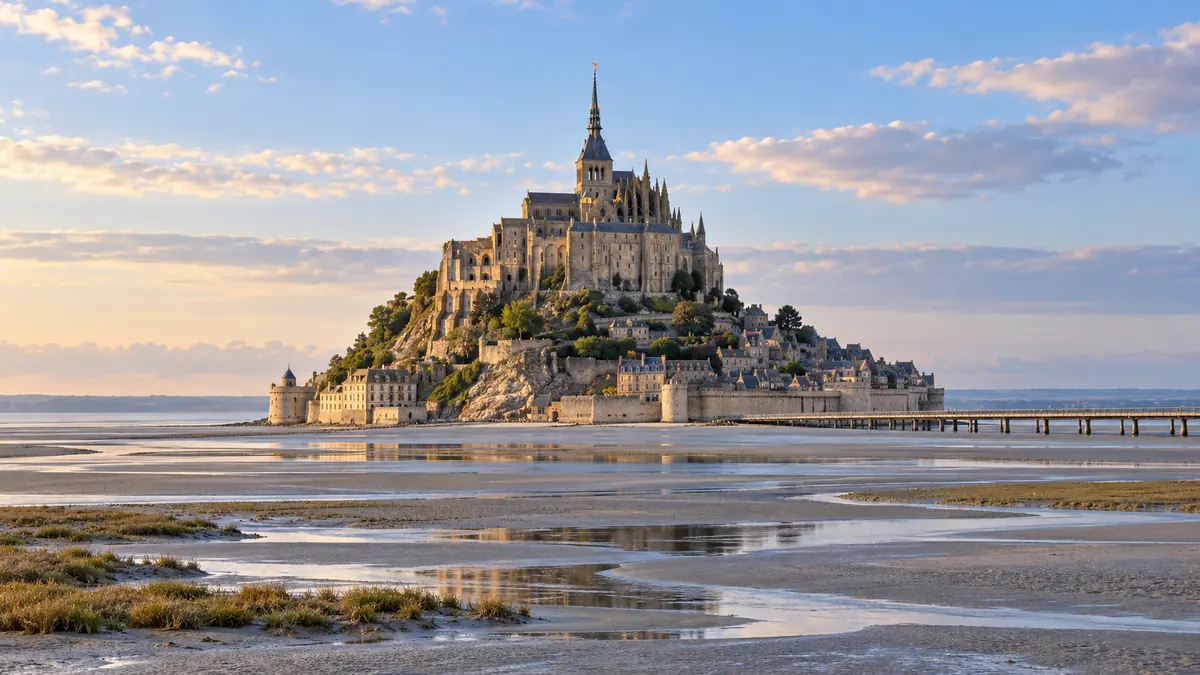
Mont-Saint-Michel is a tidal island crowned by a Benedictine abbey, sitting in a wide bay on the border between Normandy and Brittany. The village is free to enter at any hour; the abbey is the ticketed part. It is worth the long journey, and it is best seen with one night nearby or on the rock itself, so you catch it before the day-tour crowd arrives, after it leaves, and around high water. A day trip from Paris works, by coach tour, train plus bus, or car, but it makes for a very long day; a single night turns it into an unhurried visit.
Everything below is arranged around that choice: first what you are actually visiting and whether to sleep there, then the practical order a visit follows, from the journey and the last stretch across the bay to the tides, the abbey and where to base yourself.
Decide This Before You Go
- Spend one night by the bay or on the rock if your schedule allows, because the quiet early morning, the floodlit abbey and a visit timed to high water are exactly what a coach day trip misses.
- From Paris, the TGV to Rennes plus the direct bus is the most dependable public-transport route, and every arrival ends on the mainland, where the free Le Passeur shuttle or a walk over the 2.2 km bridge takes you the rest of the way.
- Check the official tide calendar before fixing your day, and arrive 1–2 hours before high water if you want to watch the bay fill.
- Book a timed abbey slot online, ideally early in the day, and expect a steep stair climb with no lift.
- Be on the rock before about 10:00 or after about 17:00 to miss the midday day-tour crush, which peaks in July and August.
- Walk out across the sands only with a licensed bay guide, never on your own, because the tide returns fast and the bay hides quicksand.
On This Page
What Mont-Saint-Michel is, and what you actually visit
Mont-Saint-Michel is a rocky tidal island at the mouth of the Couesnon river, topped by a Benedictine abbey that rises above a one-street medieval village. The village and the lanes along its ramparts are free and open day and night, all year; the abbey is the paid, timed visit at the summit. The trip is worth making for three things together: the silhouette across the bay, the abbey itself, and the tides that wrap around the rock.
A visit unfolds in four parts. It starts on the mainland, about 2.5 km from the rock, where the car parks, the hotel zone and the shuttle square sit among fields. Next comes the bridge over the bay, the moment the Mont grows from a distant outline into a wall of granite and the sands stretch out on either side. Inside the gate, the Grande Rue climbs steeply between souvenir shops, crêperies and old houses; this is the busiest stretch of the whole site. At the top, the abbey and its terraces open onto the widest views in the bay, and the ramparts lead you back down by a quieter route.
The history fits in two lines. Tradition credits Aubert, bishop of Avranches, with founding a sanctuary to the Archangel Michael here in the 8th century, and a Benedictine abbey grew on the rock over the centuries that followed. Today the Mont and its bay are listed together as a UNESCO World Heritage site.
The Mont suits almost anyone who can handle stairs: first-time visitors to France who want one landmark beyond Paris, photographers chasing tide and light, and families with children old enough to climb. It belongs on any shortlist of France’s most famous places, and it is one of the few that changes shape twice a day.
Should you day-trip Mont-Saint-Michel or stay the night?
Stay one night if your schedule allows it. The rock empties after the day-tour coaches leave, the illuminated Mont at night and the quiet early morning are the best hours of the visit, and a night nearby lets you time your walk to high water. A day trip from Paris works, but it means a 12–14-hour day on a coach tour, or a long round trip by train or car.
How long you give the Mont depends on how far you are travelling and what you want from the bay:
- A coach-tour day from Paris: the simplest option for travelers with only a Paris base and no wish to handle connections. You get the abbey and the village, but you arrive with the crowd and leave before dusk.
- A self-organised day by train plus bus, or by car: more control over when you arrive, so you can reach the rock early or stay later. The return journey to Paris still eats most of the evening.
- One night, near the car parks or on the rock: the version most visitors should choose. You see the Mont lit up after dark, walk the village almost alone in the morning, and can match the visit to the tide.
- Two nights: worth it if you want the guided bay walk as well as the abbey, or if the tide timetable is awkward on your first day.
A coach tour remains the easiest single-day format from the capital, and if that is the trip you have room for, you can reserve a coach seat and let someone else handle the driving. Readers still weighing the Mont against shorter outings can compare it with other day trips from Paris, most of which ask for far less time on the road.
The coach timetable works against the Mont: it delivers you at the busiest hour and takes you away before the floodlights come on, so a day trip misses both of the quiet windows that make the place memorable.
The Mont at night is the overnight payoff. The village never closes, so you can wander its lanes after dinner, and the illuminated abbey seen from the bridge is the image most people remember. On site, the abbey and the village together take about half a day at an easy pace; add the ramparts walk and a meal, and an afternoon arrival with a morning departure covers everything without hurry.
Tours and activities
Book skip-the-line tickets, day trips and local tours with free cancellation on most activities.
You can also browse everything on getyourguide.com.
Tripstou may earn a commission if you book through this link, at no extra cost to you.
How to get to Mont-Saint-Michel from Paris, Rennes or Saint-Malo
From Paris, the most reliable public-transport route is the TGV to Rennes, about 2 hours, followed by the direct bus to the Mont, about 1h10–1h15, with several round trips a day. A direct seasonal train-and-bus link runs on weekends all year and daily in the summer season. Driving covers about 337 km, and a coach tour handles everything in one long day.
| Way to arrive | Route | About how long | Who it suits |
|---|---|---|---|
| TGV + bus via Rennes | Paris-Montparnasse to Rennes, then Keolis Armor bus to the Mont | About 2 h by train, then 1h10–1h15 by bus | Most rail travelers; several buses a day |
| Direct seasonal link | Nomad train to Pontorson, then a connecting bus | Check the seasonal timetable | Weekend or summer visitors wanting one through journey |
| Train via Dol-de-Bretagne or Villedieu-les-Poêles | TGV to Dol-de-Bretagne, or Nomad to Villedieu-les-Poêles, then buses | About 2h40–2h50 by train, plus the bus (about 45 min from Villedieu) | Travelers continuing into Brittany or coming through Normandy |
| Car | Paris via the A13 and A84, about 337 km | Four-plus hours | Road-trippers adding Normandy and Brittany stops |
| Coach day tour | Round trip from central Paris | 12–14 h door to door | A one-day visit with no planning |
| Bus from Saint-Malo | Keolis Armor bus to the Mont | About 1 h, on days that vary by period | Visitors based on the Brittany coast |
The nearest station, Pontorson, is 9 km from the Mont; bus line 2 links it to the rock in about 27 minutes. From Bayeux, the usual base for the D-Day coast, there is no simple public route, so most people drive or join a shuttle that bundles the transfer with abbey entry; you can book the Bayeux shuttle if you would rather not drive. Every bus, train-and-bus and coach arrival ends at the mainland car parks, not on the rock.
From Paris, the Rennes route wins on frequency: with several buses a day, a late train costs you an hour, not the day. If the Mont is one stop in a longer rail journey, the France train itinerary shows how it slots between other cities, while drivers can fold it into a road trip through France along the Channel coast.
The last 2.5 km: free shuttle or a walk across the bridge
Every car stops at the mainland car parks, about 2.5 km from the rock. From the shuttle square beside the Tourist Information Centre, the free Le Passeur shuttle reaches a stop about 350 m from the ramparts in about 12 minutes; alternatively, you can walk the whole way, including the 2.2 km bridge, in about 45 minutes.
The best plan uses both. Take the shuttle in when you are fresh for the abbey climb, then walk back across the bridge — or reverse it and walk in to watch the rock grow ahead of you, which is the finest approach of all. The walk is flat and open to the wind, so carry a layer even in summer.
Parking works on a pay-at-exit system. The official Mont site lists rates of roughly €10–28 depending on season and how long you stay, with the first 30 minutes free, evenings free from 18:30 to 03:00 between September and June, and a small discount for booking online. Bus and train passengers arrive at the same mainland area and use the same free shuttle.
The bridge is open all year, except at the biggest tides, when it is cut off for about an hour while the sea covers the approach. Check the tide calendar before you set out on foot.
How the tides work, and when to watch them come in
The Mont becomes a true island only at the biggest tides, when it is cut off for about an hour to an hour and a half. To watch the bay fill, arrive 1–2 hours before high water, and check the official tide calendar on the Mont’s website before you fix your day.
The tides in this bay are exceptionally strong. At low tide the sea pulls back so far that grey sands and channels stretch for kilometres around the rock; at high tide the water returns quickly and laps against the ramparts. On most days the Mont stays linked to the mainland by the bridge, and only the strongest tides turn it back into an island.
The best viewpoints are the ramparts, where you look straight down on the rising water, and the bridge, where the sea closes in on both sides. Big-tide days are the Mont at its most dramatic, which is exactly why they draw the largest crowds: plan to arrive early if you choose one.
Never walk out onto the sands on your own. The tide moves fast across the flat bay and there are quicksand patches, so the only safe way to cross is with a licensed guide (see the bay walk below).
Is the abbey worth the climb, and do you need to book?
Yes. The abbey is the reason the Mont exists, and its church, cloister and great halls are the high point of any visit. Book a timed ticket online on the monument’s official site, especially for summer and weekends, and expect a steep stair climb with no lift.
The visit follows a route through the building from the summit down:
- The west terrace: a wide platform in front of the church, with the whole bay spread out below.
- The abbey church: the nave and choir built on the very top of the rock, the highest point of the Mont.
- The cloister: a garden hung between sea and sky, framed by slender columns.
- The refectory and the Merveille halls: the monks’ dining hall and the great Gothic rooms stacked on the north face.
- The crypts and the great wheel: the massive pillars that hold the church up, and the treadwheel once used to haul supplies up the rock.
- The way down by the ramparts: a gentler descent back to the village with views over the walls.
The official Mont site gives the abbey’s hours as 09:00–19:00 from 1 May to 31 August and 09:30–18:00 from 1 September to 30 April, with last entry about an hour before closing. It is closed on 1 January, 1 May and 25 December. A timed slot early in the day is worth having: the stairs and narrow passages feel very different with the midday crowd on them.
You can explore on your own at your own pace, or add a guided or audio visit if you want the history behind each hall. The abbey takes up a good part of the half day you spend on the rock, longer if you linger on the terraces. The climb matters for planning too: the abbey has no lift, and visitors with limited mobility should take that into account before booking.
Early mornings, evenings and weekdays beat the midday crush
Crowds peak from late morning to mid-afternoon, when the day tours are on the rock. Arrive before about 10:00 or after about 17:00, prefer weekdays outside French school holidays, and expect July and August to be the busiest months.
Each season trades something. Spring and autumn give the best balance of soft light and manageable crowds. Winter is the quietest, though the shuttle and the abbey keep shorter hours. Summer brings the latest evenings and the liveliest village, along with the heaviest traffic on the Grande Rue and in the car parks. Long weekends and French holidays fill the site at any time of year.
Lining up high water with an evening visit solves two problems at once: the coaches have gone, and the sea is at its most impressive. Look at the tide calendar first, then pick the time of day.
For the wider question of when to travel in France, from weather to festivals, see the guide to the best time to visit France. If crowds are what you most want to avoid, the list of hidden gems in France points to quieter places that ask far less of your patience.
Where to stay: on the rock, by the car parks or inland
For most visitors, the hotel zone beside the mainland car parks is the best balance, with the free shuttle at the door and the illuminated Mont within easy reach at night. Sleep on the rock itself for atmosphere, provided you can carry your bags up stone steps, or base yourself inland in Pontorson or Avranches for lower prices if you have your own transport.
- On the rock: a handful of small hotels inside the walls give you the village after dark and before breakfast, the closest you can get to having the Mont to yourself. Rooms are compact and every bag goes up by hand.
- The mainland hotel zone: modern hotels a short walk from the shuttle square, with parking, restaurants and an easy evening ride out to see the lit-up abbey. The practical choice for families and first-time visitors.
- Pontorson or Avranches: small towns inland with more ordinary prices and local restaurants. They work for drivers who do not mind a short drive to the car parks each day.
- Wider bases: for travelers combining the Mont with more of the coast, Saint-Malo works on the Brittany side and Bayeux on the Normandy side.
The Brittany guide covers Saint-Malo as a base for the western side of the bay, and the Normandy guide covers Bayeux and the D-Day coast, the natural next stop heading east.
Walking across the bay is only safe with a licensed guide
The barefoot walk across the sands is the signature Mont experience, but the tide comes in fast and there are quicksand patches, so go with a licensed bay guide and never alone.
A guided walk crosses the flats on foot, usually barefoot, through mud, shallow channels and firm sand. Guides read the tide, pick the route and stop to show how the quicksand works, letting walkers feel the ground give way under them in safety. The reward is a view of the Mont that no road or bridge offers: the rock rising alone out of an empty bay.
Walks set out from the Genêts and Avranches side of the bay and from other points along the shore, and they suit fit, active travelers and families with older children who do not mind getting muddy. In season they fill up, so book a quicksand walk before you travel.
The sands look calm and flat at low tide, and that calm is what catches unguided walkers out.
What’s free at Mont-Saint-Michel, and what you pay for
The village, the lanes along the ramparts and the Le Passeur shuttle are all free, and there is no fee to enter the village. You pay for parking, the abbey ticket, food on the Grande Rue and any guided bay walk.
Parking is the one fixed cost most visitors meet. The official Mont site puts it at roughly €10–28 depending on season and length of stay, and evenings outside July and August are free, so drivers who arrive late and stay for the illuminations pay less than those who come at noon.
On a tight day, you drive or take the bus in, carry a picnic or eat inland, and pay only for the abbey. A comfortable trip adds one night in the mainland hotel zone, a sit-down meal and a guided bay walk. A high-end stay means a room inside the walls and dinner within the ramparts, paying for the privilege of the empty village at night.
Food is where budgets leak. The Grande Rue is tourist-priced and busy at lunchtime, and the mainland zone or the inland towns give better value for the same meal.
Where Mont-Saint-Michel fits in a France trip
The Mont is the hinge between Normandy and Brittany. It works best as a one-night stop on a north-west loop that also takes in Bayeux and Saint-Malo, instead of a standalone round trip from Paris.
A standalone trip makes sense for first-time visitors who only have a Paris base and accept the long day. Everyone else gets more from the Mont as part of a route: Paris to Normandy, a night at the bay, then on into Brittany or back east, by train or by car.
On a seven-day trip, the Mont usually means a short detour from Paris through Normandy with one night at the bay. Ten days leave room for both coasts with the Mont between them, and a fortnight lets you carry on beyond the north-west. The France itinerary guide compares the main route shapes, with day-by-day plans for seven days in France, ten days in France and two weeks in France. For the country as a whole, start with the France travel guide.
How We Checked This Guide
This page explains how to reach Mont-Saint-Michel, time a visit to the tides and the abbey, and decide whether to sleep there; it does not cover Normandy or Brittany as regions, plan a trip day by day, list hotels or sell tours.
Alex Perrut, working in tourism since 2015, went over the routes, tide advice and abbey details for the Tripstou editorial team. Written with AI assistance, the page follows our editorial process.
Official sources consulted: Mont-Saint-Michel official site: hours and prices, Mont-Saint-Michel official site: getting there, Mont-Saint-Michel official site: weather and tides.
Practical Questions About Visiting the Mont
Is Mont-Saint-Michel accessible with a wheelchair or a stroller?
Only in part. The mainland side and the flat walk across the bridge are manageable, but inside the walls the Grande Rue climbs steeply through narrow, crowded lanes, and the abbey is reached by stairs alone, with no lift. Wheelchair users can see the bay and the lower village from the approach; families with small children will find a baby carrier far easier than a stroller once they pass the gate.
Can you cycle to Mont-Saint-Michel?
Yes. The official Mont site lists cycling as one way to arrive, and bikes are allowed at any hour, all year. The ride over the bay is flat but exposed to the wind, and the village lanes are too steep and busy to enjoy by bike, so plan to explore the rock on foot.
Does the Mont-Saint-Michel shuttle run at night?
Yes, until late evening, and past midnight in high summer. The official timetable for the free Le Passeur shuttle runs 08:30–22:00 from November to February, 07:00–01:00 in July and August, and 07:30–23:00 the rest of the year, with a wait of about 12 minutes at most. Outside those hours, the walk across the bridge from the shuttle square takes about 45 minutes.
Is the Mont-Saint-Michel omelette worth it, and where should you eat?
Try the famous puffy omelette once if you are curious, but treat it as a meal priced for the setting, not a bargain. For everyday value, eat in the mainland hotel zone or in Pontorson or Avranches; if you do eat on the rock, go before or after the lunchtime rush on the Grande Rue, or carry a picnic from the mainland.
Did this guide save you time or money? Tripstou is independent and reader-funded — if you'd like to give something back, you can support the site with a crypto contribution of any size.