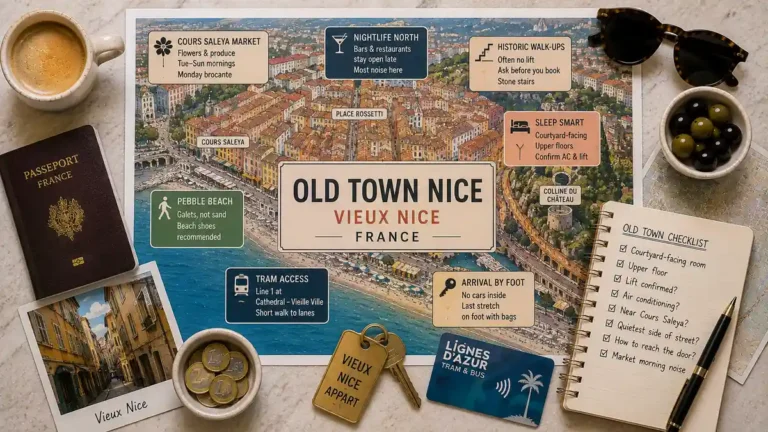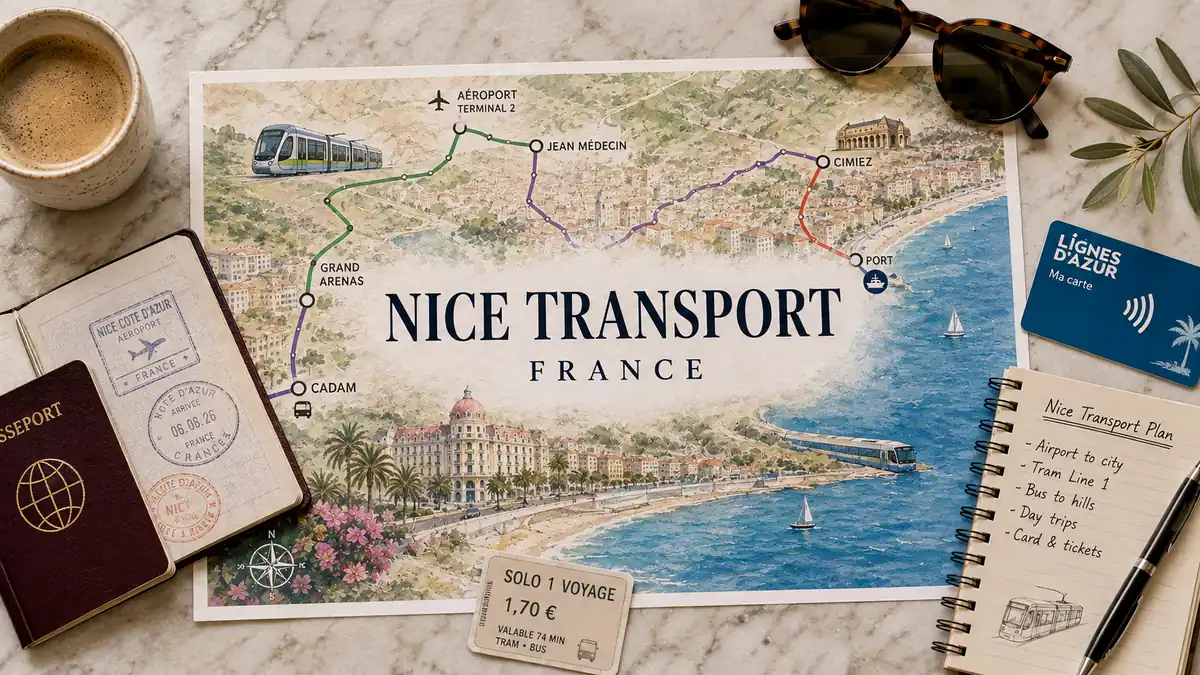
You have booked Nice, and the next question is a practical one: how do you actually move around the city, and what should you buy before your first ride? Nice makes this easier than most Mediterranean cities. The centre is compact and flat, three tram lines run through it, and the bus network picks up everywhere the tram does not reach. The complication sits in the ticketing, where several similarly priced products do very different things and visitors routinely buy the wrong one.
This guide resolves the whole movement question in one read: whether you need a car (you almost certainly do not), how far walking realistically takes you, how the tram and the bus split the city between them, exactly which ticket to buy and what it includes, and the cheapest way to pay once you know how much you will ride.
Quick Answer
Walking plus the tram covers most of a Nice visit, and you almost certainly do not need a car. How much you plan to move beyond the flat seafront centre decides the rest — hills and the wider coast push you onto buses. Buy single tickets, or load a reloadable card if you will ride repeatedly.
Trust Layer
Tripstou planning guide for travelers resolving one travel decision. Covers the main variable, traveler context, and practical tradeoffs.
Produced with AI assistance and reviewed by Alex Perrut, working in tourism since 2015, for the Tripstou editorial team. See our editorial process for details.
Last factual review: August 6, 2026.
Official sources consulted: France.fr, Atout France.
Key Takeaways
- Skip the car: central Nice punishes drivers with scarce parking and heavy seafront traffic, and the network reaches everything.
- Walking plus Line 1 covers most of a short visit; the hills and the wider coast are where buses take over.
- The standard single, Solo 1 voyage, costs €1.70 and includes transfers for 74 minutes, but no return trip.
- The €2.00 Solo secours is a different product, sold only aboard buses for passengers boarding without a card.
- Load Multi Voyages onto the €2 reloadable card once you expect more than a few rides — the per-ride price drops.
- Validate every time you board, on trams and buses, including each transfer inside the 74-minute window.
Table of Contents
Do You Need a Car in Nice?
No — almost no visitor needs a car in Nice. Central Nice is built against drivers: narrow one-way streets, scarce and expensive parking, and heavy summer traffic along the seafront. The tram, the bus network and your own feet reach everything a short visit requires.
A car earns its place in a small number of cases. If you are basing yourself outside the city and treating Nice as one stop on a wider Riviera drive, if you are travelling with someone who cannot manage stairs or long standing waits, or if you have arrived with heavy luggage and a rental already booked, driving is defensible. Everything else argues for leaving the car parked for the duration or never collecting it at all.
The hidden cost of a car here is not the rental rate — it is where you have to leave it. Central parking is limited enough that many visitors end up in a paid garage on the edge of the area they actually wanted to be in, then walk or take the tram from there anyway. You pay twice for the same journey.
If you want the broader picture of how the city is laid out and what the pieces are, our Nice travel guide covers the context this decision sits inside.
Is Nice Walkable?
Yes, central Nice is one of the most walkable cities on the French Riviera. The core is flat, compact and laid out between the Promenade des Anglais and the train station, so most visitor sights sit within a comfortable walk of each other. Walking handles a large share of a short visit.
Walking stops working in two directions. The first is vertical: Nice climbs sharply behind the seafront, and the hill neighbourhoods sit high enough above the centre that the walk up becomes the activity instead of the transport. The second is horizontal — the coast keeps going, and the villages either side of the city sit a tram or bus ride away, well beyond strolling distance.
How much walking you end up doing also depends on where you sleep, because transport access varies noticeably between areas of the city; our guide to where to stay in Nice sets out how those areas differ. To see how walking and short tram hops combine in practice, our 2 days in Nice itinerary shows the pattern in sequence.
Flat does not mean short. The Promenade des Anglais reads as an easy walk on a map and is genuinely pleasant, but end to end it is a long, shadeless stretch in high summer, and most people walk a section and ride the rest.
How Does the Tram Work in Nice?
The tram is the spine of Nice’s network, and three lines cover the city. Line 1 runs north to south through the centre, Line 2 crosses east to west, and Line 3 serves the western edge. Most visitors use Line 1, plus Line 2 for the eastern end of the seafront and the port.
The three lines split the city like this:
- Line 1 — Henri Sappia to Pasteur, running north to south through the city centre. This is the line most visitors ride most often.
- Line 2 — CADAM/Airport to Port Lympia, running east to west and partly underground beneath the centre.
- Line 3 — Airport T2 to Saint-Isidore, via the Allianz Riviera stadium on the western side of the city.
Trams run from early morning until late at night, late enough that dinner and an evening walk in the centre rarely depend on watching the clock. Trams and buses use the same tickets, so a tram journey and a bus journey are the same purchase.
Two of the three lines reach the airport. The transfer decision itself — which option to take, what it costs, when a taxi makes more sense — is resolved in a separate Nice airport guide.
When Do You Need a Bus Instead of the Tram?
Buses cover what the tram cannot: the hill neighbourhoods and the coast beyond the city. They run on the same ticket system as the tram, so switching between the two costs nothing extra inside your transfer window. For most visitors the bus is an occasional tool used for one or two specific trips.
The split is geographic. Tram lines follow the flat corridors — the centre, the eastern seafront, the western approach — while buses climb to the neighbourhoods above the city and run along the coast road to places the rails do not serve. If your day involves a hillside viewpoint, a museum away from the tram corridor, or a village along the shore, check the bus first.
Leaving the Métropole is a separate ticket question: regional trains and buses serve the wider coast, and a Ticket Azur (€2.50) covers one urban trip plus one connection out of the Métropole area. Where those trips fit into a longer stay is a sequencing decision, and our 3 days in Nice itinerary handles it.
Buses reward a little pre-checking that the tram does not. A tram route is legible from a map, while a bus stop that looks close on a hillside can sit a steep flight of steps above or below where you are standing.
Train and bus tickets
Compare routes, schedules and prices across rail and bus operators in one search, with mobile tickets on your phone.
New to Omio? Code NEW10 takes 10% off your first booking — or APPNEW10 if you book inside the Omio app. Both apply to bookings up to €80.
Search routes and compare prices on Omio →
Tripstou may earn a commission if you book through this link, at no extra cost to you.
How Much Is a Ticket in Nice, and What Exactly Do You Buy?
A standard single is €1.70 and includes transfers for 74 minutes from first validation. That ticket, sold as Solo 1 voyage, covers one journey in one direction, so it does not pay for a return trip. Trams and buses share the same ticket.
The confusion on this network comes from products that look like variations on one fare and are not. Three separate figures circulate, and each one attaches to different conditions:
- Solo 1 voyage, €1.70 — one journey, with transfers included for 74 minutes counted from your first validation. It does not cover a return trip.
- Solo secours, €2.00 — sold exclusively aboard buses, for passengers who do not have a card. It is a separate emergency product for cardless travelers.
- The reloadable card, €2 — the physical card itself, bought once, onto which you load journeys or passes.
The €1.70 and the €2.00 are not one fare at two prices. They are two products, and which one you pay depends on whether you boarded with a card already in your hand. If you know you are coming straight back the same way, a return ticket covering both journeys costs €3.40.
Every ticket below works on both trams and buses across the Lignes d’Azur network.
| Ticket | What it costs | What it covers | Where you get it |
|---|---|---|---|
| Solo 1 voyage | €1.70 for one journey | One journey, transfers for 74 minutes, no return | Machines at tram stops and ticket outlets |
| Solo secours | €2.00 for one journey | One journey for passengers boarding without a card | Sold exclusively aboard buses |
| Multi Voyages | From €1.70 down to €1.00 per journey | Journeys bought in bulk, cheaper as volume rises | Loaded onto the €2 reloadable card |
| Day and period passes | Priced by the length of the pass | Unlimited travel across the period you buy | Same machines, outlets and reloadable card |
Buying is straightforward once you know which product you want: machines at tram stops sell single tickets and load journeys onto the card, and ticket outlets around the city do the same. Validation is mandatory for every passenger on every journey, on trams and buses alike, so validate as you board rather than once at the start of the day.
For the wider set of practical habits that make a first visit smoother, our Nice travel tips guide covers the ground beyond ticketing.
What’s the Cheapest Way to Pay for Transport in Nice?
Loading Multi Voyages onto the €2 reloadable card is the cheapest option for most visits. The per-journey price falls as you load more journeys, so the more you ride, the less each ride costs. Singles only win if you expect a couple of rides in total.
The degressive scale works in steps, and the per-journey price drops at each one:
- 1 journey — €1.70 per journey
- 12 journeys — €1.50 per journey
- 25 journeys — €1.30 per journey
- 50 journeys — €1.00 per journey
The decision follows how you will actually move. Two or three rides across a short stay, and singles are fine — the card would not pay for itself. A visitor riding a few times a day for several days should load journeys in bulk instead. Anyone riding heavily from morning to night is the case where a day or period pass starts to make sense; passes exist for exactly that pattern and pay off above a few rides per day, so weigh one against what the same rides would cost loaded onto a card.
Most visitors lose money by buying singles one at a time all week, because the €2 card feels like an extra purchase on day one. A 12-journey load saves €0.20 on every ride, which covers the cost of the card itself before the load runs out.
How transport sits inside the total cost of a stay is a separate question, and our guide to Nice trip cost covers it.
Bikes, Taxis and Rideshare in Nice
Bikes, taxis and rideshare fill gaps in Nice; they are not how you plan your days. Each earns its place in a specific moment — a flat seafront ride, a late return, an arrival with luggage — and each costs more effort or money than the tram for everyday trips around the centre.
Vélo Bleu is the city’s bike-share scheme, and its first rental period is short and cheap enough to make quick hops worthwhile. It suits the seafront best: the Promenade has a dedicated cycle path, the ground is flat, and riding along the water is one of the better ways to see the city at ground level. It suits the hills far less, since the same climbs that make walking unattractive make cycling harder.
Taxis and Uber both operate in Nice and earn their place at the edges of the day: a late return once services have thinned out, an early departure, or any journey where you are moving luggage. Fares move with distance, time of day and traffic, so treat them as a convenience purchase and confirm the cost before you set off.
The seafront flatters the bike far more than the rest of the city does. Bike-share works beautifully along the water and turns awkward the moment you head inland and start climbing.
Frequently Asked Questions
Do you need to validate your ticket again when you change tram or bus?
Yes. Validation is mandatory on every vehicle you board, including each connection made inside the 74-minute transfer window. It applies per passenger, not per group: everyone travelling on a shared set of journeys validates separately, on trams and buses alike. Validate as you board, every time, and keep the ticket with you.
Can you buy a bus ticket from the driver in Nice?
Yes, but it is a specific product. The Solo secours fare, €2.00, is sold exclusively aboard buses and exists for passengers who board without a card. There is no equivalent onboard sale on the tram, where you buy at the machine before boarding, and loading journeys in advance costs less.
What time does the tram stop running in Nice?
Trams run from early morning until around 1am. That covers dinner and a drink afterwards without planning around a timetable. The last departure is displayed at each stop, worth a glance if you are heading back from the far end of a line late in the evening.
Is there a night bus in Nice?
Yes, a night bus service exists, but it is limited compared with daytime coverage and worth checking locally once you arrive. Plan evenings on the assumption that the tram and regular buses are your main options, and treat a taxi or rideshare as the fallback for a late return.
Is public transport free for children in Nice?
Yes, children under 11 travel free on trams and buses in Nice. That reshapes family arithmetic more than any volume discount does: a couple travelling with two young children is buying two fares, not four, so a modest load of journeys on one card usually covers the whole stay.
Related Guides
These guides pick up the decisions that sit next to getting around Nice:
- Nice travel guide — the city in full, and how the pieces of a visit fit together.
- Where to stay in Nice — how the areas differ, including transport access.
- 2 days in Nice itinerary — a short visit sequenced around a walkable centre.
- 3 days in Nice itinerary — a longer stay, including trips beyond the city.
- Nice travel tips — practical know-how for a first visit.
- Nice trip cost — what a stay adds up to, transport included.
- Nice airport transport — getting from the airport into the city, and which option fits.
Did this guide save you time or money? Tripstou is independent and reader-funded — if you'd like to give something back, you can support the site with a crypto contribution of any size.