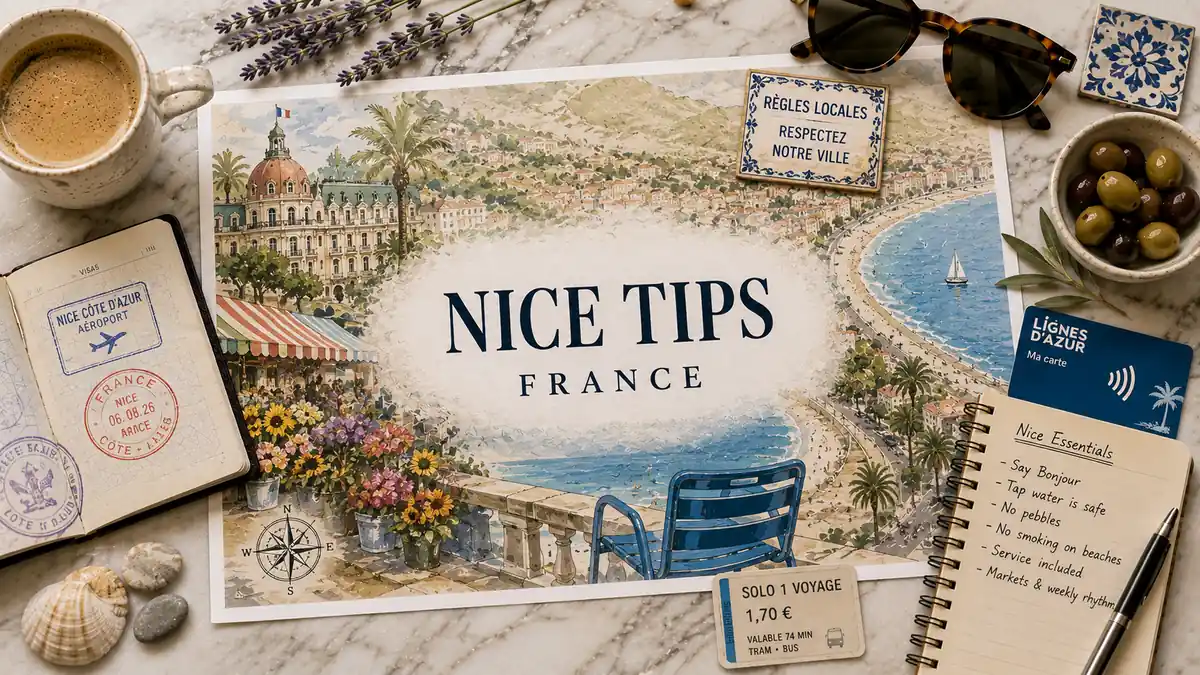
Nice runs more local rules than most visitors expect of a Mediterranean beach city, and most never hear about them until they break one. The city runs a municipal ordinance on what you can wear away from the seafront, a long-standing prohibition on removing pebbles from its beaches, and a national outdoor smoking ban that covers the beach you are sitting on. None of that appears on a typical tips page.
The problem with most Nice advice is that it flattens everything into one list, so a genuinely enforceable ordinance sits beside a soft dinner-table habit with nothing to tell them apart. This guide sorts them. You get the rules that carry consequences, the restaurant customs that decide whether you pay for your water, the way pebble beaches change how you behave, the greeting protocol that changes the service you receive, and the weekly rhythm that quietly reshapes what is open.
Quick Answer
Nice mixes a few genuinely enforced local rules with customs visitors are simply expected to know. The real rules: no swimwear on city-centre streets, no taking pebbles home, no smoking on the beach. The customs that pay off — say bonjour first, service is already included in the bill, and plan around the week.
Trust Layer
Tripstou planning guide for travelers resolving one travel decision. Covers the main variable, traveler context, and practical tradeoffs.
Produced with AI assistance and reviewed by Alex Perrut, working in tourism since 2015, for the Tripstou editorial team. See our editorial process for details.
Last factual review: August 6, 2026.
Official sources consulted: France.fr, Atout France.
Key Takeaways
- Only a handful of Nice practicalities are enforceable rules; almost everything else is custom, and confusing the two causes the friction.
- The three real rules: no swimwear on city-centre streets, no removing pebbles from the beach, and no smoking on it.
- Service is included by law in French restaurants, so tipping means loose coins for good service, never a calculated percentage.
- Ask for une carafe d’eau to get free tap water; asking simply for water usually brings a billed bottle.
- Say bonjour before any request in every shop, bakery or small restaurant — it visibly changes the service you receive.
- Cours Saleya switches from flowers and produce to the Monday brocante, while Sunday quietly closes much of the retail city.
Table of Contents
Which Rules in Nice Are Actually Enforced?
Nice enforces three real rules, and the rest of what visitors are told is custom. The three: no swimwear or bare chests on city-centre streets, no taking pebbles from the beach, and no smoking on the beach. Each exists in writing and is enforceable. The rest carries social cost only.
The distinction matters because two cities occupy the same streets here. The seafront is a resort, with everything a resort implies about how people dress and behave. A street or two inland it becomes a working French city of offices, schools, pharmacies and residents who live there all year. Nice’s local rules exist almost entirely where those two overlap, which is why they read as arbitrary to a visitor who only sees the resort half.
Custom is the larger category, and it is not weaker for being unwritten. Skipping a greeting, tipping wrongly or asking for a full meal at the wrong moment produces friction every time — friction without consequences, which is the difference worth knowing before you decide which advice to take seriously.
Direction tells you more than distance here. The further you walk away from the water, the more the city expects you to look and behave like someone who lives there.
| Practicality | Rule or custom | Where it applies | What to do |
|---|---|---|---|
| Swimwear away from the seafront | Rule, set by municipal ordinance | Streets behind the Promenade | Carry a cover-up in the beach bag |
| Taking pebbles home from the beach | Rule, a long-standing municipal prohibition | Every beach along the city shore | Leave the galets where you found them |
| Smoking on the beach | Rule, under the national outdoor ban | Beaches, parks, playgrounds, bus stops | Step onto a café terrace instead |
| Tipping after a meal | Custom, with no legal force whatsoever | Restaurants, cafés and bars | Round up with coins for good service |
| Saying bonjour on entry | Custom, but socially close to mandatory | Shops, bakeries, small restaurants | Greet first, then ask your question |
What happens if you ignore one of the rules is deliberately absent from that table. Enforcement in Nice is discretionary: the ordinances exist, they are used, and the outcome depends on the officer, the location and how you respond. Treat all three as real, and the question never comes up.
Can You Walk Around Nice in a Swimsuit or Shirtless?
No, not through the city-centre streets. A municipal ordinance bars walking shirtless or in swimwear away from the beach, and it applies to the streets behind the seafront. The Promenade des Anglais itself is tolerated in practice. The line falls where the beach ends and the city begins.
The ordinance is not a one-off measure. Nice re-issues it ahead of each beach season, which tells you how routine the problem is and how settled the city’s position has become. It is enforceable, and it is applied with discretion, so nobody is checking the seafront for bare shoulders while the same outfit two streets inland draws a different reaction entirely.
In practice the boundary is easy to read on foot. Along the Promenade and on the beach side of it, beachwear passes without comment. Cross the road and head inland toward the Old Town, the shopping streets and the residential blocks behind them, and you have entered the part of Nice that runs on a normal working day.
The fix is trivial and belongs in the beach bag before you leave the apartment: a t-shirt, a light dress, a sarong or a shirt you can pull on over a wet swimsuit. Bring it. The moment you need it is the moment you decide to buy lunch, use a pharmacy or catch a tram without going back to change first.
The ordinance targets the crossing more than the outfit itself. Nice wrote it because the beach is spliced directly into the middle of a functioning city, with no resort strip in between to absorb the transition.
How to Handle Nice’s Pebble Beaches
Nice’s beaches are pebble, and that changes both what you pack and how you behave on them. Bare feet on hot galets and a shifting slope at the waterline make entry and exit the awkward part. Two enforced rules also apply here: no removing pebbles, and no smoking.
The kit list is short, and it is the difference between an easy afternoon and a clumsy one:
- Water shoes, or sturdy sandals you can walk to the water in and leave at the edge.
- A thick towel or a mat — pebbles press through a thin one within minutes.
- Your own shade, since the public stretches have essentially none.
- A dry bag or a pouch, because there is nowhere to bury anything.
Access along the city shore is a mix of open public beach and stretches run as private concessions, and the two feel different to use. That choice sits outside this page; our Nice travel guide covers how the seafront is laid out and what the difference means in practice.
Nice treats the galets as infrastructure first and scenery second. Winter storms drag them out and the city puts them back, which is why a pocketful matters here in a way it never would on a sand beach.
Do you need water shoes on Nice’s beaches?
Water shoes are worth bringing, and most regular beach-goers wear something on their feet. The pebbles are large, uneven and hot by the middle of the day, and the walk from your towel to the water is the part that hurts. Rubber-soled sandals do the same job if you already own a pair.
Getting in and out is the real reason. The slope drops away quickly at the waterline and the galets shift underfoot as the swell moves them, so the last stretch before you swim is unstable. Face the shore on the way out, take it slowly, and use your hands on the steeper sections. Shade is the other gap: the open beach has none of its own, so an umbrella, a hat and a long-sleeved layer do more for a long afternoon than anything else you carry.
Can you take pebbles home from the beach?
No. Removing pebbles from Nice’s beaches is prohibited under a long-standing municipal rule, and it applies to a single souvenir stone as much as to a bagful. The galets are coastal-defence material: they absorb the sea’s energy before it reaches the Promenade, and the city replenishes the beaches when storms strip them back. Leave them where they are and photograph them instead.
Can you smoke on the beach in Nice?
No. A national ban covers smoking on beaches, in parks and gardens, at playgrounds, at bus stops and outside school entrances, and Nice’s beaches fall squarely inside it. Café and restaurant terraces are excluded from the ban, so a terrace remains the practical alternative. Electronic cigarettes are not covered by the same rule.
How Do Restaurant Meals Work in Nice?
The bill already includes service, so what you owe is the menu price and nothing more. French law builds staff service into the listed prices, tipping stays a small optional gesture, tap water is free if you ask for it correctly, and kitchens run two distinct services with a closed gap between them.
The shape of the meal is the part that catches visitors out more than the money. A French lunch or dinner is a sitting: you are given the table for the duration, nobody clears you out, and the bill arrives when you ask for it. Waiting for it to appear on its own is the most common way to lose half an hour you did not plan to spend.
Most visitors order bottled water on a seafront terrace out of politeness, and that is the habit worth dropping. The carafe is a right, asking for it changes nothing about how you are treated, and the seafront is exactly where the difference adds up across a stay.
Is service included — and should you still tip?
Service is included by law. Service compris means staff wages are already inside the prices printed on the menu, so the total at the bottom of the bill is what you owe, with no gratuity expected on top. Tipping in France is custom, and a light one.
What people actually do is round up or leave the small change from the bill when a meal went well. Card terminals in French restaurants generally do not prompt for a tip, so tipping in practice means coins left on the table or in the saucer as you go. Leaving nothing after an ordinary café lunch is entirely normal and nobody registers it. If you want the figures and how they sit inside a stay’s total, our guide to Nice trip cost handles the money side; this page stays on behaviour.
How do you get free tap water?
Ask for une carafe d’eau. Restaurants in France are required to serve tap water free of charge to customers taking a meal, and the carafe is how it is served. The phrasing matters: asking for de l’eau, or for “water”, is usually understood as a request for bottled water, and a billed bottle arrives at the table. One extra word gets you the jug.
When do kitchens actually serve?
Kitchens serve lunch, then close, then serve dinner. That gap reshapes a day in Nice more than any other detail on this page. Turning up between services and expecting a full meal fails almost everywhere, including on the seafront, where the terraces stay open but the kitchen behind them does not.
What stays available through the gap is drinks, ice cream and light counter food — a bakery, a café, a socca stand. Plan a proper meal inside one of the two services and treat the middle of the afternoon as a snack window. Dinner also starts later than most visitors expect, so an early arrival often means an empty room and a kitchen that has not opened yet.
Say Bonjour First — It Changes How Nice Treats You
Say bonjour before anything else — it is the price of admission to any interaction in Nice. Walking into a bakery, a shop or a small restaurant and opening with a question reads as rude, and the service you receive reflects it. The greeting functions as an opening move, and skipping it starts the exchange badly.
The protocol is simple and rarely varies. Bonjour on entry, ideally bonjour madame or bonjour monsieur where there is one person behind the counter, then your question. Merci, au revoir on the way out. That is the whole thing. Once you have opened correctly, switching to English is a normal, unremarkable next step.
Nice concentrates the custom because so much of the city’s retail is a counter with one person behind it — the Old Town alleys, the market stalls, the corner bakery, the tabac. In a supermarket the greeting is a formality; at a stall it establishes that you are a person addressing another person rather than a customer issuing an order. The response you get afterwards is visibly different.
This is French etiquette generally, and our France travel tips guide covers the national layer in full. What Nice adds is density: you will run the exchange a dozen times a day here because the city is built on small independent counters.
What Closes on Sundays and Mondays in Nice?
Nothing closes at Cours Saleya on Monday — the market changes character. Flowers and produce run Tuesday to Sunday mornings; Monday belongs to the brocante, the antiques and bric-a-brac market. Sunday is the real friction point, when much of the retail city shuts while the seafront stays busy.
The weekly rhythm is planning friction, and it works differently in each direction. Sunday empties the shopping streets: chain retail, many independent shops and a share of restaurants close, and the city’s centre of gravity moves to the Promenade, the Old Town and the beach, which stay open and get busier for it. Monday is the quieter version of the same effect, with a scattering of restaurants and smaller businesses taking their closing day.
A fixed weekday also takes several of the city’s museums out of play; our 2 days in Nice itinerary covers which day that is and what to do instead. If your stay is longer and you want the week absorbed into the sequencing, our 3 days in Nice itinerary shows how the days redistribute.
Monday is the day most visitors write off and the day Cours Saleya is at its most interesting. The brocante is the one morning the square sells something you could not buy at home.
The Mistakes First-Time Visitors Make in Nice
Most first-timer mistakes in Nice come from treating a working French city like a resort. The recurring ones are conduct errors: dressing for the beach in the streets behind it, mistiming meals, skipping the greeting, and packing for sand that does not exist. Each one has a cheap fix.
The list below names the mistake and points at the fix. Where the answer belongs to another decision, it is one clause and a route, because this page does not resolve what a sibling guide already owns:
- Walking inland in beachwear. The ordinance covers the streets behind the seafront, so pack a cover-up and put it on before you cross the road.
- Arriving for a full meal between services. Kitchens close between lunch and dinner; eat inside a service or accept a counter snack.
- Opening with a question instead of bonjour. Greet first, every time, in every shop and bakery.
- Packing for sand. The beaches are pebble, so bring shoes you can walk into the water in and a thick towel.
- Pocketing a souvenir pebble. Removing galets is prohibited; leave them where they are.
- Buying the wrong transport ticket. The products differ more than the prices suggest — our Nice public transport guide sorts out which one to buy.
- Not planning the arrival from the airport. The options vary in cost and effort; our Nice airport to city guide compares them.
- Being careless with a bag in crowds. That belongs to a separate question, answered in our Nice safety guide.
- Booking a base blind. The areas of Nice differ sharply; our guide to where to stay in Nice sets out how.
- Landing without mobile data. Sort connectivity before you fly with an eSIM for France.
Almost all of them come back to the same crossing. Nice’s rules and customs tighten the further you get from the water, and visitors who never adjust spend the whole stay half a step out of place in a city that is only half a resort.
Frequently Asked Questions
Can you drink the tap water in Nice?
Yes. Tap water in Nice is drinkable and safe, and it is exactly what arrives in the carafe you order in a restaurant. Refilling a bottle at your apartment or hotel costs nothing, which matters on a beach day when you are carrying everything down to the pebbles yourself.
Do you need cash in Nice or is a card enough?
A card covers almost everything. Cards and contactless are accepted across shops, restaurants and cafés, so you could spend a whole stay without touching notes. Small cash still earns its place at market stalls and a few older counters, and for leaving a tip, since terminals here rarely prompt for one.
Are the blue chairs on the Promenade des Anglais free to use?
Yes, the blue chairs are free public seating and anyone can sit in one. They belong to the city, not to the cafés behind them, so nobody comes to charge you. Leave them where they stand when you go; they are arranged along the Promenade deliberately.
Is it rude to speak English to staff in Nice?
No, provided you open in French. Lead with bonjour, add a short excusez-moi, then switch to English and the exchange runs normally. What reads as rude is opening a conversation in English with no greeting at all, which lands as an instruction instead of a request.
Can you wear a swimsuit on the Promenade des Anglais itself?
Yes, in practice. Swimwear passes without comment on the Promenade and on the beach side of the road, which is where the ordinance’s tolerance sits. The moment you cross inland toward the shops, the Old Town or the residential streets, the rule applies and a cover-up is expected.
Related Guides
These guides pick up the decisions that sit next to how you behave in Nice:
- Nice travel guide — the city in full, and how a visit fits together.
- 3 days in Nice itinerary — a longer stay sequenced around the week.
- Nice trip cost — what a stay adds up to, figures included.
- Nice public transport — the tram, the buses and which ticket to buy.
- Nice safety guide — areas, crowds and night-time in the city.
- Where to stay in Nice — how the areas differ and who each suits.
Did this guide save you time or money? Tripstou is independent and reader-funded — if you'd like to give something back, you can support the site with a crypto contribution of any size.