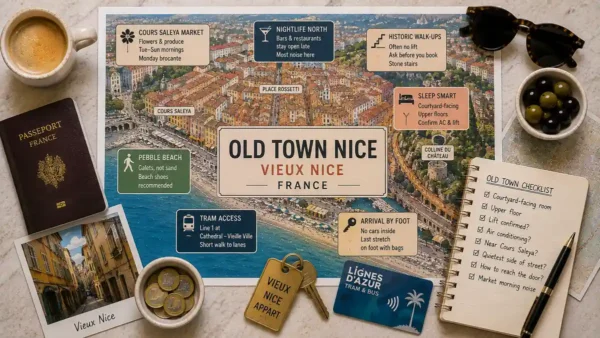

You have chosen Nice and money is the binding constraint. That changes the stay question completely. The question stops being which hotel is cheapest and becomes which zone gives you the most back for whatever you spend. Those are different questions with different answers.
Near the sea and around the Old Town, demand sets the price, not quality. A room there can be cheap and still be a bad room — walk-up floors, thin old fabric, a lane that stays awake. A few streets inland, the same money buys newer stock and quiet, and gives up nothing except immediacy.
This page does three things. It gives a budget verdict for each central zone, with the trade-off named honestly. It lists the listing fields that predict a bad cheap room before you book it. And it makes the case that most cheap-room problems are fixed by moving one street or one floor, not by changing zone.
Quick Answer
The best budget bases in Nice sit back from the seafront, in the Musicians Quarter and around Gambetta. Near the Old Town and the beach, demand sets the price, and a few streets inland buys newer buildings and quiet. Port Lympia is the quieter alternative; choose the Old Town only if atmosphere outranks comfort.
Trust Layer
Tripstou stay guide for travelers choosing where to base. Covers area atmosphere, budget, convenience, noise, and traveler fit.
Produced with AI assistance and reviewed by Alex Perrut, working in tourism since 2015, for the Tripstou editorial team. See our editorial process for details.
Last factual review: August 7, 2026.
Official sources consulted: France.fr, Atout France.
Key Takeaways
- Nice’s affordable end sits inland behind the centre: newer buildings and quieter nights, paid for in seafront immediacy.
- Port Lympia buys the calmest central evenings and charges for them with Castle Hill between you and the Old Town.
- The Old Town’s cheap rooms buy position and charge for it in stairs, older fabric and evening noise.
- Carré d’Or is the wrong zone for this reader: its budget rooms sell the address without the product.
- Jean Médecin answers availability and connections, not value — only a courtyard-facing room escapes the noise of the axis.
- Most cheap-room problems are fixed inside the zone: check floor, lift and facing before you change quarters.
Table of Contents
The Affordable End of Nice Sits Back from the Seafront
Nice’s affordable end sits in the inland belt behind the centre, with Port Lympia as the quieter middle option. The seafront-and-Old-Town core is priced by demand, not by what the buildings actually deliver. Step a few streets back and the same spend buys a better room.
Cheapness and value are different purchases. Cheap is what the listing charges. Value is what the zone hands back for it — a position you can walk from, a night you can sleep through, a building that works, a street that settles down after dinner. Nice separates those two more sharply than most Mediterranean cities, because its most sought-after ground is a thin ribbon along the water and the ground behind it drops away quickly.
Trade-offs are qualitative and zone-level; stock varies building by building.
| Zone | What you gain | What you give up | Typical stock |
|---|---|---|---|
| Old Town | Atmosphere and a pedestrianised core | Stairs, older fabric, evening noise | Apartment-led, protected historic buildings |
| Carré d’Or | Polish and a central, seafront-adjacent address | Room size and nearly every extra | Hotel-led, more consistent standards |
| Port Lympia | Calm evenings and everyday local character | Castle Hill separating you from the centre | Mixed hotels and apartments |
| Jean Médecin | Availability and straightforward tram connections | Traffic noise along the main axis | Hotels and managed apartments |
| Musicians Quarter and Gambetta | Newer buildings, quiet nights, practical comfort | Seafront immediacy and postcard streets | Residential apartments and small hotels |
In Nice the gradient runs perpendicular to the sea, so walking your search two or three streets inland does more for the room than dropping a whole category of comfort. That is the lever this page keeps returning to.
This page is deliberately one lens on a bigger decision. The all-audience survey of every central zone lives in the full where to stay in Nice breakdown, and if the trip itself is still taking shape, the Nice travel guide covers the wider city context first.
When is it easiest to find a budget room in Nice?
The budget end thins out first when the city fills up. High season tightens availability at the affordable end before it touches anything else, so the rooms this page is about are the ones that disappear soonest. Shoulder periods loosen it again, and that is when a slower, fussier search actually finds something. Book earlier than you would in a city that is not on a coast.
Old Town Is the Classic Cheap-Room Trap — and Still Right for Some
The Old Town concentrates the low end’s worst habits, and still suits a particular traveler. Stairs, lifts you have to check for, older protected stock and evening noise arrive together here. If atmosphere is the thing you refuse to give up, that package is worth carrying.
The lanes are the reason people book here. Tall shuttered buildings, market streets, and an evening that arrives at your window whether you invited it or not — the Old Town is the most concentrated version of Nice that exists, and no inland quarter reproduces it.
Convenience is close to absolute. The core is pedestrianised, so daily life happens on foot inside a few blocks, and nothing about a short stay depends on a timetable or a transfer.
In spend-style terms the quarter runs budget to mid-range, and its budget end is genuinely budget. What that end buys is position. The building fabric is the same protected historic stock across every level of the market, so paying less does not move you into a worse building — it moves you into a worse room inside the same one.
The give-ups are physical and specific. These buildings are old and protected, which limits what an owner can change: floors are reached by stairs, insulation is whatever the stone provides, and a lift is a field to look for, never one to assume. Stock is apartment-led, so a reception desk and someone on site are the exception. Evening noise carries in narrow lanes, and its source is the street itself.
Best for: atmosphere-first travelers who pack light and can sleep through an evening happening under the window.
The quarter’s full character — its markets, its rhythm, what a week there actually feels like — sits in the Old Town as a base guide. Readers weighing it directly against the polished grid to the west should go to Old Town vs Carré d’Or, which stages that choice properly.
Carré d’Or Is Mostly the Wrong Zone for a Budget Stay
Carré d’Or is the wrong zone for almost every budget stay in Nice. It sits at the premium end of the centre, and its cheapest rooms sell a compressed version of a premium product. You get the address and lose the space, the light and the extras that made the zone worth its position.
The zone is hotel-led, and that is normally an advantage: consistent standards, a desk to check in at, predictable rooms. The catch is that hotel-led stock has a floor it cannot drop below and still be that hotel. What gets cheaper at the bottom of a polished house is the room itself — the smallest one, the interior one, the one above the service side.
Paying the zone’s entry price gets you the neighbourhood but not the version of it people book the neighbourhood for. Polish and a seafront-adjacent position are priced into the building as a whole, and the budget room shares the address without sharing the product.
One case survives. A traveler who genuinely wants a central, polished address, spends the day out, and treats the room purely as somewhere to sleep can make the smallest room in a good building work.
Best for: the rare budget reader who will trade room size and every extra for a polished central address.
The zone’s full portrait — what the grid feels like day to day, who thrives there, what it genuinely does well — is in the Carré d’Or as a base guide.
Port Lympia Is the Quieter Middle Answer
Port Lympia is the quieter middle answer for a budget stay in Nice. It sits off the demand-priced core, so it hands back calm evenings and ordinary everyday character. The cost is Castle Hill, which physically separates the basin from the Old Town and the seafront.
The basin has its own life, and it is not staged for visitors. Boats, a working quay, restaurants that fill up in the evening and empty at a reasonable hour — the Port reads as a piece of the city that happens to be photogenic.
The separation is the thing to understand before booking. Castle Hill rises between the Port and the Old Town, so crossing between them means going around the headland or climbing over it. That is topography, not opinion. It is also why the Port feels further from the centre than a map suggests.
Night character splits inside the zone. The quay side is where the evening gathers; the streets behind it settle early. Two bookings a block apart can deliver very different nights here, which makes the Port unusually rewarding to book carefully.
In spend-style terms the Port sits between the budget inland quarters and the mid-range core. What it offers a budget reader is the calmest option available this close to the centre, with stock that is neither uniformly old nor uniformly polished.
The Port rewards a traveler whose day starts late and ends at dinner. If your plan is beach mornings and Old Town evenings, the hill collects a toll twice a day.
Best for: travelers who want calm evenings and will accept being on the far side of Castle Hill.
The basin’s full character as a base is covered in the Port of Nice as a base guide, and readers torn between the calm quay and the polished grid can settle that one in Carré d’Or vs the Port.
Is Jean Médecin Really the Budget Answer?
Jean Médecin is Nice’s availability-and-connection answer, and that is not the same as its value answer. The axis is easy to book and well connected, which are real assets on a tight trip. Its rooms also carry a street-noise cost that the zone’s convenience does not cancel.
Availability is a genuine budget asset, and it is badly underrated. The axis carries a lot of rooms, so it still has something bookable when the quieter quarters have emptied out — which is precisely the situation a budget traveler tends to book from. Connection is the second asset: the tram runs along it, and a base on the line removes the daily friction that quietly pushes people into taxis.
The cost is the axis itself. It is a main north–south artery, and the noise is traffic-shaped: continuous, not event-driven, and present in the morning as much as at night. That is a different problem from a lane that gets loud after dinner and goes quiet again.
Facing and floor therefore decide whether a Jean Médecin room works at all. A courtyard-facing room on the same corridor as a street-facing one is a different stay. This is the zone where the listing fields further down this page stop being a useful check and become the whole decision.
Best for: late bookers who need connections and will hold out for a courtyard-facing room.
The Musicians Quarter and Gambetta Are Where Value Actually Lives
Staying a few streets inland is worth it, and the Musicians Quarter and Gambetta are where the trade pays. Back from the seafront, the same booking buys newer buildings, quieter nights, and a realistic chance of a lift. What you give up is seafront immediacy and the postcard streets.
These quarters are residential Nice, and that is the whole proposition. Streets of apartment buildings, a bakery and a bar on the corner, people leaving for work — the Musicians Quarter behind the centre and the Gambetta–Fleurs side toward the west read as places where people live. Ordinary is the point.
Convenience here is good without being effortless. The centre, the market streets and the beach are all reachable on foot across flat ground, and the tram and bus network is close at hand. Nothing is at your door; everything is within reach.
This is where the affordable end of central Nice currently reads. Reputations drift and buildings change hands, so treat that as the present shape of the market and confirm it against what you actually find. In spend-style terms these streets run budget to mid-range, and the difference from the core is what the budget end buys: ordinary modern comfort instead of a compromised version of something grander.
The stock inland is newer than the protected fabric of the old core, which is why the practical things a budget room needs — a lift, a window that seals, a quiet back court — are simply more findable here. You are buying a construction date, not a postcode.
The give-ups are real and easy to underestimate. You are not stepping out into the lanes or onto the Promenade; you are stepping out into a normal city street. A trip built around long beach days or long Old Town evenings will feel that walk every day.
Best for: value-first travelers happy to walk to the sea instead of sleeping beside it.
Other areas on a budget reader’s map
Cimiez sits on the slope above the centre, a quiet residential district reached by a climb or a bus, and it suits a longer, slower stay where trips into town are planned rather than casual. Mont Boron rises east of the Port, and its appeal is the view and the calm — the trade is a gradient you cannot avoid and a genuine separation from everything a short stay wants to walk to. Neither belongs on a budget shortlist for a stay of 2 or 3 days, because time spent moving is the resource this reader can least afford.
Which Zone Fits Your Kind of Budget Trip
The budget decision splits by what you refuse to give up, and each refusal points at one zone. There is no zone that wins on every axis here, so the useful question is which trade-off you can live with for the length of your stay.
- Atmosphere is non-negotiable → the Old Town, with the stairs accepted in advance.
- Evenings have to be quiet → Port Lympia, on the streets behind the quay.
- Heavy luggage, or a lift is required → the Gambetta side, where the stock supports it.
- Booking late and travelling on connections → Jean Médecin, courtyard-facing only.
- Squeezing the most out of every night → the Musicians Quarter, and walking to the sea.
Two of these conditions can usually be satisfied at once; three usually cannot. When two land in different zones, protect sleep first — a broken night costs a short trip more than a longer walk ever does.
One Street or One Floor Often Beats Changing Zone
Most cheap-room problems in Nice are solved inside the zone you already chose. A back street off the busy axis, a courtyard side of the same building, or one floor higher fixes more than relocating does. The zone sets the character; the room sets the stay.
The reflex, when a room looks wrong, is to move the search somewhere cheaper or quieter. That usually costs you the reason you picked the zone in the first place, and it rarely solves the actual problem. The problem is almost never the zone. It is the specific room.
How this plays out is different in each quarter:
- Old Town — the lanes with bars behave nothing like the lanes without them, and upper floors and courtyard sides sit outside the worst of it; the climb is the price.
- Jean Médecin — one turn off the axis into a side street changes the noise source entirely while keeping the tram and the connections that made the zone attractive.
- Port Lympia — quay-facing rooms get the evening and the back streets do not, and the two can sit a block apart.
Noise is far easier to plan around once you name its source. Street conversation, nightlife spill and a traffic artery behave differently, and the first two stop while the third does not. A room that solves one of them may do nothing about another, which is why a zone’s noise character tells you more than a generic quiet claim in a listing description.
Search inside your chosen zone before you search outside it. The second-best room in the right quarter beats the best room in a quarter you did not want, because the walk you make every day is the part of the booking you cannot change later.
The Listing Fields That Predict a Bad Cheap Room
A handful of listing fields predict almost every bad cheap room in Nice. They take a minute to check and they matter far more at the low end, where nothing else in the booking is protecting you. Read them before the photographs and before the review score.
- Floor number — predicts the daily climb, and in older buildings it also predicts how much street sound reaches you.
- Lift — a field to look for explicitly; if an older building’s listing says nothing about it, treat the answer as unknown and ask before booking.
- Street-facing or courtyard-facing — the field that decides the night more than any other, and the one most often left vague.
- Air conditioning — check whether it is stated or simply absent from the description, because a listing that does not mention it has not promised it. Silence is not a yes.
- “Historic” or “traditional” in the description — usually accurate, and usually means the building’s constraints come with it: stairs, thick walls, small windows, original layout.
- Hotel or managed apartment — predicts whether anyone is reachable when something in the room goes wrong.
None of these fields require judgement. They are either stated or they are not, and a listing that leaves three of them blank at the budget end is telling you something by omission.
Hotel or apartment for a budget stay in Nice?
Hotels suit short stays and apartments suit longer ones, though in Nice the building matters more than the format:
- Hotel — suits stays of 2 or 3 days and travelers who want a predictable room and someone at a desk; the trade is less space and no way to eat in.
- Managed apartment — suits stays of 4 or more days and anyone who wants a kitchen; the trade is self-check-in, nobody on site, and stock that skews toward older walk-up buildings.
- Aparthotel or a hotel room with a kitchenette — suits the middle case and splits the difference; the trade is a much narrower choice of buildings to pick from.
Hotels and places to stay
Compare hotels, apartments and stays for your dates in one search.
Search hotels and stays on hotels.com →
Tripstou may earn a commission if you book through this link, at no extra cost to you.
Frequently Asked Questions
Do apartments in Nice Old Town have lifts?
Treat a lift as a field to confirm, never a given. Old Town stock sits in protected historic buildings, where a lift is an addition somebody made later, and listings there often state the floor and the stairs outright. If a listing says nothing about a lift, ask the host before you book.
Do you need air conditioning in Nice in summer?
Treat air conditioning as a field to check, never something to assume. In Nice it is advertised as a feature when a property has it, which tells you it is not standard across older stock. Silence in a description is not a promise, so filter for it before you book.
Does a higher floor mean a quieter room in Nice?
Often, but only against street-level noise. Height helps with conversation and pavement sound, and does much less against a traffic artery that carries through a building. The facing matters more than the floor: a courtyard side beats a street side on almost any level. In older buildings, higher also means more stairs.
Is it cheaper to stay outside Nice and travel in?
For a short stay, it rarely pays. Whatever a room outside the city gives back, the day then carries two transfers, and the evening is the part you lose — Nice is at its best when you have already left it. On a longer, slower trip the trade can work.
Is Nice’s Old Town difficult with heavy luggage?
Plan for the last stretch on foot. The Old Town core is pedestrianised, so vehicles stop at its edge, and a walk-up floor then adds stairs on top of that. If you are travelling heavy, the floor number and the lift field decide this zone for you before anything else does.
Can you stay near the Promenade des Anglais on a budget?
Yes, but the budget end of that address buys position and little else. Demand sets what the seafront ribbon charges, so its cheapest rooms tend to be the smallest and least appealing in otherwise good buildings. Move your search two or three streets inland and the same booking buys more room.
Related Guides
- Where to Stay in Nice — the full area breakdown across every traveler type.
- Staying in Nice’s Old Town — the lanes as a base, beyond the budget lens.
- Staying in Carré d’Or — the grid’s character, comfort and daily convenience.
- Staying at the Port in Nice — the basin as a base and who it suits.
- Old Town vs Carré d’Or — lanes or grid, decided on one page.
- Carré d’Or vs the Port — the two-zone choice resolved head to head.
- Nice Travel Guide — trip-level orientation before the stay decision.
Did this guide save you time or money? Tripstou is independent and reader-funded — if you'd like to give something back, you can support the site with a crypto contribution of any size.