
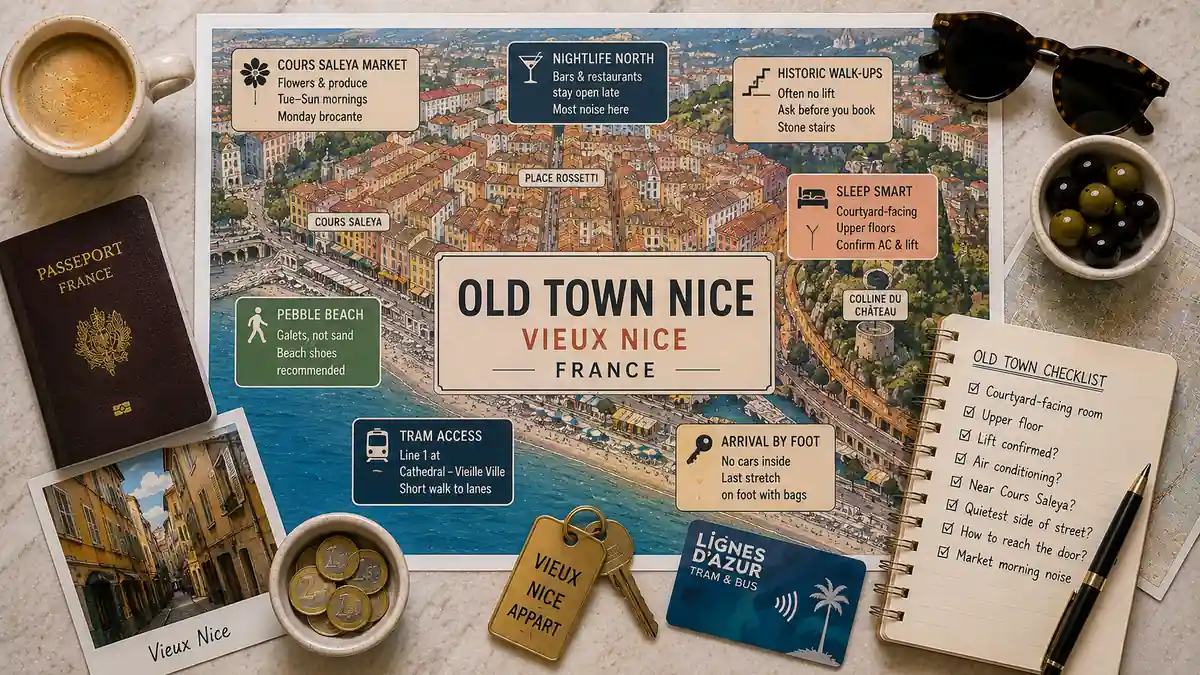
You have the quarter narrowed on a map and a listing open in another tab. This page is about what that booking actually commits you to. Vieux Nice is the dense historic quarter between the seafront and the Paillon corridor, and staying inside it is a different proposition from visiting it for an afternoon. The address you choose decides how much of the quarter’s night you hear, how many stone stairs stand between the street and your bed, and how you reach the door with luggage. What follows is the internal geography of the quarter, the noise model and where it concentrates, the coarse band to aim your map pin at, the listing filters that matter in buildings this old, and the physical conditions under which booking here is the right call. No area survey, no tour route. Just the stay decision.
Quick Answer
Old Town Nice buys position — market, lanes and sea at the door — for a real cost in night noise. The noise is structural and concentrates north of the Cours Saleya, and the buildings are historic walk-ups. Filter for courtyard-facing or upper-floor rooms and confirm a lift and air conditioning before booking.
Trust Layer
Tripstou stay guide for travelers choosing where to base. Covers area atmosphere, budget, convenience, noise, and traveler fit.
Produced with AI assistance and reviewed by Alex Perrut, working in tourism since 2015, for the Tripstou editorial team. See our editorial process for details.
Last factual review: August 6, 2026.
Official sources consulted: France.fr, Atout France.
Key Takeaways
- Staying inside Vieux Nice buys the market, the lanes and the sea at your door, paid for in night noise.
- The bars concentrate north of the Cours Saleya, so two streets of separation moves your sleep more than any glazing claim.
- Filter listings for a courtyard-facing bedroom and an upper floor before you look at anything cosmetic in the photographs.
- The stock skews to apartment rentals in historic walk-ups, which makes a lift worth more here than a star rating.
- Vehicles stop at the quarter’s boundary, so plan the last stretch on foot over uneven stone paving with your bags.
- The Cours Saleya runs flowers and produce Tuesday to Sunday mornings, and switches to the brocante on Mondays.
Table of Contents
Where the Old Town Starts and Stops
Vieux Nice is the dense historic quarter at the eastern end of the Nice seafront. The Quai des États-Unis closes it to the south, Castle Hill to the east, the Jardin Albert I line to the west, and the Promenade du Paillon–Place Garibaldi line to the north. Inside those edges, everything is walkable stone lanes.
The quarter reads as three strips running inland from the water. The seafront edge sits along the Quai des États-Unis. Behind it runs the market spine of the Cours Saleya. Then come the core lanes — Rue Droite, Rue Saint-François, Rue de la Poissonnerie and Place Rossetti — before the northern boundary opens onto the Promenade du Paillon and Place Garibaldi.
The sea is the quarter’s southern boundary, so shoreline access is decided by how far north your door sits. A booking on the market edge is effectively on the water; a booking near the northern boundary crosses the whole quarter to reach it. The beaches here are pebble — galets, not sand — which matters more for what you pack than for where you sleep.
Two orientation corrections save people a booking mistake. Place Masséna sits outside the quarter, across the Paillon corridor, so a listing that sells itself on Masséna proximity is describing a different address. Carré d’Or lies west beyond the same corridor and is a neighbour, not part of Vieux Nice. If you are still deciding between areas in the first place, start with the overview of where to stay in Nice and come back once the quarter is chosen.
What Is It Actually Like to Stay in Vieux Nice?
An address in Vieux Nice is dense, pedestrian and audibly alive from early market setup to late at night. The Cours Saleya sets the morning rhythm, the lanes fill with day visitors by mid-morning, and the evening brings a second wave of sound past your window. You are never at a remove from any of it.
The market is the quarter’s metronome. Flowers, produce and craft stalls run Tuesday to Sunday mornings on the Cours Saleya, and Monday switches the same space to the brocante — the antiques and second-hand market. For a visitor that is a scheduling detail. For someone sleeping above it, it is the difference between waking to crates and trestles or to a different set of them.
Setup happens before the day starts, and it happens under the windows of the southern edge — which is why the market is a sleep variable before it is an attraction.
Daytime is crowded in the central lanes and thins toward the edges, more so in the warm months, when an evening artisan market adds a further layer of activity to the Cours Saleya after the daytime stalls have gone. The pattern is directional and reliable: the closer your door sits to the market spine and the central lanes, the more of the quarter’s working day you live inside.
Evenings turn slowly. The dinner crowd builds, the terraces fill, and the sound gradually shifts from voices at tables to voices in the street. That shift, and not the daytime bustle, is what the sleeping decision turns on.
Night Noise Is the Old Town’s Real Tradeoff
The Old Town’s one real cost is night noise, and its cause is physical. Stone lanes with no setback between a bar terrace and a bedroom window channel sound upward and along the street, so it reaches the upper floors instead of dissipating. It runs late, and it runs year-round.
The noise has an internal geography, which is what makes it manageable. Bars concentrate in the northern part of the quarter, above the Cours Saleya, and the sound is heaviest in the lanes around them. Calmer bands exist in the same quarter — the southern market edge and the eastern lanes toward Castle Hill carry far less of it. The southern edge has its own sound instead: the pre-dawn market setup on the days the stalls come in.
Two streets of separation from the bar lanes does more for your sleep than any glazing claim in a listing description.
Four filters follow directly from that model, and they are all checkable before you book:
- Window orientation — courtyard-facing and inner-facing rooms lose the street almost entirely; the tradeoff is light and outlook.
- Distance in from the bar lanes — check the listing’s position on the map, not its adjectives; separation is the variable that actually moves.
- Floor level — upper floors clear the terrace noise but still catch sound funnelled up a narrow lane, so height alone is a partial fix.
- Courtyard-facing bedrooms specifically — the most reliable filter in this quarter, and one that listings often omit; ask directly before booking.
Most travelers arrive at this quarter with a question they phrase as safety, and inside a booking decision it behaves as a comfort question about noise and late-night activity — the wider city context belongs to our Nice travel guide. The booking lever here is the window, not the postcode.
Which Part of the Old Town Is Quietest to Book?
The quieter bookings sit south and east of the bar concentration, toward the market edge and Castle Hill. The quarter divides into three coarse bands: the market and seafront edge, the core lanes in the middle, and the northern band where the bars cluster. Each band trades one kind of noise for another.
Bands are coarse orientation for aiming a map pin; they are not street-level noise ratings.
| Band | Character | Night-noise exposure | Position relative to the sea |
|---|---|---|---|
| Southern market and seafront edge | Open sky, market spine below, working mornings | Lower late-night exposure — early setup sound instead | Closest band to the pebble shoreline |
| Core lanes through the middle | Tall stone lanes, shaded, busy through the day | Mixed, and decided mostly by window orientation | Short walk south to the seafront |
| Northern band toward the Paillon | Livelier evenings, bar activity concentrated here | Highest exposure, late and through the year | Furthest from the water within the quarter |
The eastern lanes below Castle Hill behave like a quieter extension of the core band. They sit away from the bar cluster, they carry less through-traffic on foot, and the hill closes the quarter on that side, so there is nothing beyond them to walk toward late at night.
The band that suits you is decided by which sound you can sleep through — the market’s pre-dawn setup, or the walk home after the bars close. Very few addresses in this quarter escape both.
Aim the pin, then verify the room. Band choice sets your baseline; the window and floor of the specific unit move the result more than the band does. A courtyard bedroom in the northern band can outperform a street-facing one on the market edge.
Apartment or Hotel in the Old Town?
The Old Town’s stock skews strongly to apartment rentals, with hotels present but fewer and mostly small. The buildings are historic walk-ups, so the physical features of the individual property matter more than the category you book. Filter for the building before you shortlist the interior.
Stone staircases, narrow entrances and several flights without a lift are the default, not the exception. Renovation reaches the apartment far more often than it reaches the stairwell. That single fact reorders the usual booking checklist, because the four filters below decide the week more than décor does:
- Lift — matters most with heavy luggage, limited mobility, or a top-floor unit; the tradeoff is that lift buildings are a minority here and know it.
- Air conditioning — matters in the warm months, because the alternative is an open window, and an open window imports the street; the tradeoff is that fitted units are less common in protected historic buildings.
- Level floors — matters for wheeled bags, prams and unsteady footing; the tradeoff is that many converted apartments keep internal steps between rooms even after refurbishment.
- Stair-free access from the street — matters when the entrance itself has steps before the stairwell even begins; the tradeoff is that the most accessible entrances tend to sit on the quarter’s edges.
In this quarter the lift outranks the star rating. The same apartment on the fourth floor and on the first floor is two different holidays once you are climbing it several times a day with shopping, beach kit or a tired child.
Spend styles here separate by building, not by street. Budget bookings are compact apartments and simple rooms up several flights. The mid-range is the quarter’s centre of gravity — renovated apartments and small hotels that usually offer a lift or air conditioning, seldom both. At the high end, the premium buys position, a restored building and a terrace or rooftop outlook; facilities stay modest measured against a purpose-built hotel elsewhere. What a trip to Nice costs overall is a city-wide question and belongs to the main Nice guide, not to a single quarter.
Hotels and places to stay
Compare hotels, apartments and stays for your dates in one search.
Search hotels and stays on hotels.com →
Tripstou may earn a commission if you book through this link, at no extra cost to you.
Arriving With Luggage: The Last Stretch Is on Foot
Vehicles cannot reach most Old Town doors, so the final stretch of your arrival happens on foot. The quarter is functionally car-free, and taxis or ride-hailing cars set you down at the boundary. From there you walk in over uneven stone paving with your bags. Plan the arrival around that walk.
The paving is the part people underestimate. It is old, uneven and hard on small wheels, and it is the same surface every time you return with shopping or come back late. A two-wheel case you can tilt and drag handles it better than a four-wheel spinner, which stalls on the joints.
The walk-in and the staircase compound each other. A top-floor unit without a lift turns one awkward arrival into a repeated exercise, which is exactly why the lift filter earns its place ahead of the cosmetic ones.
Tram Line 1 runs along the northern and western edge of the quarter and does not enter the lanes. Whichever stop you use, the last part is on foot through the pedestrian streets. Airport transfers and the wider transport picture are city-level questions covered in the main Nice guide, not resolved at quarter level.
Book Here If — Book Elsewhere If
Book the Old Town if you can absorb night noise and carry your own bags up stairs. The quarter rewards travelers who want the market and the sea at the door and who are moving through the city on foot. It works against anyone who needs guaranteed quiet, a lift, or a vehicle waiting outside.
Book here if:
- You sleep through street noise, or you will filter hard for a courtyard-facing, upper-floor bedroom.
- You travel light, or you can carry your bags up several flights of stone stairs without resenting it.
- You are arriving without a car and do not need one parked near your door.
- You want the market, the lanes and the pebble shoreline immediately outside, and you value that above a quiet night.
Book elsewhere if:
- You are a light sleeper and will not filter aggressively on window orientation and floor.
- You are travelling with heavy luggage and no tolerance for a walk-up building.
- You need vehicle access at the door, whether for arrival, mobility or luggage.
- You need guaranteed air conditioning and step-free access, which no band of this quarter reliably supplies.
Best for: travelers who want the market and the sea at the door and will trade quiet nights for it.
Traveler-fit verdicts live on their own pages, and this one deliberately stops at physical conditions: a first visit to Nice, couples, families, nightlife, budget stays and luxury stays. If your choice is still between this quarter and its western neighbour, that pairing is settled in Old Town vs Carré d’Or.
Do not optimise for being closest to the water or for the prettiest lane in the photographs. Inside a quarter this compact, those differences are small. The variables that decide your week are the distance from the bar lanes, the direction your bedroom window faces, and the number of stairs between the street and your bed.
Frequently Asked Questions
Which days is the Cours Saleya market on?
Flowers, produce and craft stalls run Tuesday to Sunday mornings, and Monday switches to the brocante. There is no market-free morning on the Cours Saleya, so a booking above it wakes to setup every day of the week. A Monday arrival expecting the flower market finds antiques instead.
Do apartments in Old Town Nice have lifts and air conditioning?
Often not. The quarter’s buildings are historic walk-ups, and renovation usually reaches the apartment before it reaches the stairwell. Treat both features as things to confirm in writing rather than assume from photographs, because listings frequently describe the interior without mentioning the flights of stone stairs above the entrance.
Can you park near Old Town Nice?
Not at your door. The quarter is functionally car-free, so parking means leaving the vehicle outside the boundary and walking in with whatever you are carrying. If you are arriving by car and want it close and easy to reach, the Old Town is the wrong quarter to book.
Is the beach by Old Town Nice sandy or pebble?
Pebble. Every stretch of shoreline along the quarter’s southern edge is galets, so a listing that advertises a beachfront position is describing a pebble beach, not sand. Pack beach shoes and something to lie on. How close the water is depends on how far north your door sits.
Can you walk to Nice train station from the Old Town?
Yes, but it is a genuine cross-city walk, not a stroll. The station sits inland, away from the seafront edge the quarter runs along, and no vehicle takes you the final stretch into the lanes anyway. With heavy bags, most people ride the tram along the quarter’s edge and walk in from the nearest stop.
Is Old Town Nice quieter outside summer?
Somewhat, but not enough to skip the filters. Crowds thin outside the warm months and the evening artisan market on the Cours Saleya stops running, which takes one layer of sound away. The bar activity north of the market is a year-round feature of the quarter, so window orientation still decides your night.
Related Guides
- Where to stay in Nice: choosing an area — the area-level decision this page sits inside.
- Old Town vs Carré d’Or in Nice — the pairing decision if you are down to two quarters.
- Nice travel guide — city-level planning, transport and orientation.
- Where to stay in Nice on a first visit — the area verdict for first-timers.
- Where to stay in Nice with family — family-fit areas and what they trade.
- Where to stay in Nice for nightlife — basing yourself near the evening scene on purpose.
Did this guide save you time or money? Tripstou is independent and reader-funded — if you'd like to give something back, you can support the site with a crypto contribution of any size.